Anxiety, panic, fear, pandemic stress: The cornerstones of the negative universe. Yet, while all hell is breaking around us, can we still muster up the courage to innovate and create. Is creativity still alive or is it merely napping? Do we create out of despair or want? Out of necessity or desire? I guess that depends on each one of us.
In a recent article in Psychology Today, boredom is cited as an almost certain stimuli for creativity. Now, some of you may not agree with this, and that’s okay. If you don’t and even if you do, let me hear from you with your reasoning.
According to the article, which contains some very interesting points I want to share with you, you’ll see explosive creativity everywhere you look: in how people stuck at home are constructing elaborate recreations of their favorite artworks for the #GettyChallenge; or how we make ways to connect—whether it’s singing from our balconies or happy hour delivery via drones—while social distancing; even in the acerbic memes and uplifting stories flooding social media to offer inane distractions and inspire hope during this crisis.
Interestingly, quarantine and the resulting ennui (a feeling of listlessness and dissatisfaction arising from a lack of excitement) of our home-bound brains have proven to be a catalyst for innovation. Thus, boredom breeds inventive creativity, as long as it’s the right kind of boredom.
Fruitful Boredom
Psychological studies describe five levels of boredom: indifferent, calibrating, searching, reactant, and apathetic. In its seeking state, boredom drives us to find something to engage and delight us. Think of the imaginary friend you had as a child; you did have an imaginary friend, didn’t you? Or the games you’d play with that certain stuffed animal, whose goal in life seemed to be avoiding Mom’s washing machine. Both scenarios seemed to trigger one’s own imagination, and, thus, your creativity. (Note: At least it did mine.)
In today’s society, real boredom escapes us; it seems everywhere you look, all eyes are staring into multiple-shaped devices hosting 24/7 news and entertainment. It’s as if we have to go out of our way to truly be bored.
While technology provides us creative outlets and a means of connecting when we are physically isolated from one another, these distractions are like the digital equivalent of junk food for our brains while good old fashioned boredom is a hunger that nurtures creative thinking.
What’s unique about this quarantine is that it constrains us in so many ways. Our typical means of working, socializing, and even provisioning ourselves have been dramatically restricted. And while people tend to think that constraints limit creativity and innovation, research proves quite the opposite to be true.
Saying that we’re living in challenging times is a vast understatement. Trying to keep pace with changing content demands can rattle anyone. This special AdAge webinar, now viewable on demand, will help you maneuver down a rather tumultuous road with your marketing strategy.
As brands have had to hit the pause button on planned marketing activities like events and OOH, digital creative content demands are unprecedented. Creative teams are now tasked with revising planned campaigns, coming up with new concepts, and updating messaging in existing creative. How do you do that at scale?
It’s time to rise to the occasion: Explore options for stress-free delivery of the content volume you need to carry your brand at this time.
Although the topics may vary from blog post to blog post here, one central theme usually always emerges: Creativity. Even before the nasty onslaught of the COVID-19 virus outbreak, creativity was quite important and pertinent in our industry. Now, it’s more important than ever.
In reading various articles on the subject of creativity, I found it interesting that the Brits are complaining about its overall effectiveness. One such cautionary study comes from an account manager with M&C Saatchi. Among others, he cited the legendary John Hegarty who called creativity “advertising’s special sauce” partly due to the significant effect it can have on achieving or even surpassing objectives and increasing ROI.
Advertising, to increase effectiveness, has to appeal to consumers by conveying emotions and helps to build memory structures, allowing them to choose a brand easily and instinctively. Creativity is the best way to convey emotion.
IPA (Institute for Practitioners of Advertising) studies have proven that creativity can increase ROI by 10x. Furthermore, communications that are built upon a foundation of emotion and that eventually become famous can greatly enhance the effectiveness of a campaign. Even with a fairly modest budget but a strong creative idea, a company can enter the public consciousness in a truly unique way.
Taking the idea and backing it with an effective use of budget can create a huge level of earned media, and by becoming news worthy, can generate a great return on investment.
However, creativity does not operate in a vacuum. Numerous other aspects of a campaign contribute to its effectiveness like media spend, and changes in price of products, for example.
That’s why measuring effectiveness with various KPIs (Key Performance Indicators) and economic models is so important. Furthermore, as the “Saatchi Study” indicates, it is important to remember that while creativity can act as a multiplier for ROI and other measures, creativity should never be used as a substitute for solid media investment. The best campaigns have a good balance of both.
Clearly, a creative campaign that appeals to the emotional side of peoples brains, is memorable and sparks conversation, eventually entering into public culture can have a great impact on business results. However, creativity is just one very important part of advertising and not the sole means to an end.
But even creativity, as seen in some circles, is meeting with raised eyebrows as its effectiveness is being called into question. Might it be turning a bit sour?
How would a “productive day” compare to a “creative day”? What would, if anything, they have in common? Chances are not much. One might think a productive day would be closely aligned with scratching off items on a to-do list. On the other hand, someone’s idea of a creative day might not even have a to-do list.
Our current work world is obsessed with productivity. We are inundated with books, articles, white papers, to time block this and time block that; all just to do more work. But our relentless quest to be productive is undermining one of the most important abilities in today’s workplace: creativity. What of the future, though? Will machine learning and artificial intelligence perform the routine aspects of our work at the expense of our ingenuity and creativity?
So how do we create the right conditions for creativity, particularly when we are trying to deal with a to-do list?
Consider this comment from screenwriter Aaron Sorkin (the mastermind behind the television show West Wing and films like Moneyball and The Social Network). He told The Hollywood Reporter that he takes six showers a day. “I’m not a germaphobe,” he explains but when his writing isn’t going well, he’ll shower, change into new clothes, and start again. Sorkin’s trade relies on him minting something fresh on a regular basis. And it occurred to him that his best thoughts were not happening in moments of fevered concentration, but when he was in the shower. So he had a shower installed in the corner of his office and makes regular use of it. He has described the process as “a do-over” for triggering original ideas.
In 1939, James Webb Young, a Madison Avenue advertising executive, wrote a definitive guide to the process of creativity, A Technique for Producing Ideas. In this short book, Webb Young reminds us, “that an idea is nothing more nor less than a new combination of old elements.” In his view, the skill of creativity is the ability to spot new connections between familiar thoughts, and the art is “the ability to see [new] relationships.”
Fifty years later, Steve Jobs observed something similar: “Creativity is just connecting things. When you ask creative people how they did something, they feel a little guilty because they didn’t really do it, they just saw something. It seemed obvious to them after a while. That’s because they were able to connect experiences they’ve had and synthesize new things.”
Webb Young also lays out a remarkably simple technique for creative thought. It involves stimulation. Continue reading →
We like to think that every creative execution hits right on target. Well, we know better even when we don’t like to admit it. A recent report from the UK, suggests quite the opposite, that creative effectiveness is being called into question.
UK advertising agencies are fast-paced, dynamic and produce advertising, media and marketing that many consider to be the envy of the world. One organization that voices their concerns, showcases their work and continuously develops their skills to keep them at the top of their game is the Institute of Practitioners in Advertising (IPA), incorporated by Royal Charter.
The IPA exists to help members be the best they can be. They set the protocols for the UK industry’s best practice standards. They advise on how to choose an agency, how to run an agency or how to behave if you work in an agency. They also work collaboratively with members to improve diversity within the industry.
So, as this new report makes the rounds of the British ad scene, it will be interesting to see what the reaction is. It will, I dare say, be interesting to watch what, if any, reaction there is here in the US. If anything, the US has always been much more conservative in our approach to advertising compared to the UK. Does that conservatism mean our ads are more effective than theirs. Doubtful. It’s sort of like comparing apples and oranges. Continue reading →
In a London-based publication on advertising, Shots conducted Q&A interviews with various agency and production firms around the globe.
They were asked one thing: How are you and your company coping with the current restrictions and what impact do you think they will have on the industry and your business?
In this special edition of Quotes, relating to that question, we hear how businesses are coping, what the potential fallout of this crisis could be, and about the initiatives being put in place to foster creativity during this isolation period. Here are some highlights.
Recovery will happen, however, many of the brands and clients we work with have other priorities right now and we are very sensitive to this.Sarah Cutler, Director of Partnerships, makemepulse London
Right now, the world is in isolation physically and emotionally – I believe there will be a reaction to this.Simon Hatter, Founder & Creative Director, Rumour Has It Amsterdam
Some are set up for success and, for others, this will be a wake-up call.Nancy Crimi-Lamanna, Chief Creative Officer, FCB Toronto
The world must keep moving and creative problem-solving has a vital role to play.James Razzall, President, Advertising North America, Framestore
As crippling as this crisis has been for our industry, finding ways to support brand messaging in a time where consumers are looking to them to give back is a vital role.Justin Wineburgh, CEO & President, Alkemy X
Our Chinese co-workers shared their best practices at a very early stage, both from a business and safety aspects. The worst scenario would actually be not to come prepared for what’s next. We must help companies and brands to be up and running just before lockdown ends.Olivier Lefebvre, CEO and Partner at FF Paris
The best response is to think how you, as a brand, can be genuinely useful to people.Sam Walker, ECD, Uncommon London
This will result in less projects and less work and unfortunately, in the long run, put companies out of business.Espen Horn, Executive Producer, Motion Blur Norway
I see this hitting of the pause button not just as a problem but, just possibly, as an amazing opportunity.Charlie Crompton, Managing Partner & EP, Rogue Films London
Due to the fact that there is zero new business coming in… we also started to develop self-improvement ideas for the whole company.Patrick Volm-Dettenbach, Executive Producer, ELEMENT E Filmproduktion Germany
The world is also changing how it consumes media. Print will likely take a hit (Playboy was the first to announce it had stopped printing).Héloïse Hooton, Founder, Hooton Public Relations
Our biggest priority is to relieve the anxiety of everyone in the company.Joseph Bonnici Partner & Executive Creative Director, Bensimon Byrne Toronto
I am convinced that advertisers will have to continue communicating through campaigns/commercials, especially once life returns to normal. Ruben Goots, Founder and EP, Hamlet Belgium
What will never change about our business is that creativity, craft and smart solutions will always win the day.Ari Kuschnir, Founder & Managing Partner, m ss ng p eces
It is simply impossible for any business to survive a period of expenditure with no income over a prolonged period of time. What we don’t want is a lag in getting going again and that is very much the views of the agencies we have spoken to.Spencer Dodd, Joint MD & EP, Merman London
If this crisis has one upside for entrepreneurs, it will be to force us to focus on essentials, reinvent how we do things in a leaner way.Simon Cachera, Co-Founder, Victor & Simon Amsterdam
If you liked this post, check out some others here . . .
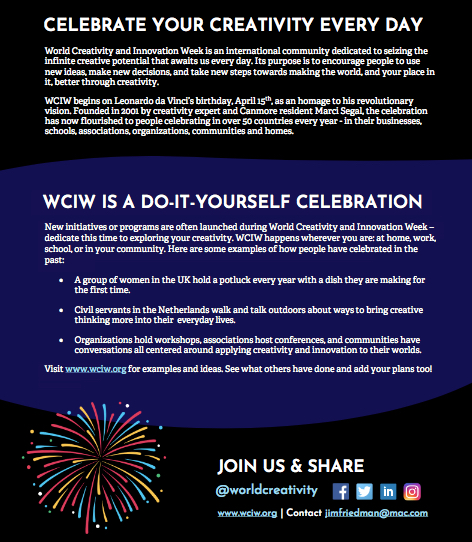
We are all creative. We just approach the process from different perspectives. After all, each one of us is unique and so is our process, our way of thinking.
On this day, slow down and rediscover your own way of creating and relish your creativity. Plus, explore what is highlighted below as well as WCIW’s site for all the events happening around the globe.
AdWeek Special Report: 6 Tips to Help Creativity and Quarantine Co-Exist
In times like these I find it particularly important to share news and helpful information wherever and whenever I come across it. Such is the case with this blog post. Thanks to Adweek and its contributor, Sara Spary for the article on which this blog is based.
In the creative world, we’re used to people getting together, face-to-face, to collaborate and exchange ideas, to, well, create that next great ad or TV commercial. So what does one do when quarantine is the order of the day for just about all the known universe?
Demands for making the abnormal as close to normal abound from clients and prospective ones. Business as usual it’s not. So, how is this all working out thus far?
The trade publication Adweek asked veteran creatives around the world to “share their experiences and advice on how to keep the creative juices flowing from home”—even when COVID-19 is knocking on the front door.
Think Face-to-Face
Since you’re already used to doing this, why stop now?
“We’ve made it a point to keep interactions face-to-face whenever possible. Every meeting, regroup, catch-up, brainstorm session—no matter how big or small—is done through Google Hangouts,” said Ryan Engelbert, creative director at We Are Social New York. “It’s forced us to be even more focused on each other and more accountable for the information and ideas that are being exchanged.”
This feels weird, not to mention a bit awkward
Engelbert’s creative partner and fellow creative director Casey De Pont recommends creatives embrace the occasional awkwardness that comes with video calls, since you never know where such moments may lead.
“Video chat still feels awkward to us as humans,” Du Pont said. “There’s a lot of pressure for maximum productivity and zero wasted time when you’re digitally staring each other down, but creative development doesn’t work that way.”
Not everybody may be used to video chat but not everybody is used to uninterrupted speech in a live conference room meeting either. Goof ups and unintended pauses work the same as if you were humanly in the same room with one another.
“You need the awkward pauses and the space between ideas to let things breathe and develop. The more we can be real people in the virtual space, the more comfortable we’ll become working there,” she said.
Be a Space Cadet
Spending time alone in quarantine gives you the time to quietly explore ideas and concepts without any critics jumping down your throat. You’ve got plenty of space to think out loud if you want.
Droga5 copywriter Gabe Santana like it this way. “I think the best part about working from home is that I can lie down on the floor and say bad ideas out loud without bothering anyone,” Santana said. “Except Germany, of course.”
That would be Germany Lancaster, Droga5 art director, Santana’s creative partner and self-proclaimed homebody. Lancaster prefers to brainstorm alone and mull it all down to a few good concepts “before meshing ideas” with Santana.
“Once I’ve got a couple ideas down, I like to either present them to my partner in a deck or chat through them in hopes that they springboard into something grand. Chatting through ideas always leads to lots of laughs, so that’s definitely a bonus,” Lancaster said.
Establish a Stronger Relationship
Working remotely can really strengthen that and those relationship(s).
For Ludovic Miege, copywriter at Havas Paris, working remotely hasn’t been too much of a problem so far because he and his creative partner, art director Jordan Molina, have worked together for six years.
“For us, working like this is not very complicated because we know how to work together and do not need to see each other to work,” he said. “We can call each other all day long using Facebook, Whatsapp, Gmail, Zoom. We have many ways to communicate and exchange our ideas.
“Because of our long relationship, we know how the other one understands things. You are more efficient when your partnership is strong.”
Have a Flexible Routine
Working remotely can feel odd and awkward to those not used to doing it. Don’t overdo the video conferences and calls just to prove something. Remember, too many conference calls can lead to less time for thinking.
But Madrid-based Javier Campopiano, who recently joined Grey as chief creative officer of Grey Europe and Global, warns this will only lead to burnout. He says keeping structure in your day is important.
“Right now, I try to keep a routine. My kids are not going to school so we don’t need to wake up as usual, but we’re trying to keep the same schedule. I try to exercise on the balcony, because I can’t go for a run—we can get a fine—so I exercise and then shower,” he told Adweek. “I dress up to work, maybe less formally than I usually do, and I sit in front of my computer in my little office here at home.”
So you work in your pajamas. So what?
Depending on what kind of routine one is used to doing, spending the day in your PJ’s may feel very normal. If not, that’s okay, too.
Mariana Albuquerque, a creative copywriter working in Ireland suggests “the main challenge is not being distracted by other people—or animals—in your home, and understanding the time to start working and finishing it,” she said. “Since I’ve been working from home for a week, I’ve created a routine for myself. I do wear comfy PJs, though. It doesn’t make me feel lazy at all. But I do comb my hair in case of a video call.”
Her creative partner and art director, Carina Caye Branco, urges the most important thing of all is open communication.
“Communication is key, and trying to organize our day and tasks. Be online all the time, or at least tell your partner if you need to go offline and how long,” she said. “And keep a record of everything you’re thinking/doing. [That has] been proving really helpful for us.”
Sara Spary is a freelance journalist based in London. She’s been a reporter for eight years, covering advertising and consumer brands.
Over the past two blog posts about crisis coping, we’ve listened in on a conversation between the author, Ellyn Kail, and photographer Danny Ghitis about various methods to cope for creatives who have been entangled in the Coronavirus pandemic.
In this, the third and last post of the series, they explore what it’s like finding a sense of community during these very scary times.
*********************************
In the last two weeks, I have received more than two dozen emails about the temporary closures of galleries and studio spaces amid the coronavirus pandemic. I’ve received several more about canceled exhibitions. This is a period of uncertainty for the photography community as a whole, but in this time, we’ve also witnessed people coming together.
In between those letters about closures and cancelations, there have also been emails from artists who are hosting camera giveaways, publishers who are discounting their books, and non-profit organizations who are offering free talks and photog resources.
Globally, photographers are sharing information about how we can donate supplies to local hospitals and encouraging us all to practice social distancing for the safety and well-being of the community.
Over the past week, we’ve spoken to the photographer and professional development coach Danny Ghitis about how creatives can cope during this time and continue to create meaningful work in unprecedented circumstances.
Photography, like any art form, can be a solitary pursuit, but it’s also full of communities and resources. With all the recent gallery closures and exhibition cancellations, how can photographers stay connected and engaged with one another?
“This is so crucial. One of the main causes of my own burnout was a feeling of isolation as a photographer, and that was way before all this coronavirus mayhem. We are wired to need other people. That lone wolf photographer icon can be really damaging because it makes asking for help look like a weakness when, in reality, it’s a superpower.
“In a way, this moment offers a unique opportunity. Everyone is struggling with the same overarching challenge. Everyone needs help, and we have the technology to easily stay in touch. We’re not as spread thin as usual with a thousand networking events, galleries, meetings, etc. So reach out, offer support, provide feedback, invite conversation, have a virtual coffee, host a roundtable discussion.”
Has the creative community faced any upheavals like this one in recent years, if not on the same scale? If so, what can we learn from that time, and how can we apply those lessons to the here and now?
“I graduated from college with a photojournalism degree in 2006, the year before the iPhone hit the market and changed everything. The newspaper bureau where I interned closed a couple months after I arrived (not my fault, I swear!). I started my freelance career at the same time as the 2008 financial meltdown.
“Somehow, I made it work and grew as a human and professional. And guess what, I’m not that special. Human beings are resilient by evolutionary design. We’ve outlasted and overpowered nearly every other living organism and are capable of incredible adaptation. If you’re reading this and you’re human, you already have the tools you need inside your body.”
What are some ways you see the creative community coming together right now to support and help one another? Any moments that have given you hope?
“All of a sudden we’re in it together. We have a common struggle and purpose. We’re thinking collectively like a tribe like in the good old prehistoric days. Of course, we don’t wish sickness and suffering upon anyone and hope this goes away soon, but it does offer a unique opportunity to see the big picture.
“I keep getting emails and social media posts about virtual gatherings and support groups, and I am getting more messages than usual from friends checking in. I just started an online meetup group, and there are lots of others out there if you’re willing to search. It’s all about taking initiative and reaching out.”
How would you advise photographers and other creatives who suddenly have a lot of free time on their hands?
“This can be viewed as a great opportunity because we’re being forced to evaluate how to spend our time wisely. First, the mindset work. If you’re not in a good state of mind, it’s very hard to be focused and productive. If you want business results, practice self-care. Remember how flight attendants demonstrate putting on your oxygen mask first? Same deal. Take care of yourself to take care of others.
“Ask yourself, ‘How can I serve?’ It’s easy to get caught up in self-centered problem solving during a crisis, while orienting toward service can be more effective in creating action and will make you feel better. What do others need, and what skills do you have that can help them?”
**********
We are truly living in unprecedented times. Deadly times. History has recorded plagues, wars, and various catastrophes yet we’ve managed to survive. Granted, the planet has lost life in measurable means before but we’ve never faced a global pandemic like this before. I guess, in a sense, this could be compared to chemical warfare on a global scale from an invisible enemy.
Yet, we will live on. We will create and innovate. We have to do that now to find a vaccine to nullify the virus so we may begin to get used to a new normal. Things won’t be the same since we won’t be the same, those of us who will survive. But we will. We have to. Together. Smarter. Stronger. More persistent. Less partisan.
Wait, what’s that? It’s creativity knocking at the door. Let’s welcome her in, shall we!
This is part three of three of our interview with Danny Ghitis. Here are parts one and two.
In this second of three part series by Ellyn Kail, they speak of various tools to utilize for staying creative, especially when stressed. Letting your creative juices flow during times like these does reduce anxiety and can give you a sense of accomplishment. Creativity is a happy, constructive tool that, when applied, can take you to a place normally abandoned during a crisis.
I speak from personal experience. Take my two blogs, for instance. I’m still trying to write them every week and during this Coronavirus outbreak, it’s like a medicine for me. It’s also important to me to provide my take and share with others that information pertinent to this crisis. Speaking of which, here’s part 2.
*******************************
Creativity doesn’t just improve our wellbeing; it can also reduce our stress levels. Recent studies tell us that creative tasks can unlock our imaginations, distract us from our feelings of stress and anxiety, and even prompt our brains to secrete feel-good chemicals.
That’s something we could all use right now. Still, it can be challenging to find that creative spark when we’re experiencing anxiety and stress. Amid the worldwide coronavirus pandemic, finding space for creative exploration and experimentation can feel overwhelming.
In the first part of our interview with the photographer and professional development coach Danny Ghitis, we asked him to share some tools for coping during this difficult period. This time, we wanted to pick his brain and get some of his best tips staying creative and motivated.
You might be stuck indoors, but there are still ways to engage your brain and get the ideas flowing. Read on for his advice.
Habits and routines can be especially important when we’re facing uncertainty and upheaval. What are your favorite creative habits?
“I don’t believe in a prescribed habit routine, and there are so many people out there modeling specific approaches. The important thing is to figure out what works for you through trial and error.
“People have a lot of ‘shoulds,’ like ‘I should get up at 6:00 AM and meditate’ or ‘I should chunk my day into rigid blocks.’ Hey, if that works for you then, totally go for it. But there’s a ton of anxiety around being someone other than yourself, and habits are much less likely to stick if they’re not intrinsically motivated.
“Give yourself a break! Take the time to reflect on what does make sense for you, given the circumstances. Ask yourself more proactive questions. What habits will support your goals at this point? What trusted person can help you be accountable for building that habit?”
Do you think stress can ever be channeled creatively?
“It depends on how you define creativity and stress. There’s a broad range of experience there. There’s a difference between the inspired creativity of discovering a new project idea and the focused creativity of cranking out five pitch emails on deadline.
“If creativity is about innovative ideas and broad perspectives, then anxiety and stress are not the best. When your body is in a stressed state, your thinking narrows and focuses on the perceived threat. So, if your goal is to think expansively, you should focus on calming your stress response and getting into a broader state of mind. It’s why people have epiphanies in the shower.
“On the other hand, if you define creativity as, say, a detail-oriented craft, then you can leverage stress in your favor by color-correcting images in Photoshop or keywording your image archive, etc.”
Do you have any skills for calming that “stress response” and getting back to thinking expansively?
“Your body’s ‘rest and digest’ mode takes much longer to activate than your ‘fight-flight-freeze’ mode. Stress is meant to keep you safe, but chronic stress defeats the purpose and can seriously hurt your immune system.
“To regulate this, get into the habit of conscious breathing as often as possible. Your breath gives you a direct line to your autonomic nervous system, which is the otherwise unconscious way your body knows how to regulate itself.
“There’s a common misconception that taking a ‘deep breath’ will calm you down. In fact, it’s the out-breath that triggers a calming response. Try this: breathe in slowly for four counts, hold for two counts, breathe out slowly for six counts, hold for two counts. Repeat.
“Ultimately, managing stress is a huge topic, and there’s no one-size-fits-all technique. It’s important to understand what triggers your stress and address it using what works for you.”
What are some of your favorite (productive and creative) things photographers can do with the time they spend stuck indoors? Do you have any books or resources you’d recommend?
“This is a hard question for me to answer because I tend to look at an individual’s specific needs before discussing a course of action. It’s easy to get caught in a social comparison trap, wanting to succeed the way others do because it looks sexy.
“It’s normal to be influenced by other artists, but you have to show up for yourself, especially when it feels hard. This is a great moment to explore, research, plan, and reassess.
“To get your creative juices flowing, The Artist’s Way by Julia Cameron and The War of Art by Steven Pressfield are always solid staples. For more insight about how you best show up in the world, I suggest taking the VIA Institute’s free character strengths assessment and reading their materials.”
Some of us are using this time to recalibrate and refocus, whether that’s in business or the creative sphere. What are your insights on setting realistic goals, both in the long and short term?
“My favorite method of self-sabotage is perfectionism. I set the bar too high, making it impossible to succeed, and it’s a terrific excuse for getting nothing done. If you never get things done, you also avoid failure and create a false sense of comfort. You’re not failing, but you’re also not succeeding.
“This is super common in creative fields rife with rejection. Aim for scoring a B instead of an A with your projects. Set iteration goals without expecting a specific final outcome. You’ll actually increase your chances of achieving an outcome you’re happy with.”
Any more tips for photographers working from home right now?
“If you want to be shooting while you’re in quarantine, my suggestion is to be proactive about it. Keep your camera with you as often as possible and think of it like a sketchbook.
“Your thoughts and behaviors influence each other, so the more you take pictures, the more you’ll think about taking pictures and feel like someone who can take pictures in the moment.
“Because of cognitive bias, your brain filters what it thinks will be useful for you. If you keep ‘telling’ it to look for interesting compositions through repetition, the more you’ll automatically start finding them.
“This also applies to your mindset about business during these strange times. If you read panicky headlines all day, you’ll believe the sky is falling and hide under your bed, but if you look for opportunity, you will find it!”
This is part two of three of our interview with Danny Ghitis. Here’s Part one. For more in-depth and tailored coaching, Ghitis offers free 30-minute consultations.




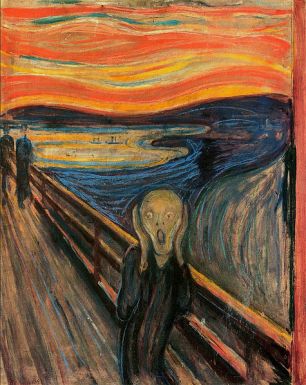 Our current work world is obsessed with productivity. We are inundated with books, articles, white papers, to time block this and time block that; all just to do more work. But our relentless quest to be productive is undermining one of the most important abilities in today’s workplace: creativity. What of the future, though? Will machine learning and artificial intelligence perform the routine aspects of our work at the expense of our ingenuity and creativity?