
Hopefully making a ruckus, one blog post at a time!
Be sure to check out my other blog,Joe’s Journey, for selected short stories and personal insights on life and its detours.

Hopefully making a ruckus, one blog post at a time!
Be sure to check out my other blog,Joe’s Journey, for selected short stories and personal insights on life and its detours.
Why the most valuable skill at work might be talking to strangers

A new book reviewed by Michael Lee Stallard for SmartBrief argues that we could be missing valuable connections. Beyond career advancement, Sandstrom presents evidence for something even more profound: that speaking with people outside our immediate circle fundamentally changes how we think.
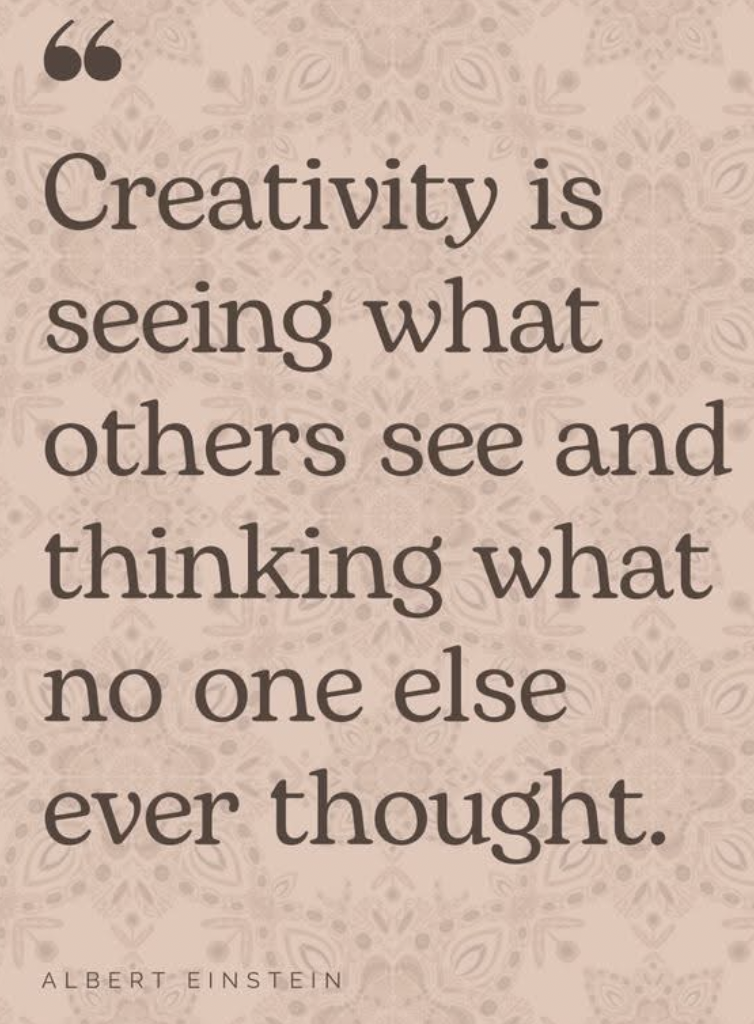
When we talk only with the people we already know — our team, our department, our usual lunch group — we tend to reinforce what we already believe. Our thinking becomes narrow and self-confirming. But when we engage with strangers, we encounter different experiences, different frames of reference and different ways of seeing the same problem. The result opens up the possibility of what researchers call convergent thinking, which is the ability to draw connections across seemingly unrelated domains and synthesize them into something new.
I think of this as “mosaic thinking.” Picture a mosaic, a piece of art composed of small fragments such as colored glass, stone or ceramic tiles. Mosaics dating back to ancient times can still be found in houses of worship in Italy, vibrant and whimsical mosaics created in the 20th century by the Spanish architect and designer Antoni Gaudí adorn buildings and park benches in Barcelona, and you’ll find mosaics on the walls of subway stations in Manhattan and the renovated LaGuardia Airport. Individually, the fragments seem unrelated, but when assembled, they form an image none of the individual pieces could have produced alone. This is precisely what happens in the mind of someone who is genuinely curious about the people they meet.
Every conversation with a stranger, therefore, has the potential to produce a “tile” — a small piece of new knowledge or perspective that, over time, accumulates into a richer, more creative, more innovative way of thinking. There may also be times when a seemingly innocuous comment someone else makes is the “aha moment” for you, and you recognize why a certain tile won’t fit, or you finally see how the tiles can come together.
In an era when organizations are desperate for creativity and innovation, this is not a soft benefit. It is a competitive advantage — and it starts with being willing to say hello.

Hopefully making a ruckus, one blog post at a time!
Be sure to check out my other blog,Joe’s Journey, for selected short stories and personal insights on life and its detours.

In a recent episode of Adspeak by ADWEEK, executive editor Alison Weissbrot leads a Brandweek panel featuring Nadja Bellan-White, group CEO at M&C Saatchi; Coltrane Curtis, founder and managing partner at Team Epiphany; and Kern Schireson, chairman and CEO at Known.
Together, they discuss the need to redefine agency-client partnerships. As budgets tighten and AI reshapes workflows, they explain why legacy and fee-based models are no longer viable.
Instead, success hinges on empathy, trust, and aligned incentives tied to outcomes. The panel shares practical strategies, from embedding test-and-learn budgets to understanding board-level pressures and deploying agile “tiger teams.”
What you’ll learn:
They emphasize deeper specialization, real human connection, and shared accountability as the foundation for resilient, high-performing partnerships in a rapidly evolving marketing landscape.
Three agency leaders on why legacy and fee-based are no longer viable.
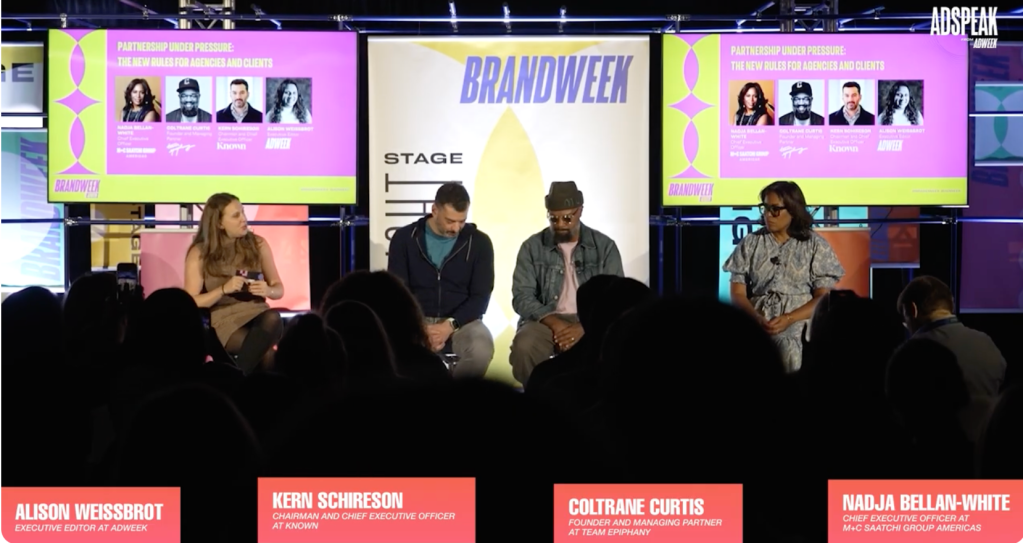
Nadja Bellan-White is the Group CEO at M&C Saatchi, and a “human-first” marketing leader known as a go-to fixer for complex brand transformations. With 25+ years in integrated marketing, she blends data, creativity, technology, and media to drive meaningful customer connections. She has led transformations for global brands including American Express, IKEA, and Coca-Cola, and partnered with African governments to spur growth. An AdColor Legend Award recipient, she brings a sharp focus on context, culture, and creativity to every engagement.
Coltrane Curtis is the Founder and Managing Partner of Team Epiphany, a New York-based influencer marketing and PR agency he launched in 2004. What began as a one-man shop has grown into a 70+ person, multidisciplinary agency with offices in New York and Portland. With roots at MTV and deep experience across brands like Nike, HBO, and Coca-Cola, Curtis blends cultural fluency with sharp strategic execution. Known for building powerful brand and celebrity partnerships, he has been recognized by Inc., Forbes, Adweek, and AdColor, and serves on the American Black Film Festival board.
Kern Schireson is the CEO of Known, a next-generation agency built on data-driven strategy and systemic innovation. With deep expertise in incentive alignment and AI-powered optimization, he is helping redefine the modern agency model. Kern champions using technology as a force multiplier for enhancing, not replacing, human creativity, while embedding rigorous test-and-learn frameworks into client partnerships. His approach focuses on aligning incentives and enabling continuous iteration, driving measurable, breakthrough results for brands navigating an increasingly complex marketing landscape.
Hopefully making a ruckus, one blog post at a time!
Be sure to check out my other blog,Joe’s Journey, for selected short stories and personal insights on life and its detours.
The art world has succumbed to controversy via a graphic outdoor display of the menstrual period. Continuing education of health issues is in the public interest so why is this display so disturbing to some?
Singapore – Kotex has launched a global campaign highlighting the absence of menstrual blood in mainstream art, positioning it as a long-standing form of cultural censorship.
Developed with DAVID London and Ogilvy Singapore, “Art’s Missing Period” brings together works that were previously rejected by galleries or removed from public display due to their depiction of menstruation.
The campaign reframes the issue as one of visibility, arguing that while violent imagery involving blood is widely accepted, menstrual blood remains excluded.

“Visibility shapes culture, and we set out to change both,” said Genevieve Gransden, Executive Creative Director at DAVID London.
“This is not just a campaign. It is a restoration of voices, narrative and art that deserves to be seen,” said Selma Ahmed, Executive Creative Director at DAVID London.
The campaign includes a short documentary directed by Emmy award-winning filmmaker Kathryn Everett and narrated by journalist Noor Tagouri.
The film examines how depictions of blood tied to violence are widely shown, while menstrual blood is treated as taboo, and features accounts from artists who have faced rejection linked to the theme.
Beyond film, Kotex has rolled out mobile billboards and street posters outside major museums, including the Guggenheim, the Metropolitan Museum of Art, the Whitney Museum of American Art, and the Museum of Modern Art.
The placements position the campaign directly at the doorstep of institutions central to shaping public art discourse.
QR codes embedded in these placements direct audiences to a virtual gallery hosting more than 40 artworks centred on menstruation.
The online platform, launched on April 6, 2026, will run for one year and is designed to provide a dedicated space for artists and exhibitions exploring the subject.
The campaign marks Kotex’s latest effort to address stigma around periods, shifting the conversation from product messaging to broader cultural representation.
Thanks to Sharona Nicole Semilla of Marketech APAC for contributing this article
Hopefully making a ruckus, one blog post at a time!
Be sure to check out my other blog,Joe’s Journey, for selected short stories and personal insights on life and its detours.

