
Time Traveler Curtis and the Ruby Red Crystal Affair

Prologue

When we last saw our time traveler, Mr. Curtis, he had returned to the Majestic of the Sixties and was rummaging around the evil GM’s office when he came upon an oddly shaped locket. It had a ruby red crystal in the middle which was obviously designed to be pressed into some form of action. Upon closer examination, Mr. Curtis discovered that it was already set to activate and, not only that, but was currently set to emit a beacon of sorts. 

Mr. Curtis felt a deep, unsettling tenseness in his gut when he realized the beacon was “live” and transmitting. Was this some sort of homing mechanism and to whom was this signal being sent? In the pit of his soul, he didn’t really want to know but he feared it was already too late.

Now for the rest of our story or continue reading via WordPress below.

This scenario raised all sorts of questions. For whomever the beacon was intended, were “they” already enroute to Earth? If so, for what reason and who was behind this?

Unfortunately, his police buddy-Time Traveler had been killed in the explosion in the Majestic Hotel lobby years ago. He thought under the circumstances he’d get cooperation in his new search.

In any event Mr. Curtis figured he needed to alert and apprise the Space Time Continuum Authority (STCA) and the Timeline Police.

So he left immediately for Mars, the galactic headquarters of the STCA. Once there he’d visit Admiral Moratoki, the fiesty ole bird from the Gamma Quadrant. Curtis had worked with the admiral before on the Saturn Caper and felt good about seeking his opinions on this Ruby locket mystery.

“Why Mr. Curtis, it’s nice to see you again,” welcomed the Admiral. “Please, take a seat and let’s compare notes, shall we?” he remarked.

“I take it you know why I’m here,” intoned Mr. Curtis.

“News travels fast in these parts,” replied Moratoki. “We’ve had our suspicions about the ruby locket for some time but we haven’t been able to gather much information on it, I’m afraid. I was hoping you might be able to fill us in a bit,” he said.

“Well, sir, all I know so far is what I found in the Majestic GM’s old office; an ornate locket with a red ruby in the center that appeared to have been activated at some previous point. I say activated since it appears the ruby itself is gently vibrating and glowing,” explained Mr. Curtis.

“That’s what I was afraid of,” grumbled Moratoki. As he gently took the locket from Curtis’ hand, he indicated he wanted to turn it over to the Seismic Lab for observation. At this point the last thing they wanted to do was to make things worse by accidentally tampering with the device and further triggering an action they may not be able to reverse.

“How far in the future do you think this thing has come from?” asked Curtis.

“Just based on preliminary data, we’d guess about 500 light years,” replied the admiral. “Wherever its origin, we think it’s from unchartered space. We need you to try and track it down,” Mr. Curtis.

“And how do you propose I do that?” inquired Curtis.

“Why, simple, ole chap. Just program that walking stick of yours for 500 light years into the future. Here, I’ll do it for ‘ya,” volunteered Moratoki.

“But, sir, I . . .,” blurted out Curtis. Then, poof, in an instant he was gone.

“Hmmm, 500 Light Years into the future,” Curtis grumbled. Where would he end up, he wondered. He was about to find out.

Time travel usually doesn’t take that long, at least that’s been Mr. Curtis’s experience. He somehow felt this time would be no different. He was right. The transport process completed and here he stood: right in the middle of a vast wasteland or desert-like environment. The air was breathable so oxygen was present.

Adobe Stock

As he stood there taking his surroundings all in, he viewed mountains in one direction and a city skyline in the other. Fortunately for him, the city did not appear that far away, maybe only about a quarter mile. He figured he could walk that. The temperature was comfortable, not hot, not cold.

As he neared the city limits, he was impressed with the architecture he saw. The buildings were quite modern and a variety of styles and shapes. Very attractive and distinctive.

Where would Curtis begin his search and who, exactly, was he looking for? He couldn’t approach the first person he saw that looked like a time traveler and ask, “Excuse me, but are you the resident time traveler on this planet?”

His first thought was to go to the city’s “grand hotel” and seek out the general manager and/or the local police detective. As he walked further down what appeared to be the Central Business District, he stopped and asked a passersby where the local hotel was.

Well, conveniently, it was located at the end of Main Street and was very “grand looking.” “You can’t miss it,” the passersby told Mr. Curtis.

And he was right. The closer Curtis got to the end of Main Street, he stopped cold. Just stood there, frozen in awe and disbelief.

He was standing at the front entrance of their grand hotel . . . The Majestic.

1930 Louisiana Postcard, Majestic Hotel, Lake Charles, LA

Is it a reproduction of the original from Lake Charles, LA in early 20th century or was it mysteriously transported to the future and here it is?

Mr. Curtis hoped to find some answers when inside this Majestic. Well, as soon as he entered the lobby he heard a voice saying “Welcome to the Majestic, Mr. Curtis!”

Then everything went dark.

————-

The room was quiet except for what sounded like a low murmur of voices. Then, “Mr. Curtis.” Silence. “Mr. Curtis,” again. “it’s alright, sir, you’re amongst friends,” said a voice.

Mr. Curtis, feeling groggy, eventually began to focus on the room and the voices just heard. Or at least he thought he heard them.

Then everything came into focus and what, or rather who, he saw first alarmed him. Shocked, however, might be a better descriptor.

“It can’t be,” he murmured. “You’re dead; you’ve been dead for several centuries! How the Hell . . .”

“All in good time, Mr. Curtis. All in good time,” said the “dead” guy’s voice.

“But, you’re the time traveler/time cop I met at the Majestic back in Lake Charles in the early sixties. I saw you die in the lobby explosion,” blurted out Mr. Curtis.

“That’s correct,” said the cop. “You see, I didn’t really die. Over time, my cells regenerated and, in effect, brought me back to life. I’ll explain it more to you over a bourbon. For now, though, we’ve got a problem on our hands,” he replied.

“Do you know about the red ruby pendant that’s acting like a homing device?” questioned Mr. Curtis. “It’s our guess that the signal was emanating from this location, on this planet in this section of unchartered space,” he explained.

“Yes, I’m very much aware of it,” answered the cop. “We’ve been trying to track it for years now but haven’t made much progress,” he pointed out.

‘Mr. Policeman’ continued, “We think the Koralye are behind this. They’re a small but deadly band of galactic pirates who not only time travel but also shape shift. Their sole mission seems to be mind-altering destruction wherever and however they please. As weird as it sounds, we believe this culture seems to be their DNA,” summed up the cop.

“So where does that leave us with the locket?,” asked Curtis. “I mean it seemed to have been activated and its homing device armed and sending signals somewhere, presumably here,” pointed out Curtis.

“By the way,” he interjected, “where the Hell are we, anyway?”

“We’re on an asteroid circling the third moon of Axios, a planet in an uncharted galaxy in what we think might be the Butella Nebula. We believe the Koralye are headquartered here and for sometime have kept the nebula invisible and undetectable to our sensors,” explained the cop.

“How is that even possible?,” Curtis asked, somewhat bewildered.

“We think the Koralye have harnessed some sort of galactic cloaking effect but we can’t be sure,” offered the cop.

“Well, that may be a question to be addressed another day,” stated Curtis. “Meanwhile, regarding the Ruby locket, is the current theory that the signals sent here from Earth are meant to guide this Koralye group to Earth for invasion?,” asked Curtis.

“That is our belief as of now,” stated the cop. “But not just invasion; total destruction of our planet,” he continued. “We think it’s a strategic move on their part so they would gain a key foothold within the Milky Way Galaxy. We can’t let that happen,” declared the cop.

“But how would the destruction of an entire planet serve in their best interests?,” asked Mr. Curtis.

“It’s simple,” said the cop. “Since they would have created a hole in space, you might say, they’d simply replace that hole with their asteroid. The one we’re standing in.”

Mr. Curtis, sounding rather dumbfounded, replied, “You mean they can actually move this asteroid into the place in space that Earth currently occupies? That’s incredible, if it’s true.”

“Incredible as it may seem, Mr. Curtis, we think it’s entirely possible,” reasoned the cop. “Given their technology behind the galactic cloaking phenomenon. We don’t even know to call it a device, or what. But to transform through space and time an entire planet would be the type of devious technology that this species probably is behind,” he continued.

“Well,” bemused Mr. Curtis, “taken into account what we already know, it seems like the Red Ruby locket can be disposed of, since they obviously know how to get to Earth. So the homing device is no longer needed. But after we stop them, seems like we’d need to destroy this asteroid, their headquarters. Then they would not be able to do anything. let alone literally move into Earth’s former space in the solar system,” Curtis conjectured.

“But if that’s the plan,” continued Curtis, “I alone don’t have the authority to give that authorization. That has to come from the… space time continuum authority,” he said.

The cop interjected, “Well, Mr. Curtis, I suggest you contact them immediately and advise them of our situation and ask for instructions.”

After several hours of discussion with the STCA and more introspection Mr. Curtis agreed with the Authority that the only option available was to destroy the asteroid housing the Koralye HQ. A not so minor problem was that they, too, were also on the asteroid.

How to destroy it and get out before complete obliteration took place was the challenge Curtis was going to have to address. Alas, the Authority was no help. What were a few lives lost in service to their planet Earth compared to the billions of lives potentially lost on Earth? In other words, Curtis and his colleagues were expendable.

So, when Curtis delivered the news to his group, the mood was understandably somber. And anxious. How soon could they enact a plan and could it be done without killing themselves in the process?

What about the Ruby pendant; could it be of use? Curtis thought of asking the STCA’s scientists and engineers who had been studying the pendant for clues as to what made it work and was it programmable.

If it can transport one over light years could it also work as a remote detonation device? Or, for that matter, could Curtis’ own walking stick with its emerald jeweled knob be used in connection with the pendant to bring about destruction?

The Authority’s experts would probably have some options. Mr. Curtis decided he’d immediately travel back in time to inquire as to what they’d found out.

Since it wouldn’t take Mr. Curtis that long to travel the 500 light years back in time, he thought he would first check in with Admiral Moratoki and compare notes as to what they knew before checking in with the “tech folks.”

“Not much, Mr. Curtis,” replied the admiral when asked about progress. “Oh, we have an idea or two about how that Ruby pendant works but it’s based on futuristic science and technology; we just don’t have that knowledge yet.”

“Well, since this Authority designed my walking stick, do we know if it’s plausible for it to connect with or talk to the Ruby pendant”?, asked Curtis.

“I’ve asked our chief technologist, Mr. Craig, to join us here for direct feedback,” stated the admiral.

“Ah, Mr. Craig, c’mon in. Right on time”, said the admiral. “This is Mr. Curtis whom I’m sure you remember. What’s the latest on the Ruby pendant? Do we know any more of its secrets”? the admiral inquired.

“Well, sort of,” replied Craig. “It’s composed of several chemical agents, most of which are unknown to us except one: hydrochlorabenzaprine; yeah, I know, it’s a mouthful! It’s commonly referred to as Hyzaprine. The Vulcans were using it back in the 24th Century in certain mining operations. And, yes, it does have destructive powers for good, as long as it’s under control. Out of control it’s extremely volatile,” explained Craig.

“How volatile?,” inquired the admiral.

“Extremely!,” answered Craig. “When combined with Veritol, an explosive, one can have a very impactful and lethal weapon,” stated Craig.

“Could it be developed for a cataclysmic explosion or destruction?,” asked the admiral, “like an entire asteroid?”

“Indirectly, sir,” Craig responded. “The combination of these chemicals would work to disrupt the asteroid’s inner core and thereby creating massive seismic shifts resulting in earthquakes and internal hemorrhages of that core. In this respect, yes, the asteroid could be obliterated; it would, in effect, blow itself up,” concluded Craig.

“How can the pendant be triggered to do this and how much time before all Hell would break loose after it’s triggered?, asked the admiral.

“Once the Ruby is pressed it would only be a matter of seconds before the chain reactions occur. And, sir, someone would have to press the Ruby; it can’t be remote controlled,” stated Craig.

Mr. Curtis interjected “Admiral, I can do that. I can certainly press the Ruby and immediately press the emerald on my walking stick to travel in time away from there.”

“But, what if something goes wrong? You’d have to be in position with Ruby in hand and then “beam” out into time and space as soon as you press the Ruby,” alerted the admiral.

“Yes, I know,” replied Curtis. “Considering what’s at stake, I’m the logical one to do this and this is the only way.”

“I sure hope you know what you’re doing, Mr. Curtis,” Morataki intoned. “Mr. Craig, how soon can you revamp the pendant to do what we need done?” he asked.

“Give me a few hours, Admiral, and we’ll be ready,” confirmed Craig.

“Proceed, Mr. Craig,” the admiral instructed.

“As for you, Mr. Curtis, sit down with me, have a drink or two and let’s chat. I want to hear how you plan to pull this off,” the admiral reassuredly stated.

And waited and drank and chatted for several hours they did until the pendant was ready. Mr. Curtis would leave this timeline at first light tomorrow. Hopefully, if all went well, he would end up saving Earth, no small feat even in the 28th Century.

**********

First light: Mr. Curtis, standing there resplendent in his crisp, all white three-piece suit and white fedora is clutching his walking stick somewhat nervously rubbing the emerald on top.

He admits to himself that he’s uncharacteristically nervous about this mission. He’s never really been in a position to “single handedly” save the world or in this case Earth.

The emerald is pushed and Mr. Curtis feels the transition of going forward in time. It’s a good thing that this voyage won’t take but a few seconds since he won’t have long at all to think anymore about it.

Before he knew it, Curtis rematerializes in a secluded area he had not been before. No problem, he thought; he could remain undetected for a bit longer than he’d anticipated.

Where could he sneak away to for the most devastating vantage point to press the Ruby? He knew from previous excursions about where “their” HQ is located. By his estimate he wasn’t that far away. Now to get there unnoticed.

Wait a second, he thought. Although seldom used he recalled a setting on the area surrounding the emerald that could program site to site transport. He could set it to beam him a few miles directly to the HQ site, hopefully undetected.

Curtis then set the emerald to beam him to an area that his sensor told him was uninhabited. Perfect, he thought. One press of the emerald and, poof, he disappeared. Next thing he knew he was by himself outside some shelter at the heart of the Koralye HQ.

All he had to do now was press the Ruby on the pendant and “all Hell” would begin. Then he had to get out of there immediately.

“3 . 2 . 1 . PUSH RUBY,” Curtis recited out loud. Then, nothing!

All of a sudden he felt trembling from the ground below; the destruction had begun. Now press the emerald on your walking stick, he thought to himself, and get the Hell out of this timeline.

Just as he positioned his walking stick so that he could access the emerald, the ground beneath his feet shook so fiercely he lost his balance and fell to the ground. His walking stick landed a few feet away but was still intact.

He quickly gathered himself and reached out for his cane when he suddenly felt something blocking his way. Someone was standing on the cane.

“Well, well what do we have here,” said a voice. “You looking for me? Ha, seems you found me or rather I found you, Mr. Curtis,” the voice continued.

“I’m Nicholas Basba, the head of the Koralye. What you’re trying to do here won’t work. Our technology is way too advanced for your “modifications “ so pressing the Ruby won’t do a thing,” Basba proudly stated.

Meanwhile, nobody seemed to notice that the ground was continuing to break up and a large swath of land was quickly opening up beneath where Basba stood. He was instantly knocked off balance and swallowed up in the resulting sink hole formed by the ground movement.

Just as Curtis had managed to slightly stand to reach for his cane, he, too, began to slip downward into the sink hole. But, as he was slipping, he held onto the edge of the hole and, while struggling, pulled himself up and out of the cave-in.

He reached down to grab his cane and started to press his emerald to activate the time shift. In a moment he would vanish, leaving this time and world far behind.

“Here we go . . .3 .2 .1,” murmured Curtis. “Press the emerald and off we go”. . . Then nothing. No action whatsoever.

Okay, don’t panic he thought to himself. He tried again, even while all around him rocks and debris were falling.

“3 . . .2 . . .1 . . .press emerald,” he almost shouted and . . . Nothing. “DAMN,” he exclaimed. “What’s wrong? It’s never failed before. Must be these surroundings,” he thought.

Curtis then quickly stammered to an opening at the edge of the sheltered area and, without missing a stride, pushed the emerald once more and suddenly in a flash he was gone. Completely vanished.

Desolation was taking place behind our time traveler. An entire asteroid was being obliterated and an evil empire was being phased out of existence.

Epilogue

Back at STCA HQ, 500 light years in the past, Admiral Moratoki was both pleased and relieved. Seems a sensor array from an affiliated solar system picked up a tremendous explosion from a planetary system light years away. It could only have come from a sun going nova or a similar mass destruction. Perhaps an asteroid explosion.

In any event Curtis was exhausted but pleased the mission was a success. Now, what’s next? Curtis was in no hurry to find out.

The only thing of importance on his mind was to travel back to the early sixties in South Louisiana, Lake Charles specifically, to visit the old Majestic Hotel and relax in their comfortable lobby and enjoy a delicious, cool Mint Julip. After all, he never knew who he might run into, again.

Wondering that, Mr. Curtis rose to stand and bent over to pick up his walking stick. Then he noticed it: The emerald had been replaced with the red ruby. And it was vibrating! What the . . . ?

More stories can be read at https://ideasnmore.net/short-stories
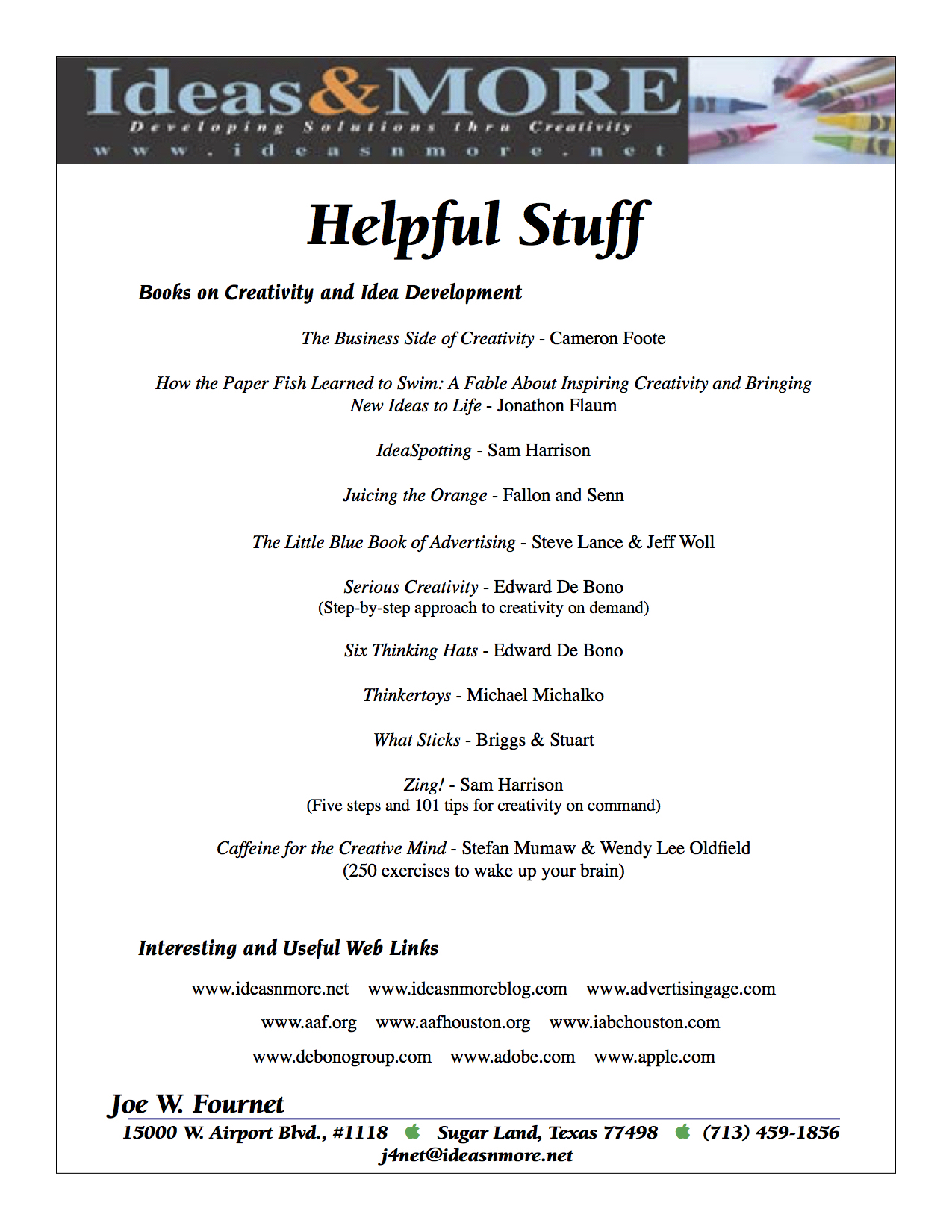


Kick Start Your Creativity

Some times we all need a kick in the pants to get our creative juices to start flowing. Perhaps the attachments in this post will help in that regard. I wrote these years ago in preparation for some speaking engagements. Given their nature, I’d bet they’re still valid today.

Hopefully making a ruckus, one blog post at a time!

Be sure to check out my other blog, Joe’s Journey, for personal insights on life and its detours.

And, check out creative selections from ideasnmore.net.

Jolan tru!


From Rod Serling to Frank Lloyd Wright

Here they are again, quotes for November this time. As usual they represent a variety of viewpoints from various folks, some better known than others. Enjoy!


The writer’s role is to menace the public’s conscience. He must have a position, a point of view. He must see the arts as a vehicle of social criticism and he must focus on the issues of his time. — Rod Serling

Nothing splendid has ever been achieved except by those who dared believe that something inside of them was superior to circumstance. — Bruce Barton, member, Advertising Hall of Fame

Advertising promotes that divine discontent which makes people strive to improve their economic status. — Ralph Starr Butler, member, Advertising Hall of Fame

Brands that keep us invisible to appease anti-LGBTQ activists … are missing a future generation of consumers and employees who demand that brands include LGBTQ people and other diverse communities in authentic and organic ways. — Sarah Kate Ellis, GLAAD’s president and CEO, as quoted by MediaPost Communications

It is easier to tone down a wild idea than to think up a new one. — Alex Osborne, member, Advertising Hall of Fame

Violence does not spring from a vacuum. It’s born out of other men’s violence. It gets nurtured and it grows in a soil of prejudice and of hate and of bigotry. ~Rod Serling

Fun without sell gets nowhere, but sell without fun tends to become obnoxious. — Leo Burnett, member, Advertising Hall of Fame

An important idea not communicated persuasively is like having no idea at all. — William Bernbach, member, Advertising Hall of Fame

When we are too timid to risk failure, we reduce the opportunities to succeed. And we eliminate the chance to learn. — Keith Reinhard, member, Advertising Hall of Fame

An idea is salvation by imagination. – Frank Lloyd Wright


Hopefully making a ruckus, one blog post at a time!

Be sure to check out my other blog, Joe’s Journey, for personal insights on life and its detours.

And, check out creative selections from my website.

Jolan tru!

“Weirder, more human, less serious”

As the creative community still grapples with how best to get their collective hands around AI, a group of creatives interviewed by Chelsea Pippin of Creative Boom, one of the UK’s leading platforms dedicated to the creative industries, give their vision for creativity’s future. I think it pertinent and interesting enough to share with you.


AI is here to stay, but the future of creativity still depends on human ingenuity

Advances in AI are unsurprisingly top of mind for most creatives trying to imagine the future of their work. They seem to agree that the next five years will be about finding ways to make AI work in service of human creativity.

Lawrence Jones, creative director for Framestore, anticipates we’ll see “greater integration of AI and machine learning in the creative process, helping artists and designers to automate routine tasks, freeing them up to accelerate the generation of new ideas.

Found Studio’s Clayton Welham agreed, suggesting that discovering the nuance of AI-creative partnership will be a major theme in the working lives of artists and designers in the coming years. Welham told Creative Boom: “With all the talk of automation, AI assistance, and tools that cut corners and make us more efficient on a day-to-day basis – I think it’s important that we continually reflect on the fundamentals of our practice and our industry. We have to embrace the new, but I feel strongly that we have to do so with our own ideas in hand and with respect for the craft aspect of our work. It will ensure any advancements remain rich, surprising and engaging and avoid becoming formulaic, predictable and machine-made.”

David Sedgwick, meanwhile, remains wary but ultimately cautiously optimistic about what AI can do in the right hands – or when partnered with the right brain. He said: “I just hope that there’s still room for ideas and concepts and that the role of AI doesn’t leave us all totally redundant. As things currently stand, I still feel we have a big role to play in the way we use AI in our jobs, and we mustn’t confuse AI as a tool to help us work better or quicker with the best tool we will always have, which is our brain.”

Ben Tallon
Ben Tallon

Creatives also need to stay on top of, and curious about, other tech advancements

Framestore’s Lawrence Jones is also betting on other technological innovations playing a crucial role in the evolving roles of creative professionals. He told Creative Boom that he expects the next few years will bring about “advancements in 3D printing technology enabling artists and designers to inexpensively create more complex and intricate designs, sculptures, and products.”

Beyond that, Jones is also keenly following the “invention and use of new types of input devices like neural interfaces and brain-computer interfaces in creating art forms such as motion design and VFX, allowing artists to create works that reflect their thoughts and emotions.”

Continue reading

Copywriting Ain’t What It Used to Be – That’s a Shame!

Some might say yes. Some might say it is what it is. Either way, it’s extremely competitive with all brands fighting for attention. I must say, though, that when I hear a tag line or read a catch phrase I often times think to myself, “what were they thinking?” or “how did that get out of committee?” It’s so stupid or simply doesn’t make sense.

While I don’t think copywriting is a dying art, I do think it’s a shrinking art in its creativeness. I recently ran across an article by Nick Emmel, founder and strategy partner of Mr President, which poses the same sort of question about whether or not copywriting is dying. What’s your take?
_____________________________________

One hundred and seventy thousand. That’s supposedly the number of words in use in the English language.

Advertising’s vocabulary has been reduced seemingly to the most meager selection of acceptable words. While we all simultaneously preach the importance of distinction. It’s too easy simply to blame the industry for getting lazy, or bemoan the lost art of copywriting. The reality is the job is so much harder now.

At the dawn of advertising, there were so many unused words to own, so many more unclaimed claims to make, so much more prose to play with. “We try harder”, “Have a break”, “Finger lickin’ good”, “Beanz meanz Heinz”, “Snap! Crackle! Pop!”, “Never knowingly undersold”. Lines, rich in insight and idea. Gorgeous, evocative three word combinations that have stayed in popular consciousness for decades. But one by one each word has been taken, every construct used, every idea explored.

As if it wasn’t enough that we have to forage for language leftovers, there is a heightened expectation of what those words must do. No longer must it simply be the perfect encapsulation of the brand promise, it needs a sprinkling of purpose, a dash of authenticity, a pinch of zeitgeist. The three little words are burdened with headlining the annual report as well as becoming a trending #hashtag. More than an ad strapline, it’s now the all-pervading branded equity in every channel and for every audience. All with a global “translatability” that renders any wordplay dead.

It’s these strategic imperatives that are forcing creativity into a corner.  In trying to focus on the many things we have to do, we are forgetting about the one thing we need to do – connect with people. It’s telling that the most iconic lines were born of campaign ideas and only later promoted to hallowed brand line status. “I’m lovin’ it”, “Think different”, “Just do it”. Briefs where the creatives were given greater leeway to do what they do best. 

Perhaps we need to unburden ourselves from the expectations of the brand line. Prioritise the strength in the idea over the stretchiness of application. Open up our accepted vocabulary to the idiosyncratic, the flamboyant, the funny, the painfully truthful, the counterintuitive, the untranslatable. Then even the most familiar of language might find a new lease of life.

_______________________________________

The art of copywriting is still that, an art. If used creatively and smartly, it can extend and enhance an idea. That doesn’t mean, however, the copywriter needs a thousand words or so to accomplish and attain his art. A great example is the famous Volkswagen ad of the Beetle in the sixties, “Think Small.” Yes, I know, that was a long time ago but the idea and execution are timeless. Creative excellence. We just need more of it.


Hopefully making a ruckus, one blog post at a time!

Be sure to check out my other blog, Joe’s Journey, for personal insights on life and its detours.

And, check out creative selections from my website.

Jolan tru!

AI’s Impact on Creativity in Ad industry: A Panel Review

How do you think AI will impact creativity in the ad industry – positively and negatively – in the near future? This is the question put forth to a panel of nine industry gurus, moderated by one Carol Cooper of Shots, in a recent article. There’s been so much written already about AI that I felt it appropriate and timely to share this panel discussion since it relates to creativity and advertising.


Johnny Vulkan, Founding Partner, Anomaly

The first photograph was allegedly taken in 1826 but it wasn’t until just shy of 100 years later that an American gallery deemed photography worthy of inclusion in their collection. After all, what artistic skill does it require to create a mechanical and chemical replication of reality?

We’re now, hopefully, more enlightened about photography and the still; moving and digitally manipulated form has become a central part of our industry. And now we have a new tool, AI.

Whilst it can be crude, nascent, often clumsily disappointing and inaccurate, we’re already seeing exquisitely crafted images and concepts brought to life. Some of these outputs would’ve taken weeks to achieve using more conventional methods, and maybe only the finest of today’s craftspeople would be able to even come close. Now, like so much software before it, seemingly impossible ideas can take seconds to render, and that democratizing of creation is exciting and terrifying in equal measure.

Jobs will be lost. New jobs will be created, but it’s clear that the best insurance anyone can have would be to experiment, learn and play. 

AI is not without problems and it’s natural for us all to experience some discomfort as ‘bad actors’ have the same access to tools as people with less malicious intent, but this genie will not be going back in the bottle. We can probably predict a few years of highly litigious legal jeopardy as all industries struggle to define new rules and concepts in intellectual property and rights but this will only slow rather than reverse the direction of travel.

It won’t take 100 years for AI creativity to appear in gallery collections, in fact it’s already controversially helping to win awards and competitions. But it’s still ultimately a tool. One that any one of us can wield and learn to master. What a great chance for us all to learn.

Above: Anomaly founder Johnny Vulkan, made by AI with Lensa.


Johnny Budden, Executive Creative Director at AKQA

As with any new technology, you could choose to limit human advancement or take people to the moon. When cars were invented we didn’t change our previous methods of transportation – we still walked, cycled and moved around as before. We simply had access to technology that improved our method of getting around.

There are countless possibilities of using AI to add creativity to our work – not replace it. And we are now harnessing those possibilities to advance civilization. For example, HeyPi.com is a compassionate AI that cares about your needs. GoFundMe used AI animation to bring donation stories to life.

The power of machine learning created a match between Serena Williams and her past self, from her first Grand Slam at the 1999 US Open versus her most recent at the 2017 Australian Open. We are going to the moon, everyday.

The advantages of AI means that our boutique team is expanded now into a team of a million. We are still driven by the same imagination and passion as before, only now with access to an infinite resource of information to help us achieve the future faster.

Continue reading

Ask Wicked Questions to Enhance Your Creativity

Enhancing one’s creativity is not difficult when you utilize various tools. One such tool is the art of questions. A recent article I read by Lee Duncan, IBM Enterprise Design Thinking Leader, explores this practice. He aims it toward designers but, in fact, all creatives should learn from it and profit by it.

I’ve heard it described by asking Better questions, too. Whichever you select, dig deeper into the problem to get to the soul of the matter to uncover more options to deliver the solution. In this post, I pass along Lee’s contribution so that you may also glean some suggestions that will help you derive better solutions to enhance your creativity.


As designers, we often get caught up in the details of our work and lose sight of the big picture. It’s easy to get bogged down in the nitty-gritty of design, but sometimes what we really need is a fresh perspective. This is where wicked questions come in.

Wicked questions are questions that challenge assumptions and shake up our thinking. They don’t have simple answers, and they force us to think deeply and creatively. By asking wicked questions, designers can gain a better understanding of the problem they are trying to solve, and ultimately create better solutions.

Why a Beginner’s Mind Matters

One of the keys to asking wicked questions is to approach a problem with a beginner’s mind. This means letting go of preconceptions and assumptions and approaching the problem as if you were completely new to it. By doing this, you open yourself up to new possibilities and ideas that you might not have considered before.

When you approach a problem with a beginner’s mind, you are more likely to ask questions that challenge assumptions and push boundaries. You are also more likely to see the problem from a fresh perspective, which can lead to innovative solutions.

The Value of Being Curious

Curiosity is an essential trait for designers. It’s what drives us to explore new ideas and try new things. By being curious, we can ask questions that lead to new insights and discoveries.

When you are curious, you are always asking questions. You want to know more about the problem you are trying to solve, the users you are designing for, and the world around you. This curiosity fuels your creativity and helps you come up with innovative solutions.

Continue reading

Quotes for May, Graduation and Enlightenment

Tis that time of year again when graduation ceremonies and insightful speeches are given to enlighten the crowd. Other notables are included here for their wisdom and foresight within the advertising industry and beyond. So, take note; it’s time for May quotes!


Attract attention, maintain interest, create desire and get action. — E. Elmo St. Lewis, member, Advertising Hall of Fame

That which is good or great makes itself known, no matter how loud the clamor of denial. That which deserves to live — lives. — Theodore Francis MacManus, member, Advertising Hall of Fame

The saddest aspect of life right now is that science gathers knowledge faster than society gathers wisdom. – Isaac Asimov

It’s really hard to design products by focus groups. A lot of times, people don’t know what they want until you show it to them. – Steve Jobs

The world of reality has its limits; the world of imagination is boundless. – Jean-Jacques Rousseau

Click on the image to get a better view of the quote

Commencement Address/ Ithaca College May 1972

The place to start in advertising is the basic selling appeal. An appeal that fulfills some existing need in the prospect’s mind, an appeal that can be readily understood and believed. — Morris Hite, member, Advertising Hall of Fame

I have learned that any fool can write a bad ad, but that it takes a real genius to keep his hands off a good one. — Leo Burnett, member, Advertising Hall of Fame

Art is not just our expression of life and of ourselves. It is not just our internal cry: Art is the lie we need about the world and ourselves. When we write or paint or act or compose, we are imposing an order, yes, but we are also crafting a world we can control, and usually it is one we can admire–or at the very least recognize. Art is not elite; art is not on a high shelf for a chosen few. Art is, like religion, a primary narcotic. — Marlon Brando

We have a need for an enlightened, watchful articulate opposition. We have no need for semi-secret societies who are absolutist, dictatorial, and would substitute for a rule of law and reason an indiscriminate assault on the institutions that must be held sacrosanct. — Rod Serling


Hopefully making a ruckus, one blog post at a time!

Be sure to check out my other blog, Joe’s Journey, for personal insights on life and its detours.

And, check out creative selections from my website.

Jolan tru!

Creativity + Constraints = A Good Pairing?

When one adds any sort of constraint to the creative process, one gets bogged down, right? Um, not necessarily. In fact, it could be just the opposite. From a variety of perspectives, constraints can open up dialogue and creative opportunities not originally thought or considered.

Portions of this blog post, originated by one, Lee Duncan, got me to thinking about just that. In the early stages of writing a short story, I jotted down some thoughts on my iPhone, knowing they would be automatically “copied” to another application (Notes) on my laptop so I could continue at some later date. When that later date came and I went to access them on my laptop, the additions I had made were nowhere to be found.

Oh, the horror!

I discovered a major constraint! Now, I had to rely on memory to reconstruct the few paragraphs I had previously written. I realized I couldn’t remember everything word for word so I revised my thinking a bit to write new dialogue based around what I did remember. All in all, it turned out okay (so far).

In his post, Duncan cites that designers, artists, writers, and creatives of all kinds are often told to “think outside the box” and let their imagination run wild. He asserts that creativity loves constraints. That limitations can actually enhance our creativity rather than hinder it? I tend to agree.

Both he and I agree that the idea that constraints can fuel creativity is not new. In fact, it has been embraced by some of the world’s most innovative thinkers, including Dr. Seuss, who famously wrote “Green Eggs and Ham” using only 50 different words. Steve Jobs once said, “Creativity is just connecting things. When you ask creative people how they did something, they feel a little guilty because they didn’t really do it, they just saw something. It seemed obvious to them after a while. That’s because they were able to connect experiences they’ve had and synthesize new things.”

Thinking Differently

Constraints force us to think differently. Or “newly” as in my case. They force us to look at a problem from a different angle and approach it in a new way. When we’re faced with limitations, we’re forced to be more resourceful, more innovative, and more creative.

Duncan cites an Instagram example: In the early days, the platform’s co-founders were faced with a constraint: they had to build a photo-sharing app for the iPhone using only the phone’s built-in camera. Rather than seeing this as a limitation, they embraced it and created a platform that revolutionized the way we share and consume visual content.

The Brain on Constraints

Research has shown that constraints can actually stimulate the brain and enhance our problem-solving abilities. When faced with a difficult problem, our brains tend to default to familiar solutions. But when we’re presented with constraints, we’re forced to explore new solutions and think outside the box.

One study conducted by the University of Amsterdam found that participants who were given a set of constraints to work within were more creative in their problem-solving than those who were given no constraints at all. Another study found that imposing a deadline on a creative project actually increased creativity, as it forced participants to make decisions and move forward with their work.

In my view, this wouldn’t necessarily increase creativity but it would increase the possibility of failure or at the very least, some new ideas. Creativity would then evolve.

Ideas and Constraints

Constraints can therefore help us generate better ideas. When we’re given a blank slate and no direction, it can be overwhelming and difficult to know where to start. You’re sort of blindly throwing the dart at the board and seeing where it lands. But when we’re given a set of constraints, we’re forced to work within certain parameters, which can actually help us come up with more focused and relevant ideas.

When a group of designers was tasked with creating a new line of office furniture, they were given a set of constraints to work within, including a specific budget and a requirement that the furniture be modular and easy to assemble. Rather than hindering their creativity, these constraints helped them generate a range of innovative ideas that met the client’s needs and exceeded their expectations.

Applying Constraints to Facilitation

Constraints can also be applied to facilitation, or the process of leading a group through a creative problem-solving process. By imposing constraints on the group, the facilitator can help guide them toward more creative solutions.

For example, a facilitator might ask a group to brainstorm ideas for a new product, but impose a constraint that the product must be made entirely from recycled materials. This constraint forces the group to think about sustainability and environmental impact, which can lead to more innovative ideas.

If no constraints were added, the group might generate hundreds of new ideas but would have to undergo a due diligence exercise to decide which ideas were better and then further decide how to proceed. That’s another exercise entirely but well worth the time invested.

While it may seem counter-intuitive, constraints can actually be a powerful tool for fueling creativity. They force us to think differently, stimulate our brains, help us generate better ideas, and can be applied to facilitation to guide groups toward more innovative solutions.

When constraints happen, and they will, gather your thoughts and let your imagination roam, exploring new opportunities and possibilities. I think you’ll find that paired together, creativity and constraints make for a viable coupling.


This blog post is based upon an article by Lee Duncan, an IBM Enterprise Design Thinking Leader.


Hopefully making a ruckus, one blog post at a time!

Be sure to check out my other blog, Joe’s Journey, for personal insights on life and its detours.

And, check out creative selections from my website.

Jolan tru!


Quotes Anew

Well, it’s that time of the month again when I present a variety of quotes from different personalities from the worlds of creativity and advertising, among others. Take to heart but also take time to think. They’ll serve you well! Enjoy!


Creativity is no longer about grabbing attention or raising consumer awareness. Its goal is to remind consumers about what is fundamental and gratifying about a brand. — Peter A. Georgescu, member, Advertising Hall of Fame

Meetings are all too often the burial grounds of great ideas. — Keith Reinhard, member, Advertising Hall of Fame

Every area of trouble gives out a ray of hope, and the one unchangeable certainty is that nothing is certain or unchangeable. — John E. Kennedy, member, Advertising Hall of Fame

The creation of something new is not accomplished by the intellect but by the play instinct acting from inner necessity. The creative mind plays with the objects it loves. – Carl Jung

Most executives, many scientists, and almost all business school graduates believe that if you analyze data, this will give you new ideas. Unfortunately, this belief is totally wrong. The mind can only see what it is prepared to see. – Edward de Bono

Ideals are like stars; you will not succeed in touching them with your hands. But like the seafaring man on the desert of waters, you choose them as your guides, and following them you will reach your destiny. – Carl Schurz

The self you know, the you deep inside, is obscured by a stack of untold stories.
Janet Mock, writer, television host, director, producer and transgender rights activist

The person who knows HOW will always have a job. The person who knows WHY will always be his boss. – Alanis Morissette

To think is to practice brain chemistry. – Deepak Chopra

A life spent making mistakes is not only more honorable, but more useful than a life spent doing nothing. – George Bernard Shaw


Hopefully making a ruckus, one blog post at a time!

Be sure to check out my other blog, Joe’s Journey, for personal insights on life and its detours.