Houston’s Creative Economy – Part Deux

Recently I reported on a day-long event at the University of Houston called Leadership in the Arts Summit: Valuing the 21st Century Creative Economy. The audience was comprised mostly of non-profits and educators but also had artists and other creative entrepreneurs (like yours truly). Those of you who missed that blog post, well, too bad (just kidding).

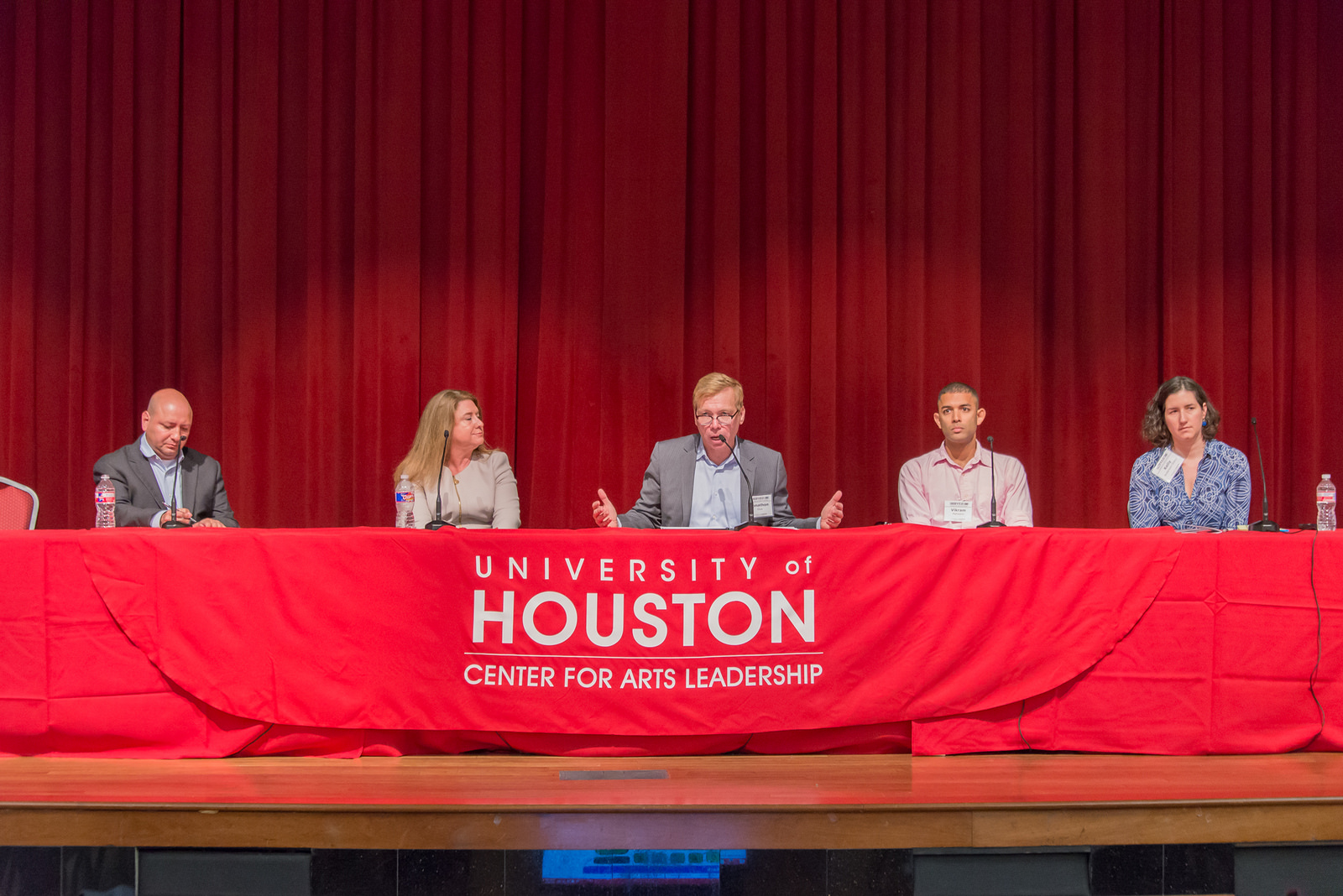
Morning Panel w/Alfred

Summit 2016 Morning Panel

Since that event a couple weeks ago, there has been some follow up by the folks in UH’s Center for Arts Leadership. They are compiling feedback from attendees in hopes of gathering sufficient info to better plan the next steps. That is no small feat.

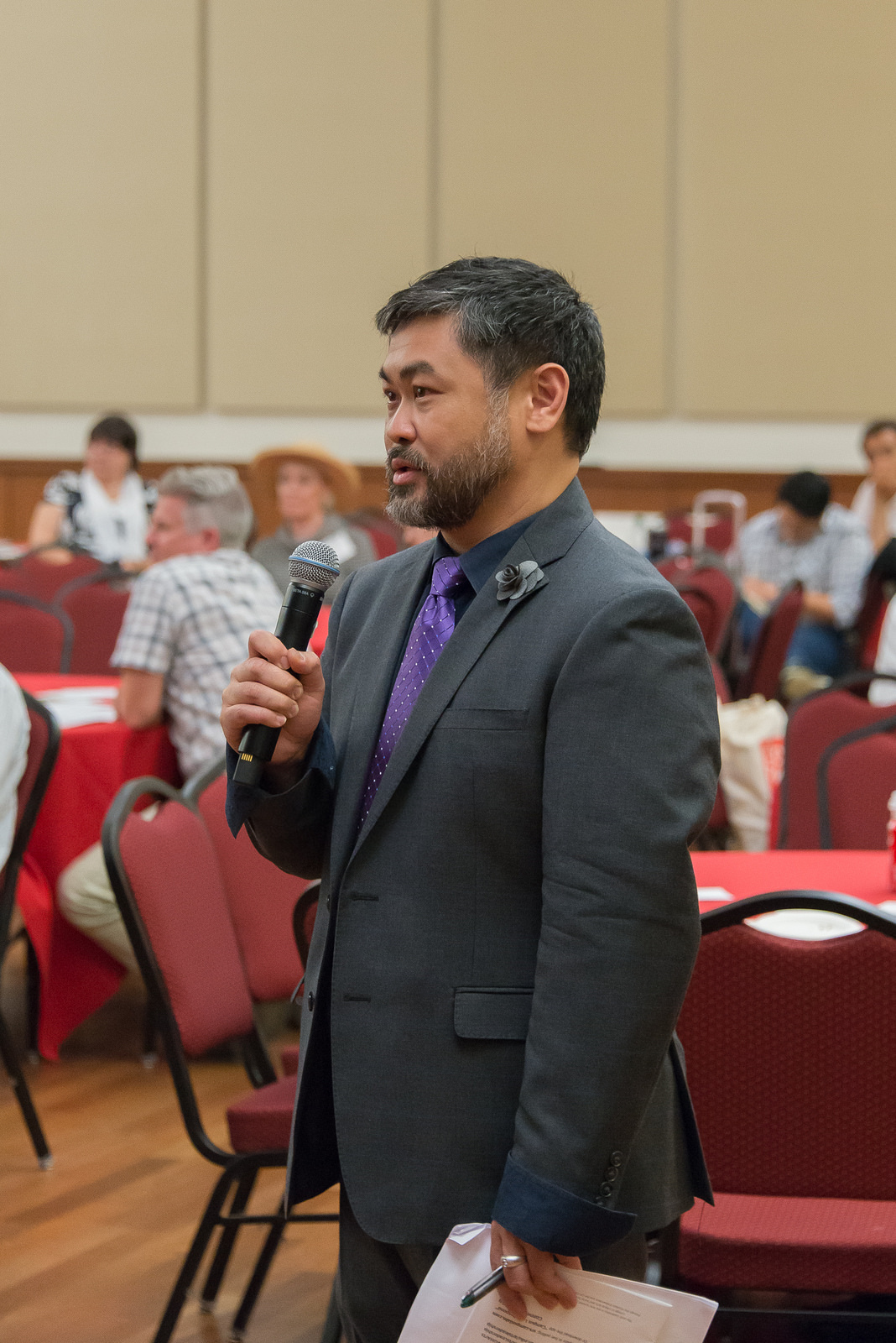
Sixto Wagan

Sixto Wagan, Host & Director Leadership in the Arts Summit

Some of the follow up consists of photos and presentations from April 11. Thanks to the University of Houston for these photos from their Flickr page.

I’m appreciative of those who “liked” my post and who left comments. I’m hoping that once you’ve read this and gone on to review the links herein, you’ll provide feedback as to what you think would be viable solutions to organizing our creative organizations around town to better harness our collective creativity.

Summit 2016 Afternoon Panel

Summit 2016 Afternoon Panel

In addition to the Houston Arts Alliance (HAA), the Greater Houston Partnership (GHP), among others, should play a key role in assisting with this movement. Jon Norby, a panelist in one of the afternoon sessions, recently joined the Partnership last year as Director of Talent Attraction and Marketing. I talked with him afterwards to get a feel for the GHP’s perspective about this new creative economy. While he acknowledged the challenges in communication among all of Houston’s various groups, he admitted it’s a challenge we must overcome to ensure the vibrancy in our creative community we all seek.

A few examples of where creative alliances have been formed, and can be formed in Houston and other cities, include Baltimore, Austin and Milwaukee. In fact, Christine Harris, who lead the first discussion, co-founded and was the CEO of the Milwaukee alliance.

As Sixto Wagan commented in his closing remarks, let us hope five years from now we’re not still trying to start a conversation that we’ve already begun present day. We’ve got a ton of talent at our disposal but we’re not clicking on all cylinders yet.

Though it may seem like we’re trying to lasso a large, puffy cloud, let’s get better organized and talk amongst one another. Let’s continue the discussion. Our creative community deserves no less.

So, who’s with me?

Summit 2016 Audience

Summit 2016 Audience

Our Creative Economy: Listen up, Houston!

This past Monday, April 11, I had the pleasure of attending a day-long discussion “Valuing the Creative Economy” at the third Leadership in the Arts Summit held at the Center for Arts Leadership at the University of Houston. Quite a stunning facility!

I learned about this summit from my friend and Only in Houston Co-chair Alfred Cervantes, who besides being the deputy director of the Houston Film Commission was also a panelist addressing the question “Creative Economy: What is it and why does it matter”?
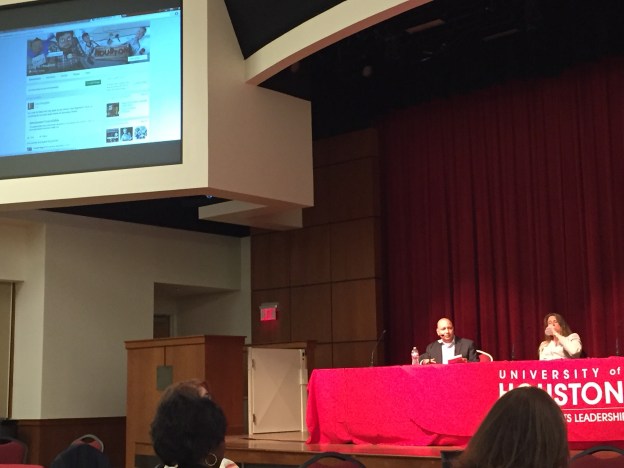
IMG_0919

Because of the length of the Summit and the depth of discussion that took place and will continue in the weeks and months to come, there will be subsequent posts about our progress and how all this can tie together here in Houston. There will also be photos and presentations from the Summit posted to the Center’s website in the days ahead.

The goal of the Summit, according to Sixto Wagan, Director, Center for Arts Leadership, is “to bring our creative community together to talk and to envision a collective future. The panels are meant to push beyond the simple binaries, help us question assumptions, and move the conversation forward toward action.”

Christine Harris lead the opening plenary (formal seminar-speak) “Creative Economy: What is it and why does it matter”? Christine has been working with creative enterprises and community development for over 30 years and was recently in Houston last November headlining a similarly-themed morning workshop at the Houston Arts Alliance (HAA) and an evening panel discussion at Gensler.

IMG_0904

Harris co-founded the Creative Economy Coalition, a working committee of the National Creativity Network, and designed and executed the nation’s first review of defining the creative economy. This study profiled and inventoried how 27 communities around the nation were profiling and measuring their creative economies. She was CEO of Creative Alliance Milwaukee, where she managed a full profile of the regional creative economy and developed online resources for the sector.

It’s not my intent to cover all that was discussed during the Summit in one blog post. We’d be reading for days! I merely want to further the conversation that was “started” last November and continued this past Monday.

And Houston, we’ve got work to do.

Just consider these questions:
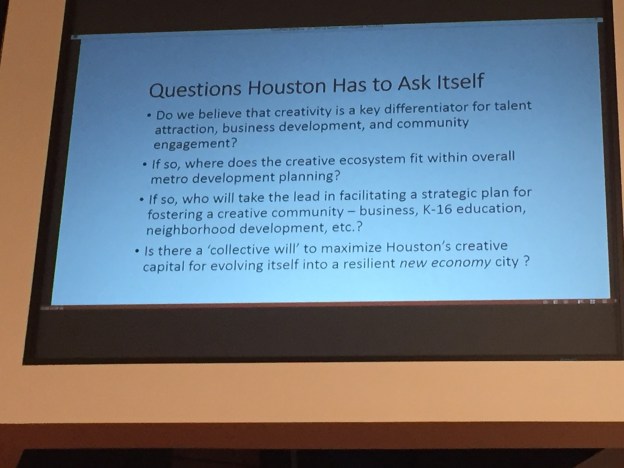
IMG_0908

And then, there’s the $64,000 question:

IMG_0952

Obviously, these questions don’t have simple, ready-made answers. They do, however, demand discussion and we need to continue this.

Feel free to comment and send me input on possible answers or solutions to these questions. You can also post your ideas on OiH-FaceBook and/or the Arts Leadership-FaceBook.

The various communication organizations in and around the city are a major resource for input and counsel. So, too, are the fine educational and non-profit venues in our area. Although this Summit centered around the arts, creativity knows no boundaries.

Through the American Advertising Federation Houston (AAFH), Only in Houston (OiH) was born a decade ago. Its intent was, and still is, to keep local creative dollars spent locally. There was even a multi-communication organization formed years ago (Houston Communication Alliance) aimed at bringing together all “creatives.”

Times change as do people and industries. Houston’s Creative Economy and its driving forces need to meet today’s challenges with tomorrow in mind. We may need to rethink how this is done. Other communities around the country are doing so, and it will take just that: A Houston-wide effort. No one organization or person can do this.

At the risk of thinking out loud (even though I’m typing this in silence), maybe Only in Houston morphs into a “Houston Creative Coalition,” which is comprised of organizations like the Houston Arts Alliance, Greater Houston Partnership, numerous professional and arts organizations, etc.? We can learn a lot from others who have started something like this. But Houston needs to create something that works in Houston, not Boston.

And we must do a helluva lot better job of communicating with one another so that we all know what’s going on and when. No problem; piece o’ cake!

The Leadership in Arts Summit 2016 is a recent example of creativity and economics blending and working together for the common good. We need to make sure the conversation continues and progresses.

More to come . . .

Onward!

 

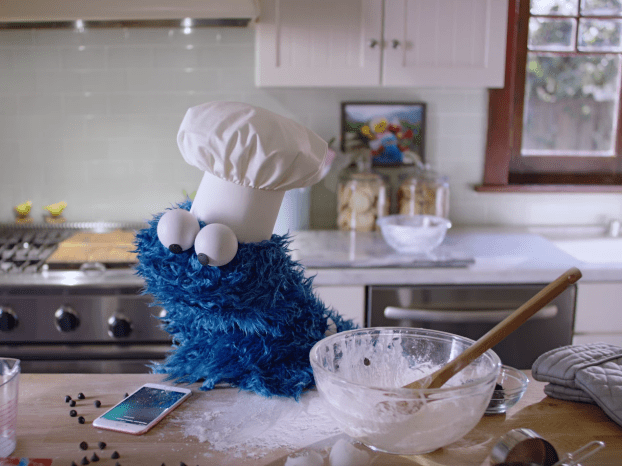
Cookie Monster & Siri: Cute Combo

OK. Time to sit back and take a chuckle break!

Some of you may have seen this on TV by now but I doubt you’ve seen the “extra” footage.

His outtakes are almost as cute as he is. Oh, the things celebrities put up with!

screen-shot-CookieMonster

Courtesy of re/code and Apple via YouTube

Advertising Hall of Fame Quotes – Part 6

Here’s the sixth in a series of various worth-remembering quotes which I find interesting and inspiring, and, hopefully, you will, too. Excerpted from the newsletter “Smart Brief” from the American Advertising Federation, these quotes are usually from a member of the Advertising Hall of Fame.

quote

51. I have a theory that the best ads come from personal experience. Some of the good ones I have done have really come out of the real experience of my life, and somehow this has come over as true and valid and persuasive.

— David Ogilvy

52. Too many ads that try not to go over the reader’s head end up beneath his notice.

— Leo Burnett

53. You can’t use up creativity. The more you use, the more you have.

— Maya Angelou (not part of original series; just a great quote)

54. Meetings are all too often the burial grounds of great ideas.

— Keith Reinhard

55. Play by the rules, but be ferocious.

— Phil Knight

56. A good ad should be like a good sermon: It must not only comfort the afflicted, it also must afflict the comfortable.

— Bernice Fitz-Gibbon

57. Some questions don’t have answers, which is a terribly difficult lesson to learn.

— Katharine Graham

58. Appeals that sound good when described to a client or employer are not always the most effective appeals that can be used. Clever, tricky ideas often sound fine when described in a conference room. But some simple, basic, plain-as-the-nose-on-your-face idea will sell more goods.

— John Caples

59. Courtesy is the one coin you can never have too much of or be stingy with.

— John Wanamaker

60. I think the harder you work, the more luck you have.

— Dave Thomas

So, which ones are your favorites?

Do you have a favorite or favorites in the series?

Lemme know.

Advertising Hall of Fame Quotes – Part 5

Happy Mardi Gras!!

Here’s the fifth in a five-part series (more to come later) of various worth-remembering quotes which I believe you’ll find interesting and hopefully inspiring. Excerpted from the newsletter “Smart Brief” from the American Advertising Federation, these quotes are usually from a member of the Advertising Hall of Fame.

Quote

41. I don’t like closed doors. Creativity flourishes best in an environment of open doors and open minds.

— Keith Reinhard

42. There is no such thing as ‘soft sell’ and ‘hard sell.’ There is only ‘smart sell’ and ‘stupid sell.’ 

— Charles H. Brower

43. In the modern world of business, it is useless to be a creative original thinker unless you can also sell what you create. Management cannot be expected to recognize a good idea unless it is presented to them by a good salesman.

— David Ogilvy

44. Grant graciously what you dare not refuse.

— George Gallup

45. Advertising makes people discontented. It makes them want things they don’t have. Without discontent, there is no progress, no achievement.

— Morris Hite

46. The artist defines creativity. The audience defines effectiveness. To be creative, study art. To be effective, study the audience. To be both, study how the audience responds to art.

— Keith Reinhard

47. I avoid clients for whom advertising is only a marginal factor in their marketing mix. They have an awkward tendency to raid their advertising appropriations whenever they need cash for other purposes.

— David Ogilvy

48. Creativity often consists of merely turning up what is already there.

— Bernice Fitz-Gibbon

49. We don’t grow unless we take risks. Any successful company is riddled with failures.

— James E. Burke

50. There’s nothing wrong with being fired.

— Ted Turner

So, which one or ones is/are your favorite(s)?

Do you have a favorite or favorites in the series?

Lemme know.

Advertising Hall of Fame Quotes – Part 4

Here’s the fourth in a (for now) five-part series of various worth-remembering quotes which I believe you’ll find interesting and hopefully inspiring. Excerpted from the newsletter “Smart Brief” from the American Advertising Federation, these quotes are usually from a member of the Advertising Hall of Fame.

Quote

31. Consumers are statistics. Customers are people.

— Stanley Marcus

32. It takes a real storm in the average person’s life to make him realize how much worrying he has done over the squalls.

— Bruce Barton

33. Big ideas are so hard to recognize, so fragile, so easy to kill. Don’t forget that, all of you who don’t have them.

— John Elliott Jr.

34. I have learned that any fool can write a bad ad, but that it takes a real genius to keep his hands off a good one.

— Leo Burnett

35. Good advertising is written from one person to another. When it is aimed at millions, it rarely moves anyone.

— Fairfax M. Cone

36. The creative process is often a matter of changing ‘What is’ to ‘What if?’ We first observe the status quo and then imagine a status novus.

— Keith Reinhard

37. No company that markets products or services to the consumer can remain a leader in its field without a deep-seated commitment to advertising.

— Edwin Artzt

38. Remove advertising, disable a person or firm from proclaiming its wares and their merits, and the whole of society and of the economy is transformed. The enemies of advertising are the enemies of freedom.

— David Ogilvy

39. We pay just as dearly for our triumphs as we do for our defeats. Go ahead and fail. But fail with wit, fail with grace, fail with style. A mediocre failure is as insufferable as a mediocre success.

— Bruce Barton

40. Know what the client wants, know what the client needs, and know how to cause the client to want what the client needs.

— Keith Reinhard

 So, which one or ones is/are your favorite(s)? Lemme know.

Advertising Hall of Fame Quotes – Part 3

Here’s the third in a multi-part series of various worth-remembering quotes which I believe you’ll find interesting and hopefully inspiring. Excerpted from the newsletter “Smart Brief” from the American Advertising Federation, these quotes are usually from a member of the Advertising Hall of Fame.

Quote

21. And I have always believed that advertising has a powerful impact on our society. It not only influences public taste and conduct; it also helps shape society’s values.

— Liener Temerlin

22. Creativity is no longer about grabbing attention or raising consumer awareness. Its goal is to remind consumers about what is fundamental and gratifying about a brand.

— Peter A. Georgescu

23. Nothing splendid has ever been achieved except by those who dared believe that something inside of them was superior to circumstance.

— Bruce Barton

24. There is no such thing as a mass mind. The mass audience is made up of individuals, and good advertising is written always from one person to another. When it is aimed at millions, it rarely moves anyone.

— Fairfax Cone

25. Advertising is a non-moral force, like electricity, which not only illuminates but electrocutes. Its worth to civilization depends upon how it is used.

— J. Walter Thompson

26. Creativity is so delicate a flower that praise tends to make it bloom while discouragement often nips it at the bud.

— Alex Osborn

27. An idea can turn to dust or magic, depending on the talent that rubs against it.

— William Bernbach

28. Rules are for people who don’t know what to do.

— Keith Reinhard

29. There is not some absolutely revolutionary model that somehow produces the best work. The core principle is still a battle between what’s relevant and what’s not.

— David Droga

30. When we are too timid to risk failure, we reduce the opportunities to succeed. And we eliminate the chance to learn.

— Keith Reinhard

So, which one or ones is/are your favorite(s)? Lemme know.

Advertising Hall of Fame Quotes – Part 2

Here’s another in a multi-part series of various worth-remembering quotes which I believe you’ll find interesting and hopefully inspiring. Excerpted from the newsletter “Smart Brief” from the American Advertising Federation, these quotes are usually from a member of the Advertising Hall of Fame.

Get ready to chuckle, and, I hope, remember.

q-curly-double

11. Know what the client wants, know what the client needs, and know how to cause the client to want what the client needs.

— Keith Reinhard

12. The good ideas are all hammered out in agony by individuals, not spewed out by groups.

— Charles Brower

13. The three ingredients of effective advertising are relevance, originality and impact, the initials of which spell out what clients most desire: ROI.

— Keith Reinhard

14. Anyone who thinks that people can be fooled or pushed around has an inaccurate and pretty low estimate of people — and he won’t do very well in advertising.

— Leo Burnett

15. Creativity varies inversely with the number of cooks involved in the broth.

— Bernice Fitz-Gibbon

16. When you are through changing, you are through.

— Bruce Barton

17. There are two kinds of men who don’t amount to much: those who can’t do what they are told and those who can do nothing else.

— Cyrus H. K. Curtis

18. You must make the product interesting, not just make the ad different. And that’s what too many of the copywriters in the U.S. today don’t yet understand.

— Rosser Reeves

19. Advertising is the ability to sense, interpret … to put the very heart throbs of a business into type, paper and ink.

— Leo Burnett

20. An important idea not communicated persuasively is like having no idea at all.

— William Bernbach

So, which one or ones is/are your favorite(s)? Lemme know.

A TED Talk: Does Education Kill Creativity?

During a recent presentation I gave on creativity to the American Advertising Federation Rio Grande Valley, the question of education came up with respect to how it deals with creativity in a child’s life. The opinions were mixed. I referenced a TED talk from some years ago by Sir Ken Robinson in which he talks about this. I’ve posted it here for my brethren in the Valley and others who may not ever have seen this.

It is by far one of the most gripping and entertaining talks I have ever heard. Though he has several more on the TED YouTube channel, take a listen. It’ll make you think. But, do more than that. Act. Speak up. Don’t let our children be short-changed.

After all, we have plenty of crayons!

GE’s attempt to “creaturefy” scary ideas – not bad!

Ideas can scare the hell out of people. They can denote change if they’re adopted.

Too many times we’re not even given the time to explore generating new ideas. Yet, we seem to be constantly trying to evolve and innovate. Hmmmm, last time I checked, one needed ideas to do that. At least one.

This is the third in a series of four related blog posts I referenced in my recent presentation to the AAF Rio Grande Valley. It pertains to ideas and how people react to them. It’s not always receptive especially since ideas are not always welcome.

Hats of to GE for this innovative commercial about ideas and their surprising effects on people. It’s actually been airing since 2014 but I just noticed it a few months ago, and again recently. Good for them to continue the campaign.

The first time I saw it, I really wasn’t sure what I was watching. The more I watched, the more intrigued I got. It still “gets” me in an unnerving kind of way. Several times I just wanted to go “yuck” to myself, but then felt guilty about wanting to do so.

For those who haven’t seen it or who might have missed it, here’s what a scary idea could look like. Next time you come across one, you might give it a bit more respect than one normally would.