Quotes on Advertising & Creativity

Greetings and good day to ‘ya! Here’s your respite into the world of famous and sometimes infamous quotes from a variety of personalities. Any one of these could prove motivation for that ad you’re working on, tweak your imagination, inspire you or just plain bring a smile to your face.

Feel free to share.

red-quotation-marks-vector-online-royalty-free-picture-435958

Nobody has ever built a brand by imitating somebody else’s advertising.
David Ogilvy, member, Advertising Hall of Fame

In the advertising business, a good idea can inspire a great commercial. But a good insight can fuel a thousand ideas, a thousand commercials. Phil Dusenberry, member, Advertising Hall of Fame

Our job is to simplify, to tear away the unrelated, to pluck out the weeds that are smothering the product message. William Bernbach, member, Advertising Hall of Fame

You can’t use up creativity. The more you use, the more you have.       Maya Angelou

The heart of creativity is discipline. William Bernbach, member, Advertising Hall of Fame

If you are writing about baloney, don’t try to make it Cornish hen because that is the worst kind of baloney there is. Just make it darned good baloney. Leo Burnett, member, Advertising Hall of Fame

Fun without sell gets nowhere, but sell without fun tends to become obnoxious. Leo Burnett, member, Advertising Hall of Fame

Yes, I sell people things they don’t need. I can’t, however, sell them something they don’t want. Even with advertising. Even if I were of a mind to. John E. O’Toole, member, Advertising Hall of Fame

Big ideas are so hard to recognize, so fragile, so easy to kill. Don’t forget that, all of you who don’t have them. John Elliott, Jr., member, Advertising Hall of Famered-quotation-marks-vector-online-royalty-free-picture-435958

There is no material with which human beings work which has so much potential energy as words. Ernest Elmo Calkins, member, Advertising Hall of Fame


Now, paraphrasing Seth Godin, Go Raise A Ruckus!

Boosting Your Creativity – Just Like Einstein – Even in Crisis Times! Part 2.

4 Ways Combinatory Play Gets You Out of a Brain Rut, Plus Helps One Deal with a Crisis.

Now that you see how the human brain can get stuck in a rut thanks to neural pathways and a fondness for the familiar, how can you free your brain and lead it on a path to innovation? Based on research and real-life examples from great minds, here are four ways Combinatory Play can to get you out of a brain rut:

1. Cross Train Your Brain

Each cross-training activity works a different, but complementary, part of the body that will help get you stronger in the overall event, task or project. In other words, if you’re a novelist, try your hand at poetry. If you’re a painter, dabble in sculpting. If you’re a computer scientist, play around with web design.

For instance, how did playing violin help Einstein theorize about matter and energy? A study from UC Irvine and the University of Wisconsin found that giving piano lessons to preschoolers significantly improved their spatial-temporal reasoning— a key skill needed for math and science—much more than giving computer lessons, singing lessons, or no lessons at all.

So try a new activity within your field or related to it; you’ll expand your neural connections and strengthen your brain overall.

2. Take a Shower, Go for a Walk or Do Some Other Mundane Activity

First, creativity and relaxation could be linked. I’ve found that whenever I’m really tired, my creativity just hits a wall. Trying to go on is fruitless. Wrap it up and go to bed or walk away from whatever it is you’re working on and come back to it in several hours or the next day.

Depending on when you’re doing this, try something boring, like showering or taking a walk (though some folks would argue that this exercise is not boring) or go for a swim. These tasks don’t require substantial cognitive effort, so our brains are free to wander. And contrary to popular belief, a brain “at rest” isn’t really resting at all.

ZZZ's

Some researchers believe there is a positive correlation between our daydreaming state (occurring in a brain region that becomes more active at rest) and creativity. Mind-wandering may allow the conscious to give way to the subconscious, so the brain can connect disparate ideas.

Second, distractions may boost creativity. Research by Harvard professor Shelley Carson found that high creative achievement was associated with low latent inhibition, or the capacity to screen out irrelevant information, especially if the participants had a high IQ.

For the creative mind, inspiration can be found everywhere. Sometimes, you just need to distract yourself long enough to notice it.

3. Sleep On It

Regarding the process of discovery, scientists have proposed that there is an incubation period during which “unconscious processes contribute to creative thinking.” In his memoir, A Moveable Feast, Ernest Hemingway reveals how he safeguarded his creativity through such a process:

Ernest_Hemingway_in_London_at_Dorchester_Hotel_

“I learned not to think about anything that I was writing from the time I stopped writing until I started again the next day. That way my subconscious would be working on it and at the same time I would be listening to other people and noticing everything…”

And in a later chapter:

“I had learned already never to empty the well of my writing; but always to stop when there was still something there in the deep part of the well, and let it refill at night from the springs that fed it.”

In 2009, a study out of the University of California San Diego was published suggesting that sleep may assist combinatorial creativity. In particular, researchers found that study participants who were allowed to slip into Rapid Eye Movement sleep (REM)—the stage during which we dream—showed an almost 40% improvement over their earlier creative problem-solving test performances, while those who had only non-REM sleep or quiet rest showed no improvement.

The authors of that study hypothesized that when we’re in REM, our brains are better able to integrate unassociated information, which is essential to creative thinking (it explains why dreams are so bizarre).

As mentioned earlier, when you’re stuck on a problem or the creative juices stop flowing, try going to bed. You’ll have a refreshed and different perspective the next morning.

4. Feed Your (copy) Cat

Is anything truly original? Uh, doubtful. In fact, according to artist Austin Kleon, the answer is no. Kleon presented a TED Talk “Steal Like an Artist” and a book of the same name, in which he asserts that nothing is original and all artists build upon previous work.

With this in mind, don’t plagiarize someone, but get inspired by and improve upon someone else’s creations. In this Age of the Internet, one can’t help “borrow” from someone else’s idea. That’s in part why I’m both sharing this article from Amy Rigby and the Trello blog but also adding some of my own perspective.

Suggestions:

  • If you’re suffering from writer’s block, buy a pack of those word magnets and rearrange them until you come up with creative phrases on your fridge;
  • As previously mentioned, break your concentration, especially when it’s hard for you to focus, and go for a walk or go to bed (depending on the time, of course);
  • If you’re not sure how to move forward on a project, bounce ideas off of your teammates and see if you find any hidden gems in their suggestions;
  • If you’re building a product and stuck in the design phase, search for competitors who have made similar products, find where their customers are unhappy, and design something new that solves the problems your competitors failed to address;
  • Step back from your computer or tablet or canvas or whatever tool you’re using and try and get a bigger or completely different picture of what you’re doing. Go wherever your mind wants to go. Although you may want to continue working on a particular piece of creative, your mind may not. Try doing what it wants. You’ll end up with a different perspective, and, maybe even a new project or topic.
  • During crisis times, our emotions seem to be at their peak. Don’t let them get the best of you, but learn from them. You’re already jacked so let your new-found motivation help guide you to your (new) goals; what was important yesterday may not be as important today.

We all get stuck in a rut at times, even the greatest minds in history like Einstein did. If you need a new way of thinking, use Combinatory Play to give your brain a boost:

  • Participate in creative cross-training to expand your brain’s neural connections;
  • Let your mind wander by doing something mundane or even boring;
  • Go to bed and let your subconscious mind connect the dots during REM sleep;
  • Use another person’s work as a springboard for inspiration and improvement;
  • Go where your mind wants to go and gain a different perspective.
  • Emotions tend to peak during crisis times; learn from them.
Abstract design made of human head and symbolic elements on the subject of human mind, consciousness, imagination, science and creativity

“Diversity of the Mind” Thanks to iStock Photo


Thanks to Amy Rigby in

Boosting Your Creativity – Just Like Einstein – Even in Crisis Times! Part 1.

Even during times of crisis and major uncertainty, creativity is very useful. The outbreak gripping the world at present, the Corona Virus (covid-19), is causing all sorts of interruption globally. The pandemic is causing us to think like we’ve never thought before or at least in a very long time.

Creativity brings itself to the forefront once again. How we use it to solve some almost unthinkable problems is up to us. Fortunately, we have viable resources upon which to fall back.

In the continuing process of exploring the myriad aspects of creativity, I was intrigued by this article from the Trillo blog regarding how Albert Einstein used a certain kind of “play” to enhance his creative streaks. What’s appealing to me is that all of us can learn from this, whether or not we’re engaged in a global pandemic.

I dare say everyone wants to boost their creativity. Now especially. How about boosting it on a par with the likes of Einstein? Well, it has to do with what’s referred to as Combinatory Play.

What the heck is Combinatory Play?

“Combinatory play seems to be the essential feature in productive thought.”
– Albert Einstein

The term “combinatory play,” also known as combinatorial creativity, was perhaps first coined by Albert Einstein in a letter to French mathematician Jacques Hadamard. In an attempt to understand mathematicians’ mental processes, Hadamard asked Einstein about how he thought.

Einstein-final

Einstein’s letter reply, later published in Ideas and Opinions, explained that his thinking process transcended what could be communicated in the written or spoken word, but that there was “a certain connection between those elements and relevant logical concepts.”

Huh?

Well, Einstein was known to play violin whenever he was stuck on a tough problem and often spoke of how music influenced the way he thought about math and science. His sister, Maja, said that sometimes after playing piano, he’d get up and say, “There, now I’ve got it.”

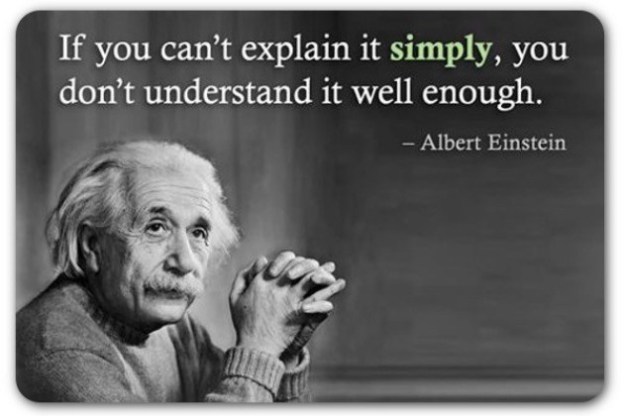
Albert Einstein quote

Call it combinatory play, combinatorial creativity, or intuition—we’ve all experienced that flash of insight, that fleeting moment when a solution we’ve been grinding away at reveals itself in an unexpected place. Playing violin helped Einstein theorize about time and space. What might be your Combinatory Play?

“Creativity is just connecting things.” – Steve Jobs

Steve+Jobs

Stuck in Traffic on the Neural Pathway to Nowhere

Understanding why Combinatory Play boosts creativity, means we should look at how the brain works.

The brain’s building blocks are neurons: nerve cells that receive and transmit signals along neural pathways. In Harvard professor of psychiatry John Ratey’s A User’s Guide to the Brain, certain pathways are forged at birth, like the ones that control your breathing and heartbeat. Others can be manipulated by learning. So when you’re stuck in a rut, your brain’s neurons could literally be stuck on a neural pathway you’ve carved out through your behavior.

The good news is you can get your brain unstuck by choosing to make new connections—forge a new neural pathway. Ratey explains, “A person who forcibly changes his behavior can break the deadlock by requiring neurons to change connections to enact the new behavior.”

If you’re frustrated by mental processes that lead nowhere, it’s kind of like your brain is taking the same old route to work every day because that’s what you’ve trained it to do. But if the highway is congested and you’re sitting in traffic, it’s up to you to tell your brain that there’s a new route it should take to get to where you want to go.

Comfort In Familiarity

Your brain is continually striving for order and predictability, and as a result, can get pretty set in its ways. While reverting to familiar paths can keep you safe and comfortable, it can also hinder your creativity. Therefore, it’s important to quiet this part of the brain if you want to invent new solutions. Combinatory Play can help you do this by relaxing your mind.

The Brain’s Inclination for Seeking Patterns Encourages Innovation

As clinical psychologist Victoria Stevens explains: “Our pattern-seeking behavior is an essential part of creative thinking, although it can also produce false assumptions and biases when previous experiences lead us to beliefs we do not question. In addition, finding links, connections, and patterns between apparently dissimilar things is essential to creative thinking.”

Your pattern-seeking behavior can benefit you in creative thinking. Just remember to:

  • Question your assumptions
  • Try to find patterns where it seems like none exist

Combinatory Play allows you to zoom out, see the bigger picture, and spot the patterns. This is especially true at times like this. Think and act creatively and responsibly, not out of fear or panic but out of rational, logical thought. The calmer we are, the better.

Continued in Part 2 . . .


Thanks to Amy Rigby in

Special Friday the 13th Edition: Rod Serling – In His Own Words.

The Man. The Mind. The Mentor.

The Dad. The Television Star.

The Host. The Creator.

Mr. Twilight Zone himself.

Night of the Meek

Christmas is more than barging up and down department store aisles and pushing people out of the way. Christmas is another thing finer than that. Richer, finer, truer, and it should come with patience and love, charity, compassion.

Somewhere between apathy and anarchy lies the thinking human being.

Violence does not spring from a vacuum. It’s born out of other men’s violence. It gets nurtured and it grows in a soil of prejudice and of hate and of bigotry.

Every writer is a frustrated actor who recites his lines in the hidden auditorium of his skull.

Serling-Judge him

A basic ‘must’ for every writer. A simple solitude– physical and mental.” ~ AS I KNEW HIM: My Dad Rod Serling

More than a man has died…More than a gallant young President has been put to death. What has been assassinated is a faith in ourselves. What has been murdered-a belief in our decency, our capacity to love, our sense of order and logic and civilized decorum.

Our greatest responsibility is not to be pencils of the past…

This is what I learned at Antioch-when something was wrong, I could get up on my own two feet and make comment on it… I think the idea of questioning is not only a right, it is a responsibility.

Serling-young

Remember that your salvation is in your capacity for human warmth–in that remarkable propensity for love.

I found that it was all right to have Martians saying things Democrats and Republicans could never say.

My dad said in a final interview, “I’d like to write something that my peers, my colleagues, my fellow writers would find a source of respect. I’d rather win a Writer’s Guild award than almost anything…

No moral, no message, no prophetic tract, just a simple statement of fact: for civilization to survive, the human race has to remain civilized. Tonight’s very small exercise in logic from the Twilight Zone.” –             The Shelter

Serling new pic

Rod left us way too soon. Not surprisingly, he is still today someone we look up to, someone we admire. From The Twilight Zone to the Night Gallery, he put his imagination on display for millions of fans.

As a writer myself, I’ve often wondered what kind of morbid, macabre mysteries would have come alive if Rod Serling and Edgar Allan Poe had lived in the same century. Deaths-Head Revisited, Murders in the Rue Morgue, The Monsters Are Due on Maple StreetAnnabel Lee, A Stop at Willoughby, The Fall of the House of Usher, Nightmare at 20,000 Feet and, of course, The Raven.

All that we see or seem is but a dream within a dream. Because this, you see, is the Twilight Zone. Quoth the raven, “Nevermore!”

Creativity in the Corporate Ivory Tower? Sheesh, surely you jest?!

This is not a whodunit, nor is it a Perry Mason murder mystery about the Case of the Kangaroo Court. What it is, however, is the Business Case for Creativity.

An excerpt from a review of the book itself reveals, “Debate in the advertising and marketing industries has raged for decades: does creativity make advertising more effective? Or is it just the folly of creative people looking to win their next award?

“The arguments of both advocates and cynics have until recently been based on conjecture and anecdotal evidence. James Hurman’s seminal creative effectiveness book The Case for Creativity brings the debate to a conclusion with three decades of international research into the link between creativity and business results.”

Tom Roach, BBH’s (Bartle-Bogle-Hegarty) effectiveness head, was asked by Thinkbox to present the business case for creativity at their spring event. Inspired by Thinkbox’s own  innovative slide desk, the presentation he gave brought together the best evidence for the value of creativity in marketing communications. Here are excerpts from that presentation along with my own take on the case for creativity.
Case for creaivity

Simply stated, without creativity one has nothing. The beautifully executed creative plan of an advertising campaign can not be overshadowed by something comprised of “just the facts.” The campaign must have charisma, its own personality, to be believable. However, being believable doesn’t necessarily mean playing it safe or conservative.

Take this attitude from Keith Wood of Unilever in his Forward of the book:

Forward-Case for Creativity

That may be the case but the industry still has a ways to go and many more folks need to know. While this may be true, can we say there is a crisis in creativity? If so, how so and what is it?

First, let’s take a step or two back and ask: “What do we mean by creative?”

Well, there’s this . . .

Novel . . .

And this . . .

Good ideas . . .

And this somewhat in-your-face guideline . . .

Make it different . . .

Okay, all good and fruitful definitions and clarifications of what creativity is or entails. As with several key issues in the business world, creativity is complicated, especially when the problem is multifaceted and everyone on the marketing committee has a different viewpoint.

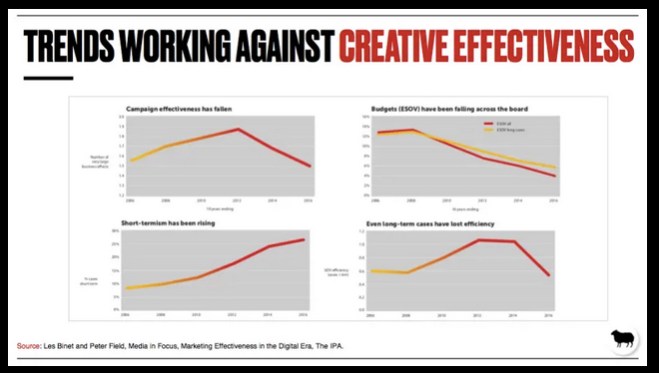
But, is there a crisis in creativity? Well, let’s see.

Trends Wrkg Against

Campaign effectiveness has fallen (UL), Budgets have been falling (UR), Short-termination has been rising (LL), Long-term cases have lost efficiency (LR)

Ad Blocking

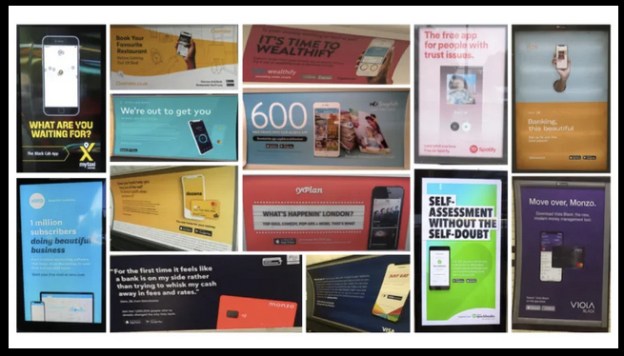
Hmmmmm, looking kinda murky, isn’t it? Let’s consider this :

Rising Sea


Smart Phones

Autos

Ah, yes, nothing like differentiation in car ads!


Case for creaivity


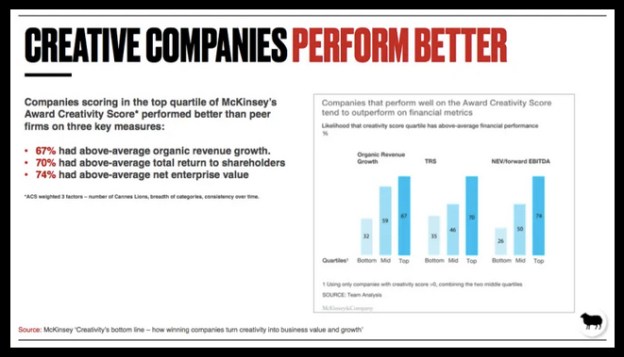
Creative Companies

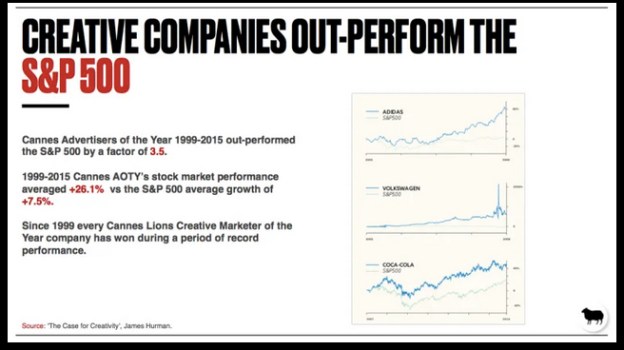
S&P 500

Disruption

Creative Execution

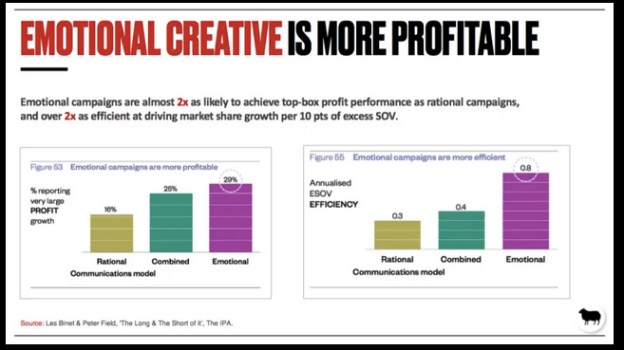
Emotional

Ad Slogans

While the above slides are true, I vote for more thoughtfulness and less cutesyness. In some advertising, the ad could have the audio muted (saying what the ad is about) with just the video or image shown, and most folks wouldn’t be able to tell what product is being promoted. Let’s face it, cars and cologne can be interchangeable. And, I guess, trucks are destined to be driven only in the “out-in-the-middle-of-nowhere” scenarios.

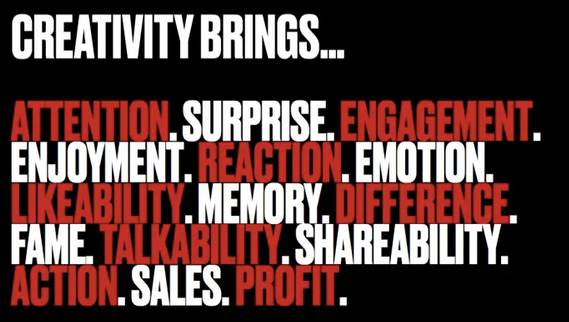
Creativity Brings

I’d like to add at least one more: Intangibles. Sometimes you just don’t know what makes a good ad good. It just works.


Our Objective

I definitely agree with this last poster. Effectiveness is key to creative execution. Smart creativity is a must. Play to one’s audience still applies but do so without insulting their intelligence. I’ll go out on a limb and say that, generally speaking, a twenty-something copywriter has little to no understanding of how best to relate to the “senior plus” set, unless he can relate to his grandparents.

Case for Creativity Book

If you want to view a more in-depth portrayal of this presentation, see the Business Case for Creativity. It’s not your ordinary slide deck. Neither is the book on which the presentation is based.

Meow Wolf’s Art World Raises Millions Highlighting Creative Economy’s Potential. Houston, take note! (Part 1)

Meow who? Wolf, Meow Wolf. Based in Santa Fe, New Mexico, Meow Wolf is an arts and entertainment group that is attracting audiences of all ages in its immersive art world.

Meow Wolf is comprised of over 400 employees creating and supporting art across a variety of media, including architecture, sculpture, painting, photography, video production, cross-reality (AR/VR/MR), music, audio engineering, narrative writing, costuming, performance, and more!

Meow Wolf creates immersive and interactive experiences that transport audiences of all ages into fantastic realms of story and exploration. This includes art installations, video and music production, and extended reality content.


Their first permanent installation, the THEA Award-winning House of Eternal Return, (HOER) launched in March 2016 with support from Game of Thrones creator, George R.R. Martin. Inside, guests discover a multidimensional mystery house with secret passages, portals to magical worlds, and an expansive narrative amidst surreal, maximalist, and mesmerizing art exhibits. Located in Santa Fe, HOER features a children’s learning center, a cafe and bar, and a music venue.

ImpactAlpha called this choose-your-own adventure, art installation, “one of the most successful examples of the creative economy.”

Meow Wolf champions otherness, weirdness, challenging norms, radical inclusion, and the power of creativity to change the world. Houston, are you listening?

Meow Wolf House of Eternal Return

Legally registered as a public benefit corporation and certified as a Benefit Corporation, or B Corp, Meow Wolf values investing in their creative team, giving back to their community, and doing their part to better the environment.

Through ticket, gift shop, food and beverage sales, and events, Meow Wolf is pulling in more than $1 million a month in revenues. George R. Martin, author of the novels adapted for HBO’s Game of Thrones series, is Meow Wolf’s landlord in Santa Fe. He’s also an investor and creative advisor to the firm.

This company, according to ImpactAlpha, emphasizes the potential of the creative economy. “This does not mean impact capital is not flowing to the creative economy—it is just not doing so on purpose,” Laura Callanan of Upstart CoLab told ImpactAlpha.

Meow Wolf firmly believes that accomplished artists must be compensated on an equal level with other skilled, in-demand professionals. Successful businesses must give back to — and participate energetically in — their communities.

Wolf provides financial assistance, expertise, and other forms of active support, and is excited to support innovative, community-focused art and social projects.

Meow Wolf’s path echoes what last year, in the Stanford Social Innovation Review, Callanan wrote: “When creative people pursue businesses that have a social purpose, they can have a catalytic impact on job creation, the economy, and social well-being.”

Asset 1

Meow Wolf’s jaw-dropping 10 year journey of an anarchic art collective has grown into a multi-million dollar business. According to their web site, Wolf grew from having no access to blowing a new, profitable portal into the art world.

This tumultuous journey has yielded new ways of participating in culture and entertainment for not only these artists, but for the people from all walks of life who engage in and are inspired by their work. With a mission to provide access to and inspire creativity in everyone, Meow Wolf continues to experience growing pains, while continuing to reach for new impossibles.

Does Houston have anything like this? While Houston is considerably larger than Santa Fe, the expansive geography lends itself to challenges for cultivating a strong and viable creative economy. Sure there are the museums, NASA, Space Center Houston as well as several start-ups in and around the Texas Medical Center serving as a harbinger of creativity and innovation.

Houston logo

But is that enough? One might argue that it is not.

Houston doesn’t seem to have a “meow wolf” instigator-like venue or organization to stimulate its own creative economy. Not that the city hasn’t tried. The Houston Arts Alliance, Greater Houston Partnership, Only in Houston/OiH Creatives, American Advertising Federation Houston are but a few of select organizations who have tried, and are still doing so, to pull together what it takes to stimulate the region’s creative economy.

As Meow Wolf would tell anyone or any city, this takes continuous effort and a belief that what one is doing is worth it for everyone. That remains a challenge for Houston, and one it must overcome.


Handwritten OOH Boards Deal Delicate Subject Gut Punch. Kudos!!

In most circles, any discussion of mental health is still taboo. On this side of the “pond” we often pretend mental health is something other than what it really is, a disease, which can and should be treated.

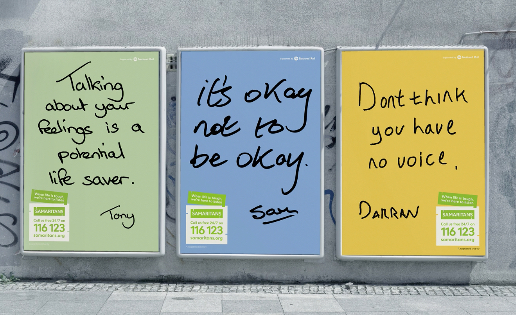
In the UK, mental health is being put to the forefront by some interesting outdoor boards.   The campaign is for Samaritan, a charity who tackles mental health and its challenges.

Featured in Ad Age, the campaign by Mother London directly takes on mental health by asking actual men, not actors, to share their stories and opinions. A unique approach the campaign uses is to feature handwritten words of advice from real-life men who have previously contacted the Samaritans feeling depressed or suicidal.
Running at locations like train stations, the boards are aimed at men when they are most susceptible, when they may be considering hurting themselves or pondering suicide. The campaign also includes social media ads.
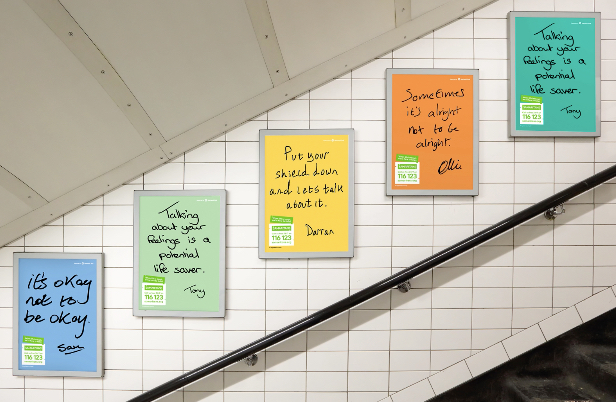
Mental Health Billboards in UK

According to AdAge’s reporting, the campaign comes as Samaritans releases results of a nationwide survey, which shows two in five (41%) men in England, Scotland and Wales aged 20-59 do not seek support when they need it because they prefer to solve their own problems.

Paul McDonald, executive director of external affairs at Samaritans, says: “We didn’t want to create just another awareness campaign. So we asked men to share their stories with us. Men who have been through tough times and come through the other side.

“They wrote some words down, and we’ve got those words on the posters to inspire and encourage other men going through difficult times to seek help, and to contact Samaritans if they’re ready to talk.”

Being in the U.S., I can’t help but wonder what kind of effect this sort of campaign would have on men here in the states. My guess is that results would echo the UK’s results if not prove more so. Most men like to solve our own problems or not even admit we have one.

Kudos to the Brits for trying to face this problem head on. Again, creativity in this case is best showcased rather simply but directly.

More OOH Mental Board

So what, dear readers, do you think of this campaign? Think it will work. Think it will do what it’s designed to do?

Let me know your thoughts. I’d love to hear your comments!

Quotes . . .Quotes . . .Quotes. And then some!

Greetings and good day to ‘ya! Here’s your respite into the world of famous and sometimes infamous quotes from a variety of personalities. Any one of these could prove motivation for that ad you’re working on, tweak your imagination, inspire you or just plain bring a smile to your face.

Feel free to share.

It’s the start of the week. Have some fun. NOW!

Enjoy!!

smartquote-top The most common trouble with advertising is that it tries too hard to impress people. —James Randolph Adams, member, Advertising Hall of Fame

Advertising did not invent the products or services which called forth jobs, nor inspire the pioneering courage that built factories and machinery to produce them. What advertising did was to stimulate ambition and desire – the craving to process, which is the strongest incentive to produce.– Bruce Barton, member, Advertising Hall of Fame

We would accomplish many more things if we did not think of them as impossible.  Vince Lombardi

Advertising is what you do when you can’t go see somebody. That’s all it is. — Fairfax Cone, member, Advertising Hall of Fame

In writing advertising it must always be kept in mind that the customer often knows more about the goods than the advertising writers because they have had experience in buying them, and any seeming deception in a statement is costly, not only in the expense of the advertising but in the detrimental effect produced upon the customer, who believes she has been misled. — John Wanamaker, member, Advertising Hall of Fame

Creativity varies inversely with the number of cooks involved in the broth. — Bernice Fitz-Gibbon, member, Advertising Hall of Fame

There is no such thing as ‘soft sell’ and ‘hard sell.’ There is only ‘smart sell’ and ‘stupid sell.’ —Charles H. Brower, member, Advertising Hall of Fame

When a distinguished but elderly scientist states that something is possible, he is almost certainly right. When he states that something is impossible, he is very probably wrong. – Arthur C. Clarke

Millions saw the apple fall, but Newton was the one who asked why.       – Bernard Baruch

They who dream by day are cognizant of many things which escape those who dream only by night. – Edgar Allan Poe smartquote-bottom


Extraordinary Creativity. Dynamic Images, strikingly different. 100 Years Apart.

What do you get when you pair an egotistical, genius architect from the early 20th Century with a young Canadian-born illustrator producing incredibly creative work?

Oh, and throw in 100 years difference between the two.

What do they have in common? Extraordinary talent.                                 Extraordinary images.

One was a visionary; the other expresses her visions colorfully. He showed bold and dramatic executions; so does she. He was extremely creative and imaginative. Her: Ditto. That’s what this blog is all about: Various and different perspectives on creativity.

In reading articles recently on re-imaging, I was reunited with the subject of a paper I’d written years ago. This article took a different perspective. About the same time, I was introduced to a new subject of creativity in an article on illustration.

The subjects: Very different and very dynamic.

The subject I wrote about years ago was the infamous and egotistical architect, Frank Lloyd Wright. I was intrigued by his designs and his persona. His works were that of genius. My aunt, being an interior designer, was quite familiar with Mr. Wright, especially after seeing him in Chicago during the fifties. This heightened my interest and pushed me to write the paper.

frank-lloyd-wright_1

Courtesy PPG Paint Color Collection: Frank Lloyd Wright™

Since this blog centers around creativity and innovation, let alone imagination, I thought it appropriate to publish some of Wrights work with an intriguing take on some of his designs that were never built. They’ve been reimagined here in the 21st Century. Keep in mind, dear audience, that Wright flourished during the early 20th Century. He died in 1959. His last project, in Phoenix, was recently put on the market for $2.7M.

Spanish architect, David Romero, has created photorealistic computer renderings of unbuilt or demolished Wright buildings. Admittedly, as I was first reading about his process and looking at the photos, the settings seemed surreal.

Wright-car showcase-davidromero

Wright’s Roy Wetmore Car Repair and Showroom was to have been built in Detroit, Michigan. Credit: David Romero

Romero also painstakingly researched the context and location of the building, including adding era-appropriate cars, traces of rain and dirt on the building, and other details in order to bring the project to life. As a result, at times it can be hard to tell these are illustrations rather than stylized photographs.

gordonstrong-davidromero

Intended to stand atop Sugarloaf Mountain in Maryland’s Blue Ridge Mountains, the plan for the Gordon Strong Automobile Objective commissioned in 1924 called for a planetarium and restaurant to accompany a scenic overlook. Its developer, wealthy Chicago businessman Gordon Strong, envisioned it as a destination where families would drive for the day from Baltimore and Washington, D.C. Credit: David Romero

Take a trip back to yesteryear and see for yourself various Wright projects either demolished or even never built.

Larkin-Administration-Building-01

Larkin-Administration-Building-inside


The Larkin Administration Building (left) and inside the building (right) made design statements all throughout. However, the building does not exist any longer. Wright’s Larkin Building in Buffalo, New York—his first office building—was built in 1903 and demolished in 1950.

According to Romero, after gobs of research and learning, they had to be works that did not exist, either because they disappeared or because they never came to be built. The reason is simple: 3D rendering tools serve precisely for this, to show what does not exist.

Describing his process of recreation, Romero explains: “I start the model in Autocad, then I export it to 3ds Max + Vray where I add textures, lights and cameras, as well as vegetation and the environment. Finally there is some retouching in Adobe Photoshop, although very light.”

Creativity of today depicting creativity of a bygone era. Fascinating!

~~~~~~~~~~~~~~~~~~~~~~~~~~~~

From the early 20th Century to present day we go. I find that creativity is not age based. What’s creative and imaginative is creative and imaginative, regardless of when created.

Take the young Canadian illustrator, Lynn Scurfield. She has positioned her career path thusly: “I wanted to be an animator until I saw artist Alphonse Mucha’s work in high school. I knew that I had to do what he did! Drawing insanely beautiful images and then having them used in different commercial ways was mind blowing.”

Lynn-Slf_Portrait2020

I was taken with this illustration of a smoke monster-type creature (any Lost fans out there?) apparently poised to eat a woman who is just leaving this house, oblivious to her impending danger.

Scurfield Illust

“Hello! I’m an illustrator living in a sleepy town just outside of Toronto, Ontario. My work is defined by crazy colours and textures with strong emotional qualities.”  For Marzena Czarnecka’s article ‘Unsafe at Home, Lost in the System,’ for city lifestyle magazine Avenue Calgary.

She describes her approach as . . . “My art style, which utilizes a mix of media, really confuses people because they never know how much of my work is done traditionally versus digitally. People are also intrigued by how emotional my work can feel. I’m usually hired to create images about emotionally difficult topics, like death, mental health and separation. The fact that I’m being hired to make illustrations that emotionally connect with a general audience is special and amazing.”

. . . and her philosophy as . . . “Don’t overthink your work. When I was in school, I was always worried if my work was good enough, if it was cool enough, if I was a two-bit artist. Since I’ve started working in the industry, I’ve realized that thoughts like these aren’t healthy, and they don’t make you a better artist. I like my work more now that I care less about what people think. As long as my clients are happy with the final results, I’m happy!”

Walrus-Lynn

“For Erin MacNair’s short story ‘Thin Crust,’ for general interest magazine The Walrus.”

Interestingly, both Wright and Scurfield, though a century apart, expressed their work in striking and dramatic ways while emitting strong, emotional qualities. Imagination is at the heart of creativity and the images exhibited by these two talents stirs that imagination.

Born of different generations, one has left his indelible mark in the world of architecture while the other continues to illustrate hers. Take heed; the rest of us can learn something. Creativity and imagination are not constrained by time and space, and to a lesser degree, neither are we. Think about it!

Fun, Frivolous, Famous, and Fearless Quotes . . . Food for your Soul!!

red-quotation-marks-vector-online-royalty-free-picture-435958Here we are again, searching through the online Quote Bag. Some of the gems I found are listed below.

Your respite into the world of famous and sometimes infamous quotes from a variety of personalities. Any one of these could prove motivation for that ad you’re working on, tweak your imagination, inspire you or just plain bring a smile to your face.


Charles Kettering Quote

I am looking for a lot of men who have an infinite capacity to not know what can’t be done.” – Henry Ford

My stories run up and bite me on the leg. I respond by writing down everything that goes on during the bite.” — Ray Bradbury, the author of Twilight Zone’s 100th episode!

Ray Bradbury Title Card

From someone on Twitter:
It was the great Ray Bradbury, whom I interviewed as a young reporter and aspiring novelist going in five different directions at once and totally befuddled.  His simple advice to me:  “Write what you love to read.”

Rod Serling Quote


Mark Twain Quote


It is the supreme art of the teacher to awaken joy in creative expression and knowledge.”   – Albert Einstein

There have been three writers that most suit me: Rod Serling, Clifford Odets and Neil Simon. With Neil it was the humor and the rhythms. Odets, the staccato. But with Rod Serling, it was the anger, the defiance and fire. He brought such fire to everything he wrote.” — Jack Klugman

No knowledge of what went before. No understanding of what is now. No knowledge of what will be.  #ZoneQuotes #S3E14  “Five Characters in Search of an Exit” by Rod Serling

Creativity requires the courage to let go of certainties.” – Erich Frommred-quotation-marks-vector-online-royalty-free-picture-435958


Which ones ring true for you? Inspire you? Make you want to scratch your head and say “Huh?” Let me know in the comments.