Copywriters’ Virtual Summit 2020

The American Writers and Artists Institute (AWAI) sends me email frequently. When I read one about a virtual summit for copywriters, I was intrigued. It was free, so I signed up. Fortunately, in registering for this free webinar, I could listen to the four+ hours of its content both live and at my leisure.

Addressing those writers out there, I think this will be well worth your time. Some of the highlights are outlined below as to what you can expect to gain as well as the current version of pricing for various writing projects. So grab a comfy chair, sit back and take a listen. Don’t forget to download the pricing guide for later reference.

10 bits of what you’ll discover….

  • How to deliver the quicker “on demand” content customers want…
  • What Google really wants when it comes to content (and why you can’t fool it…)
  • How to make your blog stand out among over the more than 1 billion blogs on the Internet…
  • Why content curation is hot – and the first step to becoming an in-demand master curator and influencer…
  • The subtle distinctions between regular copywriting and UX copywriting and why it will set you apart as a copywriter…
  • The basic formula from writing successful “chatbot” copy that feels human and why every copywriter will need to learn it…
  • The three types of newsletters you should be pitching to virtually every client you have…
  • The future of long-form video and why tomorrow’s copywriters in some niches will need to learn “Hollywood” scriptwriting and storytelling techniques…
  • Why email is “cool” again — and how copywriters can use email to generate the most sales on a word-for-word basis…
  • COPYWRITERS AND COVID-19!


AWAI Virtual Summit

Beginning with a 10,000-foot view of the copywriting industry as it stands today, AWAI’s 2020 State of the Industry Report and Copywriting Pricing Guide offers a deep dive into the immediate “state” of direct response and the copywriting needs of the market.

AWAI 2020 PriceGuide

It starts with the must-read overview “7 Marketing Trends and Predictions for Staying Connected to Your Customers” – where today it’s all about audience focused engagement through video, content, mobile, personalization, search engine “micro moments” and more.

Plus:

  • What’s working best today when it comes to copywriting messaging…
  • The most effective platforms B2B buyers use when making a purchase decision…
  • The most effective copywriting platforms for attracting new customers
  • Marketing channels businesses perceive as most effective…
  • “Going rates” for over 75 copywriting projects – everything from sales letters to PPC campaigns to press releases to e-letters and more.
  • How todays royalties and retainer deals are structured…
  • How to find and recognize a skilled copywriter (if you’re a marketer) and how to know what marketers are looking for (if you’re a copywriter…)
  • How to plan and organize a copywriting project – from what to ask for as a writer, to what to be willing to supply as a marketer…
  • How to provide extraordinary value to your client as a copywriter – and earn more and higher fees in the process…


Your comments and feedback would be welcome as I’m interested to learn what you think or thought of this program and how it’s presented. Don’t be bashful, now!


Ad Speaks Houston: A Podcast

How does one get the inside track on anything? Well, you talk or listen to someone who is on the inside, who knows what’s going on. That’s just what we have in the advertising community here in Houston.

The American Advertising Federation-Houston (AAFH) hosts a regular podcast on everything advertising right here in Houston. But the topics don’t stop with the geography; topics know no boundaries.

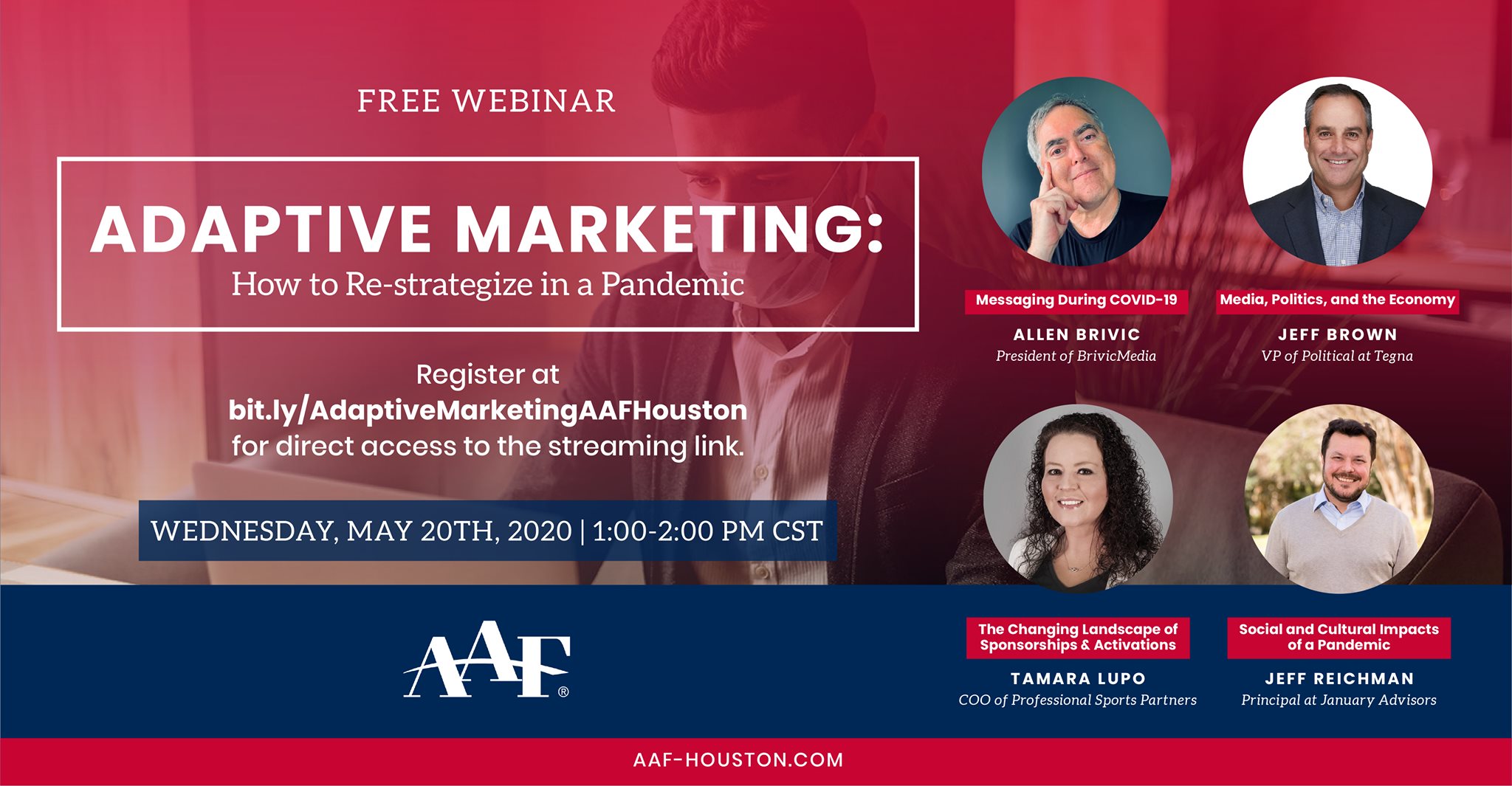
The people who guest-speak on the podcast can come from a variety of backgrounds and expertise, but they all are usually focused on what the AAFH is doing and how it relates back to advertising in the Houston community.

I’m speaking, of course, about Ad Speaks Houston, the podcast brought to you by the AAFH. If you’re into advertising at all, interested in what Houston’s ad scene is all about these days, wanting to stay current with the ever-changing ad world, well, tune in and subscribe to Ad Speaks Houston.

Ad Speaks Houston airs on KPRC 950 AM from 10 am to 11 am on Sundays. You can tune in to the podcast anytime from anywhere.

Who knows, you could be their next guest-speaker.

It’ll be fun, you’ll see! Click on the logo below and enjoy!


Ad Speaks Houston Logo


What’s the Future of Television? View the Webinar Below to Find Out.

In a previous post, we learned about the future of advertising, which is still unfolding. This post deals with the future of TV, which is definitely still unfolding and evolving. Long gone are the days when we would settle in our easy chair to watch the national news at 5:30, then continue on at 6 for one’s local news.

Today, everything seems to be easy on, instantaneous.

So much so that we find ourselves in an unprecedented time where consumers around the globe are turning to TV and internet entertainment as they adjust to world events. View the webinar below as Innovid CTO Tal Chalozin walks through today’s ever-changing TV consumer trends, what they mean for advertisers, and what brands can expect in the immediate future.

You’ll learn:

What the data reveals about viewer impressions and device usage across key markets,

How advertisers are adapting their campaigns,

Best practices for strategy adjustment planning,

Predictions for what’s to come.


Future of TV


When Sending A Hallmark Card Just Won’t Do.

AdWeek Special Report: 6 Tips to Help Creativity and Quarantine Co-Exist


In times like these I find it particularly important to share news and helpful information wherever and whenever I come across it. Such is the case with this blog post. Thanks to Adweek and its contributor, Sara Spary for the article on which this blog is based.

In the creative world, we’re used to people getting together, face-to-face, to collaborate and exchange ideas, to, well, create that next great ad or TV commercial. So what does one do when quarantine is the order of the day for just about all the known universe?

Demands for making the abnormal as close to normal abound from clients and prospective ones. Business as usual it’s not. So, how is this all working out thus far?

The trade publication Adweek asked veteran creatives around the world to “share their experiences and advice on how to keep the creative juices flowing from home”—even when COVID-19 is knocking on the front door.

Think Face-to-Face

Since you’re already used to doing this, why stop now?

“We’ve made it a point to keep interactions face-to-face whenever possible. Every meeting, regroup, catch-up, brainstorm session—no matter how big or small—is done through Google Hangouts,” said Ryan Engelbert, creative director at We Are Social New York. “It’s forced us to be even more focused on each other and more accountable for the information and ideas that are being exchanged.”

This feels weird, not to mention a bit awkward

Engelbert’s creative partner and fellow creative director Casey De Pont recommends creatives embrace the occasional awkwardness that comes with video calls, since you never know where such moments may lead.

“Video chat still feels awkward to us as humans,” Du Pont said. “There’s a lot of pressure for maximum productivity and zero wasted time when you’re digitally staring each other down, but creative development doesn’t work that way.”

Not everybody may be used to video chat but not everybody is used to uninterrupted speech in a live conference room meeting either. Goof ups and unintended pauses work the same as if you were humanly in the same room with one another.

“You need the awkward pauses and the space between ideas to let things breathe and develop. The more we can be real people in the virtual space, the more comfortable we’ll become working there,” she said.

Be a Space Cadet

Spending time alone in quarantine gives you the time to quietly explore ideas and concepts without any critics jumping down your throat. You’ve got plenty of space to think out loud if you want.

Droga5 copywriter Gabe Santana like it this way. “I think the best part about working from home is that I can lie down on the floor and say bad ideas out loud without bothering anyone,” Santana said. “Except Germany, of course.”

That would be Germany Lancaster, Droga5 art director, Santana’s creative partner and self-proclaimed homebody. Lancaster prefers to brainstorm alone and mull it all down to a few good concepts “before meshing ideas” with Santana.

“Once I’ve got a couple ideas down, I like to either present them to my partner in a deck or chat through them in hopes that they springboard into something grand. Chatting through ideas always leads to lots of laughs, so that’s definitely a bonus,” Lancaster said.

Establish a Stronger Relationship

Working remotely can really strengthen that and those relationship(s).

For Ludovic Miege, copywriter at Havas Paris, working remotely hasn’t been too much of a problem so far because he and his creative partner, art director Jordan Molina, have worked together for six years.

“For us, working like this is not very complicated because we know how to work together and do not need to see each other to work,” he said. “We can call each other all day long using Facebook, Whatsapp, Gmail, Zoom. We have many ways to communicate and exchange our ideas.

“Because of our long relationship, we know how the other one understands things. You are more efficient when your partnership is strong.”

Have a Flexible Routine

Working remotely can feel odd and awkward to those not used to doing it. Don’t overdo the video conferences and calls just to prove something. Remember, too many conference calls can lead to less time for thinking.

But Madrid-based Javier Campopiano, who recently joined Grey as chief creative officer of Grey Europe and Global, warns this will only lead to burnout. He says keeping structure in your day is important.

“Right now, I try to keep a routine. My kids are not going to school so we don’t need to wake up as usual, but we’re trying to keep the same schedule. I try to exercise on the balcony, because I can’t go for a run—we can get a fine—so I exercise and then shower,” he told Adweek. “I dress up to work, maybe less formally than I usually do, and I sit in front of my computer in my little office here at home.”

So you work in your pajamas. So what?

Depending on what kind of routine one is used to doing, spending the day in your PJ’s may feel very normal. If not, that’s okay, too.

Mariana Albuquerque, a creative copywriter working in Ireland suggests “the main challenge is not being distracted by other people—or animals—in your home, and understanding the time to start working and finishing it,” she said. “Since I’ve been working from home for a week, I’ve created a routine for myself. I do wear comfy PJs, though. It doesn’t make me feel lazy at all. But I do comb my hair in case of a video call.”

Her creative partner and art director, Carina Caye Branco, urges the most important thing of all is open communication.

“Communication is key, and trying to organize our day and tasks. Be online all the time, or at least tell your partner if you need to go offline and how long,” she said. “And keep a record of everything you’re thinking/doing. [That has] been proving really helpful for us.”

Sara Spary is a freelance journalist based in London. She’s been a reporter for eight years, covering advertising and consumer brands.

Future of Advertising

What of advertising? What of normalcy?

What of Coronavirus? What of sanity?

What of the future? The simple truth is, we don’t know.

Yet.

Though we can’t predict the future, we can wager a pretty good guess at times as to how we think all will turn out. However, everything is so up in the air right now. No one really knows what’s going to happen with this Coronavirus and the lives it has touched, plus those it hasn’t reached yet. I came upon this publication covering a variety of topics relative to advertising and its perceived future.

Regardless of the impact of COVID-19, vast changes in the way we do things are inevitable. Touching on several areas of marketing and creativity are key players in the global scene sharing their perspective on advertising and the ways we deliver the message to the consumer. Here are a couple of highlights.

Ads, Authenticity and Action

“Marketing is in a perpetual state of disruption . . . but the best way to deal with disruption is to lead it,” so says Marc Pritchard, Chief Brand Officer, Proctor & Gamble. It’s “constructive disruption” he’s looking for: “There have been many disruptions that have destroyed value but the hardest task is to disrupt in a way that creates value for the consumers we serve.”

As it relates to marketing, he adds “(we want to create campaigns) more superior, more useful and more interesting to the point where people actually look forward to seeing ads.” He continues “The way we’re focused on doing that is by merging the ad world with other creative worlds, with music, comedy, sports and entertainment. So, we can continue to convey the superiority of our brands. But done in a way that is really engaging.”

The Campaign for Creativity

Philip Thomas, chairman Cannes Lions International Festival of Creativity, “believes creativity is essential for business growth, industry and societal change and as a driving force for good.”

“The businesses we work with tell us that embedding creativity requires the right conditions and culture to drive long-term, sustainable growth and impactful brand building.

“For brands and businesses to remain relevant and future-fit, they must continually reinvent.

“In recent years, we’ve seen an emerging trend in creative work driven by purpose. And on Festival stages we have seen brand activism, social justice and diversity lead the discourse. There’s been a recognized shift in the move from purpose and activism to accountability, and of course action.

“With the combination of global reach and power of brands, as well as the expertise of organizations like the UN, and the unbounded creativity of the advertising and marketing community, change for good is truly possible.”

There is no one single “conclusion” or summary statement relegated to the future of advertising. That’s because its state is comprised of various amounts of integral data, cultures, points in time and marketing techniques. It’s complicated and it will change.

The publication Raconteur lays it out nicely and is an interesting read.

Enjoy!


Future of Advertising Cover

Creating Together in a Post-Coronavirus World

We’re still right in the thick of this mess, the Coronavirus pandemic, and with no signs of it letting up. In fact, it’s just the opposite; more cases are reported daily, around the globe. Just about a week ago a little less than 200,000 people globally had been infected while over 7,500 people have died.

In order to try and stop the spread of the virus, the globe’s inhabitants are retreating inward, at least most of them. “Stay home, stay healthy” seems to be the motto of the day. If ET were to re-visit Earth right now, he’s probably wonder, “Where did everybody go?”

Businesses are shutting down and boarding up, as if they’re dealing with some big storm surge. Eating places are delivery or take-out only, if they’re even open. Schools are closing until further notice and most modes of transportation have ground to a halt or have severely curtailed their routes. Grocery stores have become almost barren, especially the paper goods and beverage aisles.

Most everyone is self-quarantining. Very few people are on the roads unless they just have to be.

Yet, the virus persists and is spreading. Damn!

TogetherWeCreate

Image source: Unsplash.

Writing from Johannesburg, South Africa, Rohan Reddy says, “Our hands have never been cleaner, human contact is being frowned upon, people are getting sick or dying. We don’t care much about advertising or design anymore; mortality is our reality, we care about surviving.

The executive creative director for the McCann Africa network continues, “When 2020 comes to an end, the world we live in will probably look very different from the one we said goodbye to in 2019. And it is impossible to predict what this new world will look like.”

I agree with him. The world is in uncharted waters with this virus. We’re doing good to react, let alone react in some timely manner. Forget about planning and acting on the plan. This stage is in its infancy, though it is forging ahead.

making more masks

Some corners of the world are doing better than others; Italy seems to have their act together while the U.S. is falling behind and will be doing good to “fight a good fight.”

Reddy again, “Creativity will save the world. People will look to our poets, our artists, our musicians, our dancers, our inventors, our architects, our engineers, our writers and designers to redefine humanity’s purpose post-Covid-19. Businesses will look to their advertising agencies and design studios to redefine how we consume everything from food to fashion to travel.

“Because, at the end of 2020, it will not be business as usual. It will be something completely different. We will spend our money differently, we will save our money differently and we will probably make our money differently too.”

buildingnewhospitalinWuhan

We won’t have to wait until the end of this year for business and living habits to become different. That is happening right now. Our lifestyles and business practices are changing, out of necessity, right before our eyes. We will be “ever-adapting” continuously through the rest of this year and into the near future.

Creativity will play a vital role in how we think, solve problems and present solutions. Creativity won’t be the exclusive territory of advertising. Hopefully, creative thinking and development will be in hyper-drive so that society can be the benefactor.

I think most intelligent people will adopt a much more sincere form of togetherness, a true multi-partisanship. We, as a society, really have no choice. We have to create through togetherness since our survival depends on it.

Past actions of stupidity and greed will be looked upon incredulously. There will be no room for them in our future. Disease, like this COVID-19 doesn’t discriminate when it comes to these fallacies; it also doesn’t play politics.

italy on lockdown

No matter how long it takes to save ourselves from this pandemic, creativity will and must play a part. That’s creativity in all forms, not just in the creative arts.

Together we need to rebuild into a better, much more aware future. The creative minds among us have a responsibility to craft a sound and viable and livable future for our society.

I agree with Mr. Reddy. As a creative, I can’t do this on my own. I can, however, do it together in forming a creative front to help lead us in progressing forward. We owe it to ourselves, our children, their children, as well as the planet.

Let us create together!

Quotes on Advertising & Creativity

Greetings and good day to ‘ya! Here’s your respite into the world of famous and sometimes infamous quotes from a variety of personalities. Any one of these could prove motivation for that ad you’re working on, tweak your imagination, inspire you or just plain bring a smile to your face.

Feel free to share.

red-quotation-marks-vector-online-royalty-free-picture-435958

Nobody has ever built a brand by imitating somebody else’s advertising.
David Ogilvy, member, Advertising Hall of Fame

In the advertising business, a good idea can inspire a great commercial. But a good insight can fuel a thousand ideas, a thousand commercials. Phil Dusenberry, member, Advertising Hall of Fame

Our job is to simplify, to tear away the unrelated, to pluck out the weeds that are smothering the product message. William Bernbach, member, Advertising Hall of Fame

You can’t use up creativity. The more you use, the more you have.       Maya Angelou

The heart of creativity is discipline. William Bernbach, member, Advertising Hall of Fame

If you are writing about baloney, don’t try to make it Cornish hen because that is the worst kind of baloney there is. Just make it darned good baloney. Leo Burnett, member, Advertising Hall of Fame

Fun without sell gets nowhere, but sell without fun tends to become obnoxious. Leo Burnett, member, Advertising Hall of Fame

Yes, I sell people things they don’t need. I can’t, however, sell them something they don’t want. Even with advertising. Even if I were of a mind to. John E. O’Toole, member, Advertising Hall of Fame

Big ideas are so hard to recognize, so fragile, so easy to kill. Don’t forget that, all of you who don’t have them. John Elliott, Jr., member, Advertising Hall of Famered-quotation-marks-vector-online-royalty-free-picture-435958

There is no material with which human beings work which has so much potential energy as words. Ernest Elmo Calkins, member, Advertising Hall of Fame


Now, paraphrasing Seth Godin, Go Raise A Ruckus!

Creativity in the Corporate Ivory Tower? Sheesh, surely you jest?!

This is not a whodunit, nor is it a Perry Mason murder mystery about the Case of the Kangaroo Court. What it is, however, is the Business Case for Creativity.

An excerpt from a review of the book itself reveals, “Debate in the advertising and marketing industries has raged for decades: does creativity make advertising more effective? Or is it just the folly of creative people looking to win their next award?

“The arguments of both advocates and cynics have until recently been based on conjecture and anecdotal evidence. James Hurman’s seminal creative effectiveness book The Case for Creativity brings the debate to a conclusion with three decades of international research into the link between creativity and business results.”

Tom Roach, BBH’s (Bartle-Bogle-Hegarty) effectiveness head, was asked by Thinkbox to present the business case for creativity at their spring event. Inspired by Thinkbox’s own  innovative slide desk, the presentation he gave brought together the best evidence for the value of creativity in marketing communications. Here are excerpts from that presentation along with my own take on the case for creativity.

Case for creaivity

Simply stated, without creativity one has nothing. The beautifully executed creative plan of an advertising campaign can not be overshadowed by something comprised of “just the facts.” The campaign must have charisma, its own personality, to be believable. However, being believable doesn’t necessarily mean playing it safe or conservative.

Take this attitude from Keith Wood of Unilever in his Forward of the book:

Forward-Case for Creativity

That may be the case but the industry still has a ways to go and many more folks need to know. While this may be true, can we say there is a crisis in creativity? If so, how so and what is it?

First, let’s take a step or two back and ask: “What do we mean by creative?”

Well, there’s this . . .

Novel . . .

And this . . .

Good ideas . . .

And this somewhat in-your-face guideline . . .

Make it different . . .

Okay, all good and fruitful definitions and clarifications of what creativity is or entails. As with several key issues in the business world, creativity is complicated, especially when the problem is multifaceted and everyone on the marketing committee has a different viewpoint.

But, is there a crisis in creativity? Well, let’s see.

Trends Wrkg Against

Campaign effectiveness has fallen (UL), Budgets have been falling (UR), Short-termination has been rising (LL), Long-term cases have lost efficiency (LR)

Ad Blocking

Hmmmmm, looking kinda murky, isn’t it? Let’s consider this :

Rising Sea


Smart Phones

Autos

Ah, yes, nothing like differentiation in car ads!


Case for creaivity


Creative Companies

S&P 500

Disruption

Creative Execution

Emotional

Ad Slogans

While the above slides are true, I vote for more thoughtfulness and less cutesyness. In some advertising, the ad could have the audio muted (saying what the ad is about) with just the video or image shown, and most folks wouldn’t be able to tell what product is being promoted. Let’s face it, cars and cologne can be interchangeable. And, I guess, trucks are destined to be driven only in the “out-in-the-middle-of-nowhere” scenarios.

Creativity Brings

I’d like to add at least one more: Intangibles. Sometimes you just don’t know what makes a good ad good. It just works.


Our Objective

I definitely agree with this last poster. Effectiveness is key to creative execution. Smart creativity is a must. Play to one’s audience still applies but do so without insulting their intelligence. I’ll go out on a limb and say that, generally speaking, a twenty-something copywriter has little to no understanding of how best to relate to the “senior plus” set, unless he can relate to his grandparents.

Case for Creativity Book

If you want to view a more in-depth portrayal of this presentation, see the Business Case for Creativity. It’s not your ordinary slide deck. Neither is the book on which the presentation is based.

Meow Wolf’s Art World Raises Millions Highlighting Creative Economy’s Potential. Houston, take note! (Part 1)

Meow who? Wolf, Meow Wolf. Based in Santa Fe, New Mexico, Meow Wolf is an arts and entertainment group that is attracting audiences of all ages in its immersive art world.

Meow Wolf is comprised of over 400 employees creating and supporting art across a variety of media, including architecture, sculpture, painting, photography, video production, cross-reality (AR/VR/MR), music, audio engineering, narrative writing, costuming, performance, and more!

Meow Wolf creates immersive and interactive experiences that transport audiences of all ages into fantastic realms of story and exploration. This includes art installations, video and music production, and extended reality content.


Their first permanent installation, the THEA Award-winning House of Eternal Return, (HOER) launched in March 2016 with support from Game of Thrones creator, George R.R. Martin. Inside, guests discover a multidimensional mystery house with secret passages, portals to magical worlds, and an expansive narrative amidst surreal, maximalist, and mesmerizing art exhibits. Located in Santa Fe, HOER features a children’s learning center, a cafe and bar, and a music venue.

ImpactAlpha called this choose-your-own adventure, art installation, “one of the most successful examples of the creative economy.”

Meow Wolf champions otherness, weirdness, challenging norms, radical inclusion, and the power of creativity to change the world. Houston, are you listening?

Meow Wolf House of Eternal Return

Legally registered as a public benefit corporation and certified as a Benefit Corporation, or B Corp, Meow Wolf values investing in their creative team, giving back to their community, and doing their part to better the environment.

Through ticket, gift shop, food and beverage sales, and events, Meow Wolf is pulling in more than $1 million a month in revenues. George R. Martin, author of the novels adapted for HBO’s Game of Thrones series, is Meow Wolf’s landlord in Santa Fe. He’s also an investor and creative advisor to the firm.

This company, according to ImpactAlpha, emphasizes the potential of the creative economy. “This does not mean impact capital is not flowing to the creative economy—it is just not doing so on purpose,” Laura Callanan of Upstart CoLab told ImpactAlpha.

Meow Wolf firmly believes that accomplished artists must be compensated on an equal level with other skilled, in-demand professionals. Successful businesses must give back to — and participate energetically in — their communities.

Wolf provides financial assistance, expertise, and other forms of active support, and is excited to support innovative, community-focused art and social projects.

Meow Wolf’s path echoes what last year, in the Stanford Social Innovation Review, Callanan wrote: “When creative people pursue businesses that have a social purpose, they can have a catalytic impact on job creation, the economy, and social well-being.”

Asset 1

Meow Wolf’s jaw-dropping 10 year journey of an anarchic art collective has grown into a multi-million dollar business. According to their web site, Wolf grew from having no access to blowing a new, profitable portal into the art world.

This tumultuous journey has yielded new ways of participating in culture and entertainment for not only these artists, but for the people from all walks of life who engage in and are inspired by their work. With a mission to provide access to and inspire creativity in everyone, Meow Wolf continues to experience growing pains, while continuing to reach for new impossibles.

Does Houston have anything like this? While Houston is considerably larger than Santa Fe, the expansive geography lends itself to challenges for cultivating a strong and viable creative economy. Sure there are the museums, NASA, Space Center Houston as well as several start-ups in and around the Texas Medical Center serving as a harbinger of creativity and innovation.

Houston logo

But is that enough? One might argue that it is not.

Houston doesn’t seem to have a “meow wolf” instigator-like venue or organization to stimulate its own creative economy. Not that the city hasn’t tried. The Houston Arts Alliance, Greater Houston Partnership, Only in Houston/OiH Creatives, American Advertising Federation Houston are but a few of select organizations who have tried, and are still doing so, to pull together what it takes to stimulate the region’s creative economy.

As Meow Wolf would tell anyone or any city, this takes continuous effort and a belief that what one is doing is worth it for everyone. That remains a challenge for Houston, and one it must overcome.


This is one Whopper we pray will never find its way onto BK’s menu.

WARNING: If you’re squeamish, prepare yourself and, please, don’t throw up on your computer monitor!

burger-king-moldy-whopper-2020

        Burger King highlights “the beauty of no artificial preservatives” in its Moldy Whopper campaign.
Burger King

In a word, BLEAHHHHH!!!

Last week, according to Adweek, Burger King unveiled a global ad campaign  highlighting its commitment to dropping all artificial preservatives. Such campaigns, while laudable, come and go somewhat often without generating much more than passing interest.

This one is truly bizarre. It tests just how far Burger King can virtually thrust its product down its customers’ throats before they gag.

The Moldy Whopper campaign, created through a partnership between three agencies, features intriguingly high-resolution photography and video of a Whopper being consumed not by humans, but rather by the horribly incredible passage of time itself. In other words, we get to see a Whopper rotting. Lovely!

Adweek reports that each ad shows a Whopper whose ingredients are being engulfed in mold, alongside a date stamp letting you know how long the burger has been exposed to the elements (too long, but typically about a month). The tagline, are you ready for this, describes the images as “the beauty of no artificial preservatives.”

Is beauty really in the eye of the beholder?

The work promotes the brand’s pledge to drop all artificial preservatives, which it has accomplished across much of Europe and 400 locations in the United States. By the end of the year, Burger King says it will have removed artificial preservatives from Whoppers in all U.S. locations. That’s nice and laudable.

I’m still feeling nauseous.

“At Burger King, we believe that real food tastes better,” (no kidding) said Fernando Machado, CMO for Burger King parent company Restaurant Brands International. “That’s why we are working hard to remove preservatives, colors and flavors from artificial sources from the food we serve in all countries around the world.”

burger-king-moldy-whopper-outdoor-1-2020

Burger King

I’m sorry but this just looks gross! It’s certainly not appealing at all. I get what they’re trying to convey but I wonder if BK ever considered giving out Tums, Alka Seltzer or nausea tablets with their meals.

In addressing reality, Adweek posits that the mold campaign might be challenging to common sense, but it was also a difficult one to accomplish in terms of craft and required months to achieve.

“We are very proud of crafting this idea,” said Björn Ståhl, executive creative director for Ingo, one of three agencies involved. “Mold grows in a very inconsistent way. We had to work for several months, with different samples, to be able to showcase the beauty of something which is usually considered undesirable.”

” . . . the beauty of something undesirable.” Really? Sort of sounds like a contradiction in terms. I’m still feeling nauseous.

burger-king-moldy-whopper-outdoor-2-2020

Burger King

So how will it go over? According to Adweek’s reporting, in the short term, the likely answer is: not great. Head-scratching advertising tends to generate quite a bit of short-term negative publicity, usually thanks to morning talk shows and late-night monologues.

And some within advertising will call the work “awards bait,” knowing that juries at Cannes Lions and other awards festivals tend to swoon over concepts that challenge every seemingly obvious but unwritten rule of advertising, such as “Don’t make your food look like it will literally kill people.”

But in the process of sparking debate and consternation, the campaign is also likely to resonate across the industry and encourage other brands to take similar moves, knowing that the ideas will be easier to sell when something so “off the wall” (that’s one way to put it) has already been sold to a major global corporation.

burger-king-moldy-whopper-vertical-1-2020

Burger King

This campaign will indeed show something else:  How strong are BK’s customers’ stomachs? This is revolting no matter how “beautiful” the photography. Just because a global corporation has gone along with this hideous idea doesn’t make it one to copy. After all, how many global CEO’s have signed off on something that should never have come out of committee?

What will definitely be interesting to see will be the types of “toned down” ideas and executions coming forth that are based on the Moldy Whopper campaign.

In the meantime, BK needs to supply their restaurants with plenty of Tums and barf bags, just in case.


PS . . . Thanks to David Griner (@griner), creative and innovation editor at Adweek and host of Adweek’s podcast, “Yeah, That’s Probably an Ad” for source material for this blog.