Hong Kong at Night! Inspiring.

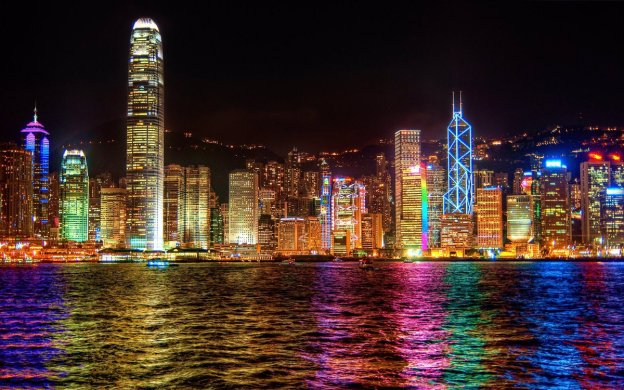
This is just damn gorgeous. Hong Kong at night. Honoring LGBT.

I came across this photo somewhere on the internet and just had to grab it. I wish I knew the photographer!

Sometimes a photograph is all one needs to be impacted.

Breathe in the colors. Be inspired!

Hong Kong at Night in LGBT Colors

Oh, Orlando!

I have a lot of emotions running through me right now. A lot of personal, business and family matters are troubling me. Yet, I can’t let anymore time go by and not express something about the horrific tragedy in Orlando this past Saturday night.

But, words in and of themselves are not the answer. Rhetoric is fine to a degree. We do that every time one of these events hits us like a 2×4. We must not stay silent but a part of me feels absolutely numb.

Prayers are plentiful. Sorrow is everywhere. Emptiness abounds. The world is in mourning . . . again. This time in and for Orlando.

Enough, damn it! Enough! These senseless acts must stop.

But we know it won’t.

I pray that our nation’s leaders have the guts to wake up and make mature, intelligent decisions rather than their usual, pitiful politicking in doing the politically correct thing.

Just do the right thing, you morons.

Lord, grant unto us the strength and courage to endure and to find some answers.

Bless the souls who perished. Bless the souls who survived. Bless us all, good and faithful servants. Onward.

Amen!

PeaceHarmonySolidarityCommunityLovePride.

This post is also being published on my Joe’s Journey blog.

It’s Friday . . . What’s that you say, Fred?


Fred Flintstone at Halifax Bank

It’s Friday and I’m ready for a good chuckle.

Actually, I got my chuckle a few days ago when I first read about this ad for Halifax Bank in the U.K. Featuring a few of The Flintstones’ characters, the spot does a wonderful job with the animation and the bank’s message.

Kudos to them for wanting to do something different, especially being somewhat contrarian to that British stiff-upper-lip perception.

According to Creativity Magazine, U.K. bank Halifax has collaborated with Warner Bros. once again, this time to feature Flintstones in a spot about switching banks. This ad, by Adam&Eve/DDB, sees Fred and Wilma walk into a Halifax branch and interact with a real-life manager as they explain why they want to switch from their Bedrock bank.

Once again, directorial duo Dom&Nic at Outsider worked with the Mill’s VFX team to integrate the iconic animated characters into a live action setting, and recreate them authentically (and) as close to the original as possible.

The team worked closely with Warner Bros. Consumer Products to get the character designs as accurate as possible, combining modern techniques with more traditional methods.

To give it a classic aged look, the Mill team also hand animated and color graded the entire end sequence, where we see Fred with his new shoes taking Wilma home, followed by Dino. Love the scene where a banker-lady is giving Dino a treat!

I’ve always appreciated a scenario when the agency is blessed with a client who is willing to bend or even break the supposed rules in order to impress and be innovative in a classy and, in this case, cute execution of a timeless classic.

The situation is scripted well and the actors are, well, believable. More importantly, the creative treats the concept with respect.

Alas, the poor boob who plays the banker. Imagine playing second fiddle to a famous caveman who is not part of Geico. Ah, the Brits!

Way to go, Fred and Wilma!

The Future of Advertising?

Ever tried to predict the future? Not easy, is it?

I don’t know if this article comes close but it is an interesting read. Dax Hamman, Chief Product Officer, Rubicon Project, did a nice job with it.

ProgrammaticMind Issue 10 22

The future of advertising may take many forms, some of which may not even be known to us at present – wait, let me jump into my time travel Shuttlecraft (on loan from Star Fleet) and I’ll get back with you.

ProgrammaticMind Issue 10 1


Until then, the publishers of Rubicon have put together an intriguing read in this their 2016 Biannual Issue, The Programmatic Mind.

Whatchathink?

Well, for one thing, how will advertisers get consumers to pay attention to ads if when we all live in an era of super-saturation? The author states we start by using information as advertising – using data available to us in order to make our ads as relevant as possible so the consumer has no choice but to pay attention.

Hmmmm, I thought that’s what we try and do everyday . . . now. That’s what smart creativity is supposed to do. Let’s face it, cutesy only goes so far! Mr. Hamman further states “. . . that elegant design won’t be enough if your ads are not providing valuable information.” That’s true.

I agree with the author when he says the future of advertising is full of tremendous promise. It’s also full of a whole bunch of challenges and subsequent responsibilities. Information overload will, I think, be even more so than it is today.

Still, consumers are a fickle bunch; they’re also quite intelligent and can certainly discern an ad that makes sense, is relevant and interesting. Our future world will most likely be more intense, with more information, quite problematic, more programmatic and probably more “anything-atic.”

Oh, boy, pass the Excedrin!

Since you folks will undoubtedly have a thought or two on this subject and the article, pro and con, let me know. Don’t be bashful. There’s plenty of Excedrin for all of us.

A little creative juice for the soul. Thank You, Creativity!

Ever get curious? Well, I was curious as to what the back cover of my Advertising Age issues referred when they featured someone and a quote. Near the bottom of the page was listed “Thank You Creativity.”

join-us-02

OK, what gives?

“A love letter to the stories, lessons and magic of creativity.” Or so says the home page.

The rest is rather intriguing. See for yourself and Enjoy.

Thank You, indeed, Creativity!

Houston’s Creative Economy – Part Deux

Recently I reported on a day-long event at the University of Houston called Leadership in the Arts Summit: Valuing the 21st Century Creative Economy. The audience was comprised mostly of non-profits and educators but also had artists and other creative entrepreneurs (like yours truly). Those of you who missed that blog post, well, too bad (just kidding).

Morning Panel w/Alfred

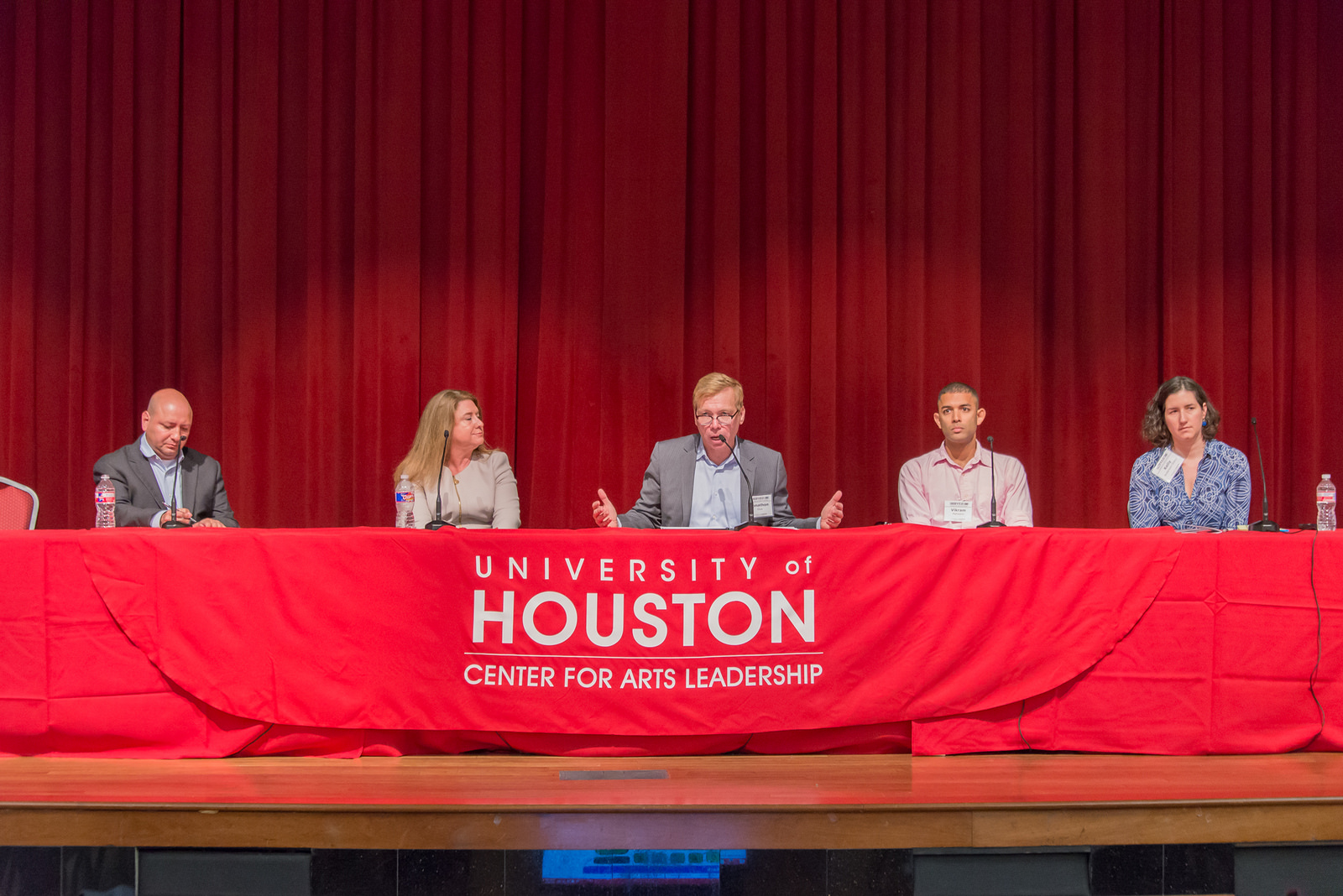
Summit 2016 Morning Panel

Since that event a couple weeks ago, there has been some follow up by the folks in UH’s Center for Arts Leadership. They are compiling feedback from attendees in hopes of gathering sufficient info to better plan the next steps. That is no small feat.

Sixto Wagan

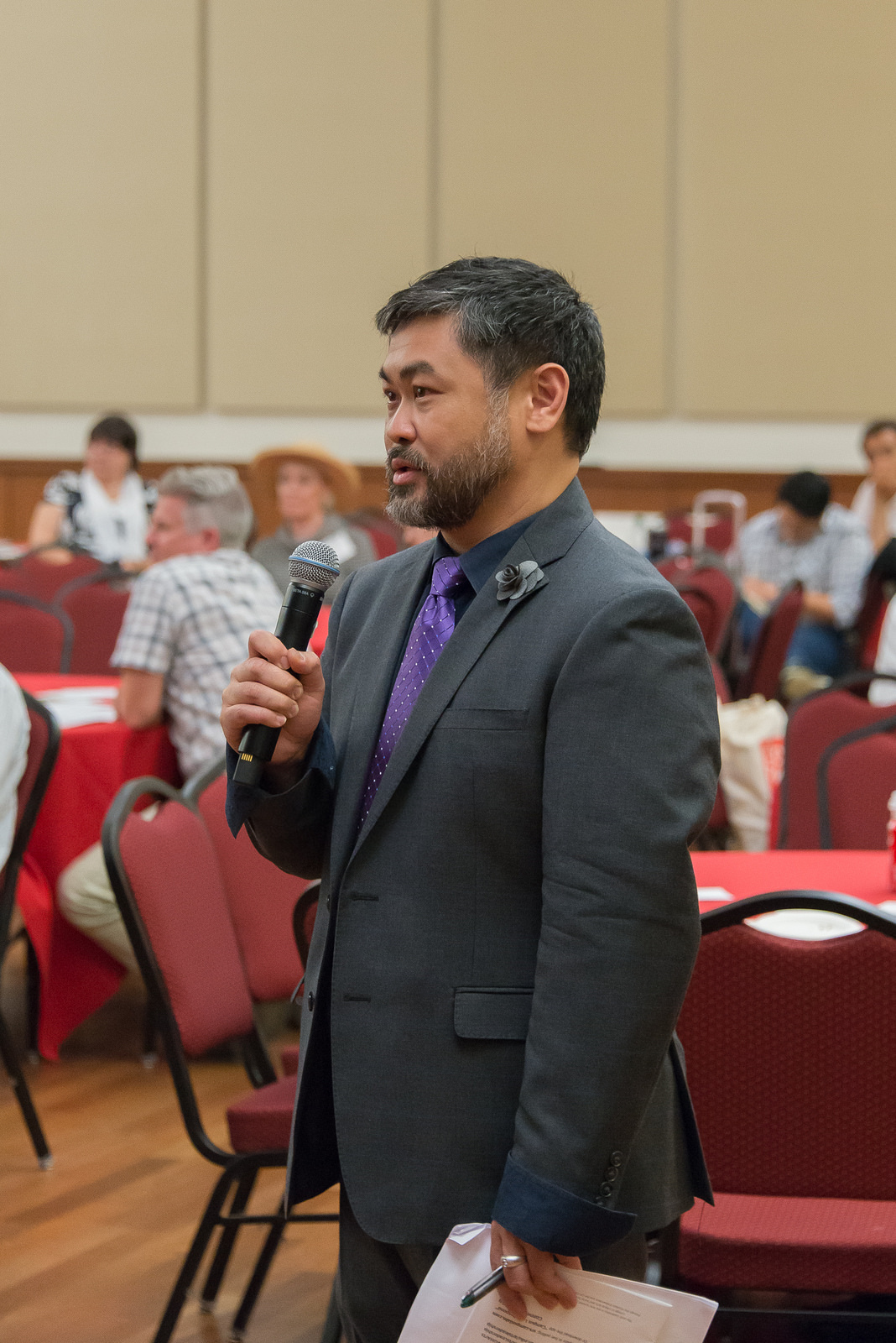
Sixto Wagan, Host & Director Leadership in the Arts Summit

Some of the follow up consists of photos and presentations from April 11. Thanks to the University of Houston for these photos from their Flickr page.

I’m appreciative of those who “liked” my post and who left comments. I’m hoping that once you’ve read this and gone on to review the links herein, you’ll provide feedback as to what you think would be viable solutions to organizing our creative organizations around town to better harness our collective creativity.

Summit 2016 Afternoon Panel

Summit 2016 Afternoon Panel

In addition to the Houston Arts Alliance (HAA), the Greater Houston Partnership (GHP), among others, should play a key role in assisting with this movement. Jon Norby, a panelist in one of the afternoon sessions, recently joined the Partnership last year as Director of Talent Attraction and Marketing. I talked with him afterwards to get a feel for the GHP’s perspective about this new creative economy. While he acknowledged the challenges in communication among all of Houston’s various groups, he admitted it’s a challenge we must overcome to ensure the vibrancy in our creative community we all seek.

A few examples of where creative alliances have been formed, and can be formed in Houston and other cities, include Baltimore, Austin and Milwaukee. In fact, Christine Harris, who lead the first discussion, co-founded and was the CEO of the Milwaukee alliance.

As Sixto Wagan commented in his closing remarks, let us hope five years from now we’re not still trying to start a conversation that we’ve already begun present day. We’ve got a ton of talent at our disposal but we’re not clicking on all cylinders yet.

Though it may seem like we’re trying to lasso a large, puffy cloud, let’s get better organized and talk amongst one another. Let’s continue the discussion. Our creative community deserves no less.

So, who’s with me?

Summit 2016 Audience

Summit 2016 Audience

Our Creative Economy: Listen up, Houston!

This past Monday, April 11, I had the pleasure of attending a day-long discussion “Valuing the Creative Economy” at the third Leadership in the Arts Summit held at the Center for Arts Leadership at the University of Houston. Quite a stunning facility!

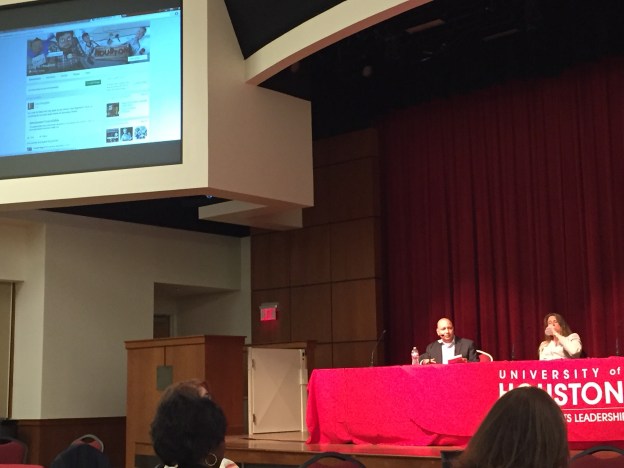
I learned about this summit from my friend and Only in Houston Co-chair Alfred Cervantes, who besides being the deputy director of the Houston Film Commission was also a panelist addressing the question “Creative Economy: What is it and why does it matter”?
IMG_0919

Because of the length of the Summit and the depth of discussion that took place and will continue in the weeks and months to come, there will be subsequent posts about our progress and how all this can tie together here in Houston. There will also be photos and presentations from the Summit posted to the Center’s website in the days ahead.

The goal of the Summit, according to Sixto Wagan, Director, Center for Arts Leadership, is “to bring our creative community together to talk and to envision a collective future. The panels are meant to push beyond the simple binaries, help us question assumptions, and move the conversation forward toward action.”

Christine Harris lead the opening plenary (formal seminar-speak) “Creative Economy: What is it and why does it matter”? Christine has been working with creative enterprises and community development for over 30 years and was recently in Houston last November headlining a similarly-themed morning workshop at the Houston Arts Alliance (HAA) and an evening panel discussion at Gensler.

IMG_0904

Harris co-founded the Creative Economy Coalition, a working committee of the National Creativity Network, and designed and executed the nation’s first review of defining the creative economy. This study profiled and inventoried how 27 communities around the nation were profiling and measuring their creative economies. She was CEO of Creative Alliance Milwaukee, where she managed a full profile of the regional creative economy and developed online resources for the sector.

It’s not my intent to cover all that was discussed during the Summit in one blog post. We’d be reading for days! I merely want to further the conversation that was “started” last November and continued this past Monday.

And Houston, we’ve got work to do.

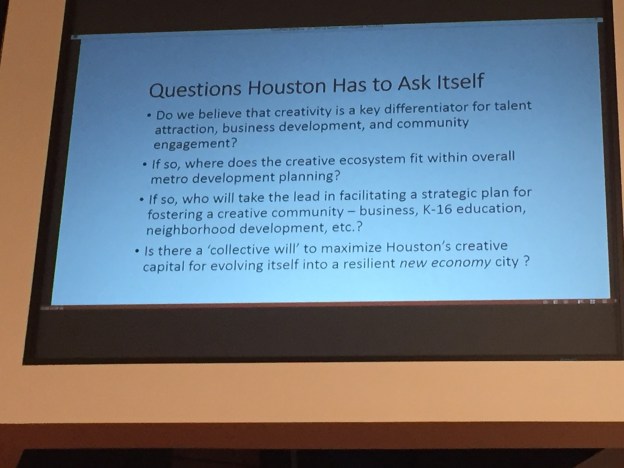
Just consider these questions:
IMG_0908

And then, there’s the $64,000 question:

IMG_0952

Obviously, these questions don’t have simple, ready-made answers. They do, however, demand discussion and we need to continue this.

Feel free to comment and send me input on possible answers or solutions to these questions. You can also post your ideas on OiH-FaceBook and/or the Arts Leadership-FaceBook.

The various communication organizations in and around the city are a major resource for input and counsel. So, too, are the fine educational and non-profit venues in our area. Although this Summit centered around the arts, creativity knows no boundaries.

Through the American Advertising Federation Houston (AAFH), Only in Houston (OiH) was born a decade ago. Its intent was, and still is, to keep local creative dollars spent locally. There was even a multi-communication organization formed years ago (Houston Communication Alliance) aimed at bringing together all “creatives.”

Times change as do people and industries. Houston’s Creative Economy and its driving forces need to meet today’s challenges with tomorrow in mind. We may need to rethink how this is done. Other communities around the country are doing so, and it will take just that: A Houston-wide effort. No one organization or person can do this.

At the risk of thinking out loud (even though I’m typing this in silence), maybe Only in Houston morphs into a “Houston Creative Coalition,” which is comprised of organizations like the Houston Arts Alliance, Greater Houston Partnership, numerous professional and arts organizations, etc.? We can learn a lot from others who have started something like this. But Houston needs to create something that works in Houston, not Boston.

And we must do a helluva lot better job of communicating with one another so that we all know what’s going on and when. No problem; piece o’ cake!

The Leadership in Arts Summit 2016 is a recent example of creativity and economics blending and working together for the common good. We need to make sure the conversation continues and progresses.

More to come . . .

Onward!
 

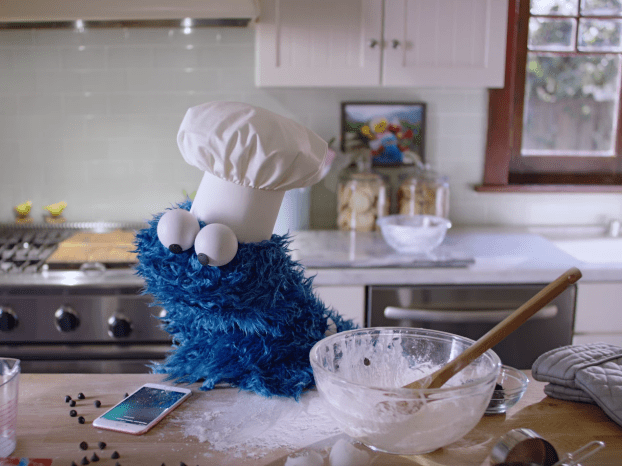
Cookie Monster & Siri: Cute Combo

OK. Time to sit back and take a chuckle break!

Some of you may have seen this on TV by now but I doubt you’ve seen the “extra” footage.

His outtakes are almost as cute as he is. Oh, the things celebrities put up with!

screen-shot-CookieMonster

Courtesy of re/code and Apple via YouTube

Advertising Hall of Fame Quotes – Part 6

Here’s the sixth in a series of various worth-remembering quotes which I find interesting and inspiring, and, hopefully, you will, too. Excerpted from the newsletter “Smart Brief” from the American Advertising Federation, these quotes are usually from a member of the Advertising Hall of Fame.

quote

51. I have a theory that the best ads come from personal experience. Some of the good ones I have done have really come out of the real experience of my life, and somehow this has come over as true and valid and persuasive.

— David Ogilvy

52. Too many ads that try not to go over the reader’s head end up beneath his notice.

— Leo Burnett

53. You can’t use up creativity. The more you use, the more you have.

— Maya Angelou (not part of original series; just a great quote)

54. Meetings are all too often the burial grounds of great ideas.

— Keith Reinhard

55. Play by the rules, but be ferocious.

— Phil Knight

56. A good ad should be like a good sermon: It must not only comfort the afflicted, it also must afflict the comfortable.

— Bernice Fitz-Gibbon

57. Some questions don’t have answers, which is a terribly difficult lesson to learn.

— Katharine Graham

58. Appeals that sound good when described to a client or employer are not always the most effective appeals that can be used. Clever, tricky ideas often sound fine when described in a conference room. But some simple, basic, plain-as-the-nose-on-your-face idea will sell more goods.

— John Caples

59. Courtesy is the one coin you can never have too much of or be stingy with.

— John Wanamaker

60. I think the harder you work, the more luck you have.

— Dave Thomas

So, which ones are your favorites?

Do you have a favorite or favorites in the series?

Lemme know.

Advertising Hall of Fame Quotes – Part 5

Happy Mardi Gras!!

Here’s the fifth in a five-part series (more to come later) of various worth-remembering quotes which I believe you’ll find interesting and hopefully inspiring. Excerpted from the newsletter “Smart Brief” from the American Advertising Federation, these quotes are usually from a member of the Advertising Hall of Fame.

Quote

41. I don’t like closed doors. Creativity flourishes best in an environment of open doors and open minds.

— Keith Reinhard

42. There is no such thing as ‘soft sell’ and ‘hard sell.’ There is only ‘smart sell’ and ‘stupid sell.’ 

— Charles H. Brower

43. In the modern world of business, it is useless to be a creative original thinker unless you can also sell what you create. Management cannot be expected to recognize a good idea unless it is presented to them by a good salesman.

— David Ogilvy

44. Grant graciously what you dare not refuse.

— George Gallup

45. Advertising makes people discontented. It makes them want things they don’t have. Without discontent, there is no progress, no achievement.

— Morris Hite

46. The artist defines creativity. The audience defines effectiveness. To be creative, study art. To be effective, study the audience. To be both, study how the audience responds to art.

— Keith Reinhard

47. I avoid clients for whom advertising is only a marginal factor in their marketing mix. They have an awkward tendency to raid their advertising appropriations whenever they need cash for other purposes.

— David Ogilvy

48. Creativity often consists of merely turning up what is already there.

— Bernice Fitz-Gibbon

49. We don’t grow unless we take risks. Any successful company is riddled with failures.

— James E. Burke

50. There’s nothing wrong with being fired.

— Ted Turner

So, which one or ones is/are your favorite(s)?

Do you have a favorite or favorites in the series?

Lemme know.