Beyond The Majestic: The Evil Doer

A sequel to the short story Stopover at the Majestic

When last we visited, the year was 1965 and our two strangers were chatting up one another in the lobby of the Majestic Hotel, just before it was to be torn down. One of the strangers is Timeline Police. The cop knows our Time Traveler is not from 1965 but the closely guarded Timeline has been disrupted; how is not known. The police are investigating. Could our time-traveling Stranger end up being trapped in 1965 at the Majestic? After their conversation, our Time Traveler, Mr. Curtis, decides it is time to move on. So with a doff of this hat and a swirl of his cane, he does and in a flash, he’s gone. Again. Only to encounter unexpected twists along his journey through time.


The year is 3068 and Mr. Curtis is now visiting another world in the Gamma Quadrant of the Solexa Solar System. The planet, similar to Earth, is not all that old. However, the surface is desolate except for one large city. Mr. Curtis, it seems, has been drawn here to see the city’s largest building. He is, among other things, a curiosity seeker.

The building is a relatively old hotel, rather grandeur in stature. Upon first glance, he thought he recognized it but he’s never been here before. Then it hits him: It’s a replica, an exact replica but a working replica nonetheless of the long-ago demolished Majestic Hotel in Lake Charles, LA, back on Earth in 1965.

How could that be? Who built it and why the Majestic?

As he stands there in front of the lobby admiring its architecture, he feels a tap on his shoulder and a voice, “Hey there. Fancy meeting you here.”

Startled, Mr. Curtis swings around to see who is disturbing him.

It’s the Timeline Police cop from Earth!

“I’m investigating the breakdown of the Timeline back in 1965, when you and I first and last met,” says the cop. “You seemed to have left the Majestic awfully quickly. And now I see you here in front of another Majestic Hotel more than 200 years in the future. Curious! What gives?”

“I could say the same thing about you,” retorts Mr. Curtis. “What are you doing here?”

“Well, it is curious. I felt a strange yearning to come to this planet and when I arrived, I was drawn to this spot, where the hotel is. Believe it or not, I did not expect to see another Majestic Hotel,” explained Mr. Curtis.

“You said you were investigating the breakdown of the Timeline back in 1965,” inquired Mr. Curtis. “Have you any answers?” he asked. “I know I did nothing to impact the Timeline. That’s not to say I wasn’t tempted, mind you.”

“Well,” intoned the cop, “something happened to the Timeline because the Majestic Hotel back then was not torn down in 1965. Oh, sure, a parking lot is in its place or was but that was later.”

Mr. Curtis interrupted, “But, all the history books say the hotel was torn down in 1965 and show photos of its demolition. How could that be if it was not torn down then?”

“Trust me,” said the cop. It wasn’t. And the only way for that to have happened was for someone to adjust the Timeline. I don’t know who and I don’t know how but it was done. The evidence is where we are standing. This is not merely a replica of the Majestic, Mr. Curtis. It is the Majestic. Somehow when the Timeline was altered, the hotel was transported to 3068, right where we are standing.”

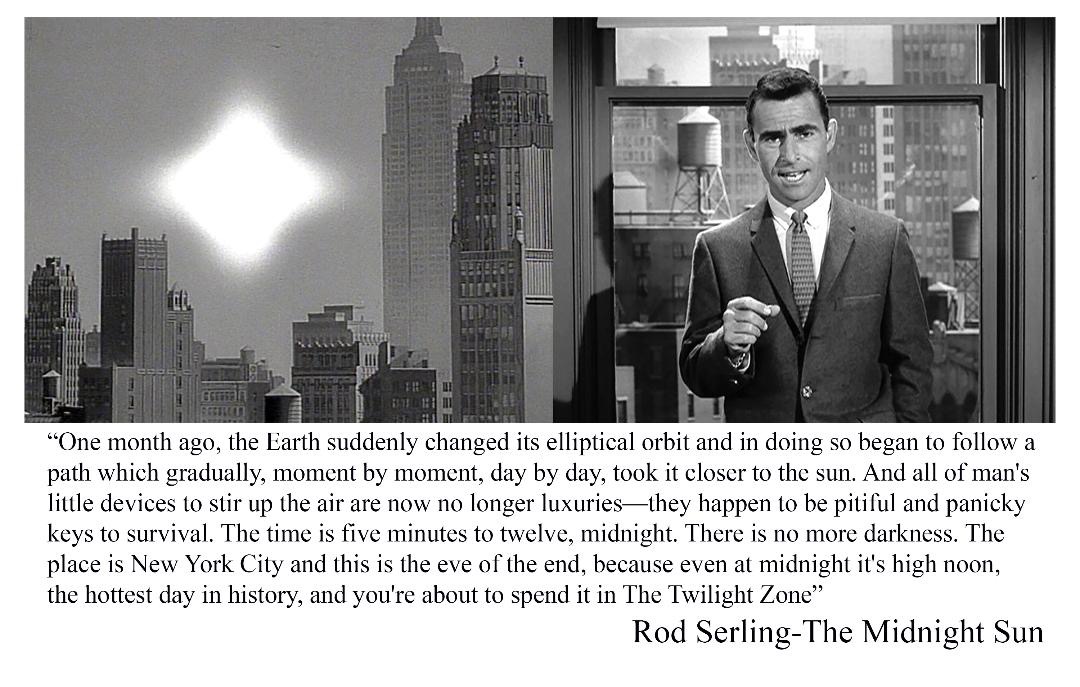
“Okay,” sighed Mr. Curtis, “now I feel like I’m in the Twilight Zone. Before we know it, Rod Serling is going to come out from behind the Concierge Desk!”

“So where does this leave you in you investigation, Mr. Timeline Policeman?,” asked Mr. Curtis. “Since this happened back in 1965, wouldn’t it make sense to return to that time and ask around?” he said.

“I’ve considered exactly that, but I may need some help to draw out our Timeline provocateur,” said the cop.

“What did you have in mind?,” inquired Mr. Curtis.

“Come join me for a cocktail at the Majestic Bar and I’ll fill you in with my plan,” invited the cop.

“You see, I figure it this way,” started the cop. “We’ll need to look around the lobby of the 1965 Majestic and see if we spot anyone who looks slightly out of place. The more I think about it, the more I’m convinced the Timeline was altered back in ’65 somehow and we’ve got to correct it,” he continued.

“You keep saying ‘we’,” said Mr. Curtis. “How can I help?,” he inquired.

“Simple,” said the cop. “You know or at least suspect what a time traveler looks like, how he acts. I need an extra pair of eyes to help me, and you’re it,” affirmed the cop.

Once back in the lobby of the 1965 Majestic Hotel, the two sat pensively in great high-back chairs, surveying the area and trying not to appear conspicuous. That is until Mr. Curtis suddenly arose from his chair and said “I need to gradually move around some. Maybe I can pick up some chatter from some unsuspecting chap who might provide us with a clue or two.”

As Mr. Curtis meandered around the lobby area, the cop stayed seated but struck up a conversation with a fellow who had just sat down by him. After awhile, and with this conversation going nowhere, the cop noticed Mr. Curtis making his way back towards him. Then he noticed Mr. Curtis stopping and looking over near the Concierge desk.

The cop noticed what appeared to be a conversation with the General Manager and the Concierge, but the GM was holding something that appeared to be quite familiar. It was a walking stick just like the one used by Mr. Curtis to travel in between times.

Mr. Curtis, seeing the same thing, gradually started walking over to the pair to strike up a conversation. He naturally wanted to compare walking sticks and also gauge how nervous the GM would be to see someone else with what appeared to be an identical “stick.”

Once within speaking distance of the GM, Mr. Curtis noticed out of the corner of his eye that the cop was meandering over to speak with the Concierge so the two of them would not appear suspicious to the GM.

“I see you have a walking stick just like mine,” said Mr. Curtis. A rather startled GM responded that the two “sticks” were not exactly alike but very similar. That’s when Mr. Curtis noticed that instead of a green inset jewel on the very top as his stick has, the GM had a red jewel.

That could mean only one thing: Time Travelers with red jewels are evil. They live to upset the Time Line. Mr. Curtis knew he had to act quickly. He also knew that the cop was unaware of what had just been noticed. More significantly, the GM now knew that Mr. Curtis had him pegged as the one who upset the Time Line that sent the 1965 Majestic into the 31st Century.

In less than an instant, all hell broke loose. An explosion from somewhere in the hotel rocked the lobby and smoke started to fill the area. People began running toward the exits while screaming “FIRE!”. As Mr. Curtis was regaining his wits about him, he noticed through the smoke haze that the Concierge had been knocked out and the cop was laying on the ground unconscious. He immediately turned to where the GM had been standing, but there was no sign of him. He’d disappeared.

The lobby was a scene of chaos. Mr. Curtis, still somewhat dazed, began to slowly move around and see to the cop. It would be a few minutes before emergency personnel would appear on the scene. In the midst of all this, Mr. Curtis wondered if the explosion were merely coincidental or if it was a plan by the GM to help him get away and remain on the Galaxy’s Most Wanted List.

That would have to be a question left for another day. Why was the GM/Time Traveler doing all this? Why did he want the Majestic transported to another time? Why be so reckless? Too many questions. Too few answers, thought Mr. Curtis. Now what?

As he tried to make his way around the immediate chaos where the cop lay, Mr. Curtis felt unsure of himself. He got more woozy and unsteady. Then as he got to the cop, Mr. Curtis suddenly fell to the floor, unconscious. Their search for answers would have to wait.

To Be Continued . . .

Be sure to check out my other blog, Joe’s Journey, for a different kind of playground for creativity, innovation and inspiring stuff.
 

Images of Creativity

Images, works of art. Striking. Unsettling. Amazing. Jaw dropping. Awesome.

Creativity in its different forms.

Below are a few examples of spaces that accommodate large scale installations.


Going big in small spaces. Irrespective of the environments we design, there are always opportunities to create unexpected scale through architectural intervention. It’s a strong and powerful way for brands to transport an audience to another world.


Credits:

Artist Matthew Mazzotta has designed HOME at Tampa airport

AC Milan HQ by Fabio Novembre

Sophie’, 2009 in Germain Restaurant, Paris by Xavier Veilhan

‘Karma’ is by the Korean sculptor and installation artist DO HO SUH STUDIOS LLP  


Hopefully making a ruckus, one blog post at a time!

Be sure to check out my other blog, Joe’s Journey, for a different kind of playground for creativity, innovation and inspiring stuff.

 

Live long and prosper, Ukraine.

When Your Muse Strikes, Follow It.

I don’t know how Seth Godin does it. He writes and publishes a blog everyday, 365 days a year. I have trouble publishing my two blogs each WEEK!

Part of my problem is having something interesting to publish. That is every blogger’s nightmare. There have been times I write a blog the night before because I came up with an idea and just developed it.

When I’m in a pinch and nothing comes to mind, I try and change my focus. In a way, I let myself become distracted, not by merely doing something else but by switching creative gears and concentrating on another creative project.

It was where my muse wanted to take me, so I let it. What is a muse you might ask?

Muse, in Greco-Roman religion and mythology, any of a group of sister goddesses of obscure but ancient origin, the chief centre of whose cult was Mount Helicon in Boeotia, Greece. They were born in Pieria, at the foot of Mount Olympus.

They probably were originally the patron goddesses of poets (who in early times were also musicians, providing their own accompaniments), although later their range was extended to include all liberal arts and sciences—hence, their connection with such institutions as the Museum (Mouseion, seat of the Muses) at Alexandria, Egypt. There were nine Muses as early as Homer’s Odyssey, and Homer invokes either a Muse or the Muses collectively from time to time.

Virgil (centre) holding a scroll with a quotation from the Aeneid, with the epic Muse (left) and the tragic Muse (right), Roman mosaic, 2nd–3rd century ad. Courtesy of the Musée Le Bardo, Tunis

As the creative juices begin to flow and my “new” project begins to take shape, I begin to develop several ideas that would make for interesting blog posts. I did, however, make sure I finished what I had previously started so I could “celebrate” the accomplishment (a musical slide show).

Whether or not you follow your instincts when you have a calling to do so, is up to you. Your mind and imagination are wondrous tools in the creative process. Don’t ignore them.


Hopefully making a ruckus, one blog post at a time!

Be sure to check out my other blog, Joe’s Journey, for a different kind of playground for creativity, innovation and inspiring stuff.

 

Live Long and Prosper, Ukraine!

Turning Gobbledygook Into Useful Garbage

Stumped. Writer’s Block. Stymied. Confused. It’s all a jumble of nothingness.

What Do You Write When You Don’t Know What to Write About?

So, how do you turn nothingness into somethingness? Start writing! Anything.

The words will come, thoughts will flow and, eventually, creativity will blossom.

You can’t force it, however. It must evolve naturally, at your own pace. Usually, if a creative suggestion doesn’t appear in your thoughts within about 20 minutes or so, abort the process and go on to something else. Then come back to it hours later or the following day.

Some writers think before they write. Some think as they write. Some writers don’t think at all; they just write a bunch of gobbledygook. That’s fine, as long as you go back and turn the gobbledygook into useful garbage.

Turning that garbage into something quite palpable and enticing will take a process of editing and refinement but when you’re at this stage, you’ve got it made.


Hopefully making a ruckus, one blog post at a time!

Be sure to check out my other blog, Joe’s Journey, for a different kind of playground for creativity, innovation and inspiring stuff.


Live Long and Prosper, Ukraine!


March Madness, er, uh, Quotes, That Is!

The quotations are as varied as the people who said them. Some you know, some you don’t. That’s what makes them interesting. From Burke to Burnett, Einstein to Degas; throw in a little Serling for seasoning and you’ve got a tasty recipe for March’s quotes.


We don’t grow unless we take risks. Any successful company is riddled with failures. — James E. Burke, Advertising Hall of Fame

Success or failure in business is caused more by mental attitude than by mental capacities. — Walter Dill Scott, Advertising Hall of Fame

Anyone who thinks that people can be fooled or pushed around has an inaccurate and pretty low estimate of people — and he won’t do very well in advertising. — Leo Burnett, Advertising Hall of Fame

If we knew what we were doing, it wouldn’t be called research, would it? – Albert Einstein

If you fall in love with the imagination, you understand that it is a free spirit. It will go anywhere, and it can do anything. – Alice Walker

Curiosity killed the cat, but for a while I was a suspect. – Steven Wright

You must aim high, not in what you are going to do at some future date, but in what you are going to make yourself do to-day. Otherwise, working is just a waste of time. – Edgar Degas

Our job is to simplify, to tear away the unrelated, to pluck out the weeds that are smothering the product message. — William Bernbach, Advertising Hall of Fame

How do we turn science fiction into fact? We do it by inventing our own future and figuring out the realistic steps that we need to make in order to get there. Dare to dream. Let your imagination leap. — David Shapton, Editor In Chief, RedShark Publications, 2012 to 2020


Hopefully making a ruckus, one blog post at a time!

Be sure to check out my other blog, Joe’s Journey, for a different kind of playground for creativity, innovation and inspiring stuff.



Live Long and Prosper, Ukraine!


The Shadows: a Short Story of Ghastly Gatherings

Today is a different kind of blog post. I’m using it to introduce my newest piece of short story fiction. It took me a longer than expected amount of time to complete it, but I finally did. Hope you enjoy it!

********

Welcome! This is a profile in the macabre. It’s a short story about a family who lived in the 19th Century. They lived a rather normal lifestyle back then, aside from a few setbacks in life. They’ve survived but not in the way you might expect.

Introducing the Graybeers: Mr. and Mrs. Jonathan and Priscilla Graybeers, and their two children, Tony and Stephanie, ages 14 and 16, respectively, at the time of death. Tony was shot in the head while Stephanie was downed by an ax. Back in 1862.

Mr. and Mrs. Graybeers committed suicide, each at the other’s hands. In 1863, following a tumultuous year of mental anguish over the loss of their children. It seems mental illness takes its toll.

Looking back, they were a typical northeastern suburban family, college educated, upper middle class, sports-minded.

In present day, they’re like most other families of similar ilk except for one thing: they can disappear. Oh, yes, one other thing: they don’t really have human form; they’re not ghosts, they’re shadows from their former life. They even live in a mansion called The Shadows, which is near a cemetery.

This image has an empty alt attribute; its file name is the-cemetary-by-jaroslav-gebr.jpg
The Cemetery by Jaroslav Gebr

Aside from select social occasions, the family rarely leaves the Shadows. The mansion has been in their family for centuries. And the location next to the cemetery has always been a family favorite, so no one has ever thought of selling the property.

Although on rare occasions, an unwitting realtor will appear at the door only to be “greeted” by Mr. Graybeers himself. But being a shadow, he really can’t be seen so the realtor leaves his card and walks away, seemingly unaffected by the opening and closing of the door — by itself.

Continue reading

To Quote is to Speak, to Listen, to Learn!

The subject matter may vary. The speaker may vary. The quote may still be memorable no matter who says it. Keep that in mind when reciting any one of the quotes below. It will make for a memorable occasion.


Advertising becomes a dialogue that becomes an invitation to a relationship. — Lester Wunderman, member, Advertising Hall of Fame

Thinking about ourselves isn’t related to knowing ourselves. — Lauren Esposito, arachnologist, co-founder of 500 Queer Scientists

Nothing comes merely by thinking about it. — John Wanamaker, member, Advertising Hall of Fame

Regardless of the moral issue, dishonesty in advertising has proved very unprofitable. — Leo Burnett, member, Advertising Hall of Fame

Attract attention, maintain interest, create desire and get action. — E. Elmo St. Lewis, member, Advertising Hall of Fame


Rules are for people who don’t know what to do. — Keith Reinhard, member, Advertising Hall of Fame

I don’t like closed doors. Creativity flourishes best in an environment of open doors and open minds. — Keith Reinhard, member, Advertising Hall of Fame

Advertising is what you do when you can’t go see somebody. That’s all it is. — Fairfax Cone, member, Advertising Hall of Fame


Hopefully making a ruckus, one blog post at a time!

Be sure to check out my other blog, Joe’s Journey, for a different kind of playground for creativity, innovation and inspiring stuff.

 

Obsession with Productivity Can Kill Creativity.

Don’t Let It Kill Yours!

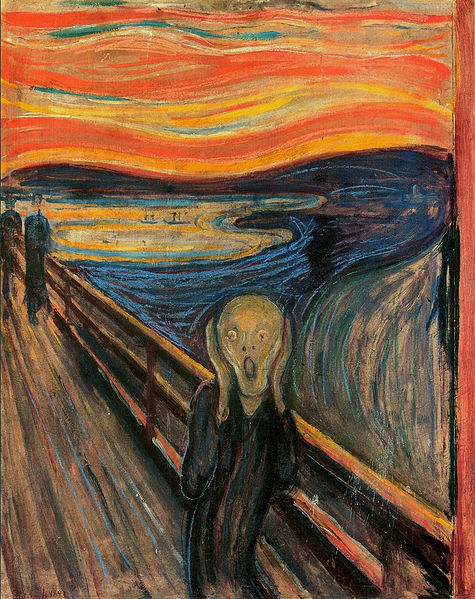
How would a “productive day” compare to a “creative day”? What would, if anything, they have in common? Chances are not much.  One might think a productive day would be closely aligned with scratching off items on a to-do list. On the other hand, someone’s idea of a creative day might not even have a to-do list. 475px-The_Scream

Our current work world is obsessed with productivity. We are inundated with books, articles, white papers, to time block this and time block that; all just to do more work. But our relentless quest to be productive is undermining one of the most important abilities in today’s workplace: creativity.

What of the future, though? Will machine learning and artificial intelligence perform the routine aspects of our work at the expense of our ingenuity and creativity? So how do we create the right conditions for creativity, particularly when we are trying to deal with a to-do list?

Consider this comment from screenwriter Aaron Sorkin (the mastermind behind the television show West Wing and films like Moneyball and The Social Network). He told The Hollywood Reporter that he takes six showers a day. “I’m not a germaphobe,” he explains but when his writing isn’t going well, he’ll shower, change into new clothes, and start again.

Sorkin’s trade relies on him minting something fresh on a regular basis. And it occurred to him that his best thoughts were not happening in moments of fevered concentration, but when he was in the shower. So he had a shower installed in the corner of his office and makes regular use of it. He has described the process as “a do-over” for triggering original ideas.

In 1939, James Webb Young, a Madison Avenue advertising executive, wrote a definitive guide to the process of creativity, A Technique for Producing Ideas. In this short book, Webb Young reminds us, “that an idea is nothing more nor less than a new combination of old elements.” In his view, the skill of creativity is the ability to spot new connections between familiar thoughts, and the art is “the ability to see [new] relationships.”

Fifty years later, Steve Jobs observed something similar: “Creativity is just connecting things. When you ask creative people how they did something, they feel a little guilty because they didn’t really do it, they just saw something. It seemed obvious to them after a while. That’s because they were able to connect experiences they’ve had and synthesize new things.” Webb Young also lays out a remarkably simple technique for creative thought. It involves stimulation. Continue reading

Some More Quotes

As it has been about a month or so since we last published some quotes, we thought it timely to publish some news ones. Like before, it contains quotes from various acclaimed individuals from the worlds of advertising, philosophy, science, literature and education. So, go ahead and immerse yourself in creativity – intelligence having fun!

It is easier to tone down a wild idea than to think up a new one.— Alex Osborne, member, Advertising Hall of Fame

The important thing is not to stop questioning. Curiosity has its own reason for existing. One cannot help but be in awe when he contemplates the mysteries of eternity, of life, of the marvelous structure of reality. It is enough if one tries merely to comprehend a little of this mystery every day. Never lose a holy curiosity. – Albert Einstein

Creativity can solve almost any problem. The creative act, the defeat of habit by originality, overcomes everything. – George Lois

If one advances confidently in the directions of his dreams, and endeavors to live the life which he has imagined, he will meet with a success unexpected in common hours. – Henry David Thoreau

Those people who think they know everything are a great annoyance to those of us who do. – Isaac Asimov

An idea can turn to dust or magic, depending on the talent that rubs against it. — William Bernbach, member, Advertising Hall of Fame

Creativity is as important as literacy and numeracy, and I actually think people understand that creativity is important – they just don’t understand what it is. – Ken Robinson
 
If you’re not prepared to be wrong, you’ll never come up with anything original. – Ken Robinson
 
I believe this passionately: that we don’t grow into creativity, we grow out of it. Or rather, we get educated out if it. – Ken Robinson
 
Many highly talented, brilliant, creative people think they’re not – because the thing they were good at at school wasn’t valued, or was actually stigmatized. – Ken Robinson

Hopefully making a ruckus, one blog post at a time!

Be sure to check out my other blog,Joe’s Journey, for personal insights on life and its detours.

Creativity Guidelines as Presented to the Baton Rouge Ad Club

Because some of you won’t be able to make my presentation tomorrow to the Baton Rouge Chapter of the American Advertising Federation, I thought I might include some of the tips I’ll give to the group in this blog post.

Regardless of how you may be involved in this industry, we all share in the design and development of our own creativity. These tips will hopefully sharpen your current set of skills so that you’ll be better equipped to address challenges as they arise.

Enjoy your dip in the pool of creative tips!


 Always think of yourself as creative! If in doubt, think of this: If you can challenge your own imagination and
stimulate thoughts leading you to a new level of solution, you’ll be realizing your own sense of creativity.


Creativity needs to be synonymous with “FUN!”


Don’t manage creativity; manage FOR creativity. Provide an environment that is open and
receptive to new ideas. Acknowledge error or failure in a constructive and supportive way, build
it into your culture as part of the process; don’t ridicule it; honor and embrace it.

Consider adopting the “suckless mentality” – When presented with something that doesn’t quite
measure up, say something to the effect of “Gee, that really sucks. However, if your tried this or
that, it might suck less.”


Chief Marketing Officers must have creativity in themselves, for the good of the business and
their own teams. “Creativity as a weapon of business is under-leveraged not for lack of ideas, but
for lack of courage to use them or refusal to give up on them. The phrase, ‘We don’t have time for
creativity,’ is not something you would ever hear in the most successful businesses,” says Mark-hans
Richer, former Sr. VP-CMO Harley-Davidson.


Trying to satisfy everybody never got anybody anywhere. Focus on what’s important, then do it.


The strategy must be clear, concise and on target. Your message is going to be screwed up if the
creative is too cute, too complex, doesn’t follow strategy or is just plain dumb.


Don’t let the execution bury the idea. The computer and software are just tools to enhance the
idea, not to compete with, replace, or screw it up. Use your own computer – your brain.


Take time to think. There’s always more than one way to do something. That’s creativity!


Do not bring a DEAD CAT without a shovel! In other words, never present a problem without
bringing the shovel – at least two possible solutions. In doing so, you save time if one of these
solutions is the one adopted, and you can share your creative thinking while learning more about
what’s important to your boss; remember, you may not know all there is to know.

**********

Hopefully making a ruckus, one blog post at a time!

Be sure to check out my other blog,Joe’s Journey, for personal insights on life and its detours.