Our Creative Economy: Listen up, Houston!

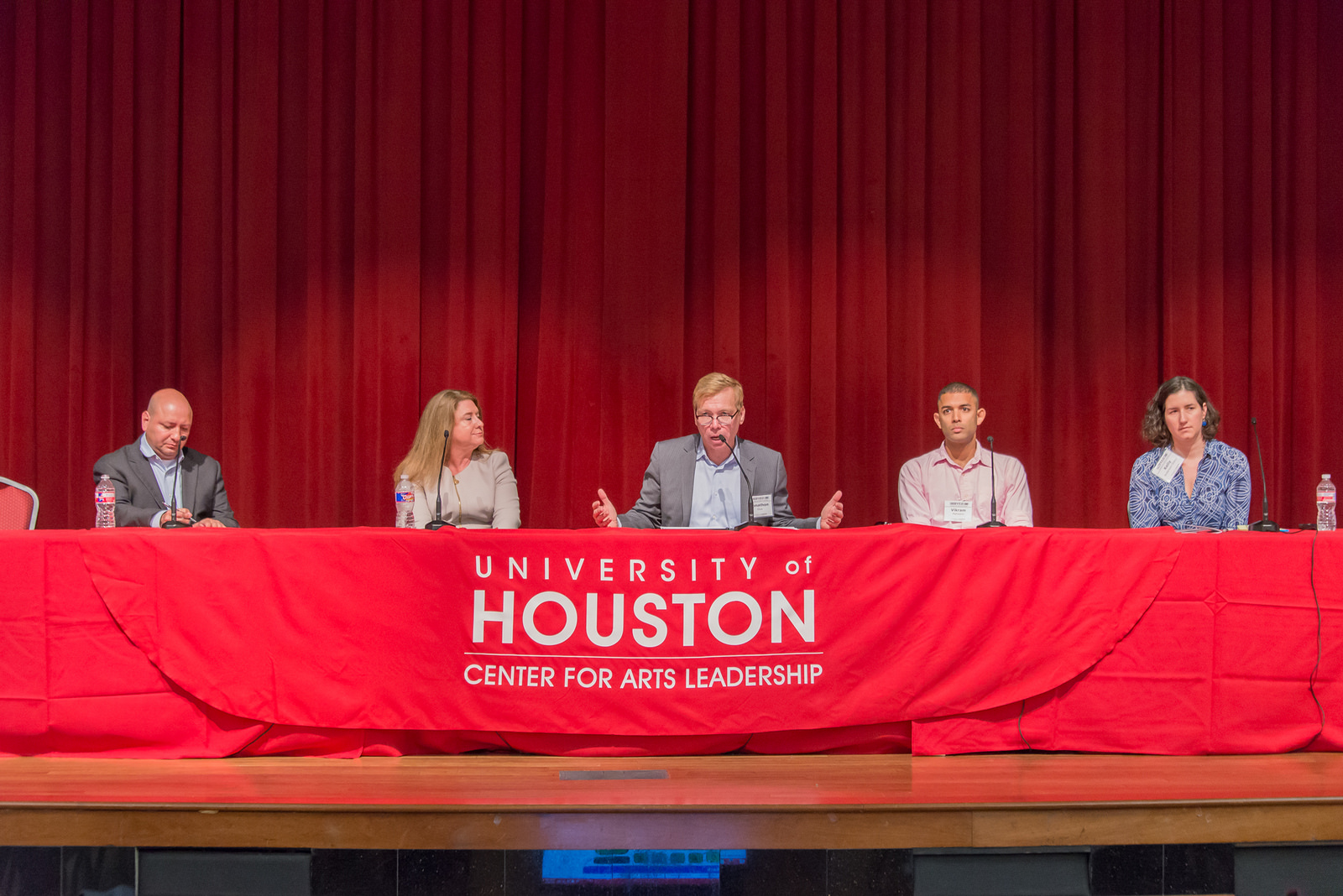
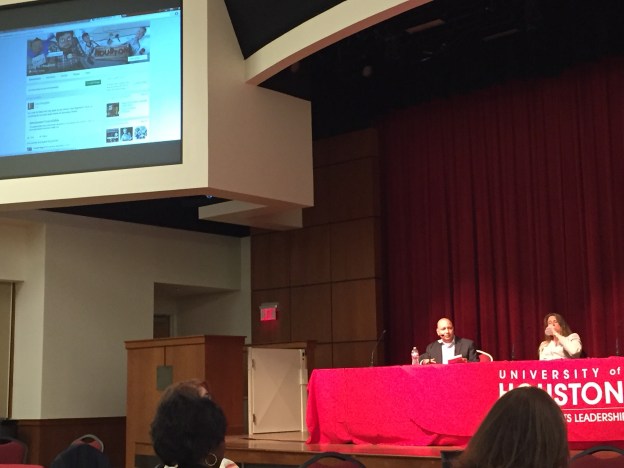
This past Monday, April 11, I had the pleasure of attending a day-long discussion “Valuing the Creative Economy” at the third Leadership in the Arts Summit held at the Center for Arts Leadership at the University of Houston. Quite a stunning facility!

I learned about this summit from my friend and Only in Houston Co-chair Alfred Cervantes, who besides being the deputy director of the Houston Film Commission was also a panelist addressing the question “Creative Economy: What is it and why does it matter”?
IMG_0919

Because of the length of the Summit and the depth of discussion that took place and will continue in the weeks and months to come, there will be subsequent posts about our progress and how all this can tie together here in Houston. There will also be photos and presentations from the Summit posted to the Center’s website in the days ahead.

The goal of the Summit, according to Sixto Wagan, Director, Center for Arts Leadership, is “to bring our creative community together to talk and to envision a collective future. The panels are meant to push beyond the simple binaries, help us question assumptions, and move the conversation forward toward action.”

Christine Harris lead the opening plenary (formal seminar-speak) “Creative Economy: What is it and why does it matter”? Christine has been working with creative enterprises and community development for over 30 years and was recently in Houston last November headlining a similarly-themed morning workshop at the Houston Arts Alliance (HAA) and an evening panel discussion at Gensler.

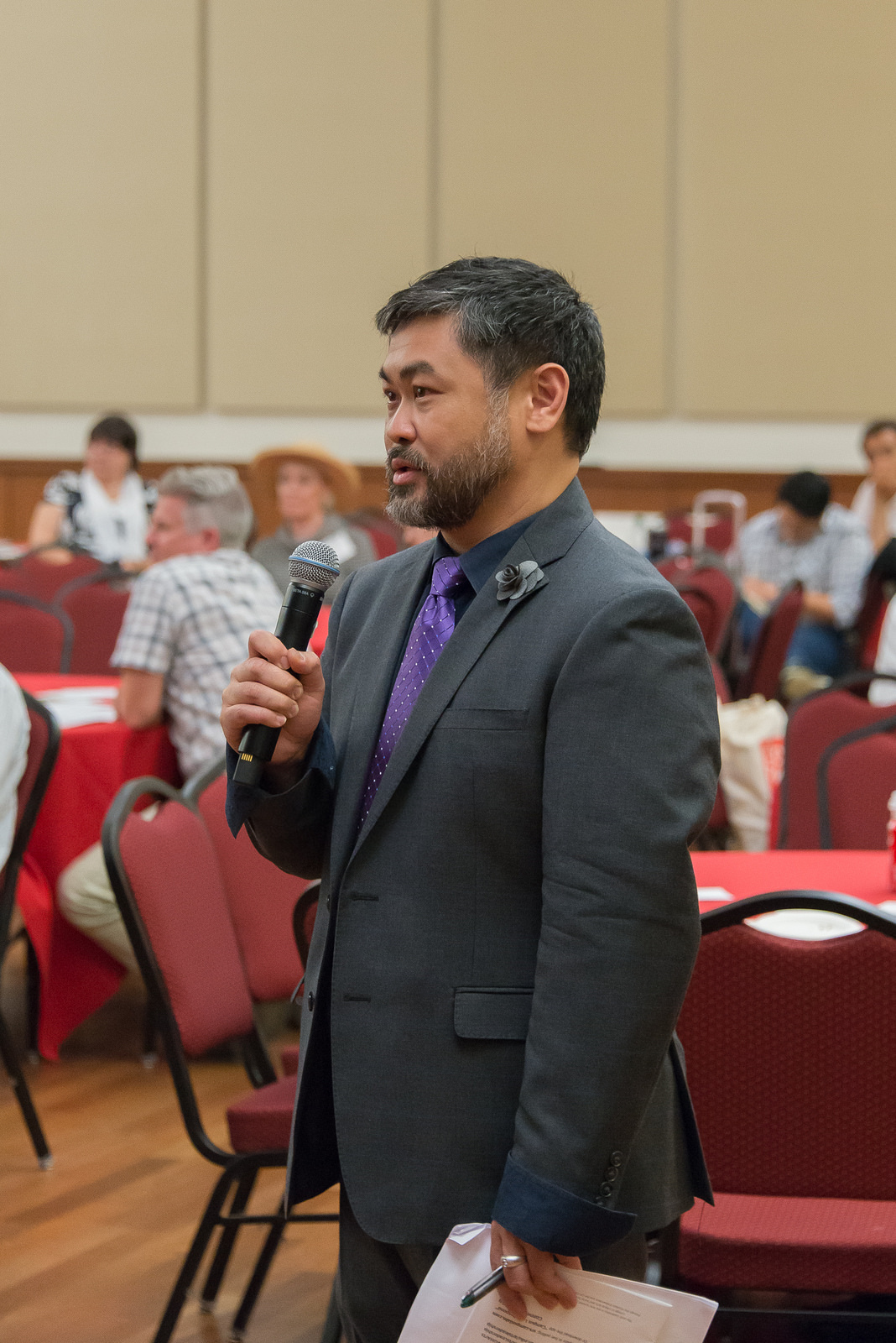
IMG_0904

Harris co-founded the Creative Economy Coalition, a working committee of the National Creativity Network, and designed and executed the nation’s first review of defining the creative economy. This study profiled and inventoried how 27 communities around the nation were profiling and measuring their creative economies. She was CEO of Creative Alliance Milwaukee, where she managed a full profile of the regional creative economy and developed online resources for the sector.

It’s not my intent to cover all that was discussed during the Summit in one blog post. We’d be reading for days! I merely want to further the conversation that was “started” last November and continued this past Monday.

And Houston, we’ve got work to do.

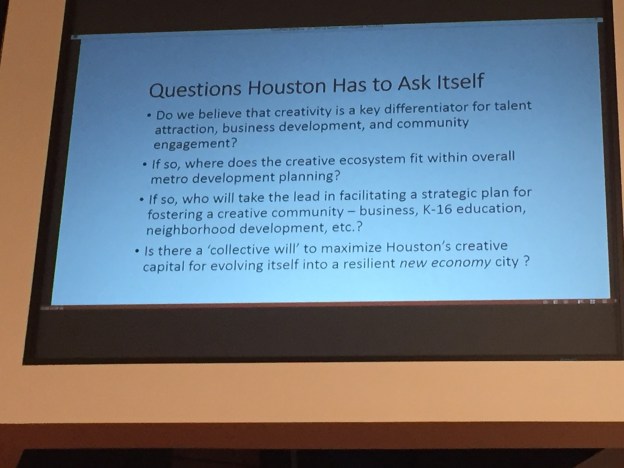
Just consider these questions:
IMG_0908

And then, there’s the $64,000 question:

IMG_0952

Obviously, these questions don’t have simple, ready-made answers. They do, however, demand discussion and we need to continue this.

Feel free to comment and send me input on possible answers or solutions to these questions. You can also post your ideas on OiH-FaceBook and/or the Arts Leadership-FaceBook.

The various communication organizations in and around the city are a major resource for input and counsel. So, too, are the fine educational and non-profit venues in our area. Although this Summit centered around the arts, creativity knows no boundaries.

Through the American Advertising Federation Houston (AAFH), Only in Houston (OiH) was born a decade ago. Its intent was, and still is, to keep local creative dollars spent locally. There was even a multi-communication organization formed years ago (Houston Communication Alliance) aimed at bringing together all “creatives.”

Times change as do people and industries. Houston’s Creative Economy and its driving forces need to meet today’s challenges with tomorrow in mind. We may need to rethink how this is done. Other communities around the country are doing so, and it will take just that: A Houston-wide effort. No one organization or person can do this.

At the risk of thinking out loud (even though I’m typing this in silence), maybe Only in Houston morphs into a “Houston Creative Coalition,” which is comprised of organizations like the Houston Arts Alliance, Greater Houston Partnership, numerous professional and arts organizations, etc.? We can learn a lot from others who have started something like this. But Houston needs to create something that works in Houston, not Boston.

And we must do a helluva lot better job of communicating with one another so that we all know what’s going on and when. No problem; piece o’ cake!

The Leadership in Arts Summit 2016 is a recent example of creativity and economics blending and working together for the common good. We need to make sure the conversation continues and progresses.

More to come . . .

Onward!

 

Advertising Hall of Fame Quotes – Part 1

Once in awhile we see or hear someone say something that we like and want to remember, so we make note of it somehow, somewhere. That’s what I’ve done with various quotes on the advertising and marketing industry by different icons from the industry.

Every time I read the newsletter “Smart Brief” from the American Advertising Federation, I notice the quote at the bottom, usually from a member of the Advertising Hall of Fame. Sometimes I chuckle, yet in most cases I want to remember them.

So here’s the first in a multi-part series of various worth-remembering quotes which I believe you’ll find interesting and hopefully inspiring.

* * * * *

1. When executing advertising, it’s best to think of yourself as an uninvited guest in the living room of a prospect who has the magical power to make you disappear instantly.

— John O’Toole

2. A good advertisement is one which sells the product without drawing attention to itself.

— David Ogilvy

3. Creative imagination — the lamp that lit the world — can light our lives.

Alex F. Osborn

4. I have always believed that writing advertisements is the second most profitable form of writing. The first, of course, is ransom notes.

— Philip Dusenberry

5. If you have anything really valuable to contribute to the world, it will come through the expression of your own personality, that single spark of divinity that sets you off and makes you different from every other living creature.

— Bruce Barton

6. We pay just as dearly for our triumphs as we do for our defeats. Go ahead and fail. But fail with wit, fail with grace, fail with style. A mediocre failure is as insufferable as a mediocre success.

— Bruce Barton

7. The soft stuff is always harder than the hard stuff.

— Roger A. Enrico

8. Let us blaze new trails. Let us prove to the world that good taste, good art and good writing can be good selling.

— William Bernbach

9. Creative people thrive in environments that stimulate and reward original thinking — where freedom is valued and controls are kept to a minimum.

— Keith Reinhard

10. The advertisers who believe in the selling power of jingles have never had to sell anything.

— David Ogilvy


So, which one or ones is/are your favorite(s)? Lemme know.

A TED Talk: Does Education Kill Creativity?

During a recent presentation I gave on creativity to the American Advertising Federation Rio Grande Valley, the question of education came up with respect to how it deals with creativity in a child’s life. The opinions were mixed. I referenced a TED talk from some years ago by Sir Ken Robinson in which he talks about this. I’ve posted it here for my brethren in the Valley and others who may not ever have seen this.

It is by far one of the most gripping and entertaining talks I have ever heard. Though he has several more on the TED YouTube channel, take a listen. It’ll make you think. But, do more than that. Act. Speak up. Don’t let our children be short-changed.

After all, we have plenty of crayons!

GE’s attempt to “creaturefy” scary ideas – not bad!

Ideas can scare the hell out of people. They can denote change if they’re adopted.

Too many times we’re not even given the time to explore generating new ideas. Yet, we seem to be constantly trying to evolve and innovate. Hmmmm, last time I checked, one needed ideas to do that. At least one.

This is the third in a series of four related blog posts I referenced in my recent presentation to the AAF Rio Grande Valley. It pertains to ideas and how people react to them. It’s not always receptive especially since ideas are not always welcome.

Hats of to GE for this innovative commercial about ideas and their surprising effects on people. It’s actually been airing since 2014 but I just noticed it a few months ago, and again recently. Good for them to continue the campaign.

The first time I saw it, I really wasn’t sure what I was watching. The more I watched, the more intrigued I got. It still “gets” me in an unnerving kind of way. Several times I just wanted to go “yuck” to myself, but then felt guilty about wanting to do so.

For those who haven’t seen it or who might have missed it, here’s what a scary idea could look like. Next time you come across one, you might give it a bit more respect than one normally would.


Kick Starting Creativity in the Rio Grande

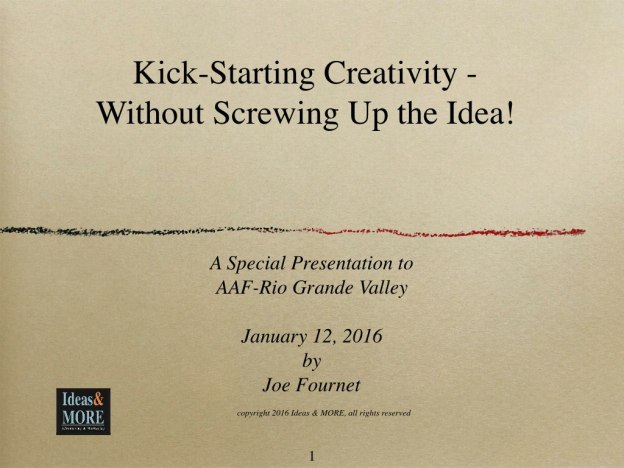
I recently had the honor and pleasure to present “Kick Starting Creativity Without Screwing Up the Idea” to the American Advertising Federation Rio Grande Valley. As with my other presentations in this series, I did some fine-tuning with this version.

I was last in the Valley before this same group back in 2008. The landscape and development may have changed (more of it) but the people have not – still friendly, wonderful, courteous . . . and, of course, creative!

Those of you who were in the audience can, hopefully, enjoy it again and get some useful tips. Those of you who did not experience it that day, may learn a few things. Naturally, what follows is just the visual and not, unfortunately, the experience itself.

Kick-Starting Creativity Without Screwing Up the Idea

Keynote version (no audio)

PDF version (no audio)


Do You Really Want to Park There? Beware the Hologram!

I was taken with this ad the first time I saw it. I was also quite unnerved. Why don’t we see more of this kind of campaign in the USA?
More than 30% of the drivers in Russia take disabled parking spaces without caring about the signs on the ground. Dislife, a Russian non-profit organization, came up with a powerful campaign to stop this inconsiderate behavior.
They installed projections of a real disabled person that popped up every time a non-disabled driver tried to park in their space. Special cameras verified the presence of the disabled sticker on their windshields and if no sticker was detected, the hologram would appear to confront the driver. Watch the stunt in action below.

Unnerving as it may be, the campaign is a great use of technology to deliver a powerful message. The agency is Y&R, Moscow. Bravo!

Feel free to share this post and your views in the comments below.

Adobe’s Creative Cloud Conference Good for Creative Community and OiH

If you live and work within driving distance of Houston, you owe it to yourself to come spend a day or two listening to and learning from Adobe’s experts as they teach all you need to know about the various applications within the Creative Cloud.

As the one stop source for finding creative talent in the Houston area, Only in Houston (OiH) is proud to be take part in presenting this Creative Cloud Masters Conference. Thanks to a partnership with Future Media Concepts, OiH members can now save 25% on their registration. Use promo code OiH15 to redeem your discount.

OiH Logo

WHY ATTEND?
Advance your skills with cutting-edge sessions
Discover time-saving techniques
Learn from top instructors in the field
Network with peers and expand your professional network

A must-attend event created for graphic designers and other creatives to perfect and diversify their skills. Join top industry speakers to learn the latest Adobe print and web design tools, plus get started in video production. The conference agenda features 3 days of training on graphic design, print, web design and motion graphics. Organized in Houston on March 11-13. Use discount code OiH15 to save 25% on your registration. 

Creative Cloud Conference Logo


So How Did They Make that Penguin so Realistic?

Okay, I admit it. I was captivated by the John Lewis Christmas commercial and wondered, “How’d they do that?!”

Creativity went behind the scenes to find out. I’m glad they did.

Love it or hate it, John Lewis’s Monty the Penguin holiday ad is an unstoppable seasonal juggernaut, with YouTube views now exceeding 17 million. One of the reasons for the appeal of the U.K. retailer’s ad is its realistic depiction of an Adelie penguin, created completely in CGI.

Behind the scenes of the making of Monty the Penguin

In this fascinating behind-the-scenes film from VFX house MPC, you can find out exactly how Monty was dreamed up, created and rendered. It’s full of interesting nuggets — for instance, Monty picks up the Lego bricks the way that real penguins pick up fish — as well as providing an insight into the film’s production, casting and more.


Announcing New Blog on Personal Insights Amid Life’s Potholes

As you may have noticed, I haven’t been here in some time. I’ve been rather preoccupied. While I’ll still contribute some creativity tidbits and other pertinent info on this blog, I wanted you to know I’ve begun a different one.

Joe’s Journey is the beginning of a series of thoughts and observations of my life as it is now, and my fight with Leukemia (CLL). Ever-mindful of branding, I wanted to keep the two blogs separate. And, as a writer, I have a thing for “Papa.”

I’d like to know what you think. Don’t be bashful. I’m not! 🙂

Creativity and Fear: Seth’s Take

Last month I posted a blog on creativity and fear. Interestingly, two days following my posting Seth Godin posted this:

 “How do I get rid of the fear?”

Alas, this is the wrong question.

The only way to get rid of the fear is to stop doing things that might not work, to stop putting yourself out there, to stop doing work that matters.

No, the right question is, “How do I dance with the fear?”

Fear is not the enemy. Paralysis is the enemy.

* * * * * * * *

I’m a follower of Seth’s and subscribe to is blog (linked above). There are times, however, when I wish he’d get into more detail or provide more insight about his points. This is one of those times.

In his brief post referenced above, he’s right. Paralysis is our enemy. We can do nothing when it envelopes us. We have to meet it head on and that can be scary. How do we do that? Well . . .

My earlier posting of “13 ways to deal with fear” also touches on the paralysis factor. We need to do something to jar ourselves out of this newly immobilized state.

When Seth states that paralysis is the enemy, how would one deal with one’s enemy. You can’t ignore him (the enemy), but you could go in another direction to get around him. You’ve faced him before and you’ll face him again. How each of us reacts depends on us. There is no one solution or antidote.

What do you think? How have you dealt with paralysis?