Top Tips for Kick-Starting Creativity

Albeit some years back, I came up with a list of tips for kick-starting one’s creativity. These are tips I’ve learned over the years and have put into practice. May they serve you as well as they have me!

Hopefully making a ruckus, one blog post at a time!

Be sure to check out my other blog, Joe’s Journey, for personal insights on life and its detours.


Feel free to review various creative selections from my website.

Quotes Anew

Well, it’s that time of the month again when I present a variety of quotes from different personalities from the worlds of creativity and advertising, among others. Take to heart but also take time to think. They’ll serve you well! Enjoy!


Creativity is no longer about grabbing attention or raising consumer awareness. Its goal is to remind consumers about what is fundamental and gratifying about a brand. — Peter A. Georgescu, member, Advertising Hall of Fame

Meetings are all too often the burial grounds of great ideas. — Keith Reinhard, member, Advertising Hall of Fame

Every area of trouble gives out a ray of hope, and the one unchangeable certainty is that nothing is certain or unchangeable. — John E. Kennedy, member, Advertising Hall of Fame

The creation of something new is not accomplished by the intellect but by the play instinct acting from inner necessity. The creative mind plays with the objects it loves. – Carl Jung

Most executives, many scientists, and almost all business school graduates believe that if you analyze data, this will give you new ideas. Unfortunately, this belief is totally wrong. The mind can only see what it is prepared to see. – Edward de Bono

Ideals are like stars; you will not succeed in touching them with your hands. But like the seafaring man on the desert of waters, you choose them as your guides, and following them you will reach your destiny. – Carl Schurz

The self you know, the you deep inside, is obscured by a stack of untold stories.
Janet Mock, writer, television host, director, producer and transgender rights activist

The person who knows HOW will always have a job. The person who knows WHY will always be his boss. – Alanis Morissette

To think is to practice brain chemistry. – Deepak Chopra

A life spent making mistakes is not only more honorable, but more useful than a life spent doing nothing. – George Bernard Shaw


Hopefully making a ruckus, one blog post at a time!

Be sure to check out my other blog, Joe’s Journey, for personal insights on life and its detours.

The Day the Monster Visited Martian Colony

{Author’s Note: This is a special blog post featuring my 12th short story. This Thursday will also feature the story on my other blog, Joe’s Journey, for those different audience members. Hope you enjoy it and Happy Mardi Gras!}


It was an unassuming place by all accounts. It stood there off the beaten path but welcoming to those wanting of a beverage or two. Or so it seemed. John and Terry were on their way home after a series of meetings during the day when they drove by in their hovercraft and decided to stop. As soon as the pair walked up to the entrance, they were met by the Bouncer who unemotionally proclaimed that only Terry was really welcomed here.

When the two inquired as to why, they were told that no one of blue skin was allowed inside. When the two pressed the issue, saying it was ridiculous in this day and age, they came nose to barrel with an old fashion, but still lethal, shotgun. The Bouncer simply stated that should they try to enter, they would be blown to bits. Both of them. When Terry asked why both of them, he was told, “Because you brought Blueskin with you!”

Feeling rightly discriminated upon, the two attempted to gain entrance. John immediately grabbed for the shotgun when it went off right in John’s face. As his head rolled down the steps, the gun went off again in Terry’s direction and in seconds only his torso remained standing. The bouncer just stood there, unemotional, and called for “cleanup at the entrance.” Soon, the bodies were quickly carried off and all was back to “normal.”

The Monster was alive and well.

Continue reading

Special Post – Beyond the Majestic: The Final Chapter

This is the third and final installment in the Majestic Trilogy. After several months of waiting for the next developments in the story line of the original “Stopover at The Majestic“, and its sequel, “Beyond the Majestic: The Evil Doer“, comes the Final Chapter. This special blog post highlights this last installment.

Majestic Hotel, Lake Charles, LA, circa unknown

Previously at The Majestic

As we were about to leave the last part of the Evil Doer sequel, the lobby was a scene of chaos. Mr. Curtis, still somewhat dazed, began to slowly move around and see to the cop. It would be a few minutes before emergency personnel would appear on the scene. In the midst of all this, Mr. Curtis wondered if the explosion were merely coincidental or if it was a plan by the GM to help him get away and remain on the Galaxy’s Most Wanted List.

That would have to be a question left for another day. Why was the GM/Time Traveler doing all this? Why did he want the Majestic transported to another time? Why be so reckless? Too many questions. Too few answers, thought Mr. Curtis. Now what?

As he tried to make his way around the immediate chaos where the cop lay, Mr. Curtis felt unsure of himself. He got more woozy and unsteady. Then as he got to the cop, Mr. Curtis suddenly fell to the floor, unconscious. Their search for answers would have to wait.


And Now, The Final Chapter

“Get that damn light out of my face!,” exclaimed Mr. Curtis. “Relax sir,” intoned the stranger. “Just checking your reflexes and your cornea.”

“Who are you and where am I?,” asked Mr. Curtis. “You’re in the hospital. I’m Dr. Zooski. You’re doing just fine, all things considered,” he said.

“Whaddaya mean?,” retorted Mr. Curtis.

“You’ve suffered a concussion and been in a coma, sir,” explained the good doctor.

“How long have I been out?,” inquired Mr. Curtis.

“Three months, fourteen days, seven hours and some assorted minutes,” said Dr. Zooski.

“Three months!,” exclaimed Mr. Curtis. “I’ve gotta get outta here! Wait, how’s the officer who was injured nearby? I need to talk to him. I need to find the GM of the Majestic, find out where he went,” explained Mr. Curtis.

“Hold on, sir. You’re not going anywhere for awhile. You just woke up from a three-month coma and we want to make sure you’re okay,” said the doc. “As for your officer friend, I’m sorry to say he didn’t make it. His internal injuries were more than he could overcome. And I have no idea about the Majestic GM,” said the doctor.

Mr. Curtis then realized that now he was on his own if he wanted to get to the bottom of the GM’s involvement with the explosion and the status of the Majestic. But where would he go and what would he do? These questions naturally troubled Mr. Curtis and also made his headache worse. No matter, he obviously wasn’t going anywhere for some time and now had more time to think and consider possibilities.


******


It has been several weeks since Mr. Curtis awakened from his coma and he was feeling much more like his old self. He thought in order to start gathering some clarification on the explosion, he’d return to the scene of the crime, the Majestic. He would talk to management and find out what, if anything, they knew. Maybe a few clues would emerge.

What he learned was that the explosion was no accident, it was arson. Evidence on the scene indicated that the former GM had indeed played a part if not planned and executed the whole thing. Question is: Where is he now? And why did he do it?

Mr. Curtis found himself wondering if other, additional sites have been targeted by this fellow and if they would alter the Space-Time Continuum. Curtis had to find out and subsequently stop him.

If the GM had been set on “moving” the Majestic into the future for whatever the reason, Mr. Curtis thought, wouldn’t it make sense for him to set himself up as general manager of the futuristic Majestic and have it serve as his HQ for more evil doing?

With this in mind, Curtis set out to locate him and confront him, and, hopefully, put a stop to the madness. So, with his time-traveling cane, Mr. Curtis set off to the future, the 24th Century to be exact. This is where he felt the GM had settled with the new Majestic.

Upon reappearing inside this futuristic Majestic, Mr. Curtis wasted no time in searching for the GM. In a matter of minutes, he found him. Not ever knowing the man’s name, Curtis opted for an introduction of himself and immediately knew the GM recognized him. After a few moments of surprise, the GM collected himself and introduced his person to Mr. Curtis. However, the look of surprise and concern were still evident on the GM’s face.

Nevertheless, the GM did not try to run away. Instead, he remained calm and in conversation with Mr. Curtis. He even acknowledged he was aware of what happened to the old Majestic and felt bad about the explosion in the historic landmark. He was not aware, however, that the officer at the scene had died. He also never admitted responsibility.

Mr. Curtis laid it out clearly for him who he was and his mission: Making the GM pay for his crimes. The GM seemed unflappable and unmoved by the possible repercussions. As such, he turned away from Mr. Curtis, answering no more questions, and proceeded to walk away.

Just then, Mr. Curtis picked up his walking stick and adjusted the very top where the indicator light showed “stun.” Pointing it toward the back of the GM, Mr. Curtis activated the setting and in a flash the GM crumbled to the marble floor unconscious.

Because a crowd had begun to gather around the two men, Mr. Curtis flashed his badge-like credentials and assured the gathering that all was under control. After a few minutes, Mr. Curtis had the GM moved to a private room where he could question him more and, if needed, to transport him back in time to the old Majestic or, possibly, even to the Space-Time Continuum Enforcement Council for trial.

Upon the GM regaining consciousness, Mr. Curtis continued with his interrogation. During questioning, he learned that the GM had indeed been responsible for the Majestic arson explosion in order to give himself a diversion for escape into the future. He had also rigged it so that he would in effect take the Majestic with him into a future setting so that he could reestablish his headquarters.

When pressed, Curtis also learned that the GM apparently acted alone in this evil deed but the GM never admitted it. Mr. Curtis thought that even if the GM acted alone, it was not beyond the realm of possibility that there were others who had been influenced by the GM and would follow him to other sites for more destruction and damage to the timeline.

Having received the information needed, Mr. Curtis decided it was time to move on and take the GM with him. He would transport him to the Enforcement Council for trial and processing. Holding up his walking stick, he merely stated, “Space-Time Continuum Enforcement Council, two to transport.” Then, poof, they were gone in an instant.

The evil GM was turned over to authorities, tried and convicted. Mr. Curtis had repaired the Space-Time Continuum and, for the moment, all was back to a rather normal state. Unfortunately for the Majestic, it would be torn down in the early 1960s for a parking lot. Thus, the Majestic of the 24th Century would cease to exist.

After the trial, Mr. Curtis returned to the Majestic of the Sixties before its demolition and was rummaging around the evil GM’s office when he came upon an oddly shaped locket. It had a ruby red crystal in the middle which was obviously designed to be pressed into some form of action. Upon closer examination, Mr. Curtis discovered that it was already set to activate and, not only that, but was currently set to emit a beacon of sorts. 

Mr. Curtis felt a deep, unsettling tenseness in his gut when he realized the beacon was “live” and transmitting. Was this some sort of homing mechanism and to whom was this signal being sent? In the pit of his soul, he didn’t really want to know but he feared it was already too late.

~

On Imagination – Another’s Thoughts

“To see, to hear, means nothing. To recognize (or not to recognize) means everything.” – André Breton

This week’s creativity blog shares another’s perspective. I’m on her email list and this particular email dissertation I found quite interesting. She goes by the name “The Used Life” and is an artist extraordinaire.

Here are some of her thoughts . . . what are some of yours?

I think of my art as an articulation of my inner life. That all of the scenes that take shape in my collage art (and poetry, too) also exist within me. There is a mystery in that which I love: that is, the mystery of human imagination. Indeed, it is a rare occasion when I am able to explain clearly and succinctly what I believe my artwork means. I like not knowing. No, I love not knowing. It is the mystery that makes it meaningful.

It is also, I think, the element of mystery that creates something akin to a mystical or religious experience—the feeling that, when I am creating, I am acting as a conduit, or channel, for “something else”, something almost otherworldly or unreal.

But, what’s the “something else”? What do I think is really happening in those moments, and what is the role of imagination in that process?

First, let me clarify by saying that I don’t define “imagination” as the ability to conjure images at will. That, I think, is a very small part of what comprises our imaginations. Here are some thoughts.

Imagination is a loss of separateness.

It is the recognition of ourselves in another—in another person, in an animal or landscape, in a character from a novel, a scrap of discarded paper, or a cardboard box. I would suggest that this “moment of recognition” is where the feelings of awe, of ecstasy, or even love that often accompany or precede creativity come from.

“Imagination is the outreaching of mind…the bombardment of the conscious mind with ideas, impulses, images and every sort of psychic phenomena welling up from the pre-conscious.” – Rollo May

What psychoanalysts might call a kind of projection, or a “leaky” subconscious. Imagination is the outpouring of inner images onto the outer world, such that a third image—a new image—may be born.

Imagination is a way of perceiving.

Maslow talks a great deal about what it means to see “unitively”, suggesting that many self-actualizing people encounter the world in a manner that allows them to see the sacred in the everyday. In the essay, “Theory Z”, he suggests self-actualizers may be divided broadly into two groups: those who experience episodes of self-transcendence (i.e., artists, poets, musicians, other creators), and those who are more pragmatic thinkers (i.e., businesspeople, entrepreneurs, politicians, scientists).

The difference between them: pragmatic thinkers deal with the here-and-now, operate within the confines of concrete reality. Transcenders are able to perceive the stuff of everyday life within the context of eternity and, as a result, are able to perceive (or feel they are perceiving) the “sacred” or “miraculous”.

What I think: the latter see imaginatively. What Maslow refers to as the perception of eternity is a function of imagination. It is the natural “outreaching of mind”, the involvement of the subconscious, or preconscious, primordial images and the emotions they carry. That’s where those feelings of “eternity,” “otherworldliness,” “surreality,” or even of encountering “the sacred” in the everyday (or in a work of art) come from.

What’s more: children see imaginatively. We were all, at one time, able to see imaginatively without trying…which leads me to my last point.

Our imaginations transform the everyday into the extraordinary.

Without the imaginative encounter—that is, without the fusion of inner and outer worlds—I doubt we would ever be able to perceive the extraordinary. I think we need those subconscious projections, those “leaky” images, impulses, and ideas. They tell us who we are. They help us make meaning. That outpouring of the unreal is what gives reality its shine.


Hopefully making a ruckus, one blog post at a time!

Be sure to check out my other blog, Joe’s Journey, for a different kind of playground for creativity, innovation and inspiring stuff.

Originality: Not required for creativity

Whether or not you agree with the premise, I found the following essay from Psychology Today an interesting take on a myth that still finds itself debatable in certain circles. Where do creative ideas come from? Are they truly original? Well, according to the essay . . .

One of the most persistent myths is that a creative idea is a totally original idea. That is, to be creative one must be able to create ideas that have never been thought before, ideas that never existed before, absolutely original. {Personally, I don’t buy this.}

{One could consider saying that all original ideas are creative but not all creative ideas are original. I would not necessarily agree with the first part of that statement but I would agree with the second part.}

The truth is that most innovative ideas are not original ideas. In most cases, they are simply the combination of previous ideas into a new concept or format. It’s about making connections with stuff that’s already there. Steve Jobs, the founder of Apple, brought this all into perspective when he said:

Creativity is just connecting things. When you ask creative people how they did something, they feel a little guilty because they really didn’t do it, they just saw something. It seemed obvious to them after awhile. That’s because they were able to connect experiences they’ve had and synthesize new things. And the reason they were able to do that was that they’ve had more experiences or that they have thought more about their experiences than other people.


One of the most-oft cited cases of creativity centers around Johannes Gutenberg who, in 1450, combined the wine press and the coin punch to create movable type and the printing press. Movable metal pieces allowed pages to be printed much more quickly than the standard wooden blocks used to press ink onto paper.

His “combination of pre-existing technologies” created printing presses that could print thousands of pages a day. This revolution allowed books to be printed more quickly and more efficiently, allowing the middle class to obtain them as never before. The result was the rapid spread of knowledge across the European continent. That intellectual revolution came about due, in large measure, to the combination of two previous (and seemingly unconnected) ideas: a wine press and a coin punch.

Creative Combinations

Ancient Greeks were also aware of the power of creative combinations. For example, it was the Greeks who combined soft copper with soft tin to create hard bronze. At their most basic levels, Gutenberg’s printing press and the creation of bronze were simply a combination of already existing ideas. History also records these interesting combinations of pre-existing concepts:

1. Copier + telephone = fax machine

2. Bell + clock = alarm clock

3. Trolley + suitcase = suitcase with wheels.

4. Igloo + hotel = ice palace

5. Mathematics + biology = laws of heredity

We like to believe that creativity is the result of a determined, focused, and solo entrepreneur who, through a flash of inspiration solves a problem for the betterment of humankind. It’s a great plot line for a TV special, but it ignores a basic fact of life about the stories of most innovations: They rarely include the human networks that sustain (and make possible) radical new ideas or changes. In fact, history is frequently edited in order to recognize a sole genius or innovator. Phil McKinney, host of the nationally syndicated radio show, Killer Innovations, puts it this way:

We have a saying in the innovation industry: “There’s no such thing as a truly new idea. Ideas are the result of building on the work of others.” Many of the creative ideas that led to creating great companies were the result of a team. Some examples: Microsoft, Intel, Google, Skype and many more.

We continue to think that to be creative is to have the ability to create new ideas rather than to combine old ideas into new configurations. It’s a persistent myth that frequently blocks us whenever we’re faced with a personal challenge or work-related endeavor. To the contrary, however, creativity is not always a series of “brilliant new ideas,” but often is the result of a lifetime of experiences and diligence in working on combinations of those ideas (instead of giving up on them after one or two failures). The myth that every idea must be an idea never considered before (in the history of humankind) is a significant impediment to our ability to think creatively.

Key Takeaways

  • We often make the mistake of assuming that creative ideas are always original ideas.
  • Creativity is, quite often, a combination of two “old” ideas.
  • One’s creativity can be enhanced by linking two or more disparate concepts.

Regardless of one’s viewpoint, never be afraid to brainstorm with your own imagination and consider borrowing from other ideas. Those ideas can always be improved upon and/or give birth to a totally new and different idea. That’s being creative.


Thanks to Dr. Fredericks for the essay and for the various examples of original thought on which this post is based. Anthony D. Fredericks, Ed.D., is Professor Emeritus of Education at York College of Pennsylvania and the author of From Fizzle to Sizzle: The Hidden Forces Crushing Your Creativity and How You Can Overcome Them.


Hopefully making a ruckus, one blog post at a time!

Be sure to check out my other blog, Joe’s Journey, for a different kind of playground for creativity, innovation and inspiring stuff.

Quotes – Special Edition

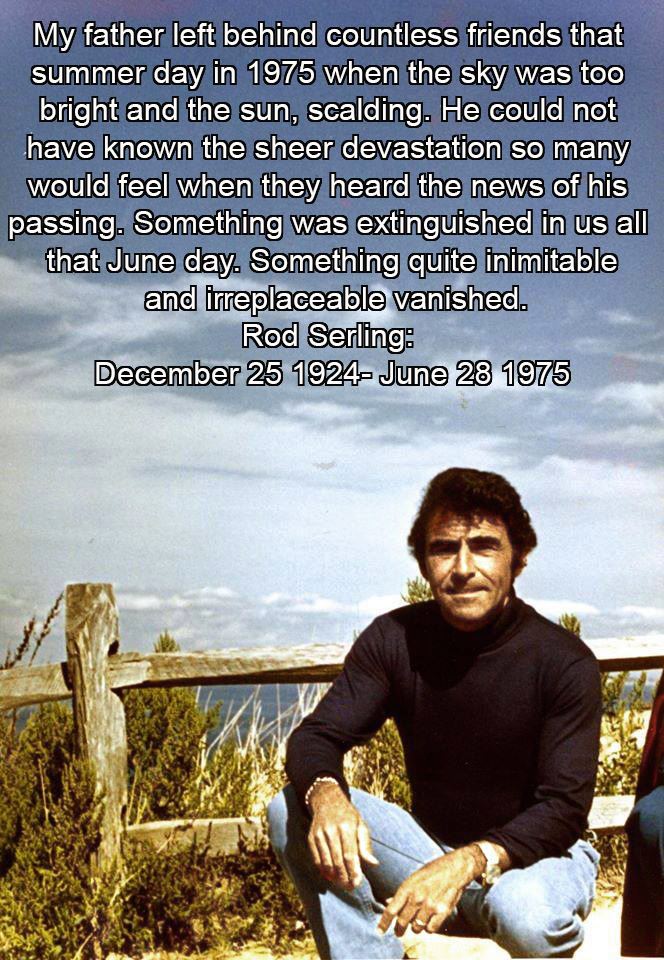
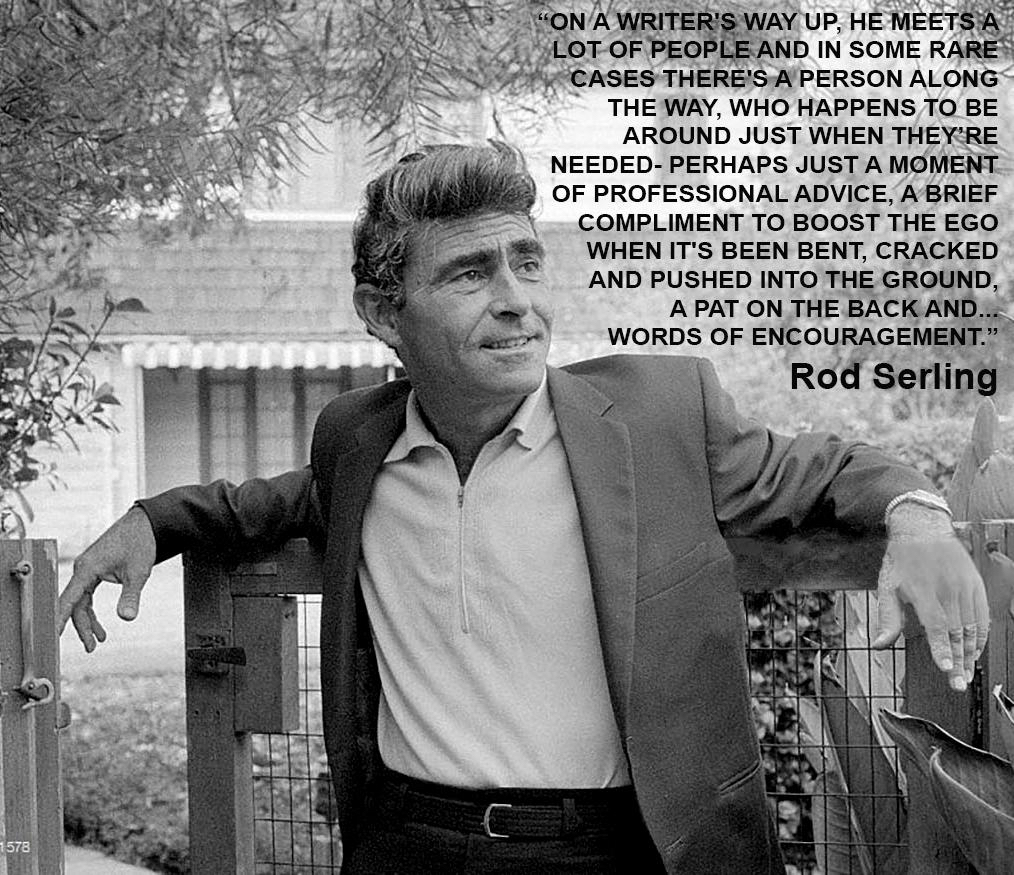
Forty-seven years ago this week, June 28, 1975, creativity lost an icon. A mentor to many both near and afar and an inspiration to those of us putting “pen to paper.” Rod Serling, creator and host of the TV series, The Twilight Zone, was a master at utilizing one’s imagination and turning it on its ear. And we loved him for it!

These quotes pay tribute not only to Rod but to various creative artists and thought leaders who have also played a role in tweaking our imagination and how we think.

I just want [people] to remember me a hundred years from now. I don’t care that they’re not able to quote any single line that I’ve written. But just that they can say, ‘Oh, he was a writer.’ That’s sufficiently an honored position for me.Rod Serling

An important idea not communicated persuasively is like having no idea at all. — William Bernbach, Advertising Hall of Fame

Human beings must involve themselves in the anguish of other human beings. This, I submit to you, is not a political thesis at all. It is simply an expression of what I would hope might be ultimately a simple humanity for humanity’s sake. ― Rod Serling

Like the musical score, a mission statement is only as good as the performance it inspires. — Keith Reinhard, Advertising Hall of Fame

Let’s gear our advertising to sell goods, but let’s recognize also that advertising has a broad social responsibility. — Leo Burnett, Advertising Hall of Fame

Treasure diversity. Seek unity, not uniformity. Strive for oneness, not sameness. — Dan Zadra, American businessman and author

Human history becomes more and more a race between education and catastrophe. – H. G. Wells

Good advertising is written from one person to another. When it is aimed at millions, it rarely moves anyone. — Fairfax M. Cone, Advertising Hall of Fame

In order to attain the impossible, one must attempt the absurd. – Miguel de Cervantes

I think, at a child’s birth, if a mother could ask a fairy godmother to endow it with the most useful gift, that gift should be curiosity. – Eleanor Roosevelt
 
Failure is the condiment that gives success its flavor. – Truman Capote


Hopefully making a ruckus, one blog post at a time!

Be sure to check out my other blog, Joe’s Journey, for a different kind of playground for creativity, innovation and inspiring stuff.


Live long and prosper, Ukraine.

Beyond The Majestic: The Evil Doer

A sequel to the short story Stopover at the Majestic

PROLOGUE

When last we visited, the year was 1965 and our two strangers were chatting up one another in the lobby of the Majestic Hotel, just before it was to be torn down. One of the strangers is Timeline Police. The cop knows our Time Traveler is not from 1965 but the closely guarded Timeline has been disrupted; how is not known. The police are investigating. Could our time-traveling Stranger end up being trapped in 1965 at the Majestic? After their conversation, our Time Traveler, Mr. Curtis, decides it is time to move on. So with a doff of this hat and a swirl of his cane, he does and in a flash, he’s gone. Again. Only to encounter unexpected twists along his journey through time.


The year is 3068 and Mr. Curtis is now visiting another world in the Gamma Quadrant of the Solexa Solar System. The planet, similar to Earth, is not all that old. However, the surface is desolate except for one large city. Mr. Curtis, it seems, has been drawn here to see the city’s largest building. He is, among other things, a curiosity seeker.

The building is a relatively old hotel, rather grandeur in stature. Upon first glance, he thought he recognized it but he’s never been here before. Then it hits him: It’s a replica, an exact replica but a working replica nonetheless of the long-ago demolished Majestic Hotel in Lake Charles, LA, back on Earth in 1965.

How could that be? Who built it and why the Majestic?

As he stands there in front of the lobby admiring its architecture, he feels a tap on his shoulder and a voice, “Hey there. Fancy meeting you here.”

Startled, Mr. Curtis swings around to see who is disturbing him.

It’s the Timeline Police cop from Earth!

“I could say the same thing about you,” retorts Mr. Curtis. “What are you doing here?”

“I’m investigating the breakdown of the Timeline back in 1965, when you and I first and last met,” says the cop. “You seemed to have left the Majestic awfully quickly. And now I see you here in front of another Majestic Hotel more than 200 years in the future. Curious! What gives?”

“Well, it is curious. I felt a strange yearning to come to this planet and when I arrived, I was drawn to this spot, where the hotel is. Believe it or not, I did not expect to see another Majestic Hotel,” explained Mr. Curtis.

“You said you were investigating the breakdown of the Timeline back in 1965,” inquired Mr. Curtis. “Have you any answers?” he asked. “I know I did nothing to impact the Timeline. That’s not to say I wasn’t tempted, mind you.”

“Well,” intoned the cop, “something happened to the Timeline because the Majestic Hotel back then was not torn down in 1965. Oh, sure, a parking lot is in its place or was but that was later.”

Mr. Curtis interrupted, “But, all the history books say the hotel was torn down in 1965 and show photos of its demolition. How could that be if it was not torn down then?”

“Trust me,” said the cop. It wasn’t. And the only way for that to have happened was for someone to adjust the Timeline. I don’t know who and I don’t know how but it was done. The evidence is where we are standing. This is not merely a replica of the Majestic, Mr. Curtis. It is the Majestic. Somehow when the Timeline was altered, the hotel was transported to 3068, right where we are standing.”

“Okay,” sighed Mr. Curtis, “now I feel like I’m in the Twilight Zone. Before we know it, Rod Serling is going to come out from behind the Concierge Desk!”

“So where does this leave you in you investigation, Mr. Timeline Policeman?,” asked Mr. Curtis. “Since this happened back in 1965, wouldn’t it make sense to return to that time and ask around?” he said.

“I’ve considered exactly that, but I may need some help to draw out our Timeline provocateur,” said the cop.

“What did you have in mind?,” inquired Mr. Curtis.

“Come join me for a cocktail at the Majestic Bar and I’ll fill you in with my plan,” invited the cop.

Continue reading

Images of Creativity

Images, works of art. Striking. Unsettling. Amazing. Jaw dropping. Awesome.

Creativity in its different forms.

Below are a few examples of spaces that accommodate large scale installations.


Going big in small spaces. Irrespective of the environments we design, there are always opportunities to create unexpected scale through architectural intervention. It’s a strong and powerful way for brands to transport an audience to another world.


Credits:

Artist Matthew Mazzotta has designed HOME at Tampa airport

AC Milan HQ by Fabio Novembre

Sophie’, 2009 in Germain Restaurant, Paris by Xavier Veilhan

‘Karma’ is by the Korean sculptor and installation artist DO HO SUH STUDIOS LLP  


Hopefully making a ruckus, one blog post at a time!

Be sure to check out my other blog, Joe’s Journey, for a different kind of playground for creativity, innovation and inspiring stuff.


Live long and prosper, Ukraine.

When Your Muse Strikes, Follow It.

I don’t know how Seth Godin does it. He writes and publishes a blog everyday, 365 days a year. I have trouble publishing my two blogs each WEEK!

Part of my problem is having something interesting to publish. That is every blogger’s nightmare. There have been times I write a blog the night before because I came up with an idea and just developed it.

When I’m in a pinch and nothing comes to mind, I try and change my focus. In a way, I let myself become distracted, not by merely doing something else but by switching creative gears and concentrating on another creative project.

It was where my muse wanted to take me, so I let it. What is a muse you might ask?

Muse, in Greco-Roman religion and mythology, any of a group of sister goddesses of obscure but ancient origin, the chief centre of whose cult was Mount Helicon in Boeotia, Greece. They were born in Pieria, at the foot of Mount Olympus.

They probably were originally the patron goddesses of poets (who in early times were also musicians, providing their own accompaniments), although later their range was extended to include all liberal arts and sciences—hence, their connection with such institutions as the Museum (Mouseion, seat of the Muses) at Alexandria, Egypt. There were nine Muses as early as Homer’s Odyssey, and Homer invokes either a Muse or the Muses collectively from time to time.

Virgil (centre) holding a scroll with a quotation from the Aeneid, with the epic Muse (left) and the tragic Muse (right), Roman mosaic, 2nd–3rd century ad. Courtesy of the Musée Le Bardo, Tunis

As the creative juices begin to flow and my “new” project begins to take shape, I begin to develop several ideas that would make for interesting blog posts. I did, however, make sure I finished what I had previously started so I could “celebrate” the accomplishment (a musical slide show).

Whether or not you follow your instincts when you have a calling to do so, is up to you. Your mind and imagination are wondrous tools in the creative process. Don’t ignore them.


Hopefully making a ruckus, one blog post at a time!

Be sure to check out my other blog, Joe’s Journey, for a different kind of playground for creativity, innovation and inspiring stuff.


Live Long and Prosper, Ukraine!