The Shadows: a Short Story of Ghastly Gatherings

Today is a different kind of blog post. I’m using it to introduce my newest piece of short story fiction. It took me a longer than expected amount of time to complete it, but I finally did. Hope you enjoy it!

********

Welcome! This is a profile in the macabre. It’s a short story about a family who lived in the 19th Century. They lived a rather normal lifestyle back then, aside from a few setbacks in life. They’ve survived but not in the way you might expect.

Introducing the Graybeers: Mr. and Mrs. Jonathan and Priscilla Graybeers, and their two children, Tony and Stephanie, ages 14 and 16, respectively, at the time of death. Tony was shot in the head while Stephanie was downed by an ax. Back in 1862.

Mr. and Mrs. Graybeers committed suicide, each at the other’s hands. In 1863, following a tumultuous year of mental anguish over the loss of their children. It seems mental illness takes its toll.

Looking back, they were a typical northeastern suburban family, college educated, upper middle class, sports-minded.

In present day, they’re like most other families of similar ilk except for one thing: they can disappear. Oh, yes, one other thing: they don’t really have human form; they’re not ghosts, they’re shadows from their former life. They even live in a mansion called The Shadows, which is near a cemetery.

This image has an empty alt attribute; its file name is the-cemetary-by-jaroslav-gebr.jpg
The Cemetery by Jaroslav Gebr

Aside from select social occasions, the family rarely leaves the Shadows. The mansion has been in their family for centuries. And the location next to the cemetery has always been a family favorite, so no one has ever thought of selling the property.

Although on rare occasions, an unwitting realtor will appear at the door only to be “greeted” by Mr. Graybeers himself. But being a shadow, he really can’t be seen so the realtor leaves his card and walks away, seemingly unaffected by the opening and closing of the door — by itself.

Continue reading →

To Quote is to Speak, to Listen, to Learn!

The subject matter may vary. The speaker may vary. The quote may still be memorable no matter who says it. Keep that in mind when reciting any one of the quotes below. It will make for a memorable occasion.


Advertising becomes a dialogue that becomes an invitation to a relationship. — Lester Wunderman, member, Advertising Hall of Fame

Thinking about ourselves isn’t related to knowing ourselves. — Lauren Esposito, arachnologist, co-founder of 500 Queer Scientists

Nothing comes merely by thinking about it. — John Wanamaker, member, Advertising Hall of Fame

Regardless of the moral issue, dishonesty in advertising has proved very unprofitable. — Leo Burnett, member, Advertising Hall of Fame

Attract attention, maintain interest, create desire and get action. — E. Elmo St. Lewis, member, Advertising Hall of Fame


Rules are for people who don’t know what to do. — Keith Reinhard, member, Advertising Hall of Fame

I don’t like closed doors. Creativity flourishes best in an environment of open doors and open minds. — Keith Reinhard, member, Advertising Hall of Fame

Advertising is what you do when you can’t go see somebody. That’s all it is. — Fairfax Cone, member, Advertising Hall of Fame


Hopefully making a ruckus, one blog post at a time!

Be sure to check out my other blog, Joe’s Journey, for a different kind of playground for creativity, innovation and inspiring stuff.


A “How to” for Improving Your Creativity

Usually every week I come across an article or narrative on creativity, its many facets and how better to utilize one’s own creativity. Such is the case this week.

One of the subscriptions I maintain (zero cost, but there is an option for minimal cost) is with Medium. I’ve even posted some of my writings on the site.

This week I came across a posting having to do with noise and the role it plays in creativity. It was written by Donald Rattner, Architect, and since it has some very interesting points, I’d like to share it with you. . .

. . .Maybe it was inevitable, but after years of touting the virtues of the open workspace, people who plan and use them appear to be having second thoughts about its effectiveness. Among the biggest drivers behind the mounting backlash are complaints about noise, especially in the form of overheard conversations, ringing phones, and clattering machines.

But before you jump on the “silence is golden” bandwagon, it might be worth taking a step back to assess the problem with a cooler, more objective eye, especially if you spend some part of your day in creative problem solving. The reason? A modicum of noise has been found to boost idea generation, rather than interfere with it.

Noises Off or Noises On?

Credit a team of researchers drawn from several different universities for daring to challenge status quo thinking.

In 2012, the trio published a paper documenting a series of lab experiments they ran to study the effect of noise on creative task performance. Their methods were pretty straightforward: Subjects performed various exercises designed to measure ideational fluency and open-mindedness while a soundtrack played in the background.

The track played at either a low (50 decibels), middle (70db), or high volume (85db). A fourth group performed the same exercises without any accompanying soundtrack to establish a baseline from which to measure the collected results.

Contrary to expectation, the people in the quiet sessions did not achieve the top scores. That honor went to subjects exposed to midlevel noise (70db).

Illustration: The author

As a point of reference, 70db is the rough equivalent of the din at a bustling restaurant or coffee shop. It also approximates the loudness of a running shower, which is probably one reason why we so often get good ideas while under the spigot.

It’s evident from the data that the right type and level of noise can literally change the way our creative minds work. But how? And why? And how do we harness this information to boost our creative output in real-world settings?

Guilford’s Model of Creative Thinking

A model of creative thinking first developed in the 1950s might be the most effective vehicle for providing answers to these questions.

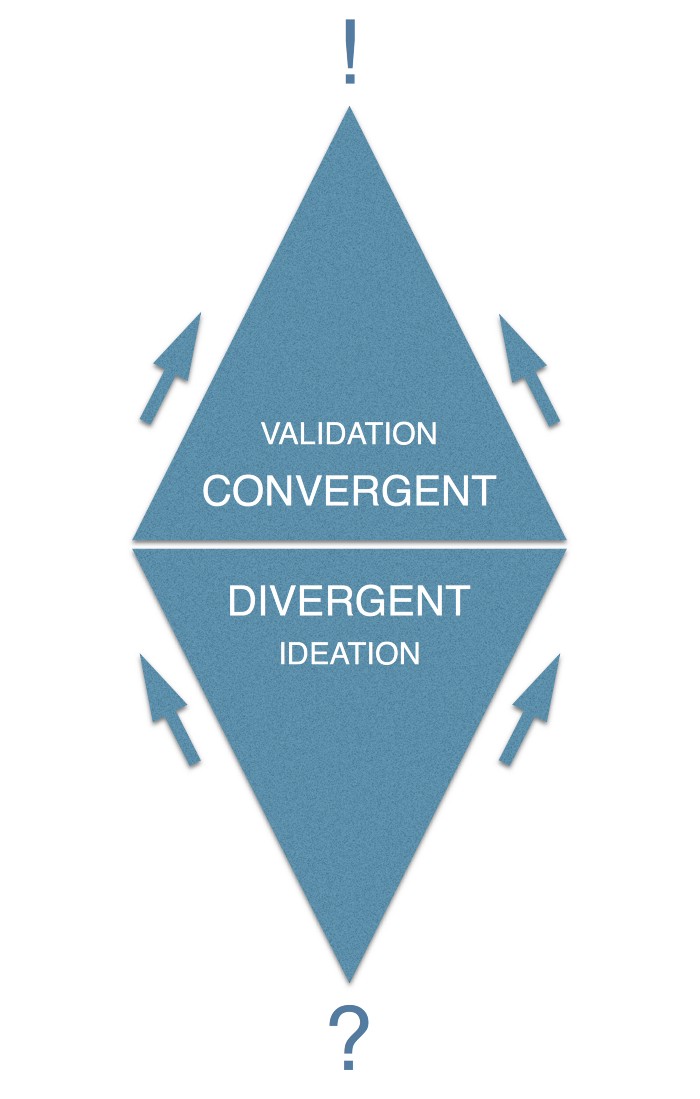
The model was the brainchild of the psychologist J.P. Guilford, an important figure in the history of modern creativity studies. Its basic premise is that creative thinking comprises two styles of cognitive processing: divergent and convergent.

Divergent thinking corresponds to what we variously call right-brain or generative thinking. It is generally abstract, big-picture, intuitive, nonlinear, and inward-focused in nature. It induces us to see things as they could be, rather than as they are.

Convergent thinking is nearly the mirror opposite. Unlike divergent thinking, it is rational, objective, sequential, narrowly focused, highly detailed, and concrete in character. It looks outward rather than inward for answers, such as when we apply the external laws of mathematics to calculate the sum of two plus two, instead of drawing from our imagination.

For Guilford, the creative process is neither one nor the other alone, but both styles working in tandem, and nominally in sequence.

Illustration: The author

As a linear progression, Guilford’s model translates into a five-stage process composed of the following phases:

  1. Definition of the problem to be solved: (?).
  2. A period of divergent thinking, during which you open up your mind to as many ideas for potential solutions as time, budget, energy, or creative capability allow. Brainstorming is a technique for inducing divergent thinking.
  3. A point of inflection where divergency ceases and convergency begins.
  4. A period of convergent thinking, during which you narrow down your options to zero in on a potential solution, which is then tested and validated.
  5. Realization of a final solution: (!).

In real life, of course, the creative process rarely travels in an uninterrupted straight-line trajectory from (?) to (!). More often than not, you find yourself going backwards one or more steps before getting to your goal — if you reach it at all.

But as a conceptual model, Guilford’s paradigm gives a pretty accurate picture of how our minds work in the course of working out feasible solutions to creative problems.

The Value of Noise

Continue reading →

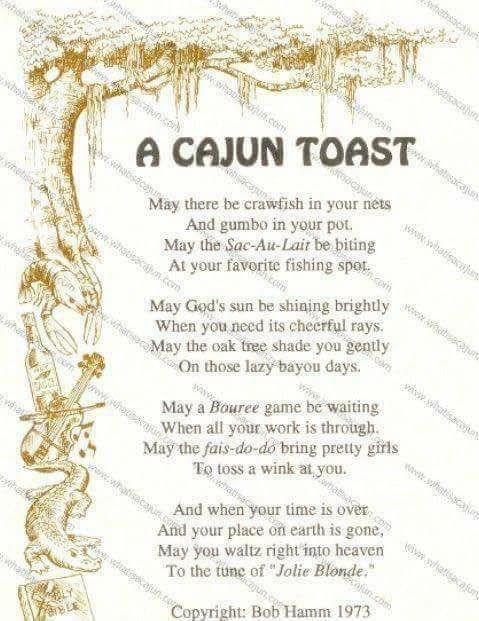
A Toast Unlike Any Other

New Year’s has a lot of tradition surrounding it. Champagne and toasts are usually at the top of the list, right alongside resolutions. It takes a certain amount of creativity to come up with a toast, so when I came upon this toast the other day I thought it somewhat appropriate to share. I couldn’t help it, given that I’m from the Bayou State of Louisiana.

Enjoy! Cheers!


Hopefully making a ruckus, one blog post at a time!

Be sure to check out my other blog,Joe’s Journey, for personal insights on life and its detours.


Have a Happy Holiday Season, Anyway!

Whether you be . . .

And I Regret Nothing! (SVG Land)


Or on the Nice List . . .

By Wily Alien


Hopefully making a ruckus, one blog post at a time!

Be sure to check out my other blog,Joe’s Journey, for personal insights on life and its detours.

Ye Olde Creativity Survival (Tool)Kit

Last week I posted about my upcoming trek to Baton Rouge and shared a list of creative guidelines to keep in mind when enhancing one’s creativity. That was what I shared with the ad club of Baton Rouge last Friday. One of the main items I shared was the Creativity Survival Kit and that’s what I’d like to review on this post, especially for folks who have no idea what I’m talking about.

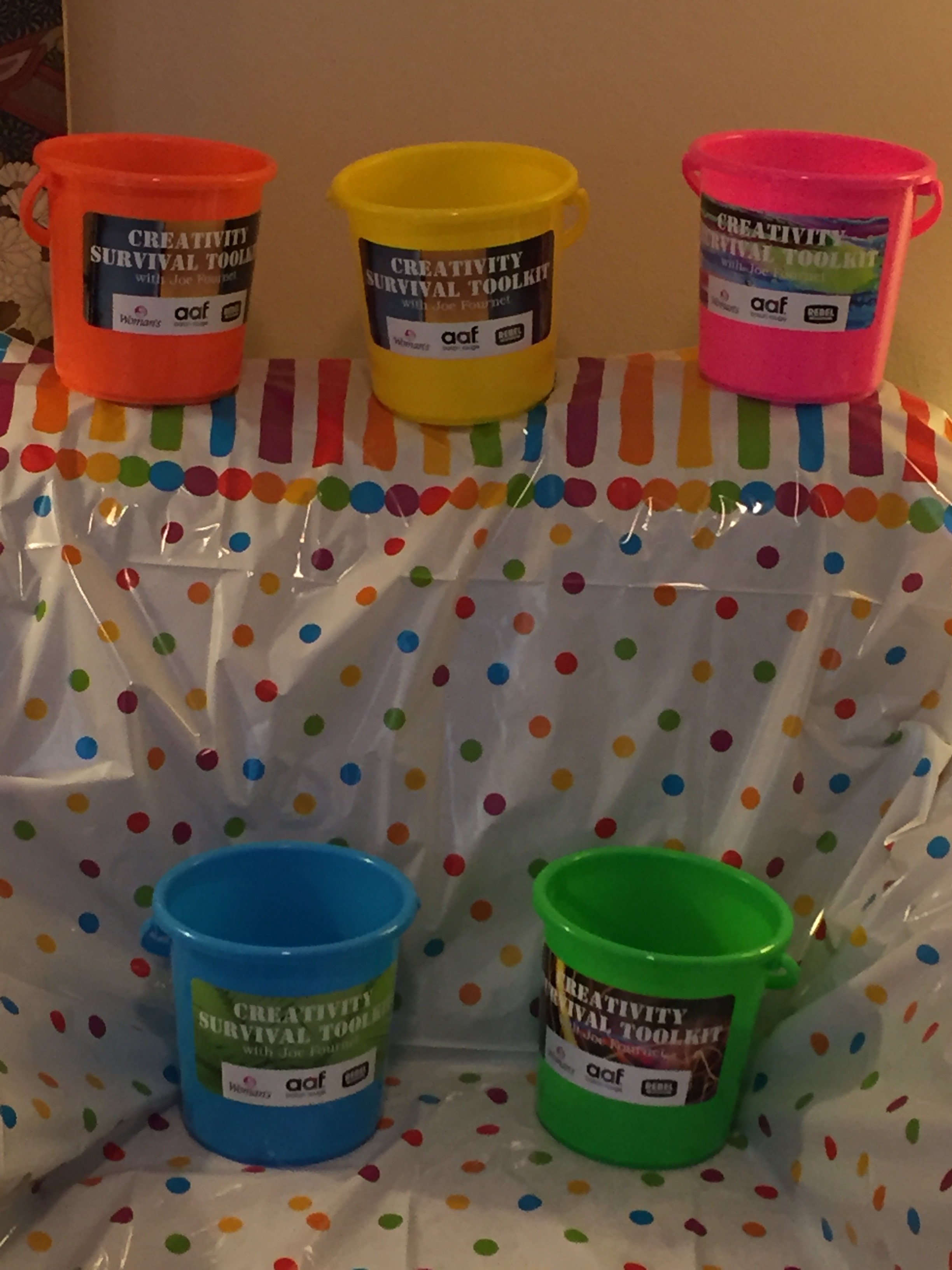
One of several different colored Creativity Kits the Baton Rouge ad club made as giveaways.

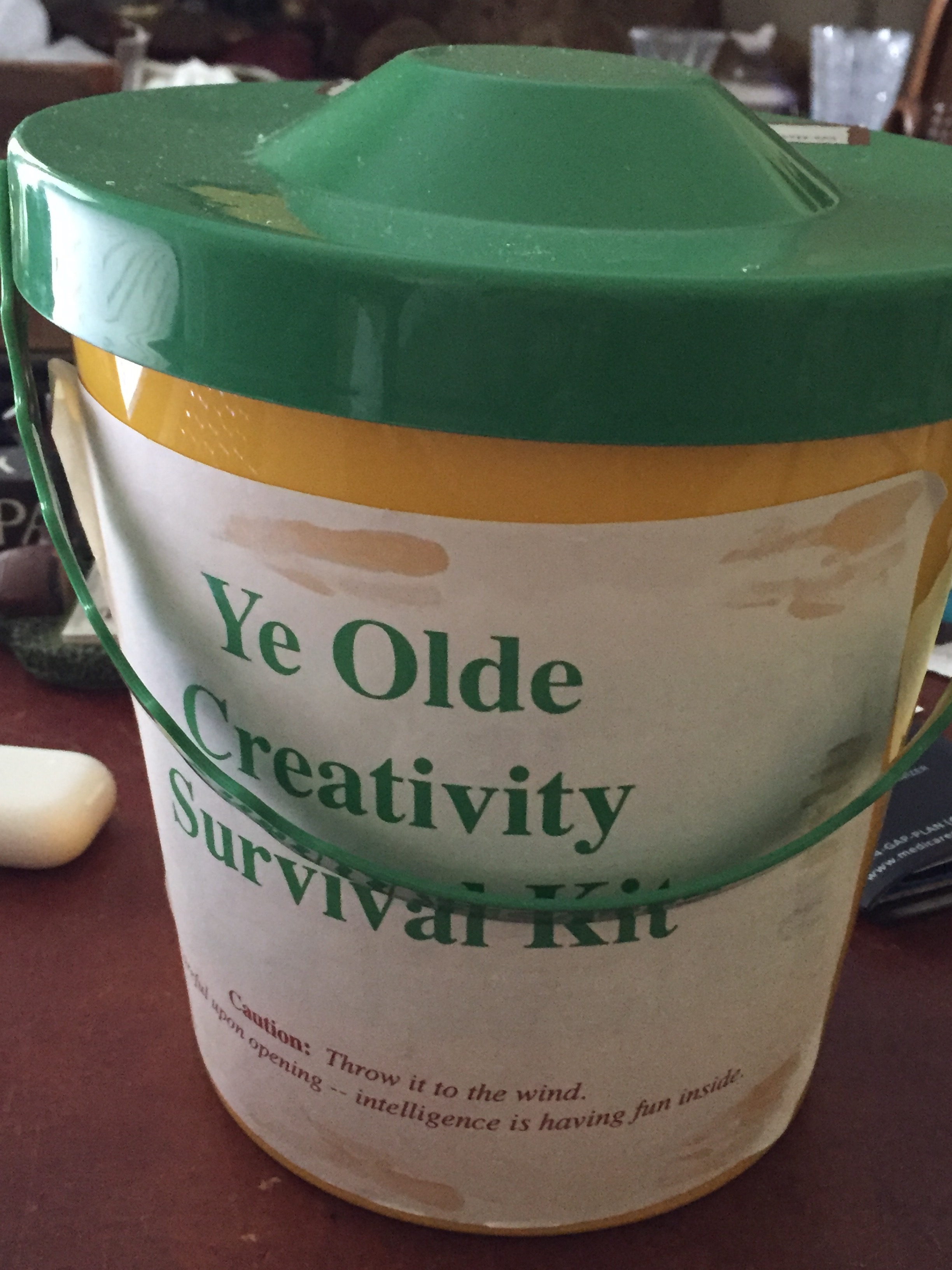
The Creativity Survival (Tool) Kit is simply any container or bucket filled with items that make you feel creative or think creatively. The contents can be almost anything depending on the individual.

They can be notes that remind you of various things, especially those items that are too large to fit into your bucket. They can be serious or silly. No judgements here; after all, it’s YOUR kit.

One of the main elements in the Kit is a stack of Post It Notes. The timed exercise, lead by a moderator, is thus: Whatever problem confronts you to be solved, needs a specific question to be asked that may help solve it. The more specific, the better.

The challenge is to come up with, say, 50 ideas in five minutes or, if you dare, 100 ideas in ten minutes. Once this is done, pick your 25 best ideas and, are you ready for this . . . TRASH THEM! Then from the 25 remaining, select your next 20 best ideas . . . and . . . TRASH THEM!

I know this is not what you’re used to doing, but trust me, this is a different take on a standard way of drilling down to the best idea. I call it the Evil Twin Technique.

Now, you’re left with five “maybe not-so-great-ideas.” For the purposes of this exercise, select three of them that you feel are good and, you know the drill, TRASH THEM. From the two remaining, trash one that you feel is better than the other one. You have one idea left. It may not have been one you thought about when you first began or one that you paid little or no attention to during this process.

You’ve come upon your Evil Twin. Whether or not it pans out as a worthwhile idea to help solve your problem remains to be seen. Your due process may bear that out. If you can combine this exercise with the more standard approach (instead of trashing the “best ideas,” keep them and simply narrow the list down to just one), it will be interesting what types of solution approaches one could come up with.  

Some other items in my kit include

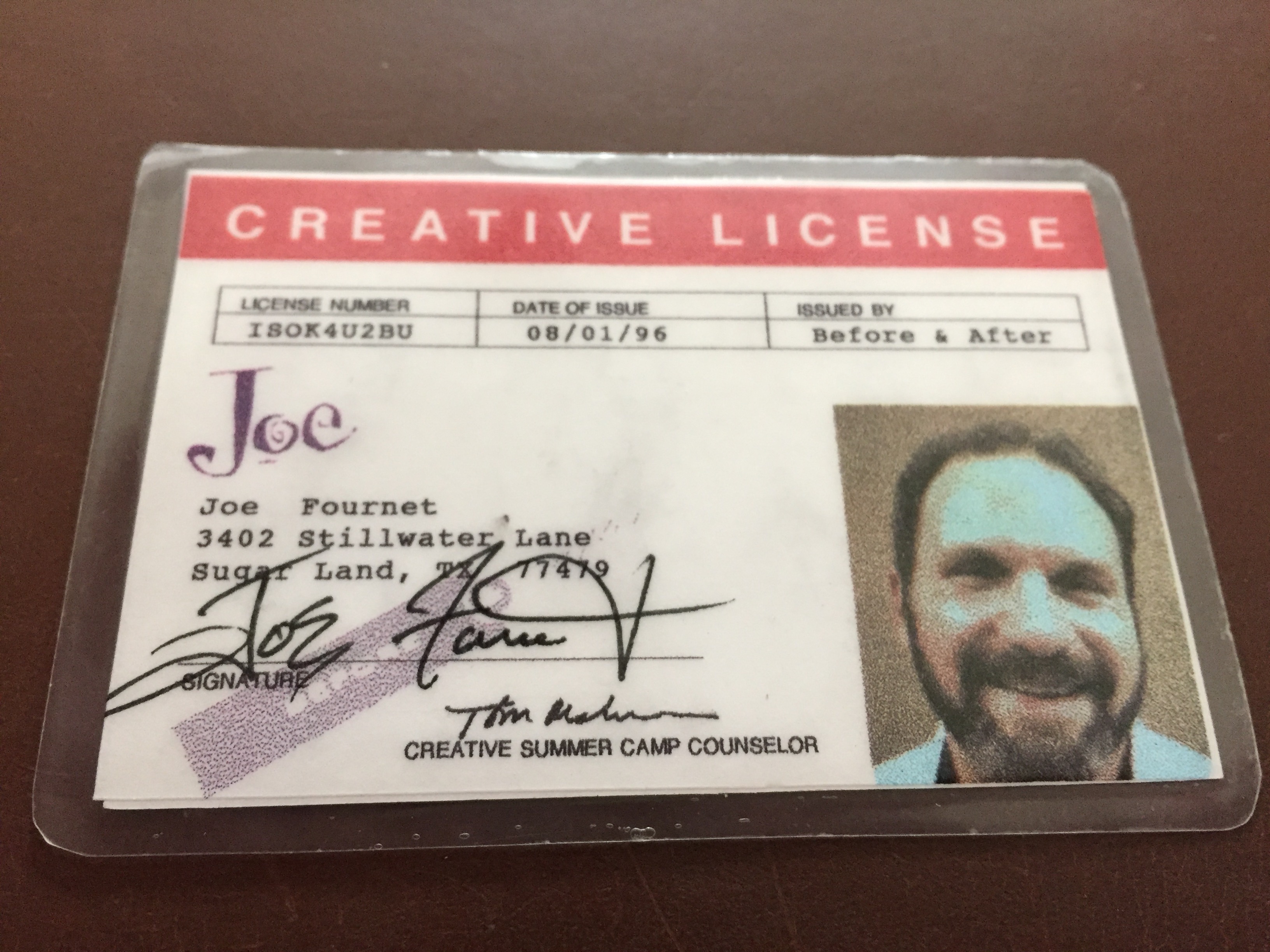
and my certification

along with my alter ego, Snoopy, and his pal, the Energizer Bunny. What can I say, I have an eclectic tool kit!

As my business card states, “Crayons. The essence of creativity.” Crayons are colorful and so should your world of creativity. Similarly, your Creativity Survival Toolkit should reflect your colorful personality and lend itself to enhance your creative world.

Hopefully making a ruckus, one blog post at a time!

Be sure to check out my other blog,Joe’s Journey, for personal insights on life and its detours.

A Dozen Tips to Enhance Your Creativity

• Creativity needs to be synonymous with “FUN!”

• Idea Tub – can be a physical place or thing and/or an electronic file. It’s a compilation of all ideas
ever submitted since you started keeping track, but organized as to be readily accessible.

An elaborate Idea Tub

• Don’t let the execution bury the idea. Your message will be diluted and possibly even confusing if
the creative is too cute, too complex or just plain dumb. Think napkin, not computer.

• Realize your own sense of creativity by challenging your imagination and stimulate thoughts to lead
yourself to a new level of solution.

• The idea, for best results, should be media and discipline neutral. Otherwise, you limit yourself.

• Focus on how you’re going to make the idea work and be relevant. But, never fall in love with it.

• Don’t ever underestimate the power of the mind or your imagination. Don’t ever be afraid to ask,
“Why, Why not or What if . . .?”.

• Ye Olde Creativity Survival Kit — Any sort of container in which you place whatever makes you
FEEL creative and THINK creatively. In this industry, silly is sometimes serious business.

• Thinking at Warp Speed – Generating ideas at breakneck speed is a great way to capture ideas on
Post-it Notes (one per note) in answering a specific question to solve a problem. Remember Giant
Post-its for your “idea wall” which can foster brainstorming and open-door policy idea addition.

• Drill Down Technique – Discovering THE idea. In this unusual method choose your five best ideas
and ELIMINATE THEM, choose five more and ELIMINATE THEM. The last idea Post-it may or
may not be the best, but it’s one to which you normally would not have paid much attention. Go play.

• As ideas are developed, make sure their essence is refined. Make sure your ideas are clear and
you can explain their basic value in about 20 seconds. If you can’t explain it to an 8-year old so they’ll understand it, you need to refine your idea more.

• Don’t manage creativity; manage for creativity. Provide an environment that is open and receptive
to new ideas, and that builds failure into the process. Acknowledge error or failure in a constructive
and supportive way.

Hopefully making a ruckus, one blog post at a time!

Be sure to check out my other blog, Joe’s Journey, for personal insights on life and its detours.

Death Resides in an Upstairs Room

Sometimes death takes on different forms for different people. This is a tale about one of those times.

Death is nothing at all. It does not count. I have only slipped away into the next room. Nothing has happened. Everything remains exactly as it was. I am I, and you are you, and the old life that we lived so fondly together is untouched, unchanged. Whatever we were to each other, that we are still.

Call me by the old familiar name. Speak of me in the easy way which you always used. Put no difference into your tone. Wear no forced air of solemnity or sorrow. Laugh as we always laughed at the little jokes that we enjoyed together.

Play, smile, think of me, pray for me. Let my name be ever the household word that it always was. Let it be spoken without an effort, without the ghost of a shadow upon it. Life means all that it ever meant. It is the same as it ever was.

There is absolute and unbroken continuity. What is this death but a negligible accident? Why should I be out of mind because I am out of sight? I am but waiting for you, for an interval, somewhere very near, just round the corner. All is well. — Author Unknown

Excuse me a moment. Believe someone’s at the door.

(Hears knocking.) Hmmm, sounds like from upstairs but I don’t have an upstairs.

(Door sounds, squeakily opens.)

“Pam?” I ask. No response.

“Pam?” I ask again. 

“I can’t come out but you can come in,” she intones.

“I hear your voice but can’t see you. If this is what I think it is, I can’t come up there now. It’s not yet my time,” I say.

Then slowly I hear a squeaky door closing. 

“Pam?”, I ask. No response. Then again; nothing.

Then, faintly, as if In the distance, I hear a door close.

I stand there, frozen and jarred by the experience.

News Bulletin from the Interdimensional News Agency:

Did this really happen? Does life exist that close to another dimension? Does just a door we cannot see separate us from the hereafter? Who knows!

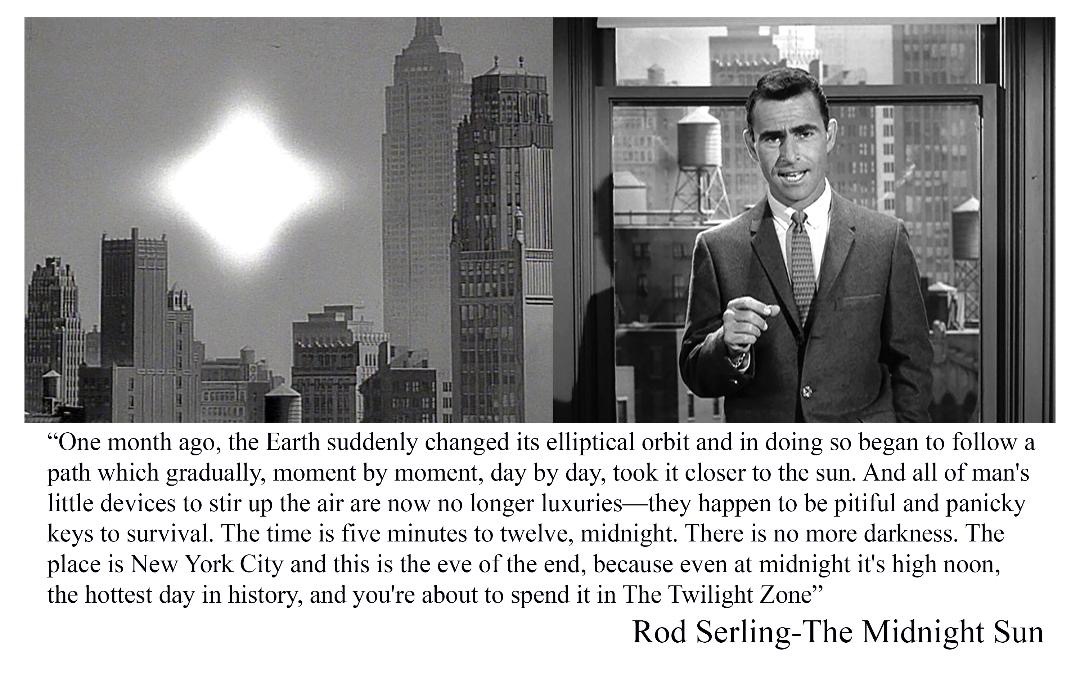
Perhaps in the Twilight Zone it does, but this is not the TZ. Or is it?

Perhaps it’s simply a page-turn at the chapter’s end in the multidimensional book of life and death.

“Pam? . . . Pam?”. . . Fade to black . . .

That was over a year ago and nothing like that has reoccurred. I think back on that evening from time to time wondering if it did, in fact, happen or was I just dreaming.

This particular evening was quiet and I found myself curled up in my easy chair with a good book. I had just come to a stopping point and started to head off to bed when I heard what I thought was a very squeaky door slowly opening. Thinking to myself it came from next door, I went off to bed.

“Joe?” the voice intoned in what was more like a low whisper.

“Joe?” the voice asked again.

I froze. I just stood there, saying and doing nothing.

“Who’s there?,” I asked, not really expecting a reply.

“I can’t come out but you can come in,” the voice replied softly.

Not again, I thought. This can’t be happening.

“Joe?,” said the voice again. “Please come up and join me. I miss you!” she said .

Playing along, I said “Who is this and what do you want?”

“It’s me, Pam. Please join me upstairs.”

“I don’t have an upstairs and you can’t be Pam. My wife died over a year ago,” I said.

“If this is some sort of sick, perverted joke, I don’t appreciate it!,” I stressed.

“It’s no joke, Joe,” the voice said softly. “It is me, Pam, and you do have an upstairs, just not like you know it to be.”

Then, for some strange reason, I turned around and looked back toward the living room and kitchen area. There was a cloud-like haze inside the apartment, almost like a cloud had seeped inside hugging just below the ceiling.

I heard what sounded like a door slowly rocking back and forth on its hinges. I stood there in awe of what I thought I saw.

What was this sight I was seeing. Could it be an actual cloud? No, that’s impossible, I thought. Another dimension?

Then the voice again, “Joe, come join me. I miss you.” This time the voice was much clearer and louder, but not yelling. “There’s a room that’s been made ready for you. It’s right next to mine. Won’t you please join us?” she asked.

“Us?” I said. “Who’s us,” I asked.

No answer. Silence. Utter stillness.

Yet, the “cloud” remained. Was it an entrance to another dimension? Was this voice talking and beckoning to me really Pam? I didn’t know. I just know that during this time the hairs on the back of my heard were still at attention and I was quite uneasy.

Meanwhile, that slow rhythmical squeaking of a door rocking back and forth on its hinges was the only sound I heard.

Until I didn’t. Then the door closed shut, rather startlingly.

“Pam? . . . Pam?” I called out.

Silence.

Continue reading →

Remembering 9/11 on its 20th Anniversary

LA Times

Never Forget

Pamela’s Lantern

A short tale of life and the somewhat perversely humorous after life.

The lantern stands guard over Pamela’s cremated remains until one day magically transforms another living being into the remains the lantern is guarding so that Pamela takes new life in the other living being’s body.

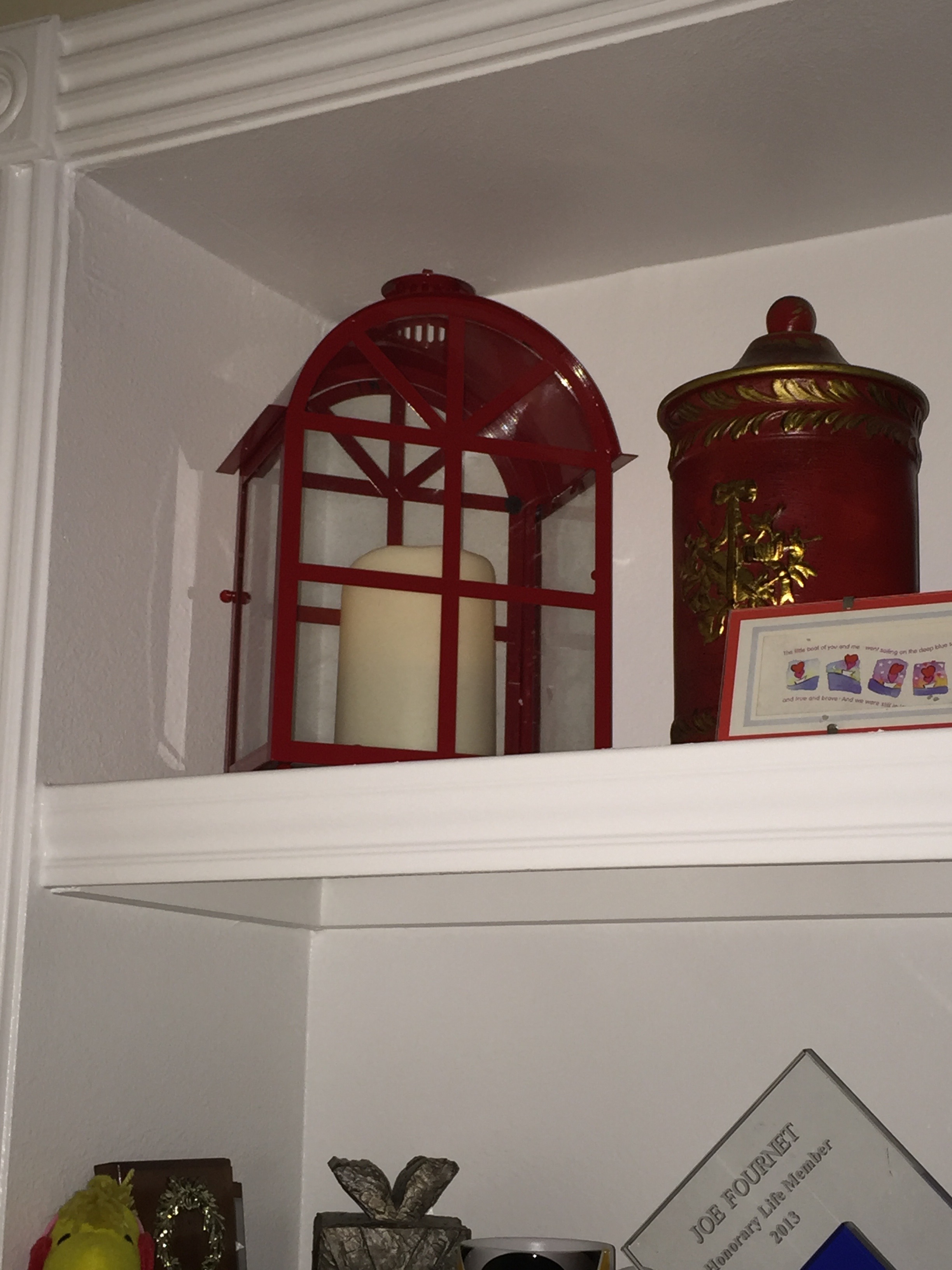
The lantern stands guard constantly overlooking the ornate, Chinese red urn containing Pamela’s remains. Almost like a person, the lantern is always looking from an angle, never taking its stare away from the urn. Its duty is to protect, watch over and remain a reminder that all is calm, peaceful, okay – A little like the eternal flame at JFK’S grave site.

By all appearances the lantern is normal looking, what one might expect at seeing a candle perched inside a window-latticed, red-lacquered, nautically designed portable lamp.

It’s normal looking and serves its purpose as a lamp overlooking Pam’s oriental urn. That is, except for when it decides to act independently and transform a living body’s substance into cremated remains and then swap them out with Pamela’s.

Admittedly a neat trick that not every lantern is capable of doing. Why it performs this rather perverse ritual, if one wants to call it that, is unknown at this juncture. It just does it. Randomly. It’s as if the lantern has a sixth sense about the person with whom it selects to interact.

You might be asking yourself how I know this happens at all. Have I witnessed this rather profane exercise in transformation? Has it happened to me? It has not. Yet! Though I wonder what type of emotional ties does the lantern have with its “subjects”. I sense it wants what’s best for Pam, to bring her joy and comfort in some very strange and weird way.

Assuming this to be true, I’d surmise that my transformation would be soon to come. I am, after all, Pam’s widower.

Can a lantern get jealous?, I asked myself one day. How can it?; it’s not a living being, I reasoned. It’s more of an entity, a thing that lights up. But it’s an entity that keeps watch over a very important vase, one in which my wife’s ashes are kept. Somehow, I think it knows that. It’s seen me take them out of the vase since they’re contained in a large plastic bag within the vase. It’s watched me handle them with utmost care. It knows of their importance.

On the other side of Pam’s urn is a cute little stuffed raccoon I gave her years ago. The raccoon, nicknamed Lil’ Rocky, also stands guard. Pamela is well protected should anything bad befall her.

11:48 pm – that’s when the lantern turns itself on every night. When that happens, it casts an entirely different light on its shelf. Though it doesn’t cast that much illumination on Pamela’s urn, it does cast a lovely glow that brings about a peaceful setting in the darkness.

Every time I get up during the night, I look over to notice the lamp and to make sure all is okay. This night was no exception. The lantern automatically turns off at about 4:15 am and all is dark in the living room. I go back to bed and wake up after the sun’s up.

One morning as I was walking through the room heading to the kitchen to make some coffee, I looked over at Pam’s urn and wished her good morning, just like I always do. After I made my coffee, I started walking back into the bedroom but paused my stride and turned back to glance in the direction of Pam and the lantern.

Everything looked the same but I stood there wondering why I had stopped to glance her way. I even walked up a few steps to get a closer look but nothing appeared out of the ordinary. I just thought I was still asleep since I hadn’t even taken sip number one of my coffee.

I didn’t realize at the time I wasn’t the only one wondering if something was amiss.

As I returned to my work area later that day, I noticed nothing odd at all. I didn’t give it another thought, so to work I went. Towards the end of this day as I was winding down, I went through my routine of shutting things off and getting ready for bed. Upon leaving my study, I glanced up to Pam’s area to bid her goodnight and I noticed something was different, if ever so slightly.

Both the lantern and the Chinese urn were exactly the same but the little raccoon was different; she was now turned to a position where she was looking down at me, where I usually work. I kind of shook my head thinking I was viewing this in a bit of a haze. Upon another gaze, I realized I was seeing things correctly. The raccoon had definitely changed positions. How? I didn’t have the foggiest idea!

I just stood there, staring up at the bookshelf where I had placed her. Without thinking, I reached up and turned her back into her original position at a slight angle, looking more at the Chinese urn than in my direction below. After doing that, I turned around and marched off to bed, turning off lights as I went.

Continue reading →