I don’t know how Seth Godin does it. He writes and publishes a blog everyday, 365 days a year. I have trouble publishing my two blogs each WEEK!
Part of my problem is having something interesting to publish. That is every blogger’s nightmare. There have been times I write a blog the night before because I came up with an idea and just developed it.
When I’m in a pinch and nothing comes to mind, I try and change my focus. In a way, I let myself become distracted, not by merely doing something else but by switching creative gears and concentrating on another creative project.
It was where my muse wanted to take me, so I let it. What is a muse you might ask?
Muse, in Greco-Roman religion and mythology, any of a group of sister goddesses of obscure but ancient origin, the chief centre of whose cult was Mount Helicon in Boeotia, Greece. They were born in Pieria, at the foot of Mount Olympus.
They probably were originally the patron goddesses of poets (who in early times were also musicians, providing their own accompaniments), although later their range was extended to include all liberal arts and sciences—hence, their connection with such institutions as the Museum (Mouseion, seat of the Muses) at Alexandria, Egypt. There were nine Muses as early as Homer’sOdyssey, and Homer invokes either a Muse or the Muses collectively from time to time.
Virgil (centre) holding a scroll with a quotation from the Aeneid, with the epic Muse (left) and the tragic Muse (right), Roman mosaic, 2nd–3rd century ad. Courtesy of the Musée Le Bardo, Tunis
As the creative juices begin to flow and my “new” project begins to take shape, I begin to develop several ideas that would make for interesting blog posts. I did, however, make sure I finished what I had previously started so I could “celebrate” the accomplishment (a musical slide show).
Whether or not you follow your instincts when you have a calling to do so, is up to you. Your mind and imagination are wondrous tools in the creative process. Don’t ignore them.
Hopefully making a ruckus, one blog post at a time!
Be sure to check out my other blog, Joe’s Journey, for a different kind of playground for creativity, innovation and inspiring stuff.
Creativity knows no bounds. Nor, it seems, does an artist’s or cartoonist’s palette. Take, for instance, a recent, uh, exhibit at the Charles Schulz Museum in Santa Rosa, CA.
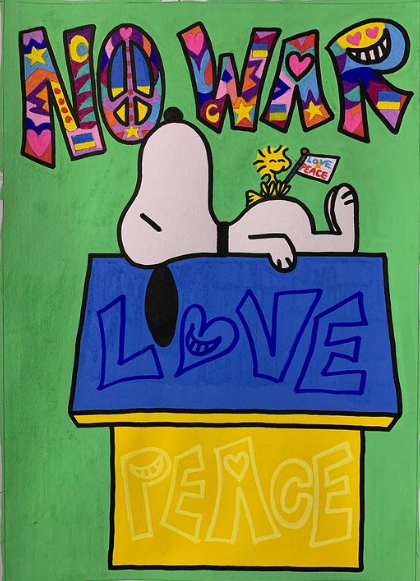
Talk about a lasting impression! If you’ve ever put your hands or feet into wet cement, you know what I’m talking about. When I came upon this photo entry by Jean Schulz, yes, that Schulz, I had to share it via my own creativity blog. All of us can relate to having impressions in concrete. Then, again, if you’re a world-famous beagle, your impressions are as varied as your moods.
In her latest blog post, “Leaving a Lasting Impression,” Jean Schulz shares the simple joy of leaving your mark in wet cement.
Hopefully making a ruckus, one blog post at a time!
Be sure to check out my other blog, Joe’s Journey, for a different kind of playground for creativity, innovation and inspiring stuff.
Stumped. Writer’s Block. Stymied. Confused. It’s all a jumble of nothingness.
What Do You Write When You Don’t Know What to Write About?
So, how do you turn nothingness into somethingness? Start writing! Anything.
The words will come, thoughts will flow and, eventually, creativity will blossom.
You can’t force it, however. It must evolve naturally, at your own pace. Usually, if a creative suggestion doesn’t appear in your thoughts within about 20 minutes or so, abort the process and go on to something else. Then come back to it hours later or the following day.
Some writers think before they write. Some think as they write. Some writers don’t think at all; they just write a bunch of gobbledygook. That’s fine, as long as you go back and turn the gobbledygook into useful garbage.
Turning that garbage into something quite palpable and enticing will take a process of editing and refinement but when you’re at this stage, you’ve got it made.
Hopefully making a ruckus, one blog post at a time!
Be sure to check out my other blog, Joe’s Journey, for a different kind of playground for creativity, innovation and inspiring stuff.
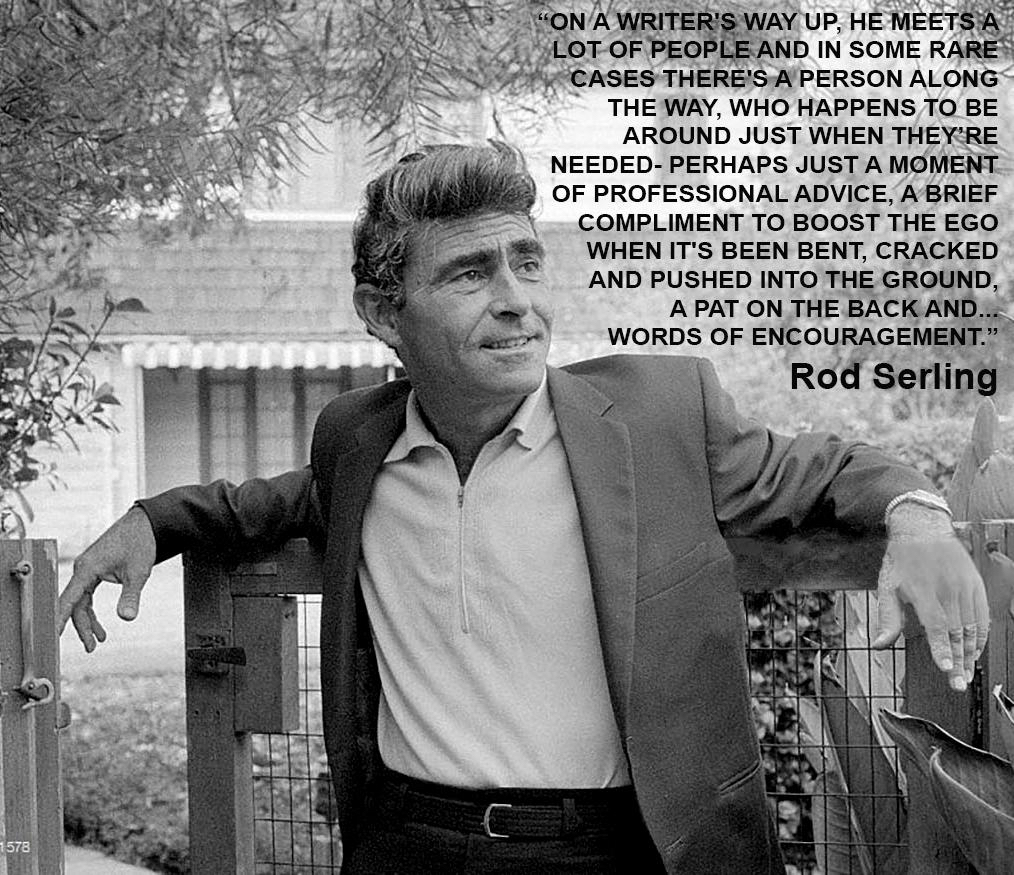
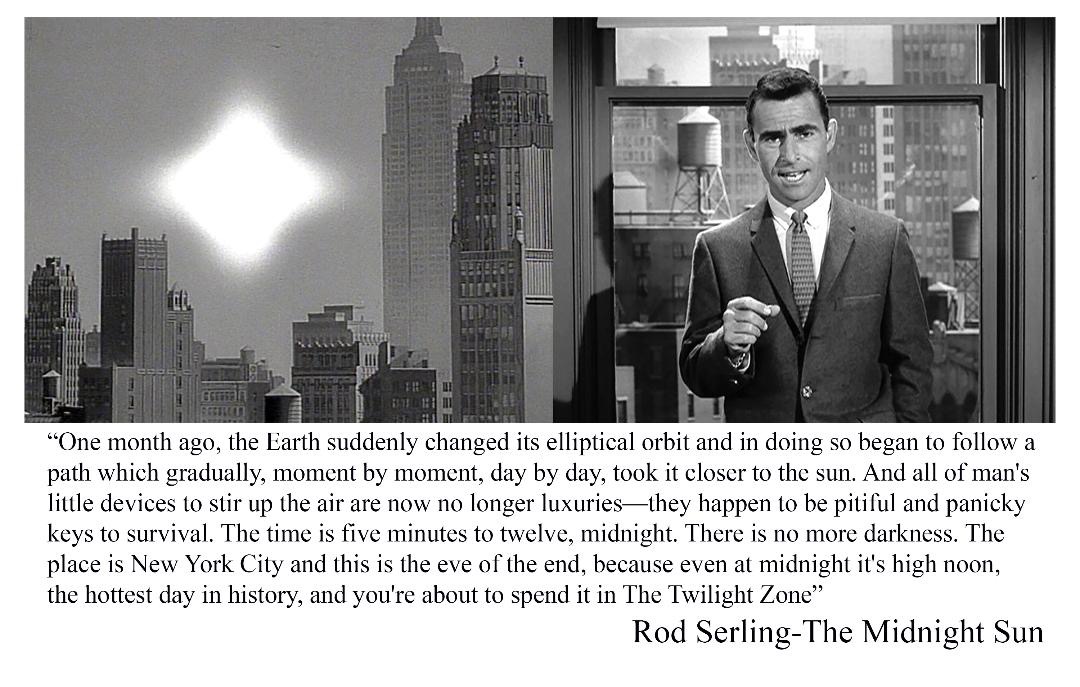
The quotations are as varied as the people who said them. Some you know, some you don’t. That’s what makes them interesting. From Burke to Burnett, Einstein to Degas; throw in a little Serling for seasoning and you’ve got a tasty recipe for March’s quotes.
We don’t grow unless we take risks. Any successful company is riddled with failures. — James E. Burke, Advertising Hall of Fame
Success or failure in business is caused more by mental attitude than by mental capacities. — Walter Dill Scott, Advertising Hall of Fame
Anyone who thinks that people can be fooled or pushed around has an inaccurate and pretty low estimate of people — and he won’t do very well in advertising. — Leo Burnett, Advertising Hall of Fame
If we knew what we were doing, it wouldn’t be called research, would it? – Albert Einstein
If you fall in love with the imagination, you understand that it is a free spirit. It will go anywhere, and it can do anything. – Alice Walker
Curiosity killed the cat, but for a while I was a suspect. – Steven Wright
You must aim high, not in what you are going to do at some future date, but in what you are going to make yourself do to-day. Otherwise, working is just a waste of time. – Edgar Degas
Our job is to simplify, to tear away the unrelated, to pluck out the weeds that are smothering the product message. — William Bernbach, Advertising Hall of Fame
How do we turn science fiction into fact? We do it by inventing our own future and figuring out the realistic steps that we need to make in order to get there. Dare to dream. Let your imagination leap. — David Shapton, Editor In Chief, RedShark Publications, 2012 to 2020
Hopefully making a ruckus, one blog post at a time!
Be sure to check out my other blog, Joe’s Journey, for a different kind of playground for creativity, innovation and inspiring stuff.
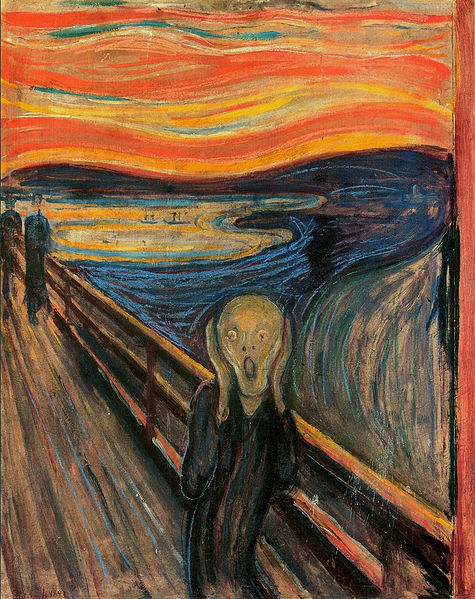
Fear and courage don’t seem likely bedfellows. Yet, they are showing us every day how they play together amongst the citizenry of Ukraine. When you’re fighting for survival, it stretches the limit of one’s creativity. Some may say that creativity is not even involved in warfare. I disagree.
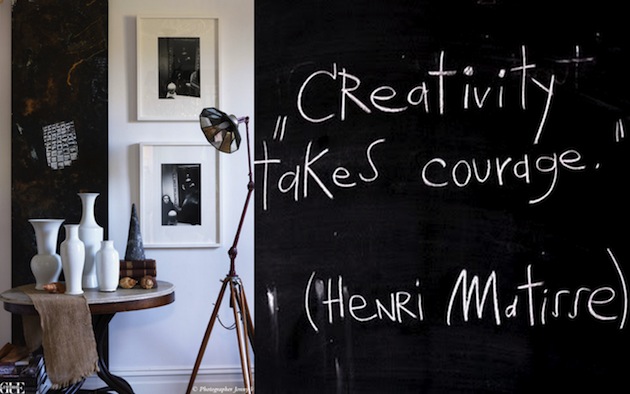
While creativity in warfare interacts with a much higher level of courage and seriousness compared to presenting an advertising campaign, it requires effort and takes courage, as Matisse says. The Ukranian people are showing resiliency and mucho bravery. Creativity lives within that realm.
Fear and courage impact our creative thinking and expression
Even in a non-combat zone, fear attacks us everyday. Courage is what most of us try and muster to get through a day’s time unscathed by said fear. We may not be fighting to stay alive but we are fighting. We’re fighting our internal demons and our self-doubt. We’re fighting to retain some of our creativity and resourcefulness.
Author and teacher Elizabeth Gilbert admits “the only reason I can speak so authoritatively about fear is that I know it so intimately. I know every inch of fear, from head to toe. I’ve been a frightened person my entire life.”
She points out that “Evolution did well to install a fear reflex within you, because if you didn’t have any fear, you would lead a short, crazy, stupid life. You would walk into traffic. You would jump into giant waves off the coast of Hawaii, despite being a poor swimmer…
“So, yes, you absolutely do need your fear, in order to protect you from actual dangers.
“But you do not need your fear in the realm of creative expression.
The subject matter may vary. The speaker may vary. The quote may still be memorable no matter who says it. Keep that in mind when reciting any one of the quotes below. It will make for a memorable occasion.
Advertising becomes a dialogue that becomes an invitation to a relationship. — Lester Wunderman, member, Advertising Hall of Fame
Thinking about ourselves isn’t related to knowing ourselves. — Lauren Esposito, arachnologist, co-founder of 500 Queer Scientists
Nothing comes merely by thinking about it. — John Wanamaker, member, Advertising Hall of Fame
Regardless of the moral issue, dishonesty in advertising has proved very unprofitable. — Leo Burnett, member, Advertising Hall of Fame
Attract attention, maintain interest, create desire and get action. — E. Elmo St. Lewis, member, Advertising Hall of Fame
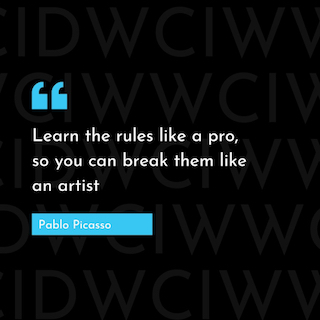
Rules are for people who don’t know what to do. — Keith Reinhard, member, Advertising Hall of Fame
I don’t like closed doors. Creativity flourishes best in an environment of open doors and open minds. — Keith Reinhard, member, Advertising Hall of Fame
Advertising is what you do when you can’t go see somebody. That’s all it is. — Fairfax Cone, member, Advertising Hall of Fame
Hopefully making a ruckus, one blog post at a time!
Be sure to check out my other blog, Joe’s Journey, for a different kind of playground for creativity, innovation and inspiring stuff.
Usually every week I come across an article or narrative on creativity, its many facets and how better to utilize one’s own creativity. Such is the case this week.
One of the subscriptions I maintain (zero cost, but there is an option for minimal cost) is with Medium. I’ve even posted some of my writings on the site.
This week I came across a posting having to do with noise and the role it plays in creativity. It was written by Donald Rattner, Architect, and since it has some very interesting points, I’d like to share it with you. . .
. . .Maybe it was inevitable, but after years of touting the virtues of the open workspace, people who plan and use them appear to be having second thoughts about its effectiveness. Among the biggest drivers behind the mounting backlash are complaints about noise, especially in the form of overheard conversations, ringing phones, and clattering machines.
But before you jump on the “silence is golden” bandwagon, it might be worth taking a step back to assess the problem with a cooler, more objective eye, especially if you spend some part of your day in creative problem solving. The reason? A modicum of noise has been found to boost idea generation, rather than interfere with it.
Noises Off or Noises On?
Credit a team of researchers drawn from several different universities for daring to challenge status quo thinking.
In 2012, the trio published a paper documenting a series of lab experiments they ran to study the effect of noise on creative task performance. Their methods were pretty straightforward: Subjects performed various exercises designed to measure ideational fluency and open-mindedness while a soundtrack played in the background.
The track played at either a low (50 decibels), middle (70db), or high volume (85db). A fourth group performed the same exercises without any accompanying soundtrack to establish a baseline from which to measure the collected results.
Contrary to expectation, the people in the quiet sessions did not achieve the top scores. That honor went to subjects exposed to midlevel noise (70db).
Illustration: The author
As a point of reference, 70db is the rough equivalent of the din at a bustling restaurant or coffee shop. It also approximates the loudness of a running shower, which is probably one reason why we so often get good ideas while under the spigot.
It’s evident from the data that the right type and level of noise can literally change the way our creative minds work. But how? And why? And how do we harness this information to boost our creative output in real-world settings?
Guilford’s Model of Creative Thinking
A model of creative thinking first developed in the 1950s might be the most effective vehicle for providing answers to these questions.
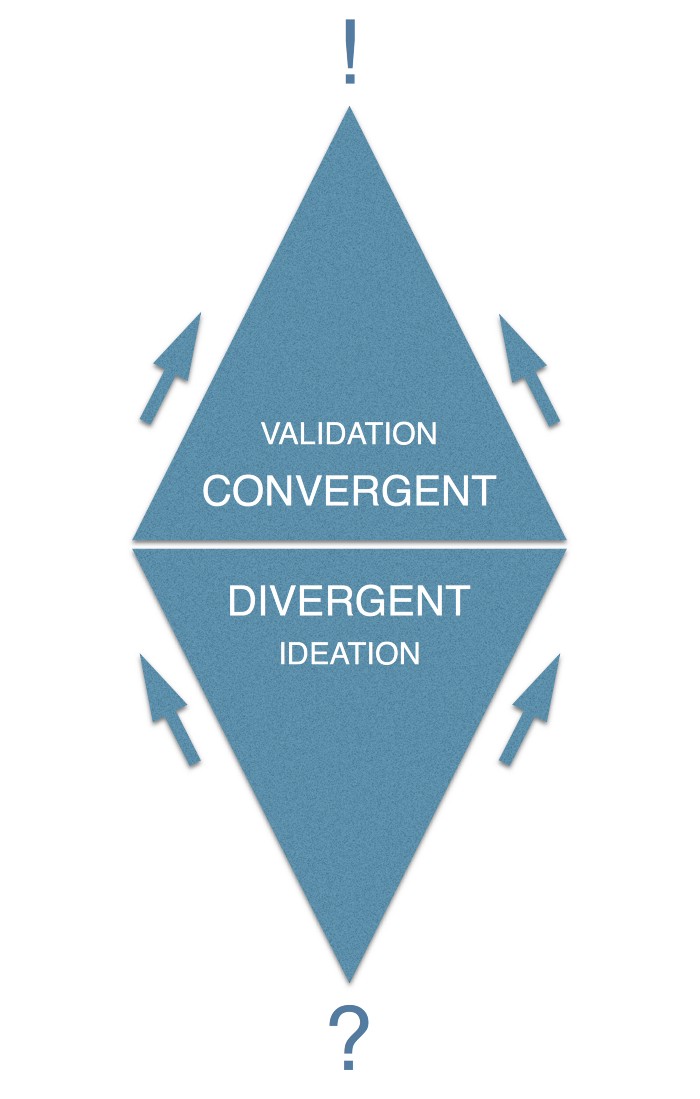
The model was the brainchild of the psychologist J.P. Guilford, an important figure in the history of modern creativity studies. Its basic premise is that creative thinking comprises two styles of cognitive processing: divergent andconvergent.
Divergent thinking corresponds to what we variously call right-brain or generative thinking. It is generally abstract, big-picture, intuitive, nonlinear, and inward-focused in nature. It induces us to see things as they could be, rather than as they are.
Convergent thinking is nearly the mirror opposite. Unlike divergent thinking, it is rational, objective, sequential, narrowly focused, highly detailed, and concrete in character. It looks outward rather than inward for answers, such as when we apply the external laws of mathematics to calculate the sum of two plus two, instead of drawing from our imagination.
For Guilford, the creative process is neither one nor the other alone, but both styles working in tandem, and nominally in sequence.
Illustration: The author
As a linear progression, Guilford’s model translates into a five-stage process composed of the following phases:
Definition of the problem to be solved: (?).
A period of divergent thinking, during which you open up your mind to as many ideas for potential solutions as time, budget, energy, or creative capability allow. Brainstorming is a technique for inducing divergent thinking.
A point of inflection where divergency ceases and convergency begins.
A period of convergent thinking, during which you narrow down your options to zero in on a potential solution, which is then tested and validated.
Realization of a final solution: (!).
In real life, of course, the creative process rarely travels in an uninterrupted straight-line trajectory from (?) to (!). More often than not, you find yourself going backwards one or more steps before getting to your goal — if you reach it at all.
But as a conceptual model, Guilford’s paradigm gives a pretty accurate picture of how our minds work in the course of working out feasible solutions to creative problems.
How would a “productive day” compare to a “creative day”? What would, if anything, they have in common? Chances are not much. One might think a productive day would be closely aligned with scratching off items on a to-do list. On the other hand, someone’s idea of a creative day might not even have a to-do list.
Our current work world is obsessed with productivity. We are inundated with books, articles, white papers, to time block this and time block that; all just to do more work. But our relentless quest to be productive is undermining one of the most important abilities in today’s workplace: creativity.
What of the future, though? Will machine learning and artificial intelligence perform the routine aspects of our work at the expense of our ingenuity and creativity? So how do we create the right conditions for creativity, particularly when we are trying to deal with a to-do list?
Consider this comment from screenwriter Aaron Sorkin (the mastermind behind the television show West Wing and films like Moneyball and The Social Network). He told The Hollywood Reporter that he takes six showers a day. “I’m not a germaphobe,” he explains but when his writing isn’t going well, he’ll shower, change into new clothes, and start again.
Sorkin’s trade relies on him minting something fresh on a regular basis. And it occurred to him that his best thoughts were not happening in moments of fevered concentration, but when he was in the shower. So he had a shower installed in the corner of his office and makes regular use of it. He has described the process as “a do-over” for triggering original ideas.
In 1939, James Webb Young, a Madison Avenue advertising executive, wrote a definitive guide to the process of creativity, A Technique for Producing Ideas. In this short book, Webb Young reminds us, “that an idea is nothing more nor less than a new combination of old elements.” In his view, the skill of creativity is the ability to spot new connections between familiar thoughts, and the art is “the ability to see [new] relationships.”
Fifty years later, Steve Jobs observed something similar: “Creativity is just connecting things. When you ask creative people how they did something, they feel a little guilty because they didn’t really do it, they just saw something. It seemed obvious to them after a while. That’s because they were able to connect experiences they’ve had and synthesize new things.” Webb Young also lays out a remarkably simple technique for creative thought. It involves stimulation. Continue reading →
The other day when I was putting some luggage back up into the closet, I came across a small notebook with a few items written in it. Must have been some of my notes from a long-ago seminar I attended somewhere. These statements are in no particular order and only one is attributable to someone. Take them for what they’re worth. Who knows, they may be able to help enhance your creativity.
Wasting time is usually resistance to writing
Be violent and original in your work, but be orderly in your normal life
Get quiet — be still and apply yourself
Creativity: Sudden cessation of stupidity
Most good ideas come fully formed
Celebrate small victories
“No” is a complete sentence
We have no art. We do everything as well as possible.
“Everything is art direction.” — Lee Clow
How to suck less: It’s not about concepts; it’s about execution (how we work)
Enemies: Laziness and Arrogance
“Effort and struggle to create simplicity and grace lives on in the soul.”
Hopefully making a ruckus, one blog post at a time!
Be sure to check out my other blog,Joe’s Journey, for personal insights on life and its detours.
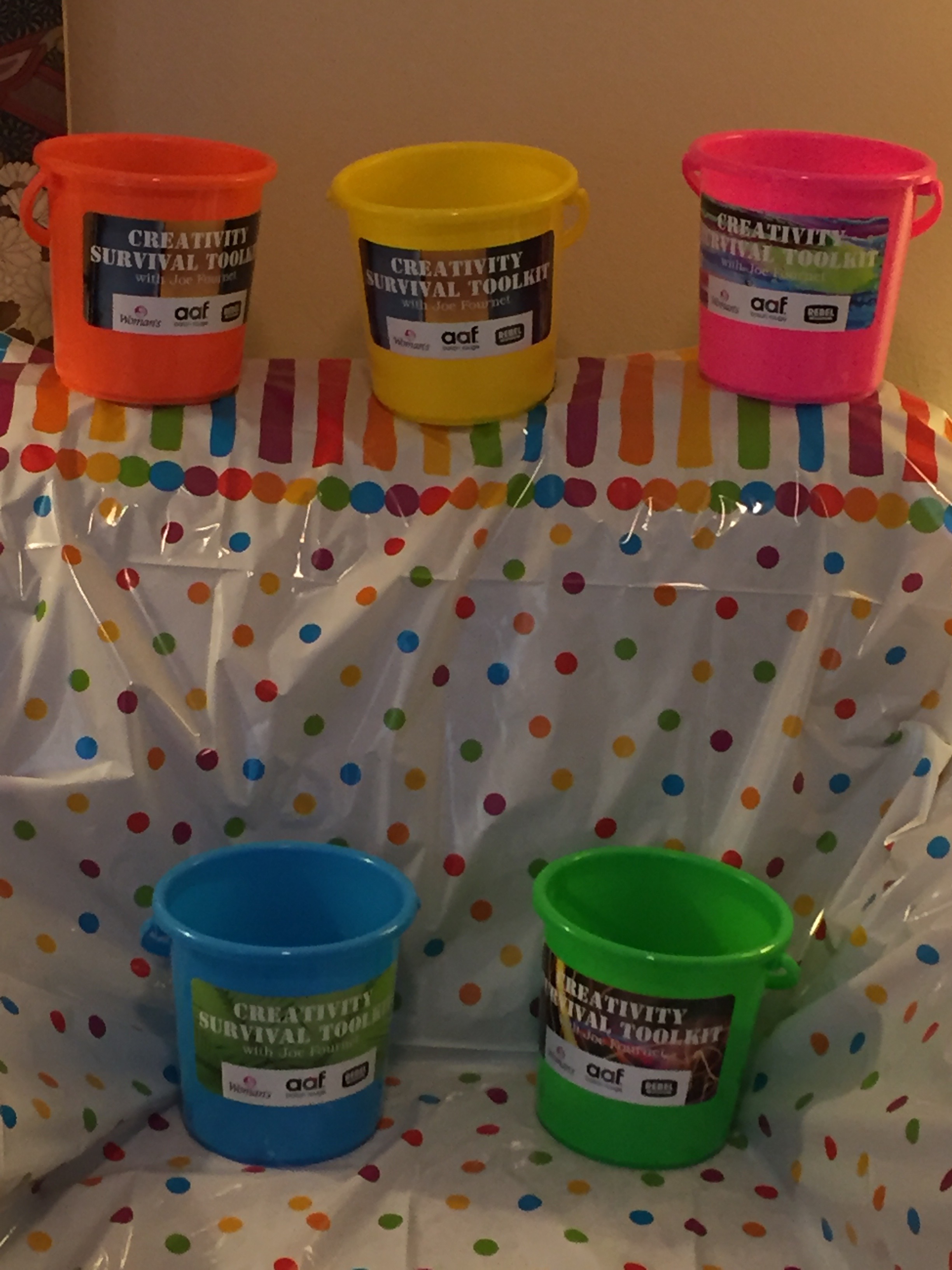
Last week I posted about my upcoming trek to Baton Rouge and shared a list of creative guidelines to keep in mind when enhancing one’s creativity. That was what I shared with the ad club of Baton Rouge last Friday. One of the main items I shared was the Creativity Survival Kit and that’s what I’d like to review on this post, especially for folks who have no idea what I’m talking about.
One of several different colored Creativity Kits the Baton Rouge ad club made as giveaways.
The Creativity Survival (Tool) Kit is simply any container or bucket filled with items that make you feel creative or think creatively. The contents can be almost anything depending on the individual.
They can be notes that remind you of various things, especially those items that are too large to fit into your bucket. They can be serious or silly. No judgements here; after all, it’s YOUR kit.
One of the main elements in the Kit is a stack of Post It Notes. The timed exercise, lead by a moderator, is thus: Whatever problem confronts you to be solved, needs a specific question to be asked that may help solve it. The more specific, the better.
The challenge is to come up with, say, 50 ideas in five minutes or, if you dare, 100 ideas in ten minutes. Once this is done, pick your 25 best ideas and, are you ready for this . . . TRASH THEM! Then from the 25 remaining, select your next 20 best ideas . . . and . . . TRASH THEM!
I know this is not what you’re used to doing, but trust me, this is a different take on a standard way of drilling down to the best idea. I call it the Evil Twin Technique.
Now, you’re left with five “maybe not-so-great-ideas.” For the purposes of this exercise, select three of them that you feel are good and, you know the drill, TRASH THEM. From the two remaining, trash one that you feel is better than the other one. You have one idea left. It may not have been one you thought about when you first began or one that you paid little or no attention to during this process.
You’ve come upon your Evil Twin. Whether or not it pans out as a worthwhile idea to help solve your problem remains to be seen. Your due process may bear that out. If you can combine this exercise with the more standard approach (instead of trashing the “best ideas,” keep them and simply narrow the list down to just one), it will be interesting what types of solution approaches one could come up with.
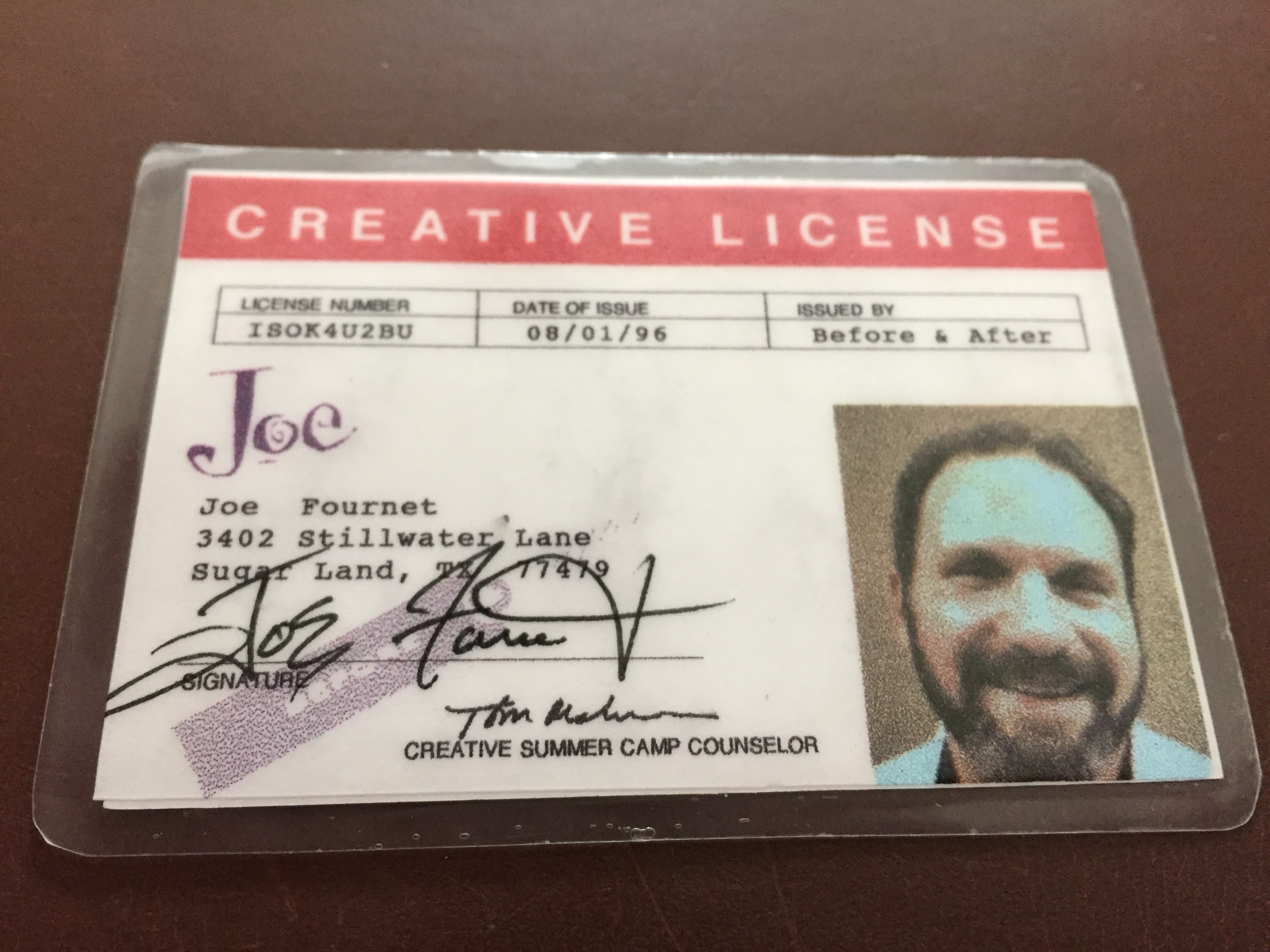
Some other items in my kit include
and my certification
along with my alter ego, Snoopy, and his pal, the Energizer Bunny. What can I say, I have an eclectic tool kit!
As my business card states, “Crayons. The essence of creativity.” Crayons are colorful and so should your world of creativity. Similarly, your Creativity Survival Toolkit should reflect your colorful personality and lend itself to enhance your creative world.
Hopefully making a ruckus, one blog post at a time!
Be sure to check out my other blog,Joe’s Journey, for personal insights on life and its detours.









 ideasnmoreblog