Being creative requires taking some risks. Sometimes it’s the risks that hold us back from moving forward and being creative. Learn about two types of risks, what it really means to step out of your comfort zone, and how to test assumptions you might have about your fears.
How do you think you’d do getting out of your comfort zone? As a test, try my Creativity Tip below. First, think of a question that is a problem needing to be solved. Then, tackle tip #23. As an added challenge, try coming up with 100 ideas (one or two words or short phrases) in 10 minutes.
Creativity Tip #23: Warp Speed Thinking – Come up with as many one or two-word ideas as you can in 5 minutes.
Hopefully making a ruckus, one blog post at a time!
Be sure to check out my other blog, Joe’s Journey, for personal insights on life and its detours.
Is your school or workplace divided between the “creatives” versus the “practical” people? Yet surely, David Kelley suggests, creativity is not the domain of only a chosen few. Telling stories from his legendary design career and his own life, he offers ways to build the confidence to create.
As for building confidence, afraid of snakes? This may help.
David Kelley’s company IDEO helped create many icons of the digital generation — but what matters even more to him is unlocking the creative potential of people and organizations to innovate routinely.
So give it a listen. I think you’ll be glad you did.
David Kelley giving his TED Talk
Creativity Tip #4: Trying to satisfy everybody never got anybody anywhere. Focus on what’s important, then do it.
Hopefully making a ruckus, one blog post at a time!
Be sure to check out my other blog, Joe’s Journey, for personal insights on life and its detours.
Do you think you’re creative? Let’s find out, shall we. According to researchers from McGill, Harvard, and the University of Melbourne, a quick test could reveal how much creative potential lies within. A recent article by Connie Lin in Fast Company magazine explores an interesting take on a creativity test.
Creativity has long been considered tough to quantify. But an international cohort of researchers from McGill University, Harvard University, and the University of Melbourne are tackling that challenge with a recent study that claims a four-minute test could reveal how much creative potential lies within.
HubSpot Blog
Here’s how it works: 1) Take a seat. 2) Think of 10 words that are as wildly unrelated—in definition, category, or concept—as possible. 3) Input here.
That’s it—the rest is algorithmic magic. The test, which is called the Divergent Association Task, then employs a computational program that measures the “semantic distance” between the words. For example: The words “cat” and “dog,” which are different but somewhat related, would have a shorter semantic distance than the words “cat” and “tunnel,” which bear fewer links.
According to researchers, people who can conjure up words with greater semantic distance might objectively be more creative. So if your words were “green,” “blue,” and “purple,” you might be deemed less creative than if your words were “sashay,” “gumption,” and “leaf.”
Results of the Divergent Association Task (DAT) appeared to match results that study participants received from two other well-established creativity barometers (the Alternative Uses Task and the Bridge-the-Associative Gap Task), suggesting it’s at least as effective.
The DAT, however, does not divine creativity in umbrella terms, but rather tests one specific type of creativity: divergent thinking, which is the capacity to generate an array of diverse solutions to an open-ended problem.
According to Jay Olson, the creator of the DAT, that’s just a “sliver”—but it’s the first step toward understanding creativity more broadly, and how it might be cultivated in the minds of the next generation.
“Creativity is fundamental to human life,” said Olson, who is a doctoral graduate of McGill’s Department of Psychiatry and a postdoctoral fellow at Harvard. “The more we understand its complexity, the better we can foster creativity in all its forms.”
The studyis in National Academy of Sciences Proceedings.
So, how creative are you?
Creativity Tip #26: Everyone needs a Creativity Survival Kit. What is that, you ask? It’s any sort of container that holds items that make you feel or be creative.
Hopefully making a ruckus, one blog post at a time!
Be sure to check out my other blog,Joe’s Journey, for personal insights on life and its detours.
A short tale of life and the somewhat perversely humorous after life.
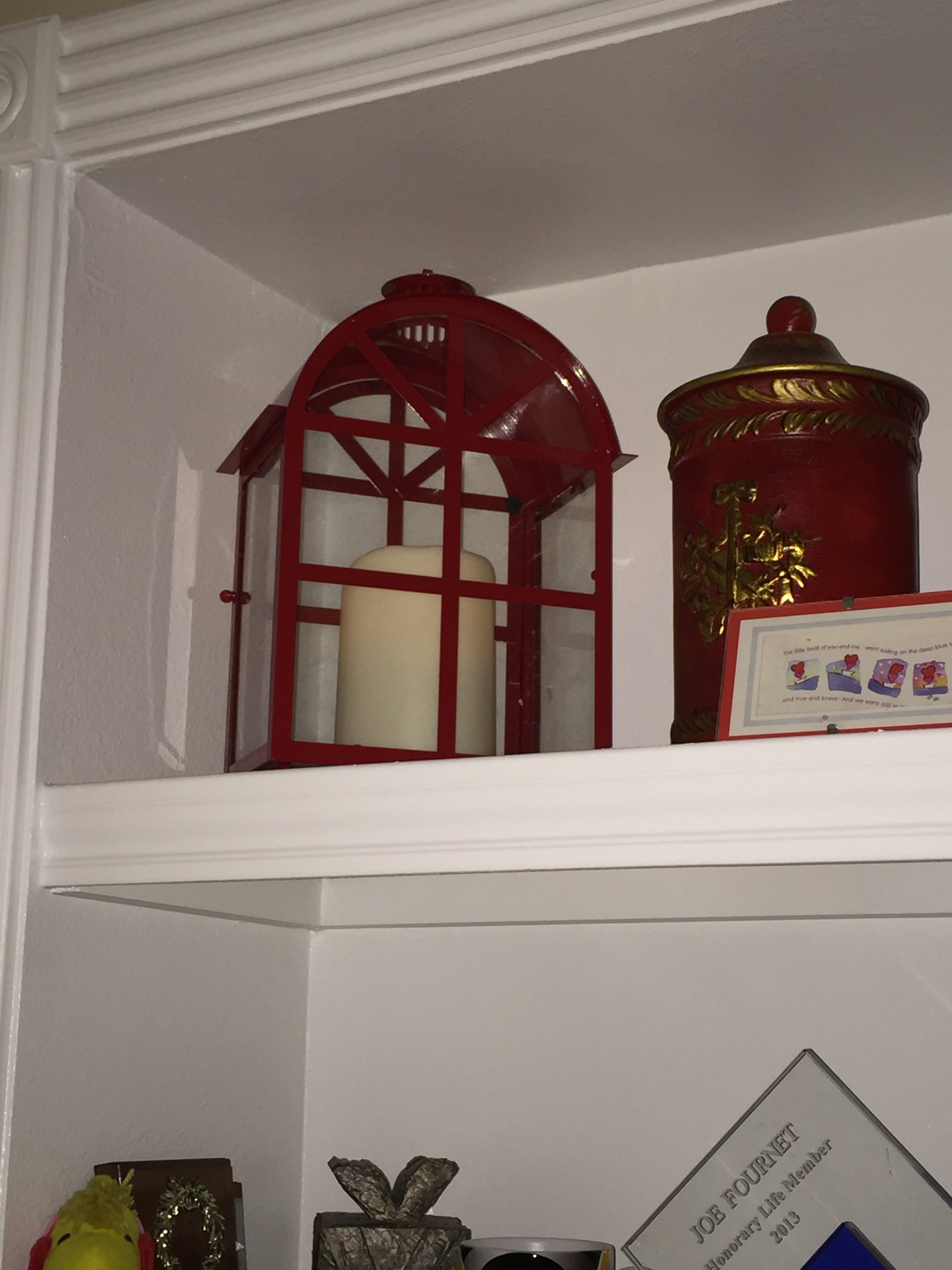
The lantern stands guard over Pamela’s cremated remains until one day magically transforms another living being into the remains the lantern is guarding so that Pamela takes new life in the other living being’s body.
The lantern stands guard constantly overlooking the ornate, Chinese red urn containing Pamela’s remains. Almost like a person, the lantern is always looking from an angle, never taking its stare away from the urn. Its duty is to protect, watch over and remain a reminder that all is calm, peaceful, okay – A little like the eternal flame at JFK’S grave site.
By all appearances the lantern is normal looking, what one might expect at seeing a candle perched inside a window-latticed, red-lacquered, nautically designed portable lamp.
It’s normal looking and serves its purpose as a lamp overlooking Pam’s oriental urn. That is, except for when it decides to act independently and transform a living body’s substance into cremated remains and then swap them out with Pamela’s.
Admittedly a neat trick that not every lantern is capable of doing. Why it performs this rather perverse ritual, if one wants to call it that, is unknown at this juncture. It just does it. Randomly. It’s as if the lantern has a sixth sense about the person with whom it selects to interact.
You might be asking yourself how I know this happens at all. Have I witnessed this rather profane exercise in transformation? Has it happened to me? It has not. Yet! Though I wonder what type of emotional ties does the lantern have with its “subjects”. I sense it wants what’s best for Pam, to bring her joy and comfort in some very strange and weird way.
Assuming this to be true, I’d surmise that my transformation would be soon to come. I am, after all, Pam’s widower.
Can a lantern get jealous?, I asked myself one day. How can it?; it’s not a living being, I reasoned. It’s more of an entity, a thing that lights up. But it’s an entity that keeps watch over a very important vase, one in which my wife’s ashes are kept. Somehow, I think it knows that. It’s seen me take them out of the vase since they’re contained in a large plastic bag within the vase. It’s watched me handle them with utmost care. It knows of their importance.
On the other side of Pam’s urn is a cute little stuffed raccoon I gave her years ago. The raccoon, nicknamed Lil’ Rocky, also stands guard. Pamela is well protected should anything bad befall her.
11:48 pm – that’s when the lantern turns itself on every night. When that happens, it casts an entirely different light on its shelf. Though it doesn’t cast that much illumination on Pamela’s urn, it does cast a lovely glow that brings about a peaceful setting in the darkness.
Every time I get up during the night, I look over to notice the lamp and to make sure all is okay. This night was no exception. The lantern automatically turns off at about 4:15 am and all is dark in the living room. I go back to bed and wake up after the sun’s up.
One morning as I was walking through the room heading to the kitchen to make some coffee, I looked over at Pam’s urn and wished her good morning, just like I always do. After I made my coffee, I started walking back into the bedroom but paused my stride and turned back to glance in the direction of Pam and the lantern.
Everything looked the same but I stood there wondering why I had stopped to glance her way. I even walked up a few steps to get a closer look but nothing appeared out of the ordinary. I just thought I was still asleep since I hadn’t even taken sip number one of my coffee.
I didn’t realize at the time I wasn’t the only one wondering if something was amiss.
As I returned to my work area later that day, I noticed nothing odd at all. I didn’t give it another thought, so to work I went. Towards the end of this day as I was winding down, I went through my routine of shutting things off and getting ready for bed. Upon leaving my study, I glanced up to Pam’s area to bid her goodnight and I noticed something was different, if ever so slightly.
Both the lantern and the Chinese urn were exactly the same but the little raccoon was different; she was now turned to a position where she was looking down at me, where I usually work. I kind of shook my head thinking I was viewing this in a bit of a haze. Upon another gaze, I realized I was seeing things correctly. The raccoon had definitely changed positions. How? I didn’t have the foggiest idea!
I just stood there, staring up at the bookshelf where I had placed her. Without thinking, I reached up and turned her back into her original position at a slight angle, looking more at the Chinese urn than in my direction below. After doing that, I turned around and marched off to bed, turning off lights as I went.
From Steinem to Van Gogh to Serling and more, these quotes cover a multitude of personalities and perspectives. Enjoy as you read through the history makers, some of our time, some not.
Without leaps of imagination, or dreaming, we lose the excitement of possibilities. Dreaming, after all, is a form of planning. Gloria Steinem
You cannot rely upon what you have been taught. All you have learned from history is old ways of making mistakes. There is nothing that history can tell you about what we must do tomorrow. Only what we must not do. Edwin H. Land
What would life be if we had no courage to attempt anything? Vincent Van Gogh
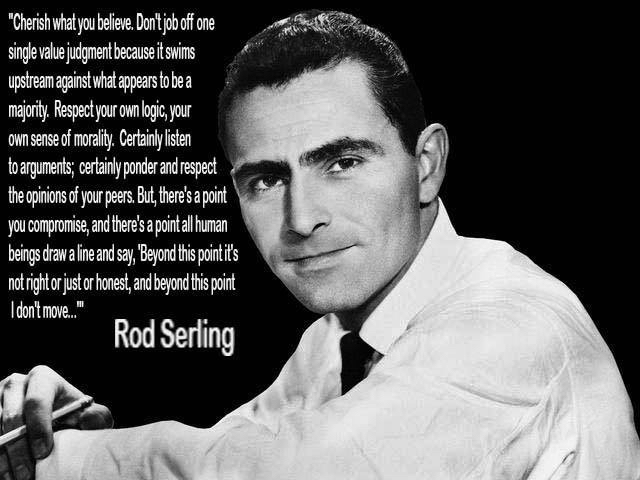
It isn’t enough for a sole voice of reason to exist. In this time of uncertainty we’re so sure that villains lurk around every corner that we will create them ourselves if we can’t find them. For while fear may keep us vigilant, it’s also fear that tears us apart. Rod Serling
Rod Serling
An important idea not communicated persuasively is like having no idea at all. William Bernbach, member, Advertising Hall of Fame
In writing advertising it must always be kept in mind that the customer often knows more about the goods than the advertising writers because they have had experience in buying them, and any seeming deception in a statement is costly, not only in the expense of the advertising but in the detrimental effect produced upon the customer, who believes she has been misled. John Wanamaker, member, Advertising Hall of Fame
Creativity is so delicate a flower that praise tends to make it bloom while discouragement often nips it at the bud. Alex Osborn, member, Advertising Hall of Fame
Good advertising is written from one person to another. When it is aimed at millions, it rarely moves anyone. Fairfax M. Cone, member, Advertising Hall of Fame
The scientist has marched in and taken the place of the poet. But one day somebody will find the solution to the problems of the world and remember, it will be a poet, not a scientist. Frank Lloyd Wright
Creativity Tip #36: If you can’t explain your idea to an 8-year old, it’s too complicated.
Hopefully making a ruckus, one blog post at a time!
Be sure to check out my other blog, Joe’s Journey, for personal insights on life and its detours.
Having trouble getting your creativity loaded? Those creative juices simply not flowing for ‘ya? “Creativity block” is something akin to writer’s block. It’s a difficult stage to get through and at times can last longer than we’d like. It’s been especially difficult developing new ideas, creating new products and launching new services in the chaotic reality of this pandemic.
subpng.com
Do times of uncertainty cause a decline in creativity and innovation? That’s not exactly a slam dunk of a “yes”. History tells us that innovation and creativity thrive even in periods of uncertainty and chaos.
Many successful companies like Airbnb and Uber, for example, were founded during the GreatRecession of 2007-2009. General Electric was established and grew during the massive economic downturn in America, also known as “The Panic of 1893.”
According to this Harvard Business School article on innovation, the Great Depression of the 1930s was one of the most innovative decades in the last century. A proliferation of new technologies, exceptional innovations and inventions that pushed the world forward were conceived and created during that time period.
Inventions such as the jet engine and the helicopter were created, followed by the FM radio, sunglasses, copiers, nylons, ballpoint pens, electric razors, car radios and much more.
Accessing the mindset of creativity and innovation in times of uncertainty is not easy. When we feel as if we are losing control over our external circumstances, we start telling ourselves there is no point in starting the creative process, as nothing we do will succeed. Nothing like shooting ourselves in our creative feet before we begin!
Uncertain times are the norm. It’s always been that way. We can’t predict the future and the only thing we can control is us. We’re the source of creativity, innovation and inspiration. Nothing new there.
The stability and certainty we need to support our creative process comes from within. How can we tap into that? As I touched upon in another blog post, we need to find an inner calm so that we may better conjure up the spark to our creativity. It’s there in all of us. We just need to find that which can ignite the spark.
Hemingway ignited the spark when he had trouble getting started on writing, by writing one declarative sentence . . . the rest, he said, will start to come naturally. You’ve got to “prime the pump,” so to speak. Even the artist needs to take a brush or a pen and just start doodling, anything that will stimulate the mind.
When we find our inner calm, alongside our commitment to continue the creative process no matter what, we’ll also find the right mindset for stepping up and making progress. The more we detach ourselves from the external madness, the more we can engage the creative process. We need to “catch the wave” before we can ride it.
Recession, chaos, uncertainty, and, yes, even a pandemic or two go hand in hand with creativity and innovation. Uncertainty surrounds us whether we like it or not. So, let’s deal with it in some way, shape or form. Start creating, inventing, solving problems and adding value. You do that by thinking clearly, calmly and intuitively. Concentrate on what you can control. The rest usually takes care of itself.
This post was contributed, in part, from an article by Nili Peretz, Forbes Councils Member.
Creativity Tip #27: Never fall in love with your idea; there’s always a better one around the corner.
Hopefully making a ruckus, one blog post at a time!
Be sure to check out my other blog, Joe’s Journey, for personal insights on life and its detours.
As it has been some time since a post was published with nothing but quotes, I thought we’d resurrect the form. Whereas in previous posts there has been a variety of authors quoting something not necessarily pertaining to advertising or the industry. This time, however, I thought we go with an emphasis on advertising, at least from people from within the ad biz. Enjoy!
When we are too timid to risk failure, we reduce the opportunities to succeed. And we eliminate the chance to learn. Keith Reinhard, member, Advertising Hall of Fame
Remove advertising, disable a person or firm from proclaiming its wares and their merits, and the whole of society and of the economy is transformed. The enemies of advertising are the enemies of freedom. David Ogilvy, member, Advertising Hall of Fame
Creative imagination — the lamp that lit the world — can light our lives. Alex F. Osborn, member, Advertising Hall of Fame
Let us blaze new trails. Let us prove to the world that good taste, good art and good writing can be good selling. William Bernbach, member, Advertising Hall of Fame
I have learned that any fool can write a bad ad, but that it takes a real genius to keep his hands off a good one. Leo Burnett, member, Advertising Hall of Fame
An important idea not communicated persuasively is like having no idea at all. William Bernbach, member, Advertising Hall of Fame
When we are too timid to risk failure, we reduce the opportunities to succeed. And we eliminate the chance to learn. Keith Reinhard, member, Advertising Hall of Fame
Creativity is no longer about grabbing attention or raising consumer awareness. Its goal is to remind consumers about what is fundamental and gratifying about a brand. Peter A. Georgescu, member, Advertising Hall of Fame
Rules are for people who don’t know what to do. AND I don’t like closed doors. Creativity flourishes best in an environment of open doors and open minds. Keith Reinhard, Advertising Hall of Fame
To sleep. Perchance to dream. To dream. Perchance to imagine. To imagine. Perchance to create. To create. Perchance to write; perchance to make a difference. Mr. Rod Serling definitely made a difference and impacted society with his unique form and brand of creativity in his writing.
One could not watch an episode of either the Twilight Zone or Night Gallery and not be moved in some way. His genius and commentary were not limited to “inside” the story lines, but could also be found in his opening and closing narration.
Take the following, for example:
Then there’s this gem on creativity (circa 1971):
Quoting from the book “As I knew Him: My Dad, Rod Serling,” by Anne Serling, (wonderful read, by the way) “In what was to be my father’s final interview, he was asked what he wanted people to say about him a hundred years from then. He responded, ‘I don’t care that they’re not able to quote any single line that I’ve written. But just that they can say, ‘Oh, he was a writer.’ That’s sufficiently an honored position for me.'”
As creativity goes, he was a master. As a writer, he was unsurpassed in this genre of storytelling. Oh sure, you have Mark Twain, Hemingway, Poe, Dickens, and Stephen King to name a few. But they were different; they each had their own style. Serling was also of another generation.
I often wonder what great works he would have produced should he have lived beyond 50 years. If King was or is the master of horror, then Serling, surely, was the master of the macabre for his generation, just as Edgar Allan Poe was for his. Not surprisingly, Poe was a great influence on Serling.
One thing to keep in mind, no matter who is or has influenced you as a creative person or a writer in particular, don’t be afraid to extend your limits, your boundaries. If you don’t think you can design it, write it or overcome it, try creating it anyway. Get to work even if you’re doing it in small, baby steps.
Even Hemingway wrote in a one sentence at a time mindset. Serling, being aware of his capacities, didn’t limit himself to actual writing of words. His generation of technology at least afforded him the dicta-phone so he could keep pace with his mind.
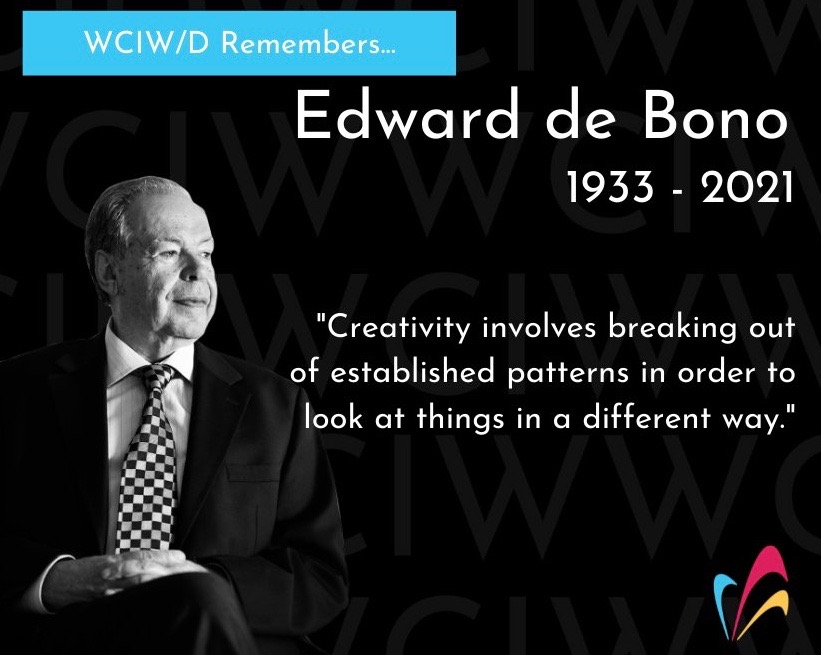
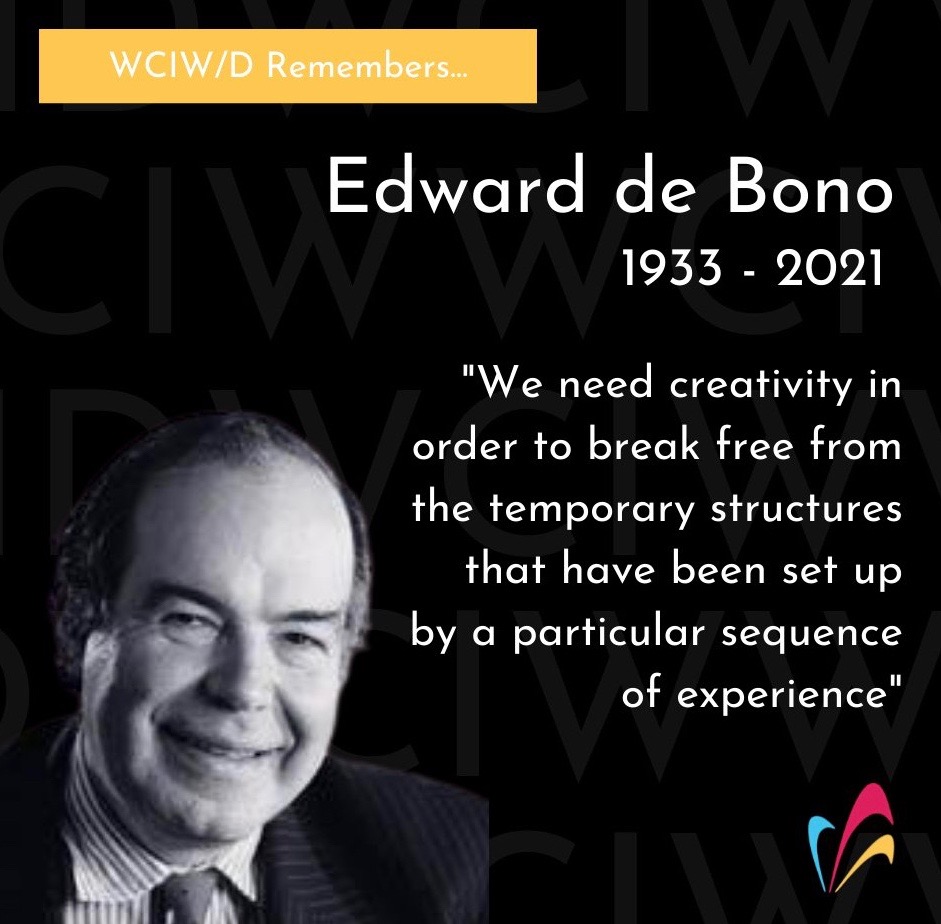
As you may know, Edward de Bono recently passed away. What he leaves with him is a vast treasure trove of creative insights and reminders of how and what we might do to strengthen and enhance our own creativity. Here are some select quotes from him provided by the World Creativity Innovation Week/Day and Prady, whom we thank for letting us further promote the creative thoughts of Dr. de Bono.
More de Bono quotes:
A memory is what is left when something happens and does not completely unhappen.
Most executives, many scientists, and almost all business school graduates believe that if you analyze data, this will give you new ideas. Unfortunately, this belief is totally wrong. The mind can only see what it is prepared to see.
Creativity is a great motivator because it makes people interested in what they are doing. Creativity gives hope that there can be a worthwhile idea. Creativity gives the possibility of some sort of achievement to everyone. Creativity makes life more fun and more interesting.
Creative thinking is not a talent, it is a skill that can be learnt. It empowers people by adding strength to their natural abilities which improves teamwork, productivityand where appropriate profits.
The need to be right all the time is the biggest bar to new ideas.
Bonus Quotes:
Humor is by far the most significant activity of the human brain.
It has always surprised me how little attention philosophers have paid to humor, since it is a more significant process of mind than reason. Reason can only sort out perceptions, but the humor process is involved in changing them.
Hopefully making a ruckus, one blog post at a time!
Be sure to check out my other blog,Joe’s Journey,for personal insights on life and its detours.
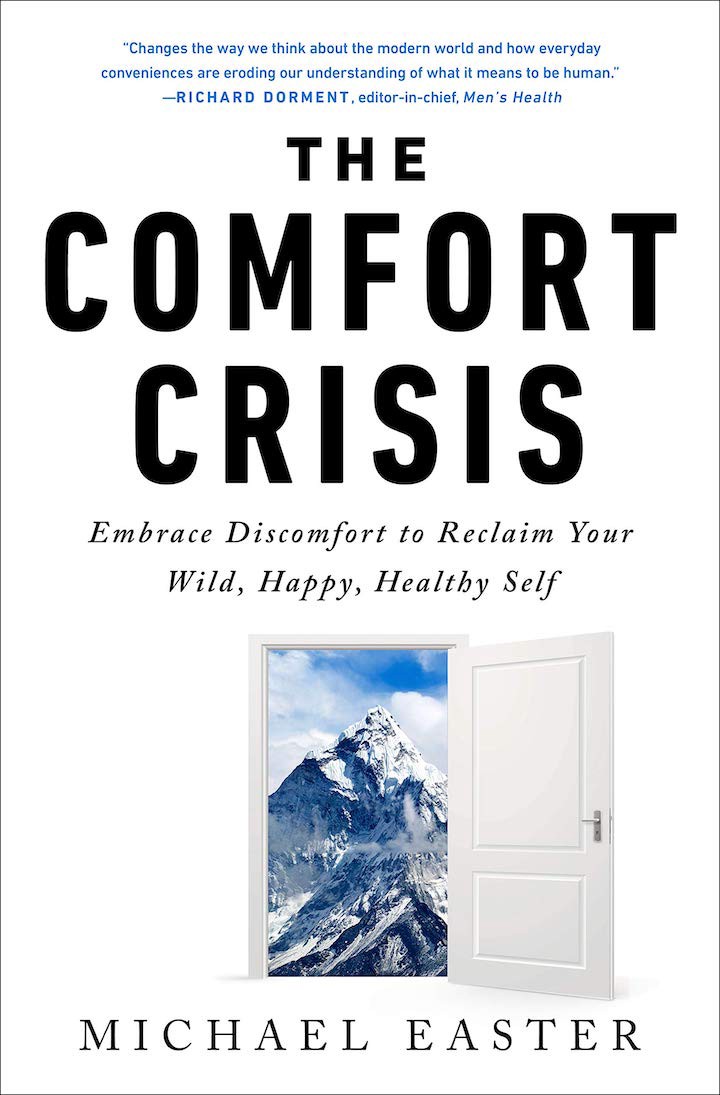
Portions of this post are based on excerpts from the book by Michael Easter, The Comfort Crisis. We spend an awful lot of time consuming digital media, lest we get easily bored. A recent study looked at what happens to a bored mind without easy access to media?
The Canadian neuroscientist James Danckert recruited some volunteers and put them into a neuroimaging scanner, and induced them into a mood of being bored They had them watch two guys hanging laundry for eight minutes. You could say they were bored out of their gords!
While bored, a part of their brains called the “default mode network” fired on. It’s a network of brain regions that activates when we’re unfocused, when our mind is off and wandering. Mind wandering is a rest state that restores and rebuilds the resources needed to work better and more efficiently when we’re focused on the outside world.
Mind wandering is also a key driver of creativity, which is why other studies have found that bored people score significantly higher on creativity tests. Research dating back to the 1950s may explain why we’re now facing a “creativity crisis.”
If I didn’t already know this was a 1950’s Classroom, I would have guessed it. Has that look and feel – BTW, where are the little girls?
Ellis Paul Torrance was an American psychologist. In the 1950s he noticed something off target about American classrooms. Teachers tended to prefer the subdued, book-smart kids. They didn’t much care for the kids who had tons of energy and big ideas. Kids who’d think up odd interpretations of readings, inventive excuses for why they didn’t do their homework, and morph into mad scientists every lab day.
The system deemed these kids “bad.” But Torrance felt they were misunderstood. Because if a problem comes up in the real world, all the book-smart kids look for an answer in … a book. But what if the answer isn’t in a book? Then a person needs to get creative.
He thus devoted his life to studying creativity and its uses for good. In 1958 he developed the “Torrance Test.” It’s since become the gold standard for gauging creativity. The TTCT (Torrance Tests of Creative Thinking) assess how creatively a child’s mind works and are often given to children to determine advanced placement or as part of an entrance examination. Instead of traditionally taught subjects such as reading or math, these tests assess creativity. Children are scored on a number of aspects, including:
Creative titles for pictures
Expressions
Imagery
and Humor
He had a large group of children in the Minnesota public school system take the exam. It includes exercises like showing a kid a toy and asking her, “how would you improve this toy to make it more fun?”
Torrance analyzed all the kids’ scores. He then tracked every accomplishment the kids earned across their lives, until he died in 2003, when his colleagues took on the job. If one of the kids wrote a book, he’d mark it; if a kid founded a business, he’d mark it; if a kid submitted a patent, he’d mark it. Every achievement was logged. What he found raises big questions about how we judge intelligence.
The kids who came up with more, better ideas in the initial tests were the ones who became the most accomplished adults. They were successful inventors and architects, CEOs and college presidents, authors and diplomats, etc.
Torrance testing, in fact, bests IQ testing so much so that a recent study of Torrance’s Kids found that creativity was a threefold better predictor of much of the students’ accomplishment compared to their IQ scores.
Now, according to Easter, we’ve killed off one of the main drivers of creativity: mind wandering. The result? A researcher at the University of William and Mary analyzed 300,000 Torrance Test scores since the 50s. She found that creativity scores began to nosedive in 1990.
She concluded that we’re now facing a “creativity crisis.” The scientist blames our hurried, over-scheduled lives and “ever increasing amounts of time interacting with electronic entertainment devices.”
And that’s bad news. Particularly when we consider that creativity is a critical skill in today’s economy, where most of us work with our brains rather than brawn.
Despite what productivity gurus will have us believe, the key to improving creativity might be to occasionally do nothing at all. Or, at least, not dive into a screen. We’ll think distinctly, in a way that delivers more original ideas.
Yet, ironically, society’s tech giants still deliver more advanced software to supposedly aid us in our creativity, while holding us increasingly captive. A proper balance has yet to be realized. And may not ever.
While it may sound silly, occasionally doing nothing works. At least for me, it does. Of course, my body may not be doing anything but my mind is usually traveling at warp speed. It’s usually during these times that I let my mental forces do what they’ll do. More times than not, they produce . . . an idea . . . several ideas . . . a partial script . . . something to which I can apply time-in-the-future to develop.
Boredom is just one evolutionary discomfort we’ve lost from our lives. Easter’s book, The Comfort Crisis, investigates nine others, covering what happens to our bodies, minds, and sense of self without them—and the benefits we can reap by reintroducing these evolutionary discomforts into our lives.