I don’t know how Seth Godin does it. He writes and publishes a blog everyday, 365 days a year. I have trouble publishing my two blogs each WEEK!
Part of my problem is having something interesting to publish. That is every blogger’s nightmare. There have been times I write a blog the night before because I came up with an idea and just developed it.
When I’m in a pinch and nothing comes to mind, I try and change my focus. In a way, I let myself become distracted, not by merely doing something else but by switching creative gears and concentrating on another creative project.
It was where my muse wanted to take me, so I let it. What is a muse you might ask?
Muse, in Greco-Roman religion and mythology, any of a group of sister goddesses of obscure but ancient origin, the chief centre of whose cult was Mount Helicon in Boeotia, Greece. They were born in Pieria, at the foot of Mount Olympus.
They probably were originally the patron goddesses of poets (who in early times were also musicians, providing their own accompaniments), although later their range was extended to include all liberal arts and sciences—hence, their connection with such institutions as the Museum (Mouseion, seat of the Muses) at Alexandria, Egypt. There were nine Muses as early as Homer’sOdyssey, and Homer invokes either a Muse or the Muses collectively from time to time.
Virgil (centre) holding a scroll with a quotation from the Aeneid, with the epic Muse (left) and the tragic Muse (right), Roman mosaic, 2nd–3rd century ad. Courtesy of the Musée Le Bardo, Tunis
As the creative juices begin to flow and my “new” project begins to take shape, I begin to develop several ideas that would make for interesting blog posts. I did, however, make sure I finished what I had previously started so I could “celebrate” the accomplishment (a musical slide show).
Whether or not you follow your instincts when you have a calling to do so, is up to you. Your mind and imagination are wondrous tools in the creative process. Don’t ignore them.
Hopefully making a ruckus, one blog post at a time!
Be sure to check out my other blog, Joe’s Journey, for a different kind of playground for creativity, innovation and inspiring stuff.
Creativity knows no bounds. Nor, it seems, does an artist’s or cartoonist’s palette. Take, for instance, a recent, uh, exhibit at the Charles Schulz Museum in Santa Rosa, CA.
Talk about a lasting impression! If you’ve ever put your hands or feet into wet cement, you know what I’m talking about. When I came upon this photo entry by Jean Schulz, yes, that Schulz, I had to share it via my own creativity blog. All of us can relate to having impressions in concrete. Then, again, if you’re a world-famous beagle, your impressions are as varied as your moods.
In her latest blog post, “Leaving a Lasting Impression,” Jean Schulz shares the simple joy of leaving your mark in wet cement.
Hopefully making a ruckus, one blog post at a time!
Be sure to check out my other blog, Joe’s Journey, for a different kind of playground for creativity, innovation and inspiring stuff.
Creativity depends on strategy to be effective and successful. And vice versa. Do they need to live in harmony together? From the United Kingdom, the British agency Five by Five’s strategy director Catherine McPherson and creative director Ravi Beeharry discuss the secret to an effective relationship between creativity, strategy and craft.
Strategy, creativity, or craft – which is more important to a successful ad? And how should they work together?
“It used to be like a relay race, with each department handing the baton to another along the production line,” says Five by Five’s strategy director Catherine McPherson. “But today rather than strategy handing over a brief and washing its hands, we’re now running alongside the creatives and cheering them on.”
To an extent, the secret to effective advertising has always been found in the relationship between strategy, creativity, and craft. Too much strategy can leave a campaign feeling more like a PowerPoint presentation, whilst unrestrained creativity risks derailing a brand’s messaging. Get the balance right, however, and you land on the kind of genius which works miracles in the marketplace.
“While there is a balance to be struck, there isn’t a simple formula,” notes creative director Ravi Beeharry. “You have to look at it on a case-by-case basis. Take the iconic Meerkat from Compare the Market, for example.
You might look at that and consider it to be an example of creativity which went a bit out of control. What is a meerkat saying about that brand? But in practice it was enormously effective because the balance was right in that instance”.
Knowing which element should take prominence, the pair agree, comes down to your definition of success.
“Does success mean winning at Cannes, or does it mean driving sales in the short-term? Or is it brand recognition? It might sound obvious, but being intentional about the end result is the first step to getting the balance right”, says Catherine.
“Something we’ll reference quite often at Five by Five is Peter Field’s research into the recent decline in creative effectiveness, and one takeaway from that has been that we don’t look for compromise between strategy and creativity but rather look for harmony. They should feed into one another”.
“The best creativity bounces off strategy like it’s a springboard”, notes Ravi. “And craft is the execution – actually, let me rephrase that. Craft is good execution. Knowing the precise balance between those elements will ultimately come down to judgement and context. It all adds up to having strong ideas, clearly communicated”.
‘Strong ideas, clearly communicated’ is Five by Five’s strategic approach to briefs. It’s what ensures their clients’ brands get noticed, processed and recalled – and it’s ultimately what delivers effective campaigns.
And as Ravi notes, when it comes to measuring a successful campaign, context will always be king. However, in recent years a fracturing media environment has made identifying that context all the more challenging.
The Ever-Growing Crowd
One reality of the modern industry is that an idea can no longer realistically be designed to live in one place. The seemingly endless proliferation of channels and platforms which occurred in the last decade has created a marketing landscape with more nuance than at any point in the industry’s history. But, according to Catherine and Ravi, there are still ways of finding the right balance between strategy, creativity, and craft.
“Something which we’ve lost sight of, I feel, is precisely what we should be using these different platforms for. They don’t need to be additional challenges, they should be seen as additional tools.
“If you’re going to take one single idea and contort it to fit a TV screen as well as a mobile phone, then I’ve no doubt that storytelling and quality will suffer as a result. But if you work out how to take a central idea and present it in a bespoke way for different formats, then you’re far more likely to have an impactful campaign”, she says.
For Ravi, there’s an opportunity for brands to become more memorable by elevating creativity and craft across multiple platforms. “It’s probably true to say that there’s a focus on promotion over entertainment at the moment”, he says. “And perhaps much of the culture and capabilities of social platforms, for example, lend themselves to promotion.”
“But look at what Nike put out just recently after Nadal won the Grand Slam. There wasn’t a single pair of trainers or shorts advertised, just a celebration of a sporting achievement which played into Nike’s brand in such an obvious way it doesn’t need underlining.
I came across that video on Twitter, so that’s a great example of using a social platform to drive results through entertainment. It’s a great execution of strategy, creativity, and craft”.
In the words of both Catherine and Ravi, these kinds of pitch-perfect ideas are the cumulative result of a long-term approach to each of strategy, creativity, and craft.
“McDonalds is another example of a brand that gets this consistently right”, says Catherine. “They run a lot of product-focused ads on the high street but they also consistently come out with beautifully-told stories based on human truths, designed for TV.”
“It’s creativity, strategy, and craft working in perfect harmony over the course of many years. And it’s because they’ve nailed their brand-building that the shorter-term promotions work so well”.
That long-term approach, then, is perhaps as close to a ‘winning formula’ as a brand is likely to get. But, as Ravi points out, the best insights are invariably based on a kind of magic which can’t be bottled.
“At Five by Five we have an unprecedented number of tools and analytics available to us”, he says, “but those genius ideas which link strategy, creativity and craft together can’t come out of a formula. If they could, it wouldn’t really be genius”.
Live Long and Prosper, Ukraine!
Hopefully making a ruckus, one blog post at a time!
Be sure to check out my other blog, Joe’s Journey, for a different kind of playground for creativity, innovation and inspiring stuff.
Stumped. Writer’s Block. Stymied. Confused. It’s all a jumble of nothingness.
What Do You Write When You Don’t Know What to Write About?
So, how do you turn nothingness into somethingness? Start writing! Anything.
The words will come, thoughts will flow and, eventually, creativity will blossom.
You can’t force it, however. It must evolve naturally, at your own pace. Usually, if a creative suggestion doesn’t appear in your thoughts within about 20 minutes or so, abort the process and go on to something else. Then come back to it hours later or the following day.
Some writers think before they write. Some think as they write. Some writers don’t think at all; they just write a bunch of gobbledygook. That’s fine, as long as you go back and turn the gobbledygook into useful garbage.
Turning that garbage into something quite palpable and enticing will take a process of editing and refinement but when you’re at this stage, you’ve got it made.
Hopefully making a ruckus, one blog post at a time!
Be sure to check out my other blog, Joe’s Journey, for a different kind of playground for creativity, innovation and inspiring stuff.
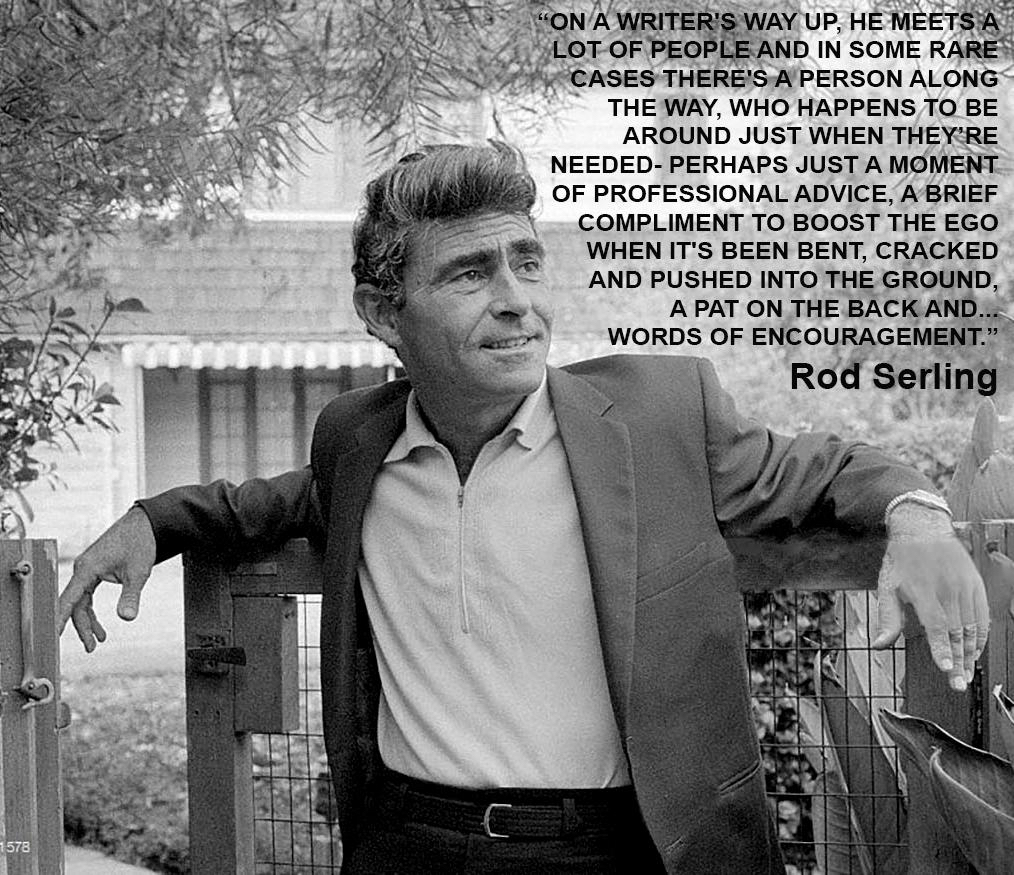
The quotations are as varied as the people who said them. Some you know, some you don’t. That’s what makes them interesting. From Burke to Burnett, Einstein to Degas; throw in a little Serling for seasoning and you’ve got a tasty recipe for March’s quotes.
We don’t grow unless we take risks. Any successful company is riddled with failures. — James E. Burke, Advertising Hall of Fame
Success or failure in business is caused more by mental attitude than by mental capacities. — Walter Dill Scott, Advertising Hall of Fame
Anyone who thinks that people can be fooled or pushed around has an inaccurate and pretty low estimate of people — and he won’t do very well in advertising. — Leo Burnett, Advertising Hall of Fame
If we knew what we were doing, it wouldn’t be called research, would it? – Albert Einstein
If you fall in love with the imagination, you understand that it is a free spirit. It will go anywhere, and it can do anything. – Alice Walker
Curiosity killed the cat, but for a while I was a suspect. – Steven Wright
You must aim high, not in what you are going to do at some future date, but in what you are going to make yourself do to-day. Otherwise, working is just a waste of time. – Edgar Degas
Our job is to simplify, to tear away the unrelated, to pluck out the weeds that are smothering the product message. — William Bernbach, Advertising Hall of Fame
How do we turn science fiction into fact? We do it by inventing our own future and figuring out the realistic steps that we need to make in order to get there. Dare to dream. Let your imagination leap. — David Shapton, Editor In Chief, RedShark Publications, 2012 to 2020
Hopefully making a ruckus, one blog post at a time!
Be sure to check out my other blog, Joe’s Journey, for a different kind of playground for creativity, innovation and inspiring stuff.
Today is the day of AAF Northeast Arkansas’ panel discussion on Empowering the Women of Advertising. I’m proud to be a participant on their panel so I have a vested interest in the event’s success.
Increasing diverse participation in advertising and marketing is a business issue, and we need everyone involved. To that end, AAF Northeast Arkansas is today raising awareness about ways to involve more men in creating inclusive work environments and how women can claim their strength within the advertising realm.
By coincidence, a British publication interviewed several key women in advertising about the current status of their gender within their industry. The timing of this report is appropriate with the timing of the Arkansas AAF panel today.
Think about the people who make the buying decisions for their households. It’s extremely likely that the majority of them are women. And they’re probably more likely to be older than younger. Now think about agency creative departments that you know of – do those teams reflect the people who are likely most efficient to market to? Probably not.
In a recent interview with LBB, a British publication, Sue Higgs, joint ECD at dentsuMB in the UK, had this advice: “I find that it’s someone else’s problem, ageism”. The stage in life Sue’s at now is a huge asset to her as a creative leader. “The great thing about being in your mid-life or wherever we are is that it’s quite liberating,” she said. “It’s quite liberating, I think, to find your strength, and your power, and your voice.”
And that liberated voice is exactly what creatives need to flourish. One thing Sue said she’s learned from her experience is that: “As you get older you learn that people lose their jobs for a trillion reasons and none of them is actually speaking your mind. There’s nothing more fulfilling to say to a young female than: ‘Just tell them. Just say it, your biggest weapon is your point of view. That’s why you’re here. Please use it.’
Fear and courage don’t seem likely bedfellows. Yet, they are showing us every day how they play together amongst the citizenry of Ukraine. When you’re fighting for survival, it stretches the limit of one’s creativity. Some may say that creativity is not even involved in warfare. I disagree.
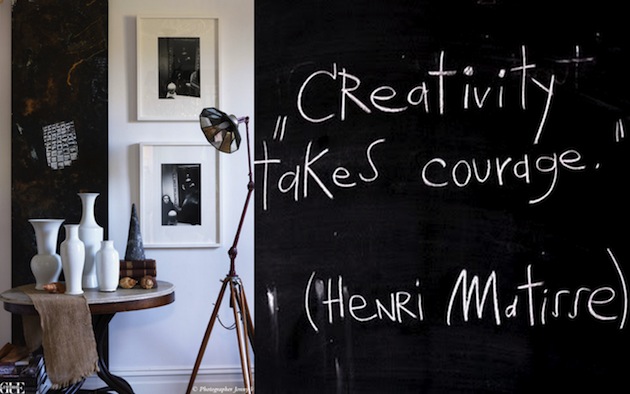
While creativity in warfare interacts with a much higher level of courage and seriousness compared to presenting an advertising campaign, it requires effort and takes courage, as Matisse says. The Ukranian people are showing resiliency and mucho bravery. Creativity lives within that realm.
Fear and courage impact our creative thinking and expression
Even in a non-combat zone, fear attacks us everyday. Courage is what most of us try and muster to get through a day’s time unscathed by said fear. We may not be fighting to stay alive but we are fighting. We’re fighting our internal demons and our self-doubt. We’re fighting to retain some of our creativity and resourcefulness.
Author and teacher Elizabeth Gilbert admits “the only reason I can speak so authoritatively about fear is that I know it so intimately. I know every inch of fear, from head to toe. I’ve been a frightened person my entire life.”
She points out that “Evolution did well to install a fear reflex within you, because if you didn’t have any fear, you would lead a short, crazy, stupid life. You would walk into traffic. You would jump into giant waves off the coast of Hawaii, despite being a poor swimmer…
“So, yes, you absolutely do need your fear, in order to protect you from actual dangers.
“But you do not need your fear in the realm of creative expression.
As you may have gathered by now, this post is an out-of-the-ordinary-one. It celebrates one of our nation’s top word sleuths, a master of reduced vocabulary and a penchant for a feline sporting a floppy chapeau.
His birthday was yesterday but his creativity, particularly with and for children, certainly merits more than just a mention in this creativity blog. He is, of course, Dr. Seuss, and with that brief introduction comes some background that some of you may not know.
Theodor Seuss Geisel (March 2, 1904 – September 24, 1991) was an American children’s author, political cartoonist, illustrator, poet, animator, and filmmaker. He is known for his work writing and illustrating more than 60 books under the pen nameDr. Seuss. His work includes many of the most popular children’s books of all time, selling over 600 million copies and being translated into more than 20 languages by the time of his death.
Geisel adopted the name “Dr. Seuss” as an undergraduate at Dartmouth College and as a graduate student at Lincoln College, Oxford. He left Oxford in 1927 to begin his career as an illustrator and cartoonist for Vanity Fair, Life, and various other publications. He also worked as an illustrator for advertising campaigns, most notably for FLIT and Standard Oil, and as a political cartoonist for the New York newspaper PM.
He published his first children’s book And to Think That I Saw It on Mulberry Street in 1937. During World War II, he took a brief hiatus from children’s literature to illustrate political cartoons, and he also worked in the animation and film department of the United States Army where he wrote, produced or animated many productions including Design for Death, which later won the 1947 Academy Award for Best Documentary Feature.
Geisel won the Lewis Carroll Shelf Award in 1958 for Horton Hatches the Egg and again in 1961 for And to Think That I Saw It on Mulberry Street. Geisel’s birthday, March 2, has been adopted as the annual date for National Read Across America Day, an initiative on reading created by the National Education Association.
He also received two Primetime Emmy Awards for Outstanding Children’s Special for Halloween is Grinch Night (1978) and Outstanding Animated Program for The Grinch Grinches the Cat in the Hat (1982).
Geisel’s most famous pen name is regularly pronounced /suːs/, an anglicized pronunciation inconsistent with his German surname. He himself noted that it rhymed with “voice”. Alexander Laing, one of his collaborators on the Dartmouth Jack-O-Lantern, wrote of it:
You’re wrong as the deuce And you shouldn’t rejoice If you’re calling him Seuss. He pronounces it Soice (or Zoice)
Geisel switched to the anglicized pronunciation because it “evoked a figure advantageous for an author of children’s books to be associated with—Mother Goose” and because most people used this pronunciation. He added the “Doctor (abbreviated Dr.)” to his pen name because his father had always wanted him to practice medicine.
So whether or not you heard Horton’s Who or salivate over his breakfast suggestion of Green Eggs and Ham, take a moment and say Thank You to the one main character to whom millions of kids have related to for years, Dr. Seuss.
Usually every week I come across an article or narrative on creativity, its many facets and how better to utilize one’s own creativity. Such is the case this week.
One of the subscriptions I maintain (zero cost, but there is an option for minimal cost) is with Medium. I’ve even posted some of my writings on the site.
This week I came across a posting having to do with noise and the role it plays in creativity. It was written by Donald Rattner, Architect, and since it has some very interesting points, I’d like to share it with you. . .
. . .Maybe it was inevitable, but after years of touting the virtues of the open workspace, people who plan and use them appear to be having second thoughts about its effectiveness. Among the biggest drivers behind the mounting backlash are complaints about noise, especially in the form of overheard conversations, ringing phones, and clattering machines.
But before you jump on the “silence is golden” bandwagon, it might be worth taking a step back to assess the problem with a cooler, more objective eye, especially if you spend some part of your day in creative problem solving. The reason? A modicum of noise has been found to boost idea generation, rather than interfere with it.
Noises Off or Noises On?
Credit a team of researchers drawn from several different universities for daring to challenge status quo thinking.
In 2012, the trio published a paper documenting a series of lab experiments they ran to study the effect of noise on creative task performance. Their methods were pretty straightforward: Subjects performed various exercises designed to measure ideational fluency and open-mindedness while a soundtrack played in the background.
The track played at either a low (50 decibels), middle (70db), or high volume (85db). A fourth group performed the same exercises without any accompanying soundtrack to establish a baseline from which to measure the collected results.
Contrary to expectation, the people in the quiet sessions did not achieve the top scores. That honor went to subjects exposed to midlevel noise (70db).
Illustration: The author
As a point of reference, 70db is the rough equivalent of the din at a bustling restaurant or coffee shop. It also approximates the loudness of a running shower, which is probably one reason why we so often get good ideas while under the spigot.
It’s evident from the data that the right type and level of noise can literally change the way our creative minds work. But how? And why? And how do we harness this information to boost our creative output in real-world settings?
Guilford’s Model of Creative Thinking
A model of creative thinking first developed in the 1950s might be the most effective vehicle for providing answers to these questions.
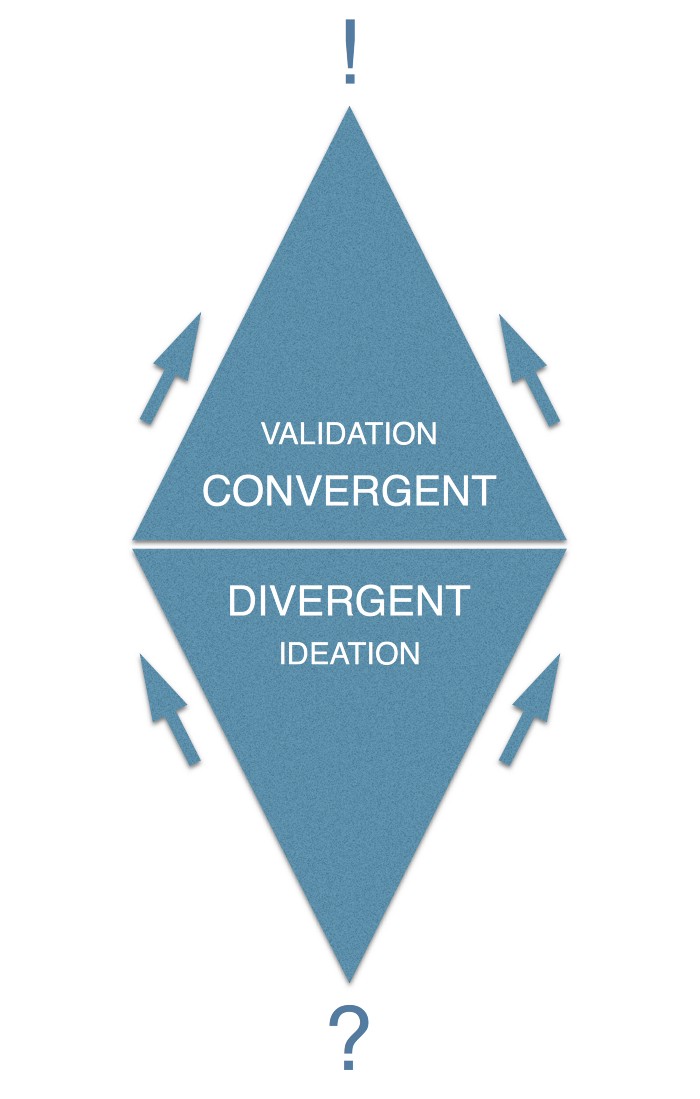
The model was the brainchild of the psychologist J.P. Guilford, an important figure in the history of modern creativity studies. Its basic premise is that creative thinking comprises two styles of cognitive processing: divergent andconvergent.
Divergent thinking corresponds to what we variously call right-brain or generative thinking. It is generally abstract, big-picture, intuitive, nonlinear, and inward-focused in nature. It induces us to see things as they could be, rather than as they are.
Convergent thinking is nearly the mirror opposite. Unlike divergent thinking, it is rational, objective, sequential, narrowly focused, highly detailed, and concrete in character. It looks outward rather than inward for answers, such as when we apply the external laws of mathematics to calculate the sum of two plus two, instead of drawing from our imagination.
For Guilford, the creative process is neither one nor the other alone, but both styles working in tandem, and nominally in sequence.
Illustration: The author
As a linear progression, Guilford’s model translates into a five-stage process composed of the following phases:
Definition of the problem to be solved: (?).
A period of divergent thinking, during which you open up your mind to as many ideas for potential solutions as time, budget, energy, or creative capability allow. Brainstorming is a technique for inducing divergent thinking.
A point of inflection where divergency ceases and convergency begins.
A period of convergent thinking, during which you narrow down your options to zero in on a potential solution, which is then tested and validated.
Realization of a final solution: (!).
In real life, of course, the creative process rarely travels in an uninterrupted straight-line trajectory from (?) to (!). More often than not, you find yourself going backwards one or more steps before getting to your goal — if you reach it at all.
But as a conceptual model, Guilford’s paradigm gives a pretty accurate picture of how our minds work in the course of working out feasible solutions to creative problems.
Here’s a sample of select quotes from some of the great minds in advertising and education.
The arts, sciences, humanities, physical education, languages and maths all have equal and central contributions to make to a student’s education. – Ken Robinson
You can be creative in anything – in math, science, engineering, philosophy – as much as you can in music or in painting or in dance. – Ken Robinson
Whether or not you discover your talents and passions is partly a matter of opportunity. If you’ve never been sailing, or picked up an instrument, or tried to teach or to write fiction, how would you know if you had a talent for these things? – Ken Robinson
You can’t be a creative thinker if you’re not stimulating your mind, just as you can’t be an Olympic athlete if you don’t train regularly.– Ken Robinson
Every area of trouble gives out a ray of hope, and the one unchangeable certainty is that nothing is certain or unchangeable. -John E. Kennedy, member, Advertising Hall of Fame
Brand value is very much like an onion. It has layers and a core. The core is the user who will stick with you until the very end. – Edwin Artzt, member, Advertising Hall of Fame
When you are through changing, you are through. – Bruce Barton, member, Advertising Hall of Fame
If you can’t turn yourself into your customer, you probably shouldn’t be in the ad writing business at all. – Leo Burnett, member, Advertising Hall of Fame
Creativity is no longer about grabbing attention or raising consumer awareness. Its goal is to remind consumers about what is fundamental and gratifying about a brand. – Peter A. Georgescu, member, Advertising Hall of Fame
We pay just as dearly for our triumphs as we do for our defeats. Go ahead and fail. But fail with wit, fail with grace, fail with style. A mediocre failure is as insufferable as a mediocre success. – Bruce Barton, member, Advertising Hall of Fame








 ideasnmoreblog