Dreams . . . Cancer . . . Nightmares . . . Sleeplessness . . . What of Insomnia?

Note: This week begins a celebration of World Creativity and Innovation Week, April 15-21. I thought it appropriate to highlight some intriguing, insightful and, hopefully, entertaining bits and pieces of creativity and innovation from around our globe.

My initial offering deals with Insomnia and how, for some people, it can be truly nightmarish. This post includes information and images from both a presentation on insomnia and select photos by a photographer who has severely suffered from insomnia.

In this excerpt from an issue of Adobe Create Magazine, the photog takes us into his bizarre world of striking, nightmarish illusions.

And his fight with insomnia.

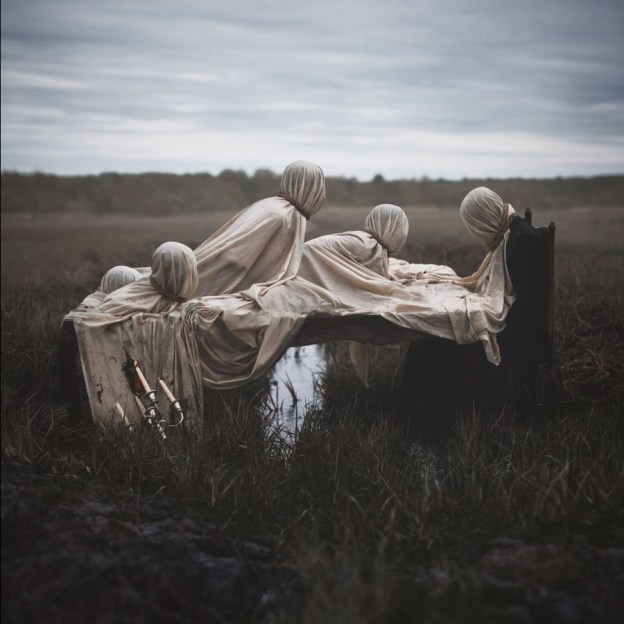
Photographer Nicolas Bruno has suffered from sleep paralysis since he was seven years old. In Bruno’s case, when he enters REM sleep, his mind becomes conscious, or awake, but his body remains asleep. During these recurring episodes, he experiences shortness of breath or pressure on his chest and the feeling that he’s being choked or is going to be killed. Screaming shadow figures menace him in bed. He’s unable to move, and the state seems to last hours. Sometimes it stops because he awakens; other times he moves into another dream. All of it is out of his control.

And you thought you had nightmares!

BrunoSleepless-3

When Bruno was fifteen, he began experiencing sleep paralysis almost every night. To help process the resulting stress, he kept a dream journal and then turned to drawing and photography. At first, he photographed mostly landscapes and abandoned places. Over time, he started making work directly inspired by what he goes through during sleep paralysis.

“Transforming my experiences with sleep paralysis into artwork not only helps me understand the dreams,” Bruno says. “It gives me a universal voice to speak about something almost impossible to describe with words. After I complete a photo shoot and see my final image, I feel so relieved to have transformed a once uncontrollable nightmare into something positive and tangible.”

BrunoSleepless-1

“The characters I portray within my work are figures I’ve documented within my sleep paralysis episodes. Faceless men in suits often stand at the foot of my bed, and women in dresses might float across my bedroom to shriek in my ear. Sometimes I’m grasped by hands that attempt to drag me off of my bed. These characters reoccur, transform, and sometimes reveal more about themselves as time goes on,” explains Bruno.

Though Bruno still suffers from regular episodes of sleep paralysis, he has learned to minimize the contributing factors, which include excessive stress, too much screen time before bed, an irregular sleep schedule, and sleeping in unfamiliar locations.

BrunoSleepless-2

“As I’ve become used to the feelings,” he says, “I’ve found that riding out the experience subdues the terrifying nature of the dream and can leave room for analysis, and even a quick exit. If you allow the fear to win, you’ll never have control of the situation. My advice is to build up your courage to face these dreams head on, whether it be through strength, religion, logic, or spiritualism.”

I struggle with sleeplessness and insomnia, too. Strange dreams of partially true vignettes of moments in my past life sometimes intermingle with “newly scripted” happenings, making for a weird combination of mental nighttime gymnastics.

I’m a cancer survivor as well as a caregiver to my wife. No stress here!

When I consider the various meds I take daily as well as the numerous decisions and judgement calls my wife and I make on a daily basis, it’s probably no wonder why I have insomnia. And weird dreams.

I was interested when I heard about a lecture recently given by MD Anderson Cancer Center in Houston relative to sleeplessness and insomnia. Here’s a link to a presentation I received that evening so you, too, can gain insight into this all-too troubling disorder.

Please don’t hesitate to share your own insomnia stories, especially if you have learned some techniques to counter or offset this malaise.


Sir John at 2018 Cannes Festival of Creativity on, well, Creativity.

Okay, I’ll admit it, I’ve been involved in the advertising and marketing industry for a long time. Mostly, I’ve enjoyed it. I love creating things. I love the creative process, creative problem solving. I love creativity.

Creativity is, in part, what this blog is all about. It’s also, me thinks, one of those words that is vastly overused, and when you ask several people what is meant by it, you’ll get several different responses. It’s difficult for most folks to equate creativity with, say, engineering. Frankly, I think it was damned creative when the design and engineering of the Golden Gate Bridge came about.

Creativity is always evolving. We, as creative practitioners, should be evolving right along with it. So, whenever I see an article on the subject or hear a renowned expert talk about it, I want to read and listen to what is said. Maybe I can pick up some tips.

That happened recently when reading an issue of AdAge. I thought I’d share some of what I read.

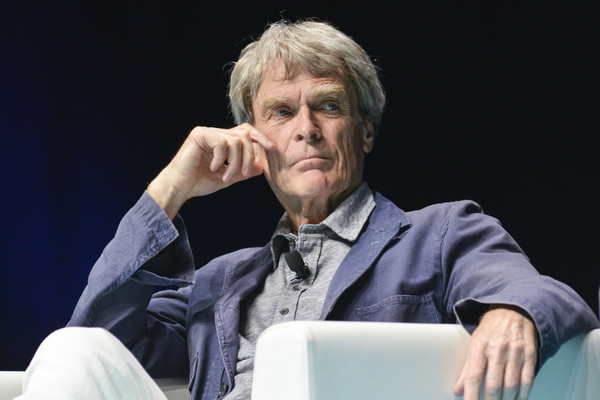
The expert: Sir John Hegarty.

Sir John Hegarty Cannes 2016

Sir John Hegarty attends The Cannes Lions 2016 on June 20, 2016 in Cannes, France.
(June 19, 2016 – Source: Christian Alminana/Getty Images Europe)

Sir John was attending the 2018 Cannes Festival of Creativity where he’s been coming since 1989. A founding shareholder in Saatchi & Saatchi and a co-founder of TBWA London before starting Bartle Bogle Hegarty in 1982, Sir John has himself been behind hall of fame work for Levi’s, Volkswagen and Audi. Never shy about his opinions, Hegarty took the opportunity of yet another Cannes Lions to share a few thoughts on the current state of creativity with Ad Age.

A few excerpts from the interview by . . .

You’ve bemoaned the increasing role data and tech have played in the creative process.

I was accused by Martin Sorrell of being a dinosaur because somebody said “Hegarty doesn’t believe in data,” which is not actually true. Data is fundamentally important. One of the greatest stories ever told, the Nativity, came out of data collection, didn’t it? You’ve got to remember a brand’s job is also to convert.  . . . Go out and throw your net wide. How do I know who’s going to like what I’m selling?

Meaning that with targeting, advertisers are preaching to the converted?

It’s not that. It’s a lazy way of marketing: “Look at the data, what does the data tell us? It’s an instruction manual!” No, it’s not an instruction manual. You’ve got to think about how you’re building the values of this brand. I know I’m boring and I say this all the time, but a brand is made not only by the people who buy it but also by the people who know about it.

“Those people” being the brand itself and also agents of the brand?

If I say to you “Rolls Royce,” you say, “Ooh!” You’re probably not going to buy one, but by talking to a broad audience who understands what your brand is about, you become part of culture. We are forgetting that part of advertising’s function of course is about effectiveness, but it’s also helping that brand become a part of culture.

Last year the talk was all about Fearless Girl. There doesn’t seem to be a corollary this year.

I’ll get provocative here again: Fearless Girl did what for the brand? I don’t know what brand it was associated with. We’ve lost connection. We’ve confused persuasion with promotion. Everybody got hugely excited about the Nike FuelBand 10 years ago. I thought it was a brilliant promotion. I used to be a runner. There was no way I would ever run in Nikes. New Balance, yes. I don’t care how many FuelBands you create, I won’t buy them. I don’t think you make a great running shoe. You have to persuade me.

What do you make of consultancies moving into the agency space?

Why shouldn’t these people get involved? Unless you understand how to convert that into a communications program that stands out in the marketplace, then what’s the point? The trouble is agencies are their own worst enemies and are not very good at establishing a trusted rapport with clients.

You mentioned the Nativity being the original data-informed creative. You look at the Ten Commandments, some of the most enduring “content” ever, and it was written on stone. The oldest medium there is.

Exactly. The greatest brand in the world is the Catholic Church. Best logo. Every lesson in marketing is there. The point is: Two thousand years, some problems, still going. Where will you be in 2,000 years?

Well, gee, Sir John, I don’t know where I’ll be in 2,000 years. I imagine I’ll most likely have been turned into a pile of dust somewhere or maybe I’ll have been recycled somehow. The key word here is imagine-ation. It’s the heart and soul of creativity. Each one of us has an unlimited imagination and boundless creativity — even when we think we don’t.

It’s when limitations are thrust upon us that our abilities are challenged. At times, our creativity is even called into question. As Albert Einstein once said, “Imagination is more important than knowledge.” It’s what we do with our knowledge that’s important.

How may we apply creativity and that imagination to do something constructive with that knowledge, to contribute to society, to help educate someone; heck, even to make someone laugh. We must keep on creating, keep on striving.

Does it take a mindset of creativity to be creative? Huh, imagine that!

Hall of Fame Quotes – Advertising & Otherwise

As it’s been some time since I last submitted for your amusement various illustrious quotes, I thought I’d showcase another in a series of worth-remembering “sayings” which I find interesting and inspiring, and, hopefully, you will, too.

Some quotes are from the American Advertising Federation newsletter “Smart Brief,” while others come from various sources. Enjoy!!

red-quotation-marks-vector-online-royalty-free-picture-435958Never write an advertisement which you wouldn’t want your family to read. You wouldn’t tell lies to your own wife. Don’t tell them to mine. David Ogilvy

Nothing will put a bad product out of business faster than a good advertising campaign. Advertising causes people to try a product once, but poor quality eliminates any possibility of a repeat purpose.  Morris Hite

Never hesitate to steal a good idea.  Al Neuharth

I like that they are talking about the work. If they aren’t talking, then your brand is dead.  Alex Bogusky

Make it idiot-proof and someone will make a better idiot.  Bob Pritchard – VoiceAmerica Business Channel

Success is going from failure to failure without loss of enthusiasm.  Bob Pritchard – VoiceAmerica Business Channel

Advertising becomes a dialogue that becomes an invitation to a relationship.   Lester Wunderman

Energy and persistence conquer all things.  Benjamin Franklin

Vision without execution is simply hallucination.  Bob Pritchard

red-quotation-marks-vector-online-royalty-free-picture-435958

There are two kinds of people, those who do the work and those who take the credit. Try to be in the first group; there is less competition there.  Bob Pritchard

The Boundaries of the Imagination

Are there any?

That’s what a recent weekend conference at The Jung Center on Montrose in the Museum District here in Houston explored. What did we come up with? Jury’s still out.

The Boundaries of the Imagination

I’ve been to only a couple of seminars at The Jung Center over the years and, coincidentally, both had to do with imagination as it relates to imagery and creativity.

Both were also moderated by my friend, Felix Scardino, author of The Pebble and the Canyon.

Now, I’m not a therapist nor do I have that type of background, although I have spent years in the advertising and creative industry so, I suppose, there are some who would say I’ve been in therapy all these years!

This special summer conference, The Boundaries of the Imagination, intrigued me.

When I reviewed the list of speakers for this weekend conference, I’ll admit to not knowing any of them. Yet, I anticipated the experience, the topics. I also assumed I would be in the minority; I am not a therapist or a psychologist. I’m just a curious creative.

Friday night began with a lecture from Jeffrey Kripal, PhD, past chair of the Department of Religious Studies at Rice University. His lecture, “When the Imagined Is Not Imaginary,” seemed to center on the evolutionary goal of imagination. Quite extraordinary.

Though it was a very thoughtful discussion, it really got down into the “imaginary weeds” for this listener. When Jeffrey mentioned the term “imaginal,” he went on to define it according to one Mr. Frederick Myers as “imagination on spiritual steroids.”

According to Frederick Myers, imaginal is defined as “imagination on spiritual steroids.”

HELLO!  Spiritual steroids? I’m not sure what the hell that means but it grabbed my attention.

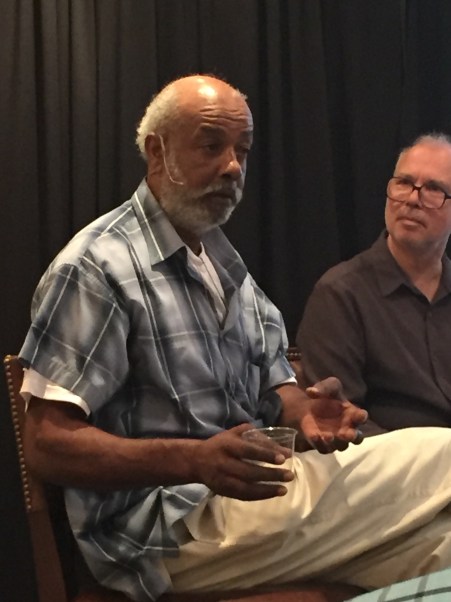
Saturday morning’s session, “The Street of Heaven Was as Glass,” was a conversation between Jay Wehnert (right, below) of Intuitive Eye, his arts organization founded in 2011, and Vanzant Driver (left, below), a Houston-based artist whose work  is included in The Menil Collection.

IMG_1048

This conversation was a highlight for me personally just to listen and observe. One of the observations from Vanzant really touched my spirit – “Inspiration is the medicine for the soul and creativity.”

DAMN!

“I can’t wait to inspire somebody,” Vanzant said. “This should be what gets you up everyday.”

Inspiration is the medicine for the soul and creativity – Vanzant Driver

Since different attendees would no doubt mention other things that got their attention, I won’t attempt to cover everything from that weekend. My thoughts and impressions are my own. So are my dreams and my imagination.

IMG_1052

There will also be other blog posts, I’m sure.

As a photog-hobbyist, I couldn’t help but capture one of my conference colleagues chatting with Vanzant about her artwork in abstract visualization (I think that’s what she called it). Her paintings are hanging in back of her and Vanzant.

According to Vanzant, the philosopher, “the most powerful things in the universe are things you can’t see.”

We sometimes forget this. Hmmm, let me rephrase that . . . we rarely remember this!


Before we wound up our weekend conference, I participated in one last exercise. I played in the sand. Well, I had my own sand trap, er, tray. I even got to select as many toys, er, symbols, as I could carry.

But before that, I closed my eyes and “became one with the sand.” I moved my hands around the sand and just had fun, like the little kid inside me did many years ago, both on Lake Charles (LA) and Galveston beaches.

IMG_1060

“Playing in the Imagination” was what we did under the watchful eyes of Michele Lees, a depth psychotherapist in private practice in Houston with emphasis and training in Jungian psychology. And, evidently, one helluva sand castle builder!

Each one of the objects in my sand tray above represented something to me; some of them really did “call out to me” to be chosen, just as Michelle advised they would.

In case you can’t quite make it out, that is indeed a sleigh sitting within the branches of the Christmas tree . . . on a beach next to a treasure chest near a beached boat. The symbolism I was feeling that Sunday morning was both of fond memories and sadness (note the half buried Eiffel Tower near the voodoo doll), and, well, use your imagination to figure out the rest.

The entire weekend was like nothing I had experienced before. Not being a therapist, I wasn’t sure what to expect. Being of the creative bent, I anticipated exploring my imagination in ways I had not, uh, imagined before.

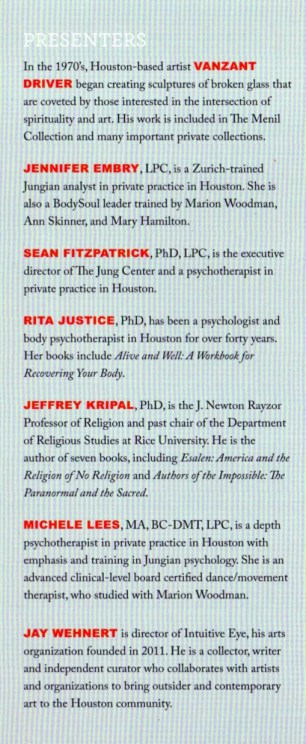
Presenters to 2016 Summer Conference at Jung Center

Each one of the “speakers, therapists, authors, experts” were enlightening and, dare I say, imaginative. If you get the chance to hear one of these folks speak or present, go for it.

Have we been underestimating the power and reach of the imagination? Perhaps.

It is my firm belief that creativity is entrenched in our imagination. In fact, my favorite definition of imagination is “intelligence having fun.”

Yet, is imagination a location, an experience, a physical phenomenon? What is, as the brochure talking about this conference asks, its hidden power in a culture that tends to understand imagination as the opposite of reality?

Are there boundaries of imagination? If so, how many and are they truly discernible? What are the possibilities in exploring them and what do we risk?

What if we come to understand that imagination is reality?

What then?

Then, my friends, we come to grips with our emotions and, when we’re ready, if we truly are, we take another trek into the vast landscape of our own imagination to explore.

But be cautious. Rational thought may be cast aside; symbolism may take over. Creativity may be awakened. A new masterpiece may be unfolding right before your eyes.

Capture it, and enjoy . . . before it goes poof!


Editors Note: Those of you wanting to see Jay & Vanzant’s conversation can view it on YouTube.

It’s Friday . . . What’s that you say, Fred?


Fred Flintstone at Halifax Bank

It’s Friday and I’m ready for a good chuckle.

Actually, I got my chuckle a few days ago when I first read about this ad for Halifax Bank in the U.K. Featuring a few of The Flintstones’ characters, the spot does a wonderful job with the animation and the bank’s message.

Kudos to them for wanting to do something different, especially being somewhat contrarian to that British stiff-upper-lip perception.

According to Creativity Magazine, U.K. bank Halifax has collaborated with Warner Bros. once again, this time to feature Flintstones in a spot about switching banks. This ad, by Adam&Eve/DDB, sees Fred and Wilma walk into a Halifax branch and interact with a real-life manager as they explain why they want to switch from their Bedrock bank.

Once again, directorial duo Dom&Nic at Outsider worked with the Mill’s VFX team to integrate the iconic animated characters into a live action setting, and recreate them authentically (and) as close to the original as possible.

The team worked closely with Warner Bros. Consumer Products to get the character designs as accurate as possible, combining modern techniques with more traditional methods.

To give it a classic aged look, the Mill team also hand animated and color graded the entire end sequence, where we see Fred with his new shoes taking Wilma home, followed by Dino. Love the scene where a banker-lady is giving Dino a treat!

I’ve always appreciated a scenario when the agency is blessed with a client who is willing to bend or even break the supposed rules in order to impress and be innovative in a classy and, in this case, cute execution of a timeless classic.

The situation is scripted well and the actors are, well, believable. More importantly, the creative treats the concept with respect.

Alas, the poor boob who plays the banker. Imagine playing second fiddle to a famous caveman who is not part of Geico. Ah, the Brits!

Way to go, Fred and Wilma!

The Future of Advertising?

Ever tried to predict the future? Not easy, is it?

I don’t know if this article comes close but it is an interesting read. Dax Hamman, Chief Product Officer, Rubicon Project, did a nice job with it.

ProgrammaticMind Issue 10 22

The future of advertising may take many forms, some of which may not even be known to us at present – wait, let me jump into my time travel Shuttlecraft (on loan from Star Fleet) and I’ll get back with you.

ProgrammaticMind Issue 10 1


Until then, the publishers of Rubicon have put together an intriguing read in this their 2016 Biannual Issue, The Programmatic Mind.

Whatchathink?

Well, for one thing, how will advertisers get consumers to pay attention to ads if when we all live in an era of super-saturation? The author states we start by using information as advertising – using data available to us in order to make our ads as relevant as possible so the consumer has no choice but to pay attention.

Hmmmm, I thought that’s what we try and do everyday . . . now. That’s what smart creativity is supposed to do. Let’s face it, cutesy only goes so far! Mr. Hamman further states “. . . that elegant design won’t be enough if your ads are not providing valuable information.” That’s true.

I agree with the author when he says the future of advertising is full of tremendous promise. It’s also full of a whole bunch of challenges and subsequent responsibilities. Information overload will, I think, be even more so than it is today.

Still, consumers are a fickle bunch; they’re also quite intelligent and can certainly discern an ad that makes sense, is relevant and interesting. Our future world will most likely be more intense, with more information, quite problematic, more programmatic and probably more “anything-atic.”

Oh, boy, pass the Excedrin!

Since you folks will undoubtedly have a thought or two on this subject and the article, pro and con, let me know. Don’t be bashful. There’s plenty of Excedrin for all of us.

A little creative juice for the soul. Thank You, Creativity!

Ever get curious? Well, I was curious as to what the back cover of my Advertising Age issues referred when they featured someone and a quote. Near the bottom of the page was listed “Thank You Creativity.”

join-us-02

OK, what gives?

“A love letter to the stories, lessons and magic of creativity.” Or so says the home page.

The rest is rather intriguing. See for yourself and Enjoy.

Thank You, indeed, Creativity!

Houston’s Creative Economy – Part Deux

Recently I reported on a day-long event at the University of Houston called Leadership in the Arts Summit: Valuing the 21st Century Creative Economy. The audience was comprised mostly of non-profits and educators but also had artists and other creative entrepreneurs (like yours truly). Those of you who missed that blog post, well, too bad (just kidding).

Morning Panel w/Alfred

Summit 2016 Morning Panel

Since that event a couple weeks ago, there has been some follow up by the folks in UH’s Center for Arts Leadership. They are compiling feedback from attendees in hopes of gathering sufficient info to better plan the next steps. That is no small feat.

Sixto Wagan

Sixto Wagan, Host & Director Leadership in the Arts Summit

Some of the follow up consists of photos and presentations from April 11. Thanks to the University of Houston for these photos from their Flickr page.

I’m appreciative of those who “liked” my post and who left comments. I’m hoping that once you’ve read this and gone on to review the links herein, you’ll provide feedback as to what you think would be viable solutions to organizing our creative organizations around town to better harness our collective creativity.

Summit 2016 Afternoon Panel

Summit 2016 Afternoon Panel

In addition to the Houston Arts Alliance (HAA), the Greater Houston Partnership (GHP), among others, should play a key role in assisting with this movement. Jon Norby, a panelist in one of the afternoon sessions, recently joined the Partnership last year as Director of Talent Attraction and Marketing. I talked with him afterwards to get a feel for the GHP’s perspective about this new creative economy. While he acknowledged the challenges in communication among all of Houston’s various groups, he admitted it’s a challenge we must overcome to ensure the vibrancy in our creative community we all seek.

A few examples of where creative alliances have been formed, and can be formed in Houston and other cities, include Baltimore, Austin and Milwaukee. In fact, Christine Harris, who lead the first discussion, co-founded and was the CEO of the Milwaukee alliance.

As Sixto Wagan commented in his closing remarks, let us hope five years from now we’re not still trying to start a conversation that we’ve already begun present day. We’ve got a ton of talent at our disposal but we’re not clicking on all cylinders yet.

Though it may seem like we’re trying to lasso a large, puffy cloud, let’s get better organized and talk amongst one another. Let’s continue the discussion. Our creative community deserves no less.

So, who’s with me?

Summit 2016 Audience

Summit 2016 Audience

Our Creative Economy: Listen up, Houston!

This past Monday, April 11, I had the pleasure of attending a day-long discussion “Valuing the Creative Economy” at the third Leadership in the Arts Summit held at the Center for Arts Leadership at the University of Houston. Quite a stunning facility!

I learned about this summit from my friend and Only in Houston Co-chair Alfred Cervantes, who besides being the deputy director of the Houston Film Commission was also a panelist addressing the question “Creative Economy: What is it and why does it matter”?

IMG_0919

Because of the length of the Summit and the depth of discussion that took place and will continue in the weeks and months to come, there will be subsequent posts about our progress and how all this can tie together here in Houston. There will also be photos and presentations from the Summit posted to the Center’s website in the days ahead.

The goal of the Summit, according to Sixto Wagan, Director, Center for Arts Leadership, is “to bring our creative community together to talk and to envision a collective future. The panels are meant to push beyond the simple binaries, help us question assumptions, and move the conversation forward toward action.”

Christine Harris lead the opening plenary (formal seminar-speak) “Creative Economy: What is it and why does it matter”? Christine has been working with creative enterprises and community development for over 30 years and was recently in Houston last November headlining a similarly-themed morning workshop at the Houston Arts Alliance (HAA) and an evening panel discussion at Gensler.

IMG_0904

Harris co-founded the Creative Economy Coalition, a working committee of the National Creativity Network, and designed and executed the nation’s first review of defining the creative economy. This study profiled and inventoried how 27 communities around the nation were profiling and measuring their creative economies. She was CEO of Creative Alliance Milwaukee, where she managed a full profile of the regional creative economy and developed online resources for the sector.

It’s not my intent to cover all that was discussed during the Summit in one blog post. We’d be reading for days! I merely want to further the conversation that was “started” last November and continued this past Monday.

And Houston, we’ve got work to do.

Just consider these questions:

IMG_0908

And then, there’s the $64,000 question:

IMG_0952

Obviously, these questions don’t have simple, ready-made answers. They do, however, demand discussion and we need to continue this.

Feel free to comment and send me input on possible answers or solutions to these questions. You can also post your ideas on OiH-FaceBook and/or the Arts Leadership-FaceBook.

The various communication organizations in and around the city are a major resource for input and counsel. So, too, are the fine educational and non-profit venues in our area. Although this Summit centered around the arts, creativity knows no boundaries.

Through the American Advertising Federation Houston (AAFH), Only in Houston (OiH) was born a decade ago. Its intent was, and still is, to keep local creative dollars spent locally. There was even a multi-communication organization formed years ago (Houston Communication Alliance) aimed at bringing together all “creatives.”

Times change as do people and industries. Houston’s Creative Economy and its driving forces need to meet today’s challenges with tomorrow in mind. We may need to rethink how this is done. Other communities around the country are doing so, and it will take just that: A Houston-wide effort. No one organization or person can do this.

At the risk of thinking out loud (even though I’m typing this in silence), maybe Only in Houston morphs into a “Houston Creative Coalition,” which is comprised of organizations like the Houston Arts Alliance, Greater Houston Partnership, numerous professional and arts organizations, etc.? We can learn a lot from others who have started something like this. But Houston needs to create something that works in Houston, not Boston.

And we must do a helluva lot better job of communicating with one another so that we all know what’s going on and when. No problem; piece o’ cake!

The Leadership in Arts Summit 2016 is a recent example of creativity and economics blending and working together for the common good. We need to make sure the conversation continues and progresses.

More to come . . .

Onward!


Advertising Hall of Fame Quotes – Part 5

Happy Mardi Gras!!

Here’s the fifth in a five-part series (more to come later) of various worth-remembering quotes which I believe you’ll find interesting and hopefully inspiring. Excerpted from the newsletter “Smart Brief” from the American Advertising Federation, these quotes are usually from a member of the Advertising Hall of Fame.

Quote

41. I don’t like closed doors. Creativity flourishes best in an environment of open doors and open minds.

— Keith Reinhard

42. There is no such thing as ‘soft sell’ and ‘hard sell.’ There is only ‘smart sell’ and ‘stupid sell.’ 

— Charles H. Brower

43. In the modern world of business, it is useless to be a creative original thinker unless you can also sell what you create. Management cannot be expected to recognize a good idea unless it is presented to them by a good salesman.

— David Ogilvy

44. Grant graciously what you dare not refuse.

— George Gallup

45. Advertising makes people discontented. It makes them want things they don’t have. Without discontent, there is no progress, no achievement.

— Morris Hite

46. The artist defines creativity. The audience defines effectiveness. To be creative, study art. To be effective, study the audience. To be both, study how the audience responds to art.

— Keith Reinhard

47. I avoid clients for whom advertising is only a marginal factor in their marketing mix. They have an awkward tendency to raid their advertising appropriations whenever they need cash for other purposes.

— David Ogilvy

48. Creativity often consists of merely turning up what is already there.

— Bernice Fitz-Gibbon

49. We don’t grow unless we take risks. Any successful company is riddled with failures.

— James E. Burke

50. There’s nothing wrong with being fired.

— Ted Turner

So, which one or ones is/are your favorite(s)?

Do you have a favorite or favorites in the series?

Lemme know.