Stumped. Writer’s Block. Stymied. Confused. It’s all a jumble of nothingness.
What Do You Write When You Don’t Know What to Write About?
So, how do you turn nothingness into somethingness? Start writing! Anything.
The words will come, thoughts will flow and, eventually, creativity will blossom.
You can’t force it, however. It must evolve naturally, at your own pace. Usually, if a creative suggestion doesn’t appear in your thoughts within about 20 minutes or so, abort the process and go on to something else. Then come back to it hours later or the following day.
Some writers think before they write. Some think as they write. Some writers don’t think at all; they just write a bunch of gobbledygook. That’s fine, as long as you go back and turn the gobbledygook into useful garbage.
Turning that garbage into something quite palpable and enticing will take a process of editing and refinement but when you’re at this stage, you’ve got it made.
Hopefully making a ruckus, one blog post at a time!
Be sure to check out my other blog, Joe’s Journey, for a different kind of playground for creativity, innovation and inspiring stuff.

A lot of people have, over time, written about creativity. They’ve tried to define it, rationalize it and better understand it. There are opinions galore. The article I reference in this post offers another perspective on the subject of creativity in the here and now.
Creativity can be wonderful in its use and experience. Everyone enjoys that potential even if they don’t recognize it as one of their assets. It can also be quite frustrating during its process. Just think of giving birth to an original idea. Then developing that idea into something useful and meaningful. That can be rough sledding. It can also be a helluva lot of fun!
In so far as the state of creativity in the 21st Century, I ran across an article posted on Medium.com that addresses this subject. It’s quite interesting and I want to share it with you. See link below.
In his discussion, the author elaborates on three traits he feels are essential to develop a creative process that works for us and the people we serve:
Harnessing Flexibility is a Prerequisite
Seeking Collective Confidence and Collaboration
Having Empathy is the Key
Also, here’s a video clip from the late Sir Ken Robinson who was an expert on various aspects of creativity, especially how best to apply it in education.
4 Ways Play Gets You Out of a Brain Rut, and Helps One Deal with a Crisis.
The human brain can get stuck in a rut thanks to neural pathways and a fondness for the familiar. So how can you free your brain and lead it on a path to innovation? Based on research and real-life examples from great minds, here are four ways Play can get you out of a brain rut:
1. Cross Train Your Brain
Each cross-training activity works a different, but complementary, part of the body that will help get you stronger in the overall event, task or project. In other words, if you’re a novelist, try your hand at poetry. If you’re a painter, dabble in sculpting. If you’re a computer scientist, play around with web design. For instance, how did playing violin help Einstein theorize about matter and energy?
A study from UC Irvine and the University of Wisconsin found that giving piano lessons to preschoolers significantly improved their spatial-temporal reasoning— a key skill needed for math and science—much more than giving computer lessons, singing lessons, or no lessons at all. So try a new activity within your field or related to it; you’ll expand your neural connections and strengthen your brain overall.
2. Take a Shower, Go for a Walk or Do Some Other Mundane Activity
First, creativity and relaxation could be linked. I’ve found that whenever I’m really tired, my creativity just hits a wall. Trying to go on is fruitless. Wrap it up and go to bed or walk away from whatever it is you’re working on and come back to it in several hours or the next day. Depending on when you’re doing this, try something boring, like showering or taking a walk (though some folks would argue that this exercise is not boring) or go for a swim. These tasks don’t require substantial cognitive effort, so our brains are free to wander. And contrary to popular belief, a brain “at rest” isn’t really resting at all.
Second, distractions may boost creativity. Research by Harvard professor Shelley Carson found that high creative achievement was associated with low latent inhibition, or the capacity to screen out irrelevant information, especially if the participants had a high IQ. For the creative mind, inspiration can be found everywhere. Sometimes, you just need to distract yourself long enough to notice it. Continue reading →
How would a “productive day” compare to a “creative day”? What would, if anything, they have in common? Chances are not much. One might think a productive day would be closely aligned with scratching off items on a to-do list. On the other hand, someone’s idea of a creative day might not even have a to-do list.
Our current work world is obsessed with productivity. We are inundated with books, articles, white papers, to time block this and time block that; all just to do more work. But our relentless quest to be productive is undermining one of the most important abilities in today’s workplace: creativity.
What of the future, though? Will machine learning and artificial intelligence perform the routine aspects of our work at the expense of our ingenuity and creativity? So how do we create the right conditions for creativity, particularly when we are trying to deal with a to-do list?
Consider this comment from screenwriter Aaron Sorkin (the mastermind behind the television show West Wing and films like Moneyball and The Social Network). He told The Hollywood Reporter that he takes six showers a day. “I’m not a germaphobe,” he explains but when his writing isn’t going well, he’ll shower, change into new clothes, and start again.
Sorkin’s trade relies on him minting something fresh on a regular basis. And it occurred to him that his best thoughts were not happening in moments of fevered concentration, but when he was in the shower. So he had a shower installed in the corner of his office and makes regular use of it. He has described the process as “a do-over” for triggering original ideas.
In 1939, James Webb Young, a Madison Avenue advertising executive, wrote a definitive guide to the process of creativity, A Technique for Producing Ideas. In this short book, Webb Young reminds us, “that an idea is nothing more nor less than a new combination of old elements.” In his view, the skill of creativity is the ability to spot new connections between familiar thoughts, and the art is “the ability to see [new] relationships.”
Fifty years later, Steve Jobs observed something similar: “Creativity is just connecting things. When you ask creative people how they did something, they feel a little guilty because they didn’t really do it, they just saw something. It seemed obvious to them after a while. That’s because they were able to connect experiences they’ve had and synthesize new things.” Webb Young also lays out a remarkably simple technique for creative thought. It involves stimulation. Continue reading →
The other day when I was putting some luggage back up into the closet, I came across a small notebook with a few items written in it. Must have been some of my notes from a long-ago seminar I attended somewhere. These statements are in no particular order and only one is attributable to someone. Take them for what they’re worth. Who knows, they may be able to help enhance your creativity.
Wasting time is usually resistance to writing
Be violent and original in your work, but be orderly in your normal life
Get quiet — be still and apply yourself
Creativity: Sudden cessation of stupidity
Most good ideas come fully formed
Celebrate small victories
“No” is a complete sentence
We have no art. We do everything as well as possible.
“Everything is art direction.” — Lee Clow
How to suck less: It’s not about concepts; it’s about execution (how we work)
Enemies: Laziness and Arrogance
“Effort and struggle to create simplicity and grace lives on in the soul.”
Hopefully making a ruckus, one blog post at a time!
Be sure to check out my other blog,Joe’s Journey, for personal insights on life and its detours.
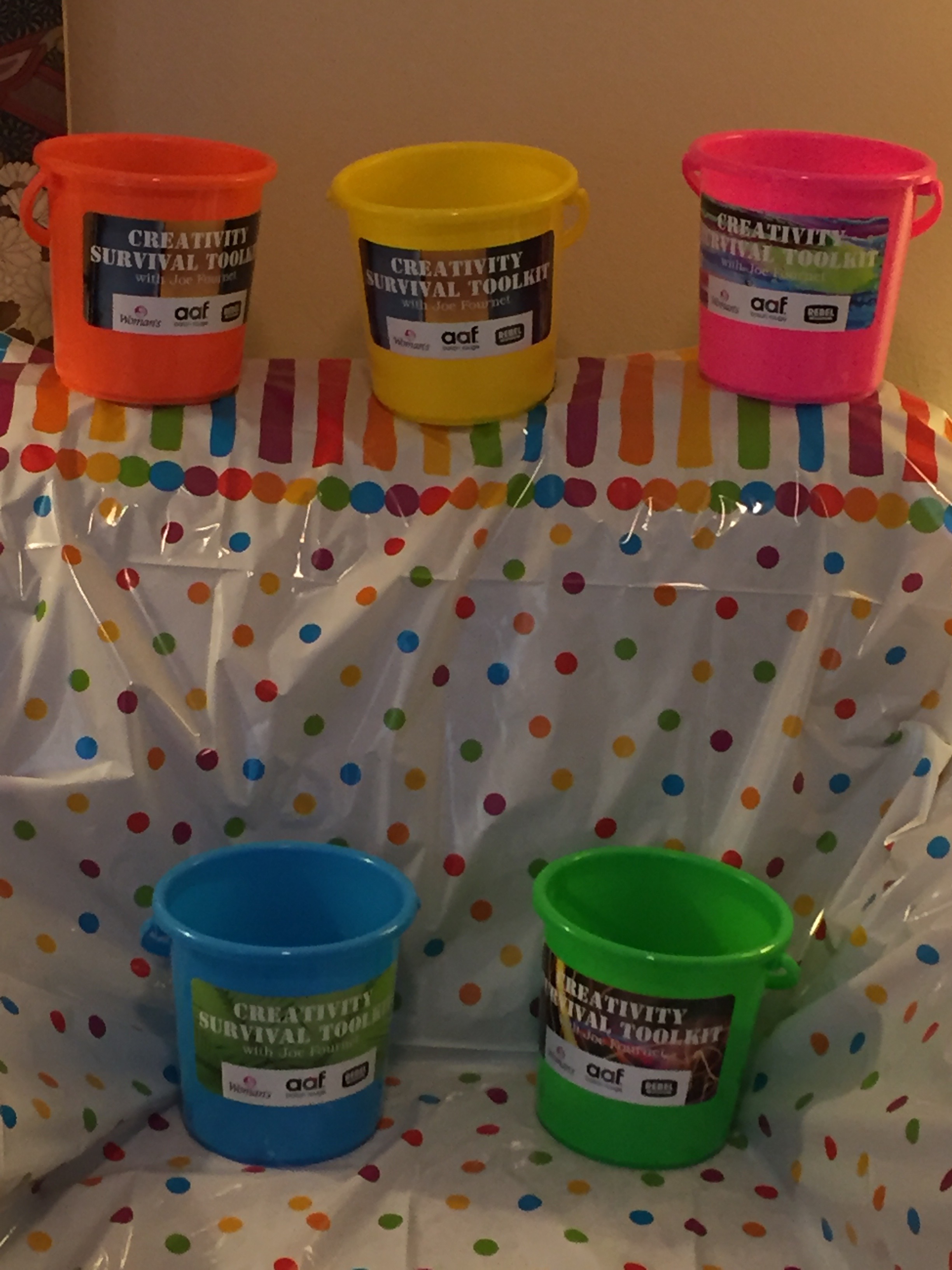
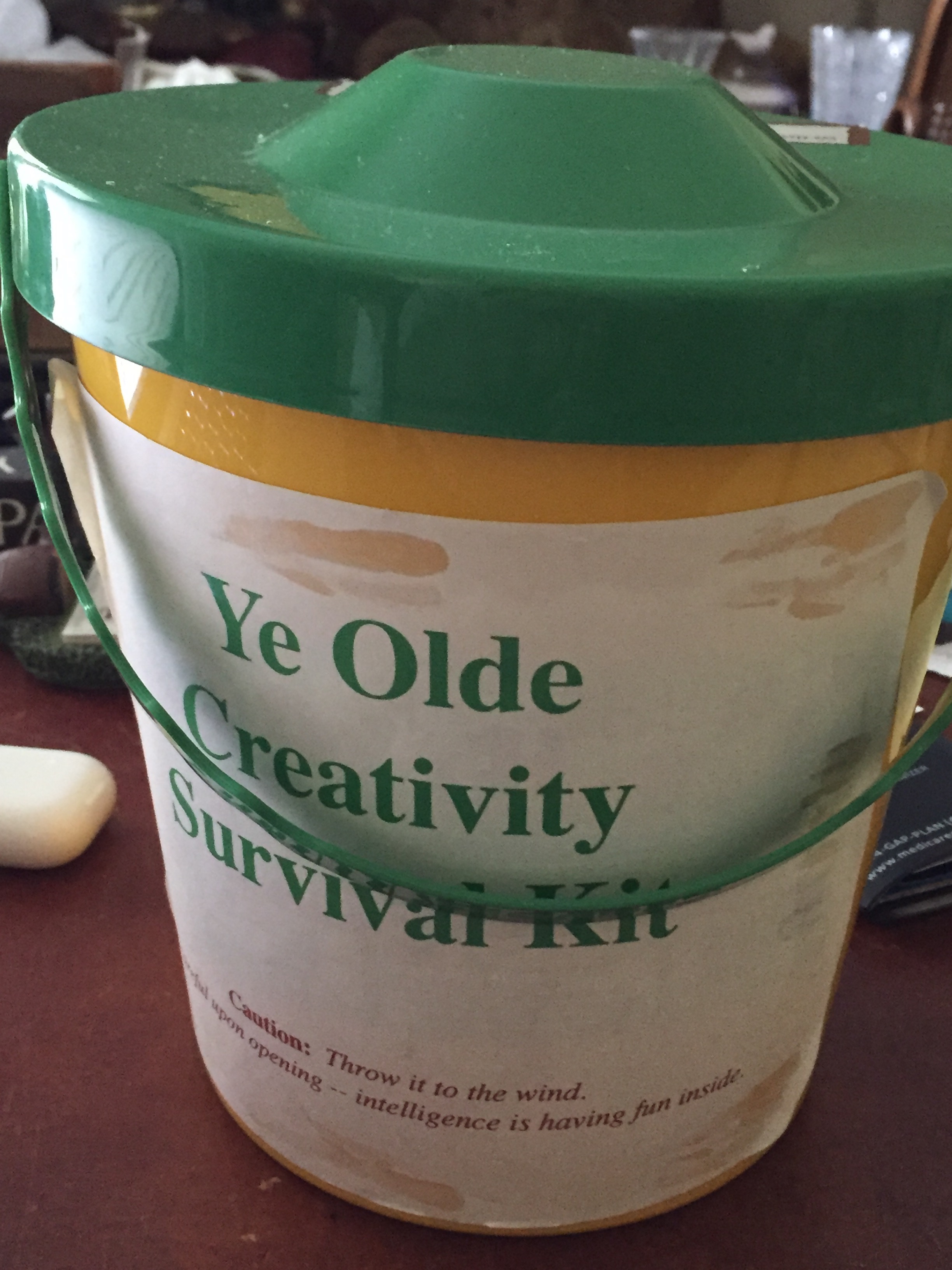
Last week I posted about my upcoming trek to Baton Rouge and shared a list of creative guidelines to keep in mind when enhancing one’s creativity. That was what I shared with the ad club of Baton Rouge last Friday. One of the main items I shared was the Creativity Survival Kit and that’s what I’d like to review on this post, especially for folks who have no idea what I’m talking about.
One of several different colored Creativity Kits the Baton Rouge ad club made as giveaways.
The Creativity Survival (Tool) Kit is simply any container or bucket filled with items that make you feel creative or think creatively. The contents can be almost anything depending on the individual.
They can be notes that remind you of various things, especially those items that are too large to fit into your bucket. They can be serious or silly. No judgements here; after all, it’s YOUR kit.
One of the main elements in the Kit is a stack of Post It Notes. The timed exercise, lead by a moderator, is thus: Whatever problem confronts you to be solved, needs a specific question to be asked that may help solve it. The more specific, the better.
The challenge is to come up with, say, 50 ideas in five minutes or, if you dare, 100 ideas in ten minutes. Once this is done, pick your 25 best ideas and, are you ready for this . . . TRASH THEM! Then from the 25 remaining, select your next 20 best ideas . . . and . . . TRASH THEM!
I know this is not what you’re used to doing, but trust me, this is a different take on a standard way of drilling down to the best idea. I call it the Evil Twin Technique.
Now, you’re left with five “maybe not-so-great-ideas.” For the purposes of this exercise, select three of them that you feel are good and, you know the drill, TRASH THEM. From the two remaining, trash one that you feel is better than the other one. You have one idea left. It may not have been one you thought about when you first began or one that you paid little or no attention to during this process.
You’ve come upon your Evil Twin. Whether or not it pans out as a worthwhile idea to help solve your problem remains to be seen. Your due process may bear that out. If you can combine this exercise with the more standard approach (instead of trashing the “best ideas,” keep them and simply narrow the list down to just one), it will be interesting what types of solution approaches one could come up with.
Some other items in my kit include
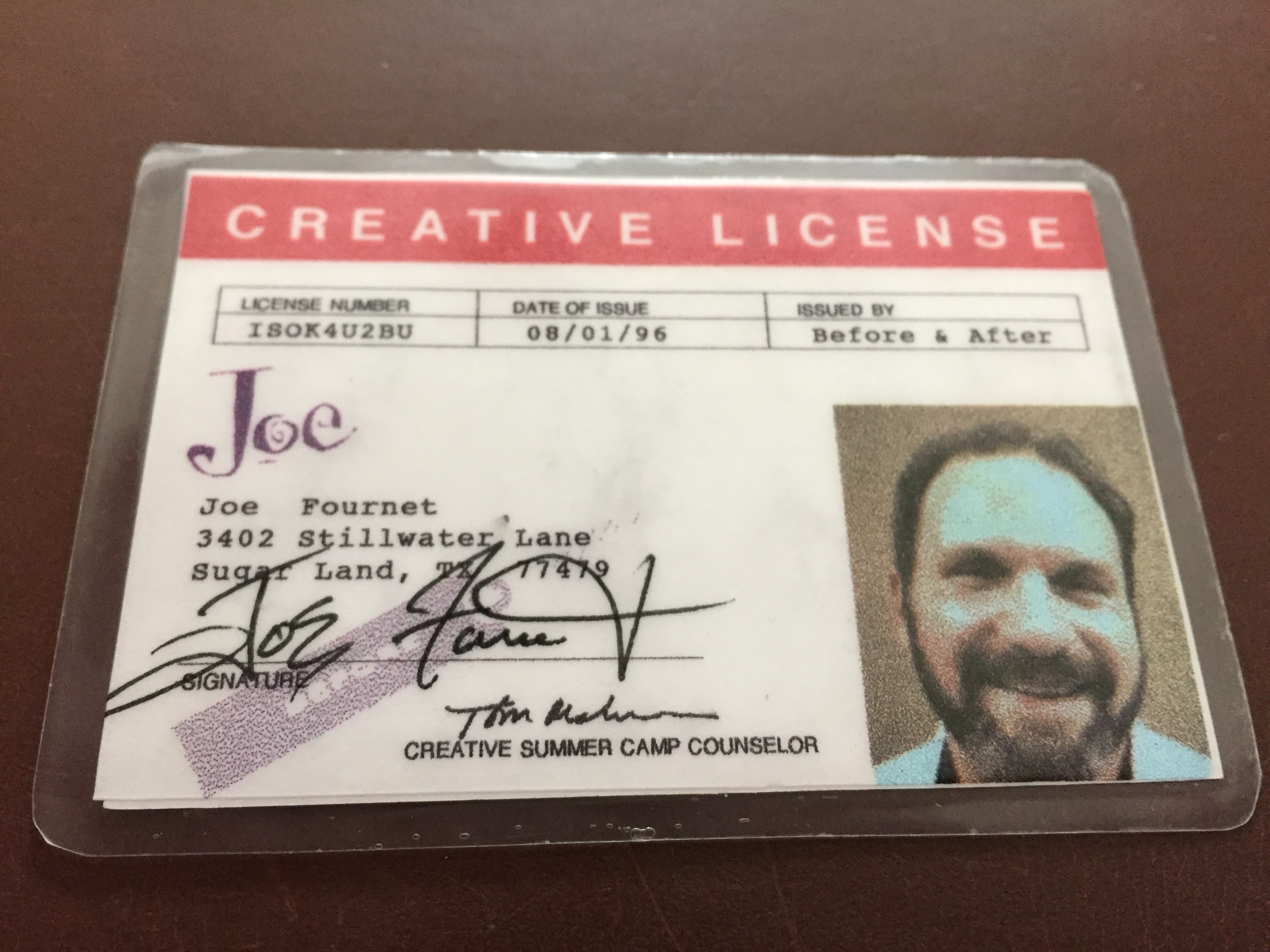
and my certification
along with my alter ego, Snoopy, and his pal, the Energizer Bunny. What can I say, I have an eclectic tool kit!
As my business card states, “Crayons. The essence of creativity.” Crayons are colorful and so should your world of creativity. Similarly, your Creativity Survival Toolkit should reflect your colorful personality and lend itself to enhance your creative world.
Hopefully making a ruckus, one blog post at a time!
Be sure to check out my other blog,Joe’s Journey, for personal insights on life and its detours.
Because some of you won’t be able to make my presentation tomorrow to the Baton Rouge Chapter of the American Advertising Federation, I thought I might include some of the tips I’ll give to the group in this blog post.
Regardless of how you may be involved in this industry, we all share in the design and development of our own creativity. These tips will hopefully sharpen your current set of skills so that you’ll be better equipped to address challenges as they arise.
Enjoy your dip in the pool of creative tips!
Always think of yourself as creative! If in doubt, think of this: If you can challenge your own imagination and stimulate thoughts leading you to a new level of solution, you’ll be realizing your own sense of creativity.
Creativity needs to be synonymous with “FUN!”
Don’t manage creativity; manage FOR creativity. Provide an environment that is open and receptive to new ideas. Acknowledge error or failure in a constructive and supportive way, build it into your culture as part of the process; don’t ridicule it; honor and embrace it.
Consider adopting the “suckless mentality” – When presented with something that doesn’t quite measure up, say something to the effect of “Gee, that really sucks. However, if your tried this or that, it might suck less.”
Chief Marketing Officers must have creativity in themselves, for the good of the business and their own teams. “Creativity as a weapon of business is under-leveraged not for lack of ideas, but for lack of courage to use them or refusal to give up on them. The phrase, ‘We don’t have time for creativity,’ is not something you would ever hear in the most successful businesses,” says Mark-hans Richer, former Sr. VP-CMO Harley-Davidson.
Trying to satisfy everybody never got anybody anywhere. Focus on what’s important, then do it.
The strategy must be clear, concise and on target. Your message is going to be screwed up if the creative is too cute, too complex, doesn’t follow strategy or is just plain dumb.
Don’t let the execution bury the idea. The computer and software are just tools to enhance the idea, not to compete with, replace, or screw it up. Use your own computer – your brain.
Take time to think. There’s always more than one way to do something. That’s creativity!
Do not bring a DEAD CAT without a shovel! In other words, never present a problem without bringing the shovel – at least two possible solutions. In doing so, you save time if one of these solutions is the one adopted, and you can share your creative thinking while learning more about what’s important to your boss; remember, you may not know all there is to know.
**********
Hopefully making a ruckus, one blog post at a time!
Be sure to check out my other blog,Joe’s Journey, for personal insights on life and its detours.
The ones who see things differently…who are not fond of rules…they change things. They invent. They imagine. They heal. They explore. They create. — Steve Jobs
Be brave enough to live life creatively. The creative place where no one else has ever been. – Alan Alda
Where there is shouting, there is no true knowledge. – Leonardo da Vinci
I think it’s better to be overly ambitious and fail than to be underambitious and succeed in a mundane way. I have been very fortunate. I failed upward in my life! – Francis Ford Coppola
Meetings are all too often the burial grounds of great ideas. — Keith Reinhard, member, Advertising Hall of Fame
You cannot force ideas. Successful ideas are the result of slow growth. Ideas do not reach perfection in a day, no matter how much study is put upon them. – Alexander Graham Bell
The most dangerous phrase in the language is, We’ve always done it this way. – Grace Hopper
If at first, the idea is not absurd, then there is no hope for it. – Albert Einstein
We are drowning in information, while starving for wisdom. The world henceforth will be run by synthesizers, people able to put together the right information at the right time, think critically about it, and make important choices wisely. – E. O. Wilson
There is nothing to writing. All you do is sit down at a typewriter and bleed. — Ernest Hemingway
Hopefully making a ruckus, one blog post at a time!
Be sure to check out my other blog, Joe’s Journey, for personal insights on life and its detours.
• Idea Tub – can be a physical place or thing and/or an electronic file. It’s a compilation of all ideas ever submitted since you started keeping track, but organized as to be readily accessible.
An elaborate Idea Tub
• Don’t let the execution bury the idea. Your message will be diluted and possibly even confusing if the creative is too cute, too complex or just plain dumb. Think napkin, not computer.
• Realize your own sense of creativity by challenging your imagination and stimulate thoughts to lead yourself to a new level of solution.
• The idea, for best results, should be media and discipline neutral. Otherwise, you limit yourself.
• Focus on how you’re going to make the idea work and be relevant. But, never fall in love with it.
• Don’t ever underestimate the power of the mind or your imagination. Don’t ever be afraid to ask, “Why, Why not or What if . . .?”.
• Ye Olde Creativity Survival Kit — Any sort of container in which you place whatever makes you FEEL creative and THINK creatively. In this industry, silly is sometimes serious business.
• Thinking at Warp Speed – Generating ideas at breakneck speed is a great way to capture ideas on Post-it Notes (one per note) in answering a specific question to solve a problem. Remember Giant Post-its for your “idea wall” which can foster brainstorming and open-door policy idea addition.
• Drill Down Technique – Discovering THE idea. In this unusual method choose your five best ideas and ELIMINATE THEM, choose five more and ELIMINATE THEM. The last idea Post-it may or may not be the best, but it’s one to which you normally would not have paid much attention. Go play.
• As ideas are developed, make sure their essence is refined. Make sure your ideas are clear and you can explain their basic value in about 20 seconds. If you can’t explain it to an 8-year old so they’ll understand it, you need to refine your idea more.
• Don’t manage creativity; manage for creativity. Provide an environment that is open and receptive to new ideas, and that builds failure into the process. Acknowledge error or failure in a constructive and supportive way.
Hopefully making a ruckus, one blog post at a time!
Be sure to check out my other blog,Joe’s Journey,for personal insights on life and its detours.
At one time or another, we’ve all been on a creative hot streak even if we didn’t realize it. The words flowed freely, the design snapped into place magically making for very impactful creative. But how did that happen? How does one get on a “hot steak” of creativity? A new study from the Kellogg School of Management at Northwestern University may have a road map.
The secret involves experimenting with a wide range of subjects, styles, and techniques before perfecting a specific area of one’s craft—what the authors describe as a mix of exploration and exploitation.
“Although exploration is considered a risk because it might not lead anywhere, it increases the likelihood of stumbling upon a great idea,” the study’s lead author, Dashun Wang, said in a statement. “By contrast, exploitation is typically viewed as a conservative strategy. If you exploit the same type of work over and over for a long period of time, it might stifle creativity. But, interestingly, exploration followed by exploitation appears to show consistent associations with the onset of hot streaks.”
Wang’s findings, published in the journal Nature, sought to identify periods of intense creativity in the work of visual artists, as well as film directors and scientists. The team used image recognition algorithms to analyze data from 800,000 artworks from 2,128 artists, including Jackson Pollock, Frida Kahlo, and Vincent van Gogh. The rest of the study was based on Internet Movie Database (IMDb) data sets for 4,337 directors, and publications and citations on the Web of Science and Google Scholar for 20,040 scientists.
Creative trajectories and hot-streak dynamics: three exemplary careers. Data analyzing the work of Jackson Pollock, Peter Jackson, and John Fenn.
Pollock, who achieved widespread popular and critical success with his groundbreaking drip paintings from 1946 to 1950, is one of three creators singled out as examples in the paper.
Director Peter Jackson, who famously made the “The Lord of the Rings” epic fantasy trilogy after experimenting in genres such as horror-comedy and biography is another.
John Fenn, who won the 2002 Nobel Prize in chemistry for his work with electrospray ionization, having previously studied numerous other topics is another.
The paper identified patterns in the creators’ work over time—changes in brushstrokes, plot points or casting decisions, or research topics. It noted the diversity both in the period leading up to a hot streak, which typically lasts about five years, and at other times in the subject’s career. Five years?!
I found this to be surprising in that most hot streaks I’ve personally encountered have been anywhere from a few hours to several months. I’ve never thought of them in terms of years. Anywhoo . . .
In all three fields, the trend tended toward a more diverse body of work in the period before a hot streak than at other points in time. Then, during the hot streak, the creators tended to continue to work in the same vein, suggesting “that individuals become substantially more focused on what they work on, reflecting an exploitation strategy during hot streak.”
So when is your next hot streak coming up and will you know it when it hits you?
This post is based upon the article by Sarah Cascone of Art Net News.