Cannes Lions 2022: The State of Creativity

Every summer the advertising world treks to France and pays tribute to its version of Mecca, the Cannes Creativity Festival. In the words of a UK publication who was onsite last week, “Cannes Lions is a circus, a meeting of minds, a place to hear the same buzzwords again and again and a chance to listen to celebrities try to explain how to do advertising to rooms full of people who do advertising for a living.

But it’s also a chance to take the temperature of creativity once a year. Seeing all the work that’s winning and being surrounded by people talking about creativity gives people a unique bird’s eye perspective for just one week.”

So, while talking to the cross section of creative leaders, a very broad, but pertinent question was asked: “what is the state of creativity in 2022?”

Here’s what some of them said.

Caitlyn Ryan
VP, Meta

There’s much more optimism and real celebration. We were seeing lots more joyful work. There was one piece that won Gold [in Social & Influencer], for BMW China for the Lunar New Year. The team worked out that the word for BMW in China includes the word horse, and it was the year of the Tiger. It’s properly bonkers but it’s also so joyful. I think it’s a really great example of a couple of things, this celebration and joyfulness, but also as a social campaign. They created all of these assets that then they gave over to the community that allowed them to socialise the idea. I think it’s quite complex but it looks simple and fun.

Yes, there of course is social purpose work – and there was amazing work, especially the charity work The Lost Class, which was just beautiful. That definitely triggers a reaction and wanting to sign up to a social purpose activation. Also we can sell products through joyfully co-creating with the community. I think that’s a really important next step out of the pandemic. It’s incredibly important that we get the economy up and running again, and we use creativity to do that.

Bruno Bertelli
Global Creative Director, Publicis WW and CEO, Le Pub

On one level, there’s a little bit of dated work. Still purpose-led, still a little bit from the past. But on the other hand, there is a trend which is interesting, which is that today brands cannot tell people [things] or inspire people, it’s much more about supporting people doing things. Even if it’s for a small issue, it’s much more about supporting people in what they want to achieve. Story-doing has become much more societally relevant and less strategic – what’s your purpose, what’s your message? Some of these activations don’t even need a message because it’s clear that ‘here’s an issue and I’m just here to help’. It’s a very gen-z attitude. The other thing is not all brands are understanding the importance of being topical today. It’s so important after covid. If you’re not topical, you’re not going anywhere. 

Anna Qvennerstedt
Senior Partner and Chairman of the Board, Forsman & Bodenfors

Last year I was judging brand experience and activation. And I think that my big takeaway from last year was that there are so many really ‘nice’ ideas, but you can feel how quite a few of them are just… very reasonable. You look at it and it’s well done… but there’s no tension in it. There’s no element of surprise. It’s just basically very, very clever. And I think in the jury, when you look at it, you know that it’s going to do well, but then you see something where there’s an actual idea that is expected and no one saw coming, and that sort of changes you a little bit. Those are the ones that win the big awards, I think, and there are not many of them. I mean, again, lots of great work, but those really unexpected ones felt quite rare.

But I think there’s a renaissance for really creative ideas, that we’re sort of starting to see a little bit in the requests from clients.

Rod Sobral
Global CCO, Oliver 

I am a paranoid optimistic. I know it’s a cliche, but I use it all the time. I think every leader should be a bit of a paranoid optimistic. You have to believe that things are going to change, that it’s going to evolve in order for you to be in the right state of mind, and to take some risks. 

My view on that is absolutely, still the most important thing in the marketplace – and I don’t think this will ever change – is the idea. And an idea that connects with you on an emotional or a rational level, sometimes both. 

I think we do have this superpower in our industry to change people’s lives. It can be an ad that’ll put a smile on your face or remind you to call your mom or it can be an app that will help you to deal with your asthma or to run better. So I know that this is possible. And I think we should be doing that. 

I believe, when it comes to the state of creativity, we are in a very exciting place, frankly, because I feel that there’s a lot of energy to try things. Let’s be honest, with digital, with commerce, we have so many platforms, we produce so much. Any creative can relate to the many times you create something and you end up with one asset that people see for a fraction of a second. There is a lot of vision from people saying, ‘I don’t want to be part of the clutter, I want to be part of the signal’. The more clutter there is, the more anxious people get to change, to try to do something to break the mould.

John Berghdal
Global Creative Lead, Forsman & Bodenfors

There was so much fear in the last few years and everybody was thinking about just controlling things, not wanting things to get out of hand. And of course, then you lean on data, and you’re like, ‘OK, Facebook, Google, what can you give me? This is my budget and let’s just use programmatic. Let’s just steer this thing to not have a catastrophe, we’re going to control the situation’. Through creativity and unexpectedness, you have to be bold. You have to risk something – and I don’t think people have been in a risky kind of mood… [We were talking earlier] about the pendulum and maybe this is when people are waking up and coming out and saying, ‘OK, wait a minute, let’s build brands that people care about.’


Hopefully making a ruckus, one blog post at a time!

Be sure to check out my other blog, Joe’s Journey, for a different kind of playground for creativity, innovation and inspiring stuff.


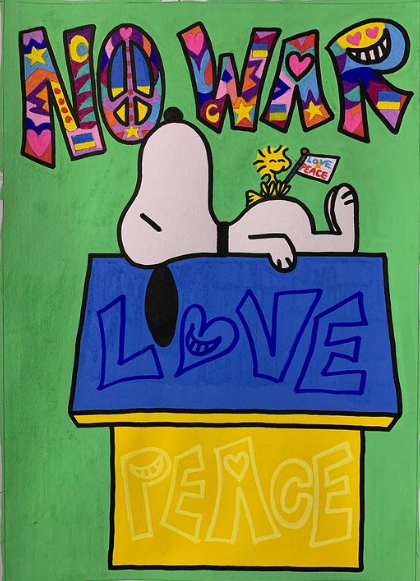
Live long and prosper, Ukraine.

Images of Creativity

Images, works of art. Striking. Unsettling. Amazing. Jaw dropping. Awesome.

Creativity in its different forms.

Below are a few examples of spaces that accommodate large scale installations.


Going big in small spaces. Irrespective of the environments we design, there are always opportunities to create unexpected scale through architectural intervention. It’s a strong and powerful way for brands to transport an audience to another world.


Credits:

Artist Matthew Mazzotta has designed HOME at Tampa airport

AC Milan HQ by Fabio Novembre

Sophie’, 2009 in Germain Restaurant, Paris by Xavier Veilhan

‘Karma’ is by the Korean sculptor and installation artist DO HO SUH STUDIOS LLP  


Hopefully making a ruckus, one blog post at a time!

Be sure to check out my other blog, Joe’s Journey, for a different kind of playground for creativity, innovation and inspiring stuff.


Live long and prosper, Ukraine.

Snoopy in Concrete

Creativity knows no bounds. Nor, it seems, does an artist’s or cartoonist’s palette. Take, for instance, a recent, uh, exhibit at the Charles Schulz Museum in Santa Rosa, CA.

Talk about a lasting impression! If you’ve ever put your hands or feet into wet cement, you know what I’m talking about. When I came upon this photo entry by Jean Schulz, yes, that Schulz, I had to share it via my own creativity blog. All of us can relate to having impressions in concrete. Then, again, if you’re a world-famous beagle, your impressions are as varied as your moods.

In her latest blog post, “Leaving a Lasting Impression,” Jean Schulz shares the simple joy of leaving your mark in wet cement.


Hopefully making a ruckus, one blog post at a time!

Be sure to check out my other blog, Joe’s Journey, for a different kind of playground for creativity, innovation and inspiring stuff.

Live Long and Prosper, Ukraine!

Creativity vs Strategy

Creativity depends on strategy to be effective and successful. And vice versa. Do they need to live in harmony together? From the United Kingdom, the British agency Five by Five’s strategy director Catherine McPherson and creative director Ravi Beeharry discuss the secret to an effective relationship between creativity, strategy and craft.

Strategy, creativity, or craft – which is more important to a successful ad? And how should they work together?

“It used to be like a relay race, with each department handing the baton to another along the production line,” says Five by Five’s strategy director Catherine McPherson. “But today rather than strategy handing over a brief and washing its hands, we’re now running alongside the creatives and cheering them on.”

To an extent, the secret to effective advertising has always been found in the relationship between strategy, creativity, and craft. Too much strategy can leave a campaign feeling more like a PowerPoint presentation, whilst unrestrained creativity risks derailing a brand’s messaging. Get the balance right, however, and you land on the kind of genius which works miracles in the marketplace.

“While there is a balance to be struck, there isn’t a simple formula,” notes creative director Ravi Beeharry. “You have to look at it on a case-by-case basis. Take the iconic Meerkat from Compare the Market, for example.

You might look at that and consider it to be an example of creativity which went a bit out of control. What is a meerkat saying about that brand? But in practice it was enormously effective because the balance was right in that instance”.

Knowing which element should take prominence, the pair agree, comes down to your definition of success. 

“Does success mean winning at Cannes, or does it mean driving sales in the short-term? Or is it brand recognition? It might sound obvious, but being intentional about the end result is the first step to getting the balance right”, says Catherine.

“Something we’ll reference quite often at Five by Five is Peter Field’s research into the recent decline in creative effectiveness, and one takeaway from that has been that we don’t look for compromise between strategy and creativity but rather look for harmony. They should feed into one another”. 

“The best creativity bounces off strategy like it’s a springboard”, notes Ravi. “And craft is the execution – actually, let me rephrase that. Craft is good execution. Knowing the precise balance between those elements will ultimately come down to judgement and context. It all adds up to having strong ideas, clearly communicated”.

‘Strong ideas, clearly communicated’ is Five by Five’s strategic approach to briefs. It’s what ensures their clients’ brands get noticed, processed and recalled – and it’s ultimately what delivers effective campaigns. 

And as Ravi notes, when it comes to measuring a successful campaign, context will always be king. However, in recent years a fracturing media environment has made identifying that context all the more challenging. 

The Ever-Growing Crowd

One reality of the modern industry is that an idea can no longer realistically be designed to live in one place. The seemingly endless proliferation of channels and platforms which occurred in the last decade has created a marketing landscape with more nuance than at any point in the industry’s history. But, according to Catherine and Ravi, there are still ways of finding the right balance between strategy, creativity, and craft. 

“Something which we’ve lost sight of, I feel, is precisely what we should be using these different platforms for. They don’t need to be additional challenges, they should be seen as additional tools.

“If you’re going to take one single idea and contort it to fit a TV screen as well as a mobile phone, then I’ve no doubt that storytelling and quality will suffer as a result. But if you work out how to take a central idea and present it in a bespoke way for different formats, then you’re far more likely to have an impactful campaign”, she says. 

For Ravi, there’s an opportunity for brands to become more memorable by elevating creativity and craft across multiple platforms. “It’s probably true to say that there’s a focus on promotion over entertainment at the moment”, he says. “And perhaps much of the culture and capabilities of social platforms, for example, lend themselves to promotion.”

“But look at what Nike put out just recently after Nadal won the Grand Slam. There wasn’t a single pair of trainers or shorts advertised, just a celebration of a sporting achievement which played into Nike’s brand in such an obvious way it doesn’t need underlining.

I came across that video on Twitter, so that’s a great example of using a social platform to drive results through entertainment. It’s a great execution of strategy, creativity, and craft”. 

In the words of both Catherine and Ravi, these kinds of pitch-perfect ideas are the cumulative result of a long-term approach to each of strategy, creativity, and craft.

“McDonalds is another example of a brand that gets this consistently right”, says Catherine. “They run a lot of product-focused ads on the high street but they also consistently come out with beautifully-told stories based on human truths, designed for TV.”

“It’s creativity, strategy, and craft working in perfect harmony over the course of many years. And it’s because they’ve nailed their brand-building that the shorter-term promotions work so well”. 

That long-term approach, then, is perhaps as close to a ‘winning formula’ as a brand is likely to get. But, as Ravi points out, the best insights are invariably based on a kind of magic which can’t be bottled. 

“At Five by Five we have an unprecedented number of tools and analytics available to us”, he says, “but those genius ideas which link strategy, creativity and craft together can’t come out of a formula. If they could, it wouldn’t really be genius”.


Live Long and Prosper, Ukraine!


Hopefully making a ruckus, one blog post at a time!

Be sure to check out my other blog, Joe’s Journey, for a different kind of playground for creativity, innovation and inspiring stuff.

Turning Gobbledygook Into Useful Garbage

Stumped. Writer’s Block. Stymied. Confused. It’s all a jumble of nothingness.

What Do You Write When You Don’t Know What to Write About?

So, how do you turn nothingness into somethingness? Start writing! Anything.

The words will come, thoughts will flow and, eventually, creativity will blossom.

You can’t force it, however. It must evolve naturally, at your own pace. Usually, if a creative suggestion doesn’t appear in your thoughts within about 20 minutes or so, abort the process and go on to something else. Then come back to it hours later or the following day.

Some writers think before they write. Some think as they write. Some writers don’t think at all; they just write a bunch of gobbledygook. That’s fine, as long as you go back and turn the gobbledygook into useful garbage.

Turning that garbage into something quite palpable and enticing will take a process of editing and refinement but when you’re at this stage, you’ve got it made.


Hopefully making a ruckus, one blog post at a time!

Be sure to check out my other blog, Joe’s Journey, for a different kind of playground for creativity, innovation and inspiring stuff.


Live Long and Prosper, Ukraine!


Empowering the Women of Advertising – Today

Today is the day of AAF Northeast Arkansas’ panel discussion on Empowering the Women of Advertising. I’m proud to be a participant on their panel so I have a vested interest in the event’s success.

Increasing diverse participation in advertising and marketing is a business issue, and we need everyone involved. To that end, AAF Northeast Arkansas is today raising awareness about ways to involve more men in creating inclusive work environments and how women can claim their strength within the advertising realm. 

By coincidence, a British publication interviewed several key women in advertising about the current status of their gender within their industry. The timing of this report is appropriate with the timing of the Arkansas AAF panel today.

Think about the people who make the buying decisions for their households. It’s extremely likely that the majority of them are women. And they’re probably more likely to be older than younger. Now think about agency creative departments that you know of – do those teams reflect the people who are likely most efficient to market to? Probably not.

In a recent interview with LBB, a British publication, Sue Higgs, joint ECD at dentsuMB in the UK, had this advice: “I find that it’s someone else’s problem, ageism”. The stage in life Sue’s at now is a huge asset to her as a creative leader. “The great thing about being in your mid-life or wherever we are is that it’s quite liberating,” she said. “It’s quite liberating, I think, to find your strength, and your power, and your voice.”

And that liberated voice is exactly what creatives need to flourish. One thing Sue said she’s learned from her experience is that: “As you get older you learn that people lose their jobs for a trillion reasons and none of them is actually speaking your mind. There’s nothing more fulfilling to say to a young female than: ‘Just tell them. Just say it, your biggest weapon is your point of view. That’s why you’re here. Please use it.’

Continue reading

A Tip of the Hat to the Cat in the Hat! (and his creator)

Happy Belated Birthday, Dr. Seuss!

As you may have gathered by now, this post is an out-of-the-ordinary-one. It celebrates one of our nation’s top word sleuths, a master of reduced vocabulary and a penchant for a feline sporting a floppy chapeau.

His birthday was yesterday but his creativity, particularly with and for children, certainly merits more than just a mention in this creativity blog. He is, of course, Dr. Seuss, and with that brief introduction comes some background that some of you may not know.

Theodor Seuss Geisel (March 2, 1904 – September 24, 1991) was an American children’s author, political cartoonist, illustrator, poet, animator, and filmmaker. He is known for his work writing and illustrating more than 60 books under the pen name Dr. Seuss. His work includes many of the most popular children’s books of all time, selling over 600 million copies and being translated into more than 20 languages by the time of his death.

Geisel adopted the name “Dr. Seuss” as an undergraduate at Dartmouth College and as a graduate student at Lincoln College, Oxford. He left Oxford in 1927 to begin his career as an illustrator and cartoonist for Vanity Fair, Life, and various other publications. He also worked as an illustrator for advertising campaigns, most notably for FLIT and Standard Oil, and as a political cartoonist for the New York newspaper PM.

He published his first children’s book And to Think That I Saw It on Mulberry Street in 1937. During World War II, he took a brief hiatus from children’s literature to illustrate political cartoons, and he also worked in the animation and film department of the United States Army where he wrote, produced or animated many productions including Design for Death, which later won the 1947 Academy Award for Best Documentary Feature.

After the war, Geisel returned to writing children’s books, writing classics like If I Ran the Zoo (1950), Horton Hears a Who! (1955), The Cat in the Hat (1957), How the Grinch Stole Christmas! (1957), Green Eggs and Ham (1960), One Fish Two Fish Red Fish Blue Fish (1960), The Sneetches (1961), The Lorax (1971), The Butter Battle Book (1981), and Oh, the Places You’ll Go (1990). He published over 60 books during his career, which have spawned numerous adaptations, including 11 television specials, five feature films, a Broadway musical, and four television series.

Geisel won the Lewis Carroll Shelf Award in 1958 for Horton Hatches the Egg and again in 1961 for And to Think That I Saw It on Mulberry Street. Geisel’s birthday, March 2, has been adopted as the annual date for National Read Across America Day, an initiative on reading created by the National Education Association.

He also received two Primetime Emmy Awards for Outstanding Children’s Special for Halloween is Grinch Night (1978) and Outstanding Animated Program for The Grinch Grinches the Cat in the Hat (1982).

Geisel’s most famous pen name is regularly pronounced /suːs/, an anglicized pronunciation inconsistent with his German surname. He himself noted that it rhymed with “voice”. Alexander Laing, one of his collaborators on the Dartmouth Jack-O-Lantern, wrote of it:

You’re wrong as the deuce
And you shouldn’t rejoice
If you’re calling him Seuss.
He pronounces it Soice (or Zoice)

Geisel switched to the anglicized pronunciation because it “evoked a figure advantageous for an author of children’s books to be associated with—Mother Goose” and because most people used this pronunciation. He added the “Doctor (abbreviated Dr.)” to his pen name because his father had always wanted him to practice medicine.

So whether or not you heard Horton’s Who or salivate over his breakfast suggestion of Green Eggs and Ham, take a moment and say Thank You to the one main character to whom millions of kids have related to for years, Dr. Seuss.

Have a Happy Holiday Season, Anyway!

Whether you be . . .

And I Regret Nothing! (SVG Land)


Or on the Nice List . . .

By Wily Alien


Hopefully making a ruckus, one blog post at a time!

Be sure to check out my other blog,Joe’s Journey, for personal insights on life and its detours.

Seth Godin on Creativity

“To count, it needs to ship,” Seth Godin.

Whatever you end up creating, for it to count, it needs to ship. Ship in the sense that it needs to be published, displayed, lectured, drawn, invented, etc. Whatever you create needs exposure.

If you’re not that familiar with Seth or his myriad of work, go explore Seth’s site. You’ll be glad you did.

I’ve been following Seth’s podcast, Akimbo, for several years now and find it quite nourishing. I also subscribe to his emails. How he does this 365 days of the year, I’ll never know.

But, I’m glad he does.

So take a listen below to Seth’s take on Creativity if you haven’t already. Once done, choose to create something.

Then ship it!

Hopefully making a ruckus, one blog post at a time!

Be sure to check out my other blog, Joe’s Journey, for personal insights on life and its detours.

Campaign From Gillette Venus Features Singing Pubic Hair

My my, what will they think of next? I learned something . . . that, evidently, a pubic hair can sing! I did not realize that. What else did I not realize, Gillette?

Now, I know what you must be thinking: “What in the hell kind of blog post is this?!” It’s, uh, well, different.

This blog sets out each week to present thoughts and ideas about various aspects of creativity; those that touch directly on advertising and those that do not. This is one that does.

According to AdAge, marketers increasingly have dared to defy traditional taboos when it comes to personal care, as we’ve seen in more pushes around menstruationbreastfeeding and grooming. In the case of the latter, brands such as Billie razors and Veet razors have given the thumbs up to having hair wherever you want it, while EOS recently celebrated a TikTok creator who has been teaching her fans the best way to shave their lady parts. Now, Gillette Venus is jumping into the bikini line fray by encouraging consumers to “say pubic.”

The centerpiece of the campaign from Grey is an animated film starring a singing pubic hair. Yes, you heard me right.

“Hi, I’m a pube!” she announces before breaking into a Broadway-style tune, singing of her plight as a lowly, gnarly curl, hoping to be treated like her colleagues who spring forth from other parts of the body.  As the tune ramps up, she’s joined by other pubettes in a Busby Berkeley-style routine. 

For those of you unable to log into the AdAge site to view the animation, here are the lyrics to Gillette’s latest.

I’m just a pube, and it’s not fair.
All I ever wished to be was just another hair
But when they got one look at me
The ruling from society was “Ewww”
“Not you!”
Oh what’s a curl to do
It seems like all the ads are showing perfect skin and shiny hair
But what about this other world inside your underwear?
It’s ok to say our name
You really can say pubic
No need to be ashamed
It’s even kind of therapeutic
Why the mass hysteria about the pubic area?
There’s nothing diabolical about this little follicle
So take care of us, your pubic hair
If you trim, or you shave or you’re bare down there
Whichever way’s your way
It’s all okayyyyyyyyy
Yes, it’s okay!

Another push encouraging consumers to be at ease with body parts and bodily functions

The campaign aims to normalize conversation around body parts like the pubic area to make women feel more comfortable about grooming there. “Because pubic is not a dirty word, and your pubic hair and skin deserve its own care,” the brand said in a statement.

Gillette Venus had conducted a female consumer survey about the use of anatomical terms such as “pubic.” It found that nearly half of them believed it feels more accurate to use such terms yet only 18% are actually using them. More than half, 56%, said they wished there were more accurate imagery and descriptions in media of women grooming in the pubic region.

The campaign playfully addresses the issue, while the Gillette Venus site promoting the products also features imagery of a diverse range of women shaving their bikini lines. The packaging too, features the words “pubic hair.” Along with the video, the effort includes a TikTok component inviting others to sing “The Pube Song.”

“With over two decades of research and scientific development in women’s hair and skin under our belt, literally, we know that grooming means something different to every woman,” said MyAnh Nghiem, Gillette Venus communications director in the statement. “Our new collection not only offers women more options for pubic grooming than we ever have before, but starts a new conversation about using language that accurately and respectfully represents the female body.”

Okay, okay, some of you may already be saying, “Enough is enough!” You gotta admit, though, advertising ain’t boring (well, alright, some of it is; some of it is even dreadful). This spot tries to be educational, informative, and entertaining, I guess, if not a little quirky. Frankly, if you didn’t realize the animated curl was in fact a pubic hair, I’m not sure that you’d figure it out based solely on looks.

What will they think of next? Uh, I’d really rather not think about it.