It’s that time of the month again when we feature different quotes from a variety of people in the fields of creativity, the arts, psychology, advertising and many more. Some are very well known while others not so much. In any event, they are thought-provoking, interesting and in some cases, rather surprising.
Creators, makers of the new, can never become obsolete, for in the arts there is no correct answer. The story of discoverers could be told in simple chronological order, since the latest science replaces what went before. But the arts are another story — a story of infinite addition. We must find order in the random flexings of the imagination. – Daniel J. Boorstin
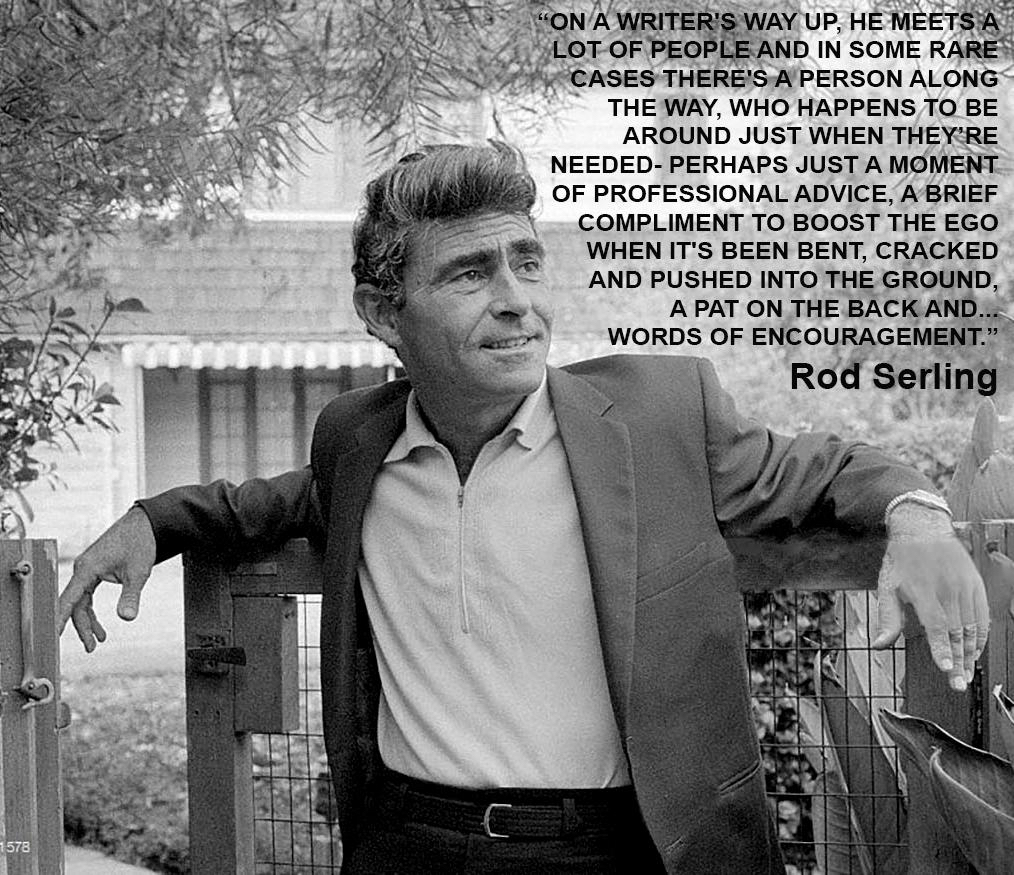
The writer’s role is to menace the public’s conscience. He must have a position, a point of view. He must see the arts as a vehicle of social criticism and he must focus the issues of his time. — Rod Serling
Rod Serling on set
Creativity comes from a conflict of ideas. — Donatella Versace
An essential aspect of creativity is not being afraid to fail. — Edwin Land
If you can’t turn yourself into your customer, you probably shouldn’t be in the ad writing business at all. Leo Burnett, Advertising Hall of Fame
Creativity is no longer about grabbing attention or raising consumer awareness. Its goal is to remind consumers about what is fundamental and gratifying about a brand. — Peter A. Georgescu, Advertising Hall of Fame
If opportunity doesn’t knock, build a door. – Milton Berle
Passion is one great force that unleashes creativity, because if you’re passionate about something, then you’re more willing to take risks. – Yo-Yo Ma
Meetings are all too often the burial grounds of great ideas. — Keith Reinhard, Advertising Hall of Fame
The more complex the world becomes, the more creative we need to be to meet its challenges. – Sir Ken Robinson (Mar 04, 1950 – Aug 21, 2020)
Hopefully making a ruckus, one blog post at a time!
Be sure to check out my other blog, Joe’s Journey, for a different kind of playground for creativity, innovation and inspiring stuff.
Whether or not you agree with the premise, I found the following essay from Psychology Today an interesting take on a myth that still finds itself debatable in certain circles. Where do creative ideas come from? Are they truly original? Well, according to the essay . . .
One of the most persistent myths is that a creative idea is a totally original idea. That is, to be creative one must be able to create ideas that have never been thought before, ideas that never existed before, absolutely original. {Personally, I don’t buy this.}
{One could consider saying that all original ideas are creative but not all creative ideas are original. I would not necessarily agree with the first part of that statement but I would agree with the second part.}
The truth is that most innovative ideas are not original ideas. In most cases, they are simply the combination of previous ideas into a new concept or format. It’s about making connections with stuff that’s already there. Steve Jobs, the founder of Apple, brought this all into perspective when he said:
Creativity is just connecting things. When you ask creative people how they did something, they feel a little guilty because they really didn’t do it, they just saw something. It seemed obvious to them after awhile. That’s because they were able to connect experiences they’ve had and synthesize new things. And the reason they were able to do that was that they’ve had more experiences or that they have thought more about their experiences than other people.
One of the most-oft cited cases of creativity centers around Johannes Gutenberg who, in 1450, combined the wine press and the coin punch to create movable type and the printing press. Movable metal pieces allowed pages to be printed much more quickly than the standard wooden blocks used to press ink onto paper.
His “combination of pre-existing technologies” created printing presses that could print thousands of pages a day. This revolution allowed books to be printed more quickly and more efficiently, allowing the middle class to obtain them as never before. The result was the rapid spread of knowledge across the European continent. That intellectual revolution came about due, in large measure, to the combination of two previous (and seemingly unconnected) ideas: a wine press and a coin punch.
Creative Combinations
Ancient Greeks were also aware of the power of creative combinations. For example, it was the Greeks who combined soft copper with soft tin to create hard bronze. At their most basic levels, Gutenberg’s printing press and the creation of bronze were simply a combination of already existing ideas. History also records these interesting combinations of pre-existing concepts:
1. Copier + telephone = fax machine
2. Bell + clock = alarm clock
3. Trolley + suitcase = suitcase with wheels.
4. Igloo + hotel = ice palace
5. Mathematics + biology = laws of heredity
We like to believe that creativity is the result of a determined, focused, and solo entrepreneur who, through a flash of inspiration solves a problem for the betterment of humankind. It’s a great plot line for a TV special, but it ignores a basic fact of life about the stories of most innovations: They rarely include the human networks that sustain (and make possible) radical new ideas or changes. In fact, history is frequently edited in order to recognize a sole genius or innovator. Phil McKinney, host of the nationally syndicated radio show, Killer Innovations, puts it this way:
We have a saying in the innovation industry: “There’s no such thing as a truly new idea. Ideas are the result of building on the work of others.” Many of the creative ideas that led to creating great companies were the result of a team. Some examples: Microsoft, Intel, Google, Skype and many more.
We continue to think that to be creative is to have the ability to create new ideas rather than to combine old ideas into new configurations. It’s a persistent myth that frequently blocks us whenever we’re faced with a personal challenge or work-related endeavor. To the contrary, however, creativity is not always a series of “brilliant new ideas,” but often is the result of a lifetime of experiences and diligence in working on combinations of those ideas (instead of giving up on them after one or two failures). The myth that every idea must be an idea never considered before (in the history of humankind) is a significant impediment to our ability to think creatively.
Key Takeaways
We often make the mistake of assuming that creative ideas are always original ideas.
Creativity is, quite often, a combination of two “old” ideas.
One’s creativity can be enhanced by linking two or more disparate concepts.
Regardless of one’s viewpoint, never be afraid to brainstorm with your own imagination and consider borrowing from other ideas. Those ideas can always be improved upon and/or give birth to a totally new and different idea. That’s being creative.
Thanks to Dr. Fredericks for the essay and for the various examples of original thought on which this post is based. Anthony D. Fredericks, Ed.D., is Professor Emeritus of Education at York College of Pennsylvania and the author of From Fizzle to Sizzle: The Hidden Forces Crushing Your Creativity and How You Can Overcome Them.
Hopefully making a ruckus, one blog post at a time!
Be sure to check out my other blog, Joe’s Journey, for a different kind of playground for creativity, innovation and inspiring stuff.
Every summer the advertising world treks to France and pays tribute to its version of Mecca, the Cannes Creativity Festival. In the words of a UK publication who was onsite last week, “Cannes Lions is a circus, a meeting of minds, a place to hear the same buzzwords again and again and a chance to listen to celebrities try to explain how to do advertising to rooms full of people who do advertising for a living.
But it’s also a chance to take the temperature of creativity once a year. Seeing all the work that’s winning and being surrounded by people talking about creativity gives people a unique bird’s eye perspective for just one week.”
So, while talking to the cross section of creative leaders, a very broad, but pertinent question was asked: “what is the state of creativity in 2022?”
Here’s what some of them said.
Caitlyn Ryan VP, Meta
There’s much more optimism and real celebration. We were seeing lots more joyful work. There was one piece that won Gold [in Social & Influencer], for BMW China for the Lunar New Year. The team worked out that the word for BMW in China includes the word horse, and it was the year of the Tiger. It’s properly bonkers but it’s also so joyful. I think it’s a really great example of a couple of things, this celebration and joyfulness, but also as a social campaign. They created all of these assets that then they gave over to the community that allowed them to socialise the idea. I think it’s quite complex but it looks simple and fun.
Yes, there of course is social purpose work – and there was amazing work, especially the charity work The Lost Class, which was just beautiful. That definitely triggers a reaction and wanting to sign up to a social purpose activation. Also we can sell products through joyfully co-creating with the community. I think that’s a really important next step out of the pandemic. It’s incredibly important that we get the economy up and running again, and we use creativity to do that.
Bruno Bertelli Global Creative Director, Publicis WW and CEO, Le Pub
On one level, there’s a little bit of dated work. Still purpose-led, still a little bit from the past. But on the other hand, there is a trend which is interesting, which is that today brands cannot tell people [things] or inspire people, it’s much more about supporting people doing things. Even if it’s for a small issue, it’s much more about supporting people in what they want to achieve. Story-doing has become much more societally relevant and less strategic – what’s your purpose, what’s your message? Some of these activations don’t even need a message because it’s clear that ‘here’s an issue and I’m just here to help’. It’s a very gen-z attitude. The other thing is not all brands are understanding the importance of being topical today. It’s so important after covid. If you’re not topical, you’re not going anywhere.
Anna Qvennerstedt Senior Partner and Chairman of the Board, Forsman & Bodenfors
Last year I was judging brand experience and activation. And I think that my big takeaway from last year was that there are so many really ‘nice’ ideas, but you can feel how quite a few of them are just… very reasonable. You look at it and it’s well done… but there’s no tension in it. There’s no element of surprise. It’s just basically very, very clever. And I think in the jury, when you look at it, you know that it’s going to do well, but then you see something where there’s an actual idea that is expected and no one saw coming, and that sort of changes you a little bit. Those are the ones that win the big awards, I think, and there are not many of them. I mean, again, lots of great work, but those really unexpected ones felt quite rare.
But I think there’s a renaissance for really creative ideas, that we’re sort of starting to see a little bit in the requests from clients.
Rod Sobral Global CCO, Oliver
I am a paranoid optimistic. I know it’s a cliche, but I use it all the time. I think every leader should be a bit of a paranoid optimistic. You have to believe that things are going to change, that it’s going to evolve in order for you to be in the right state of mind, and to take some risks.
My view on that is absolutely, still the most important thing in the marketplace – and I don’t think this will ever change – is the idea. And an idea that connects with you on an emotional or a rational level, sometimes both.
I think we do have this superpower in our industry to change people’s lives. It can be an ad that’ll put a smile on your face or remind you to call your mom or it can be an app that will help you to deal with your asthma or to run better. So I know that this is possible. And I think we should be doing that.
I believe, when it comes to the state of creativity, we are in a very exciting place, frankly, because I feel that there’s a lot of energy to try things. Let’s be honest, with digital, with commerce, we have so many platforms, we produce so much. Any creative can relate to the many times you create something and you end up with one asset that people see for a fraction of a second. There is a lot of vision from people saying, ‘I don’t want to be part of the clutter, I want to be part of the signal’. The more clutter there is, the more anxious people get to change, to try to do something to break the mould.
John Berghdal Global Creative Lead, Forsman & Bodenfors
There was so much fear in the last few years and everybody was thinking about just controlling things, not wanting things to get out of hand. And of course, then you lean on data, and you’re like, ‘OK, Facebook, Google, what can you give me? This is my budget and let’s just use programmatic. Let’s just steer this thing to not have a catastrophe, we’re going to control the situation’. Through creativity and unexpectedness, you have to be bold. You have to risk something – and I don’t think people have been in a risky kind of mood… [We were talking earlier] about the pendulum and maybe this is when people are waking up and coming out and saying, ‘OK, wait a minute, let’s build brands that people care about.’
Hopefully making a ruckus, one blog post at a time!
Be sure to check out my other blog, Joe’s Journey, for a different kind of playground for creativity, innovation and inspiring stuff.
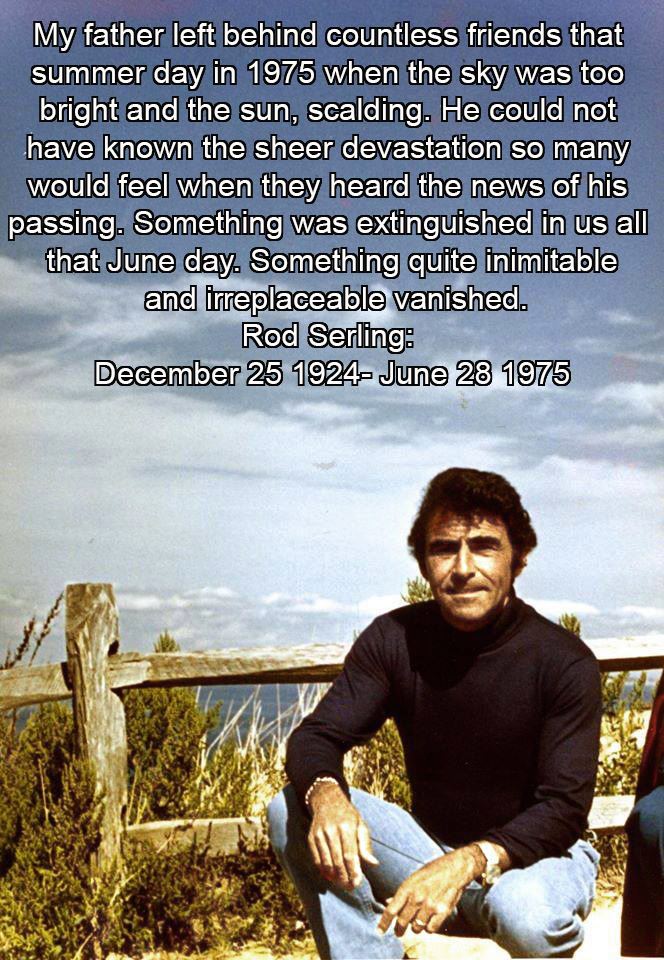
Forty-seven years ago this week, June 28, 1975, creativity lost an icon. A mentor to many both near and afar and an inspiration to those of us putting “pen to paper.” Rod Serling, creator and host of the TV series, The Twilight Zone, was a master at utilizing one’s imagination and turning it on its ear. And we loved him for it!
These quotes pay tribute not only to Rod but to various creative artists and thought leaders who have also played a role in tweaking our imagination and how we think.
Ijust want [people] to remember me a hundred years from now. I don’t care that they’re not able to quote any single line that I’ve written. But just that they can say, ‘Oh, he was a writer.’ That’s sufficiently an honored position for me. – Rod Serling
An important idea not communicated persuasively is like having no idea at all. — William Bernbach, Advertising Hall of Fame
Human beings must involve themselves in the anguish of other human beings. This, I submit to you, is not a political thesis at all. It is simply an expression of what I would hope might be ultimately a simple humanity for humanity’s sake. ― Rod Serling
Like the musical score, a mission statement is only as good as the performance it inspires. — Keith Reinhard, Advertising Hall of Fame
Let’s gear our advertising to sell goods, but let’s recognize also that advertising has a broad social responsibility. — Leo Burnett, Advertising Hall of Fame
Treasure diversity. Seek unity, not uniformity. Strive for oneness, not sameness. — Dan Zadra, American businessman and author
Human history becomes more and more a race between education and catastrophe. – H. G. Wells
Good advertising is written from one person to another. When it is aimed at millions, it rarely moves anyone. — Fairfax M. Cone, Advertising Hall of Fame
In order to attain the impossible, one must attempt the absurd. – Miguel de Cervantes
I think, at a child’s birth, if a mother could ask a fairy godmother to endow it with the most useful gift, that gift should be curiosity. – Eleanor Roosevelt
Failure is the condiment that gives success its flavor. – Truman Capote
Hopefully making a ruckus, one blog post at a time!
Be sure to check out my other blog, Joe’s Journey, for a different kind of playground for creativity, innovation and inspiring stuff.
Images, works of art. Striking. Unsettling. Amazing. Jaw dropping. Awesome.
Creativity in its different forms.
Below are a few examples of spaces that accommodate large scale installations.
Going big in small spaces. Irrespective of the environments we design, there are always opportunities to create unexpected scale through architectural intervention. It’s a strong and powerful way for brands to transport an audience to another world.
Credits:
Artist Matthew Mazzotta has designed HOME at Tampa airport
AC Milan HQ by Fabio Novembre
Sophie’, 2009 in Germain Restaurant, Paris by Xavier Veilhan
‘Karma’ is by the Korean sculptor and installation artist DO HO SUH STUDIOS LLP
Hopefully making a ruckus, one blog post at a time!
Be sure to check out my other blog, Joe’s Journey, for a different kind of playground for creativity, innovation and inspiring stuff.
It’s that time of the month again wherein I present an array of quotes from a variety of well-respected folks offering numerous perspectives. From Obama to Burnett to Serling and more.
Take note. Take a listen. Take heed. Put ’em into practice if you can. Enjoy!
Promoting science isn’t just about providing resources, it’s about protecting free and open inquiry. It’s about ensuring that facts and evidence are never twisted or obscured by politics or ideology. It’s about listening to what our scientists have to say, even when it’s inconvenient, especially when it’s inconvenient. Because the highest purpose of science is the search for knowledge, truth and a greater understanding of the world around us.– Barack Obama
Don’t let anyone rob you of your imagination, your creativity, or your curiosity. It’s your place in the world; it’s your life. Go on and do all you can with it, and make it the life you want to live. – Mae Jemison
Nothing splendid has ever been achieved except by those who dared believe that something inside of them was superior to circumstance. — Bruce Barton, member, Advertising Hall of Fame
The place to start in advertising is the basic selling appeal. An appeal that fulfills some existing need in the prospect’s mind, an appeal that can be readily understood and believed. — Morris Hite, member, Advertising Hall of Fame
I have learned that any fool can write a bad ad, but that it takes a real genius to keep his hands off a good one. — Leo Burnett, member, Advertising Hall of Fame
Defeat is not the worst of failures. Not to have tried is the true failure. – George E. Woodberry
A teacher’s influence doesn’t stay in school. It goes out into the world and cannot truly ever be measured. Every student you inspire to do something great goes on to inspire others. There is no limit to your impact. – George Couros
It has forever been thus: So long as we write what we think, then all of the other freedoms – all of them – may remain intact. And it is then that writing becomes a weapon of truth, an article of faith, an act of courage. – Rod Serling
A good ad should be like a good sermon: It must not only comfort the afflicted, it also must afflict the comfortable. — Bernice Fitz-Gibbon, member, Advertising Hall of Fame
It is easier to tone down a wild idea than to think up a new one. — Alex Osborne, member, Advertising Hall of Fame
Hopefully making a ruckus, one blog post at a time!
Be sure to check out my other blog, Joe’s Journey, for a different kind of playground for creativity, innovation and inspiring stuff.
There will be a cloud of creativity lurking over the advertising center of northeast Arkansas tomorrow when the AAF chapter of Northeast Arkansas hosts Expanding Your Toolbelt, a series of afternoon workshop sessions covering a variety of topics relative to advertising and creativity.
Projected schedule:
Lunch & Session 1: 11:30 am – 1:00 pm | Take This Job and #^*& with Anissa Centers This workshop is about investing in what it takes to excel in your field, even when you are no longer motivated.
Session 2: 1:00 – 2:00 | Digital Drawing Workshop with Whitney Blackburn Take some time to learn a new skill that you can utilize in your professional or personal time. Learn all the ins and outs of digital drawing.
Session 3: 2:00 – 3:00 | Kickstarting Creativity Without Screwing Up the Idea with Joe Fournet Creativity plays a vital role in getting the consumer’s attention, no matter the size of one’s budget or what it is a company is selling to the public. Joe’s presentation has some fun showcasing winning and wacky ways to kick-start the creative process while staying true to the core ideas.
Session 4: 3:00 – 4:00 | Leadership Lessons From the Lockdown with AAF National President, Steve Pacheco From handling crises to navigating new channels of communication and connecting with your team, advice, and tips from lessons learned during lockdown.
Session 5: 4:00 – 5:00 | Curiosity with Professor Leslie Moore Parker This session helps identify the self-imposed constraints that may hold us back in our careers and lives. It encourages participants to open their minds and hearts to the unexpected and the outrageous.
I am honored to be a part of this elite panel of speakers and some of the highlights of Kick Starting can be found in the Download section of my website at the link below.
For those of you who can’t make the virtual visit, feel free to download a couple of documents I’ve posted on my website relative to various tips and techniques to enhance and develop the creative process. You’ll find them here at ideasnmore.net as well as other helpful information.
Organizations like the AAF are wonderful resources for professionals interested in joining with other like-minded peers in the advertising and marketing spheres. Various chapters like this one in northeast Arkansas, and mine in Houston, serve the local advertising and creative community and make it worthwhile to become a member and strengthen one’s career and life interests.
Hope you can join us tomorrow either in-person or virtually. I think you’ll be glad you did!
Hopefully making a ruckus, one blog post at a time!
Be sure to check out my other blog, Joe’s Journey, for a different kind of playground for creativity, innovation and inspiring stuff.
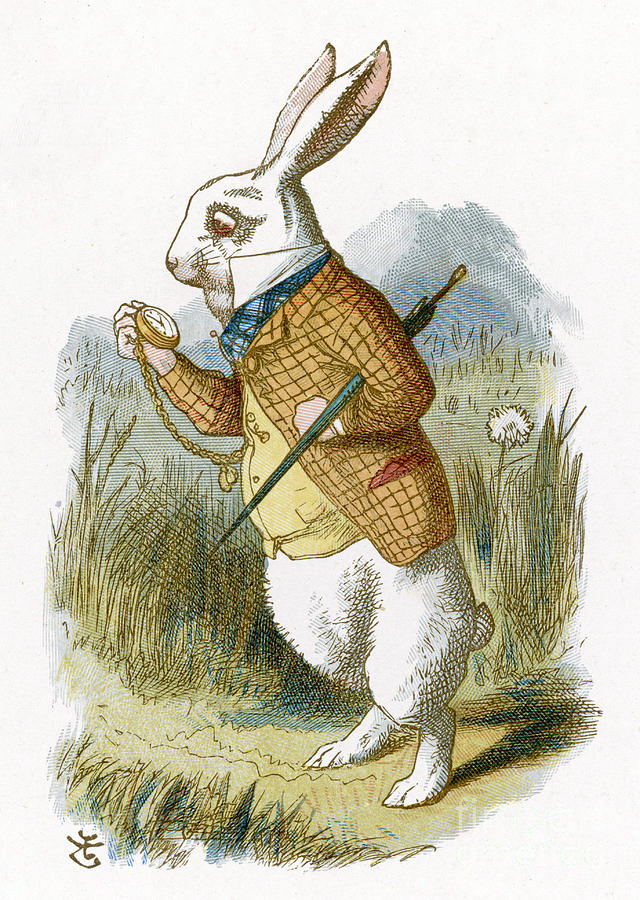
I’m late, I’m late! For a very important date! No time to say ‘hello, goodbye,’ I’m late, I’m late, I’m late! — White Rabbit
The White Rabbit is a fictional and anthropomorphic character in Lewis Carroll’s 1865 book Alice’s Adventures in Wonderland. Mary Evans Picture
No company that markets products or services to the consumer can remain a leader in its field without a deep-seated commitment to advertising. — Edwin Artzt, member, Advertising Hall of Fame
You can say the right thing about a product and nobody will listen. You’ve got to say it in such a way that people will feel it in their gut. Because if they don’t feel it, nothing will happen. — William Bernbach, member, Advertising Hall of Fame
The soft stuff is always harder than the hard stuff. — Roger A. Enrico, member, Advertising Hall of Fame
And that’s the world’s biggest problem: the future is seen as someone else’s concern. –David A. Sinclair, biologist, professor of genetics
Everything has its beauty, but not everyone sees it. – Andy Warhol
The most beautiful thing we can experience is the mysterious. It is the source of all true art and all science. He to whom this emotion is a stranger, who can no longer pause to wonder and stand rapt in awe, is as good as dead: his eyes are closed. – Albert Einstein
Obstacles are those frightful things you see when you take your eyes off your goal. – Henry Ford
Whenever a theory appears to you as the only possible one, take this as a sign that you have neither understood the theory nor the problem which it was intended to solve. – Karl Popper
Diversity is truly about seeing everyone’s uniqueness as a beautiful gift to be nurtured and developed, not changed to conform to some arbitrary standard. — Mary-Frances Winters, American author and diversity & inclusion expert
Hopefully making a ruckus, one blog post at a time!
Be sure to check out my other blog, Joe’s Journey, for a different kind of playground for creativity, innovation and inspiring stuff.
Creativity depends on strategy to be effective and successful. And vice versa. Do they need to live in harmony together? From the United Kingdom, the British agency Five by Five’s strategy director Catherine McPherson and creative director Ravi Beeharry discuss the secret to an effective relationship between creativity, strategy and craft.
Strategy, creativity, or craft – which is more important to a successful ad? And how should they work together?
“It used to be like a relay race, with each department handing the baton to another along the production line,” says Five by Five’s strategy director Catherine McPherson. “But today rather than strategy handing over a brief and washing its hands, we’re now running alongside the creatives and cheering them on.”
To an extent, the secret to effective advertising has always been found in the relationship between strategy, creativity, and craft. Too much strategy can leave a campaign feeling more like a PowerPoint presentation, whilst unrestrained creativity risks derailing a brand’s messaging. Get the balance right, however, and you land on the kind of genius which works miracles in the marketplace.
“While there is a balance to be struck, there isn’t a simple formula,” notes creative director Ravi Beeharry. “You have to look at it on a case-by-case basis. Take the iconic Meerkat from Compare the Market, for example.
You might look at that and consider it to be an example of creativity which went a bit out of control. What is a meerkat saying about that brand? But in practice it was enormously effective because the balance was right in that instance”.
Knowing which element should take prominence, the pair agree, comes down to your definition of success.
“Does success mean winning at Cannes, or does it mean driving sales in the short-term? Or is it brand recognition? It might sound obvious, but being intentional about the end result is the first step to getting the balance right”, says Catherine.
“Something we’ll reference quite often at Five by Five is Peter Field’s research into the recent decline in creative effectiveness, and one takeaway from that has been that we don’t look for compromise between strategy and creativity but rather look for harmony. They should feed into one another”.
“The best creativity bounces off strategy like it’s a springboard”, notes Ravi. “And craft is the execution – actually, let me rephrase that. Craft is good execution. Knowing the precise balance between those elements will ultimately come down to judgement and context. It all adds up to having strong ideas, clearly communicated”.
‘Strong ideas, clearly communicated’ is Five by Five’s strategic approach to briefs. It’s what ensures their clients’ brands get noticed, processed and recalled – and it’s ultimately what delivers effective campaigns.
And as Ravi notes, when it comes to measuring a successful campaign, context will always be king. However, in recent years a fracturing media environment has made identifying that context all the more challenging.
The Ever-Growing Crowd
One reality of the modern industry is that an idea can no longer realistically be designed to live in one place. The seemingly endless proliferation of channels and platforms which occurred in the last decade has created a marketing landscape with more nuance than at any point in the industry’s history. But, according to Catherine and Ravi, there are still ways of finding the right balance between strategy, creativity, and craft.
“Something which we’ve lost sight of, I feel, is precisely what we should be using these different platforms for. They don’t need to be additional challenges, they should be seen as additional tools.
“If you’re going to take one single idea and contort it to fit a TV screen as well as a mobile phone, then I’ve no doubt that storytelling and quality will suffer as a result. But if you work out how to take a central idea and present it in a bespoke way for different formats, then you’re far more likely to have an impactful campaign”, she says.
For Ravi, there’s an opportunity for brands to become more memorable by elevating creativity and craft across multiple platforms. “It’s probably true to say that there’s a focus on promotion over entertainment at the moment”, he says. “And perhaps much of the culture and capabilities of social platforms, for example, lend themselves to promotion.”
“But look at what Nike put out just recently after Nadal won the Grand Slam. There wasn’t a single pair of trainers or shorts advertised, just a celebration of a sporting achievement which played into Nike’s brand in such an obvious way it doesn’t need underlining.
I came across that video on Twitter, so that’s a great example of using a social platform to drive results through entertainment. It’s a great execution of strategy, creativity, and craft”.
In the words of both Catherine and Ravi, these kinds of pitch-perfect ideas are the cumulative result of a long-term approach to each of strategy, creativity, and craft.
“McDonalds is another example of a brand that gets this consistently right”, says Catherine. “They run a lot of product-focused ads on the high street but they also consistently come out with beautifully-told stories based on human truths, designed for TV.”
“It’s creativity, strategy, and craft working in perfect harmony over the course of many years. And it’s because they’ve nailed their brand-building that the shorter-term promotions work so well”.
That long-term approach, then, is perhaps as close to a ‘winning formula’ as a brand is likely to get. But, as Ravi points out, the best insights are invariably based on a kind of magic which can’t be bottled.
“At Five by Five we have an unprecedented number of tools and analytics available to us”, he says, “but those genius ideas which link strategy, creativity and craft together can’t come out of a formula. If they could, it wouldn’t really be genius”.
Live Long and Prosper, Ukraine!
Hopefully making a ruckus, one blog post at a time!
Be sure to check out my other blog, Joe’s Journey, for a different kind of playground for creativity, innovation and inspiring stuff.
The quotations are as varied as the people who said them. Some you know, some you don’t. That’s what makes them interesting. From Burke to Burnett, Einstein to Degas; throw in a little Serling for seasoning and you’ve got a tasty recipe for March’s quotes.
We don’t grow unless we take risks. Any successful company is riddled with failures. — James E. Burke, Advertising Hall of Fame
Success or failure in business is caused more by mental attitude than by mental capacities. — Walter Dill Scott, Advertising Hall of Fame
Anyone who thinks that people can be fooled or pushed around has an inaccurate and pretty low estimate of people — and he won’t do very well in advertising. — Leo Burnett, Advertising Hall of Fame
If we knew what we were doing, it wouldn’t be called research, would it? – Albert Einstein
If you fall in love with the imagination, you understand that it is a free spirit. It will go anywhere, and it can do anything. – Alice Walker
Curiosity killed the cat, but for a while I was a suspect. – Steven Wright
You must aim high, not in what you are going to do at some future date, but in what you are going to make yourself do to-day. Otherwise, working is just a waste of time. – Edgar Degas
Our job is to simplify, to tear away the unrelated, to pluck out the weeds that are smothering the product message. — William Bernbach, Advertising Hall of Fame
How do we turn science fiction into fact? We do it by inventing our own future and figuring out the realistic steps that we need to make in order to get there. Dare to dream. Let your imagination leap. — David Shapton, Editor In Chief, RedShark Publications, 2012 to 2020
Hopefully making a ruckus, one blog post at a time!
Be sure to check out my other blog, Joe’s Journey, for a different kind of playground for creativity, innovation and inspiring stuff.









 ideasnmoreblog