

In a recent episode of Adspeak by ADWEEK, executive editor Alison Weissbrot leads a Brandweek panel featuring Nadja Bellan-White, group CEO at M&C Saatchi; Coltrane Curtis, founder and managing partner at Team Epiphany; and Kern Schireson, chairman and CEO at Known.
Together, they discuss the need to redefine agency-client partnerships. As budgets tighten and AI reshapes workflows, they explain why legacy and fee-based models are no longer viable.
Instead, success hinges on empathy, trust, and aligned incentives tied to outcomes. The panel shares practical strategies, from embedding test-and-learn budgets to understanding board-level pressures and deploying agile “tiger teams.”
What you’ll learn:
They emphasize deeper specialization, real human connection, and shared accountability as the foundation for resilient, high-performing partnerships in a rapidly evolving marketing landscape.
- How to shift from legacy fee-based models to incentive-aligned partnerships
- Why understanding your client’s board-level KPIs is non-negotiable
- The “Three Ideas Framework” for managing risk and building trust
- How to build genuine relationships through human connection and empathy
- Why agency expertise depth matters more than breadth
- How to balance internal restructuring and team protection with client excellence
Three agency leaders on why legacy and fee-based are no longer viable.
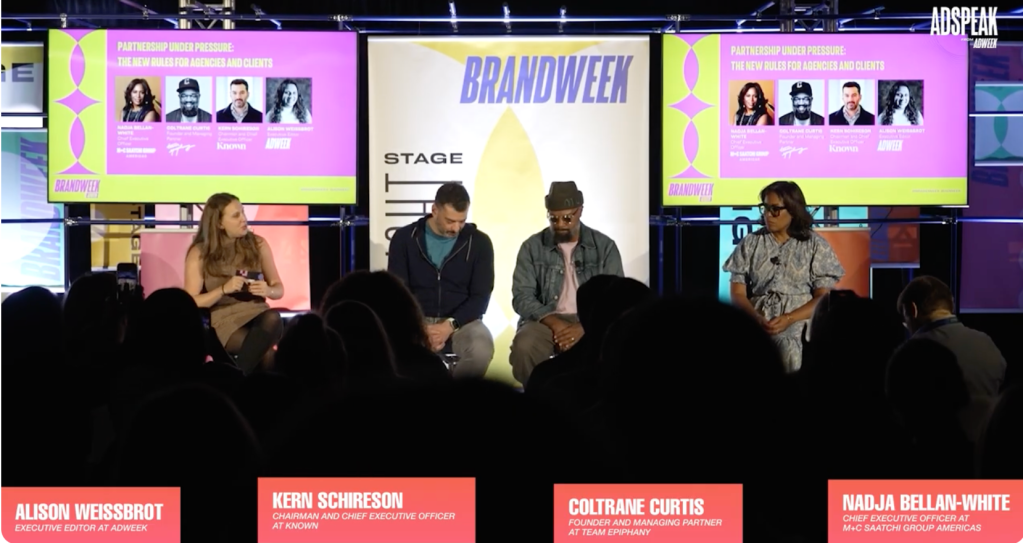
Nadja Bellan-White is the Group CEO at M&C Saatchi, and a “human-first” marketing leader known as a go-to fixer for complex brand transformations. With 25+ years in integrated marketing, she blends data, creativity, technology, and media to drive meaningful customer connections. She has led transformations for global brands including American Express, IKEA, and Coca-Cola, and partnered with African governments to spur growth. An AdColor Legend Award recipient, she brings a sharp focus on context, culture, and creativity to every engagement.
Coltrane Curtis is the Founder and Managing Partner of Team Epiphany, a New York-based influencer marketing and PR agency he launched in 2004. What began as a one-man shop has grown into a 70+ person, multidisciplinary agency with offices in New York and Portland. With roots at MTV and deep experience across brands like Nike, HBO, and Coca-Cola, Curtis blends cultural fluency with sharp strategic execution. Known for building powerful brand and celebrity partnerships, he has been recognized by Inc., Forbes, Adweek, and AdColor, and serves on the American Black Film Festival board.
Kern Schireson is the CEO of Known, a next-generation agency built on data-driven strategy and systemic innovation. With deep expertise in incentive alignment and AI-powered optimization, he is helping redefine the modern agency model. Kern champions using technology as a force multiplier for enhancing, not replacing, human creativity, while embedding rigorous test-and-learn frameworks into client partnerships. His approach focuses on aligning incentives and enabling continuous iteration, driving measurable, breakthrough results for brands navigating an increasingly complex marketing landscape.
Hopefully making a ruckus, one blog post at a time!
Be sure to check out my other blog,Joe’s Journey, for selected short stories and personal insights on life and its detours.


