Ideas, not AI, will decide who survives in 2030

In a world where everything can be personalized and optimized, there’s only one true differentiator left: ideas. (Adobe Stock)

AI will undoubtedly shrink the marketing services industry. Or so that’s the opinion of industry paper Ad Age via author Barry Lowenthal in a recent piece a few weeks back. Thought it worthwhile to share again especially to those of you who may not have seen it yet.

Many of the functions agencies are paid for today—targeting, media planning, asset versioning — are already being handled faster and cheaper by machines.

Yet the most successful agencies in 2030 won’t be those with the biggest AI budgets; they’ll be the ones still capable of original thought.

Since the explosion of generative AI, holding companies have raced to future-proof themselves, pouring hundreds of millions of dollars into the technology. They’ve hired engineers, signed vendor deals and built proprietary tools. The logic is that automation improves margins by enabling more work to be produced with less overhead, and it’s attractive to clients.

But here’s the problem: Everyone is doing the same thing.

AI platforms might look different, but they’re powered by the same foundation—similar models, trained on similar data, offering similar outputs.

AI is a great equalizer. While early investment and enterprise deals offer short-term advantages, the tools are ultimately accessible to all. As technology becomes commodified, there’s only one true differentiator left: ideas.

In a world where everything can be personalized and optimized—where every ad element, from celebrity to color palette to music cue, is engineered for conversion—what cuts through is the unexpected.

Zany, emotional, human ideas. The kinds that make people laugh out loud, tear up or text a friend because it hit a nerve. The kind no algorithm can predict because they come from life experience, not data.

Those ideas aren’t born from prompts or dashboards, but from humans living messy, interesting lives—wandering museums, walking unfamiliar streets, swapping stories at a dive bar.

The agencies that stay relevant in an AI era will be the ones that protect this kind of cultural immersion. They’ll hire for life experience, not just technical literacy. They’ll measure inspiration like they do performance, instead of grinding their teams into creative exhaustion. They’ll reward originality over speed and efficiency. 

If the goal is to survive the next five years, curiosity and creative instinct must be treated as core competencies.

That means rethinking workflows to allow time for discovery, not just delivery. It means protecting those unproductive long walks and deep rabbit holes.

The payoff won’t always show up neatly in a dashboard, so it will be a challenging pitch to the CFO. But in a world where AI devours everything else agencies in once thought made them valuable, it’s the only bet worth making.

That’s the future. And no, you can’t buy it; you have to nurture it.

********

I agree with Mr. Lowenthal, original thought leading to creatively inspired ideas will and must lead the way. I’ve been involved in this business for several decades and I realize that the industry has turned into a young person’s game. Most have grown up with AI and consider it the “standard.” That is unfortunate. It still must be considered a tool in the work belt of the creative person who’s developing the idea. It can’t be used as the end-all. That is unless sameness is one’s idea of creative thought.

Hopefully making a ruckus, one blog post at a time!

Be sure to check out my other blog, Joe’s Journey, for selected short stories and personal insights on life and its detours.

Creative ideas—not spreadsheets—drive long-term brand growth

In a recent edition of Ad Age I caught an interesting article posted by Jon Gibbs having to do with the importance of creative ideas to brand growth. I thought it appropriate enough to share it with you. So here goes . . . enjoy!

In today’s climate of shrinking budgets, AI automation and relentless pressure to prove ROI fast, marketers are increasingly forced to make creative decisions based on what’s measurable rather than what’s meaningful. Dashboards and spreadsheets dominate boardroom conversations. But metrics tell you only what has worked. Creativity shows you what could work.

That difference is critical. The most powerful growth doesn’t come from simply following the data; it comes from ideas bold enough to break new ground. Ideas that capture attention, stir emotion and become memorable. Safe decisions may feel efficient, but safe doesn’t build distinctiveness. Safe builds sameness. And sameness is a dangerous place for brands to be in a hyper-competitive, three-second-attention world.

Creativity is what gives brands an edge. It’s how you move from being seen to being remembered. In other words, when creativity leads, the numbers follow.

The problem is that creative ambition is often cut short by over-measurement. Distinctive ideas can feel unfamiliar at first, and unfamiliarity makes people uncomfortable in a test group. Measure too early, and you’re often just testing comfort levels, not long-term effectiveness. As a result, bold work gets diluted or dropped before it has the chance to breathe.

So how can leaders, whether running an agency or leading marketing inside a brand, protect creativity in a world ruled by metrics?

Trust your instincts

We often turn to measurement when we’re unsure about trusting our instincts. But instinct isn’t guesswork: it’s built on years of experience, consumer understanding and category knowledge. Leaders who know their brand and market well should feel confident backing that expertise when making decisions.

That doesn’t mean being reckless. It means recognising that the best creative decisions often come from people who understand the brand and its audience most deeply, not from what a spreadsheet says.

Protect the process

Great ideas take time to evolve. They need space to be explored, debated and refined. Forcing ideas through rapid testing cycles or rushed approval rounds is more likely to drown out the creative ideas in favor of safer ideas proven by metrics. Agency leaders should create an environment where their teams can push boundaries without the constant fear of metrics-based rejection early on. Brand leaders must give their agencies the space to explore, not demand instant metrics.

The world’s obsession with efficiency often makes this worse. Too many global brand decisions happen in 15-minute Teams calls with a yes or no verdict. That’s not enough time for the deeper conversations that sharpen ideas. Feedback loops matter; every time work is put on the table, the team learn more about each other’s insights and instincts. Cutting those discussions out cuts out a lot of that depth that drives strong creative ideas. 

Protecting the process also means resisting the urge to test too soon. The point of iterative feedback is to build confidence before the work goes in front of consumers; otherwise, you end up evaluating unfinished thinking.

Know when to hold your nerve

Almost every bold idea meets a moment of doubt. They’re supposed to feel novel or different. Leaders earn their value by having the conviction to back the work. If the strategy is sound, the team is experienced and the creative instinct is strong, that’s the time to stand by it. 

Brand campaigns that hold their nerve are usually the ones that people remember. Nike did this with its “So Win” Super Bowl return this year (after 27 years), which highlighted the rise of female athletes. Rather than celebrity cameos or quick laughs, it backed a cinematic, purpose-driven film, and the risk paid off with one of the most celebrated ads of the night.

Use metrics wisely

Metrics are essential for informing insight, for sense-checking later in the process and for guiding optimization once work is in market. But they shouldn’t dictate the earliest imaginative ideas, because those ideas need space to breathe. 

And not all research is equal. Too often, multimillion-dollar brand decisions hinge on the cheapest possible online focus group. Thirty people in a £500 panel should not determine the fate of a £25 million brand. Poor-quality research is worse than no research at all. Whether you’re commissioning research on the brand side or interpreting it on the agency side, resist the temptation to reduce decisions to the cheapest possible test.

Telstra’s recent stop-motion campaign, which scooped the Cannes Lions Film Craft Grand Prix, is a good example: 26 playful shorts that probably wouldn’t have survived an early focus group, but once in market, they resonated widely. It proves the value of creative originality.

Champion distinctiveness over novelty

Bold does not mean weird for weird’s sake. Distinctive ideas are rooted in what makes a brand unique. It amplifies personality, sharpens positioning and makes the brand easier to recall in buying moments. Leaders should push teams to be distinctive, not just different, by allowing space for imaginative thinking, while asking the right questions: what does the brand want to be known for? What makes it meaningfully different? How can creativity make that difference visible and memorable?

Too many people today have become conditioned to believe that what can be measured is what matters most, but agency and brand leaders need to show that the truth is the opposite. What matters most often can’t be fully measured in advance. 

The campaigns that thrive will be the ones with leaders who defend creativity against premature measurement, holding their nerve when bold ideas feel risky, and treating creativity as the most important driver of growth.

Hopefully making a ruckus, one blog post at a time!

Be sure to check out my other blog, Joe’s Journey, for selected short stories and personal insights on life and its detours.

The future of ad jobs—what changes to expect by 2030 and why it matters

In my recent past I ran across this story about future advertising jobs and thought it interesting in light of the increasing presence of AI. The story is part of Ad Age’s Future of Advertising 2030 series exploring how marketing, media and creativity will evolve over the next five years. I thought it worth sharing. Credit Lindsay Rittenhouse, senior reporter, Ad Age.

As the advertising industry transforms, the skills needed to climb the ladder are as well. At the top, chief marketing officers may take on new duties as others in the C-suite are replaced by AI; at the entry level, young marketers need to develop targeted and differentiated skills to stand out against work that could be automated.

And the relationship between the highest and lowest workers may change as the need for apprentice-like models emerges to maintain the talent pipeline.

“Some agencies are now rethinking how junior roles are comprised…By 2030, they’re going to be looking for generalists, more client-facing junior employees, more strategists versus the intern-type tasks, the reporting and those technical kinds of jobs.”

Ad Age Insider podcast transcript

Parker Herren, host: Let’s dig in to today’s topic: inside the rapidly changing job market and how talent can plan ahead for their career paths. Jack, how will the CMO job look different in 2030?

The CMO of 2030

Jack Neff, editor-at-large: For CMOs, AI may actually help them to some extent in that AI is good at what a lot of CMOs aren’t good at: data, analytics, legal logistics, product science, things of that nature. And some folks believe that AI will lessen the role of other participants in the C-suite and increase the role of marketers.

The new entry level

Parker: Lindsay, I know you had perspective on the opposite end of the industry. How will entry-level jobs change by 2030?

Lindsay Rittenhouse, senior reporter:From my reporting, AI is going to drastically change the role of junior employees. So a lot of the tasks that they’re doing right now in media, there’s reporting and certain technical tasks—AI can take over, which threatens their jobs. But some agencies are now rethinking how junior roles are comprised.

They’re building junior roles. By 2030, they’re going to be looking for generalists, more client-facing junior employees, more strategists versus them doing the intern-type tasks, the reporting and those technical kinds of jobs.

The new AI workflow

Parker: AI seems to be a recurring theme. So let’s popcorn over to Garett Sloane, Ad Age’s chief technology reporter. Then we’ll go to senior agency reporter Brian Bonilla and media reporter Brandon Doerrer.

Garett Sloane, chief technology reporter:I’m sure we’re going to hear a lot of this throughout the package, this sort of angst about whether AI will be taking jobs, how much it will replace. And when you talk to the experts, it’s always, “AI will supplement your job,” and, “it’s going to just be an assistant,” and, “it’s going to make you do more work, not less; we’re going to need more workers, not fewer.” 

I think that may be a little optimistic. I think some of these AI agents being developed and other tools built on AI—these are going to replace a lot of work that is currently being done. You’re going to have to be working with AI and someone who’s knowledgeable about it to manage a lot more and do a lot more with less. So I think we have to be ready for that.

Brian: There’s a few different things here. Again, with AI, we’re seeing resumes being catered to AI-specific roles. And a lot of times, people are looking for people who understand how to prompt-engineer specific tasks. And we’re seeing [applications] that have specific tests for different AI functions. Talent needs to be thinking about getting prepared for that, just like how when I was growing up, I was prepared for certain questions. I think these are going to be very common. 

Beyond AI, we’re seeing a few different rises. Social media accounts, in general, are growing within agencies. I’m expecting a rise in social media expertise, same as strategists and consulting-type roles, especially as agencies like VaynerMedia, for example, they’re investing in this new product called Co-Lab, where the whole premise is basically having agency teams built within in-house teams at brands. And they believe that by 2030, this can make up 50% of their revenue. That is not a traditional advertising agency role. 

So how do you prepare for that? You need to start thinking more strategically. How are you building your consulting expertise just as much as your creative thinking expertise?

Brandon: I spoke with Matt Moorut, who is an analyst at Gartner, for my 2030 checklist story, and we talked a lot about how the unpredictability of the next five years makes it a lot harder to justify hiring specialists anymore, particularly in media. It just doesn’t make a lot of sense to hire people who have a lot of hyper-expertise on one platform or a small handful of platforms. It seems like marketers are going to benefit from having a broad skill set and being generalists.

Parker: How can talent start preparing right now for that unpredictability?

Brandon: Something that Matt and I talked about is that it makes more sense to train the employees you have right now to be more generalists, give them a broader set of tools, especially in the media landscape. Get them familiar with all the different places that they can help a brand show up. These people already know the needs of a brand, of a company, and it’s going to be easier to train the people you already have than to hire new generalists and get them familiar with everything that a brand needs.

Parker: Who else has a tip for marketers? Jack?

Jack: [Marketers] should probably work on becoming adept at managing AI as part of their workforce essentially, and becoming conceivably the force within the C-suite that is better at working with AI than anybody else.

The emerging apprenticeship model

Parker: Okay, I’m seeing a hand. This is Creativity Editor Tim Nudd with a little nuance on this AI conversation.

Tim Nudd, creativity editor: One thing I think is interesting and important as agencies and brands get ready for this new structure is finding ways to maintain the excitement in the creative department. One interesting thing is that people worry about what’s called “cognitive atrophy” when it comes to AI, which is where if AI does a lot for you, then you start to think less yourself and maybe you lose skills. And I think that can be true in creativity as well, where if AI is coming up with most of your ideas and you’re just curating them, that could have a negative impact on people’s creativity. 

One thing that agencies can do to prepare is to think about how to guard against that. If you think back to the Renaissance, there was this apprentice model where the young folks learning a craft would have direct access to the master. Creative departments could end up being structured that way too, where juniors work more directly with senior creatives much earlier in their careers. That doesn’t happen a lot now. 

So, to guard against AI doing all the work and people not actually learning any skills, marketers and agencies would do well to really focus on human mentorship and really getting people to learn those skills, the fundamentals of creativity, fundamentals of advertising earlier in their careers, or really [give] access to the top folks.

What this may end up doing is hollowing out the middle management within creative agencies, where you really have the seniors who can work directly with the brands, and then you’ve got more juniors who are learning the trade directly from them. In some ways, it could end up being a throwback to the centuries-old model of learning from the master within advertising too.

Parker: Garrett, take us home with a last thought on how talent can prepare for the industry’s future job market.

Garett: They should be incorporating AI into their general daily work. You’re using ChatGPT every day—I’m sure people are already doing that. It’s already become part of the basic computing tools we’re using. 

A fun term to come out of my future of ad tech story is a topic known as “vibe targeting.” Vibe targeting is using AI in sort of a jazzy, freestyle way where you’re prompting it to come up with new ideas and for targeting in programmatic advertising. It’s about finding new audiences, just going with the flow to figure out the best way to come up with a target audience, feeding AI different pieces of data so you can uncover new trends maybe from social media or from something about your brand. And then having AI assist you with just good vibes.

Hopefully making a ruckus, one blog post at a time!

Be sure to check out my other blog, Joe’s Journey, for selected short stories and personal insights on life and its detours.

The Season of Creativity

Photo by Joel Holland

Periodically, my friend, Felix Scardino, a psychotherapist here in Houston, publishes an email/blog that touches upon various aspects of life and its challenges. The below segment is his latest and I thought I’d share it on this blog. Learn and enjoy!

**************

In our winter message, The Season of Inwardness, Thomas Merton urged us to Trust the winter when the plant says nothing. He was reminding us that, although things appear dead, hidden within them are resources that lead to new life. With its burst of color and growth, spring validates that concept. Let this season be your teacher. Spring can remind you not to jump to dire conclusions when all seems lost, when you can’t see much in your future, or when you feel that your reserves have dried up.

Take a lesson from nature. Our resources for new ideas and insights are often so hidden that our lives look like dead branches. If you find yourself in a personal winter of doubt, confusion and fear (what Shakespeare calls the Winter of our Discontent), rest assured that there is a creative source within you. You will begin to see shoots of life and hope, which usher you into your spring. But be prepared to work for it!

In spring, at the end of the day, you should smell like dirt.

                                                                        ~Margaret Atwood 

‘Smell like dirt’ means be willing to do the work, take a chance, experiment, risk disapproval, fall on your face, start over! New biomedical research suggests that you will thereby activate your healing system. We feel most alive when, acting from our deepest nature, we allow what lives inside of us to come out.

Don’t wait for the big bang of colossal insights before you roll up your sleeves. Trust the “still, small voice” of your quiet inkling and hunches–not by thinking about them, but by acting on them.

Honor them, work with them, shape them as you would clay. Speak them, write them and teach them in your office and at school. Stir them, mix them and chop them in your kitchen. Hammer them, sand them and paint them in your workshop. Make bold strokes. Make a mess. You can always clean it up and start over.

Welcome spring and your new creative self!

Hopefully making a ruckus, one blog post at a time!

Be sure to check out my other blog, Joe’s Journey, for selected short stories and personal insights on life and its detours.

Kick Start Your Creativity

Some times we all need a kick in the pants to get our creative juices to start flowing. Perhaps the attachments in this post will help in that regard. I wrote these years ago in preparation for some speaking engagements. Given their nature, I’d bet they’re still valid today.

Hopefully making a ruckus, one blog post at a time!

Be sure to check out my other blog, Joe’s Journey, for personal insights on life and its detours.
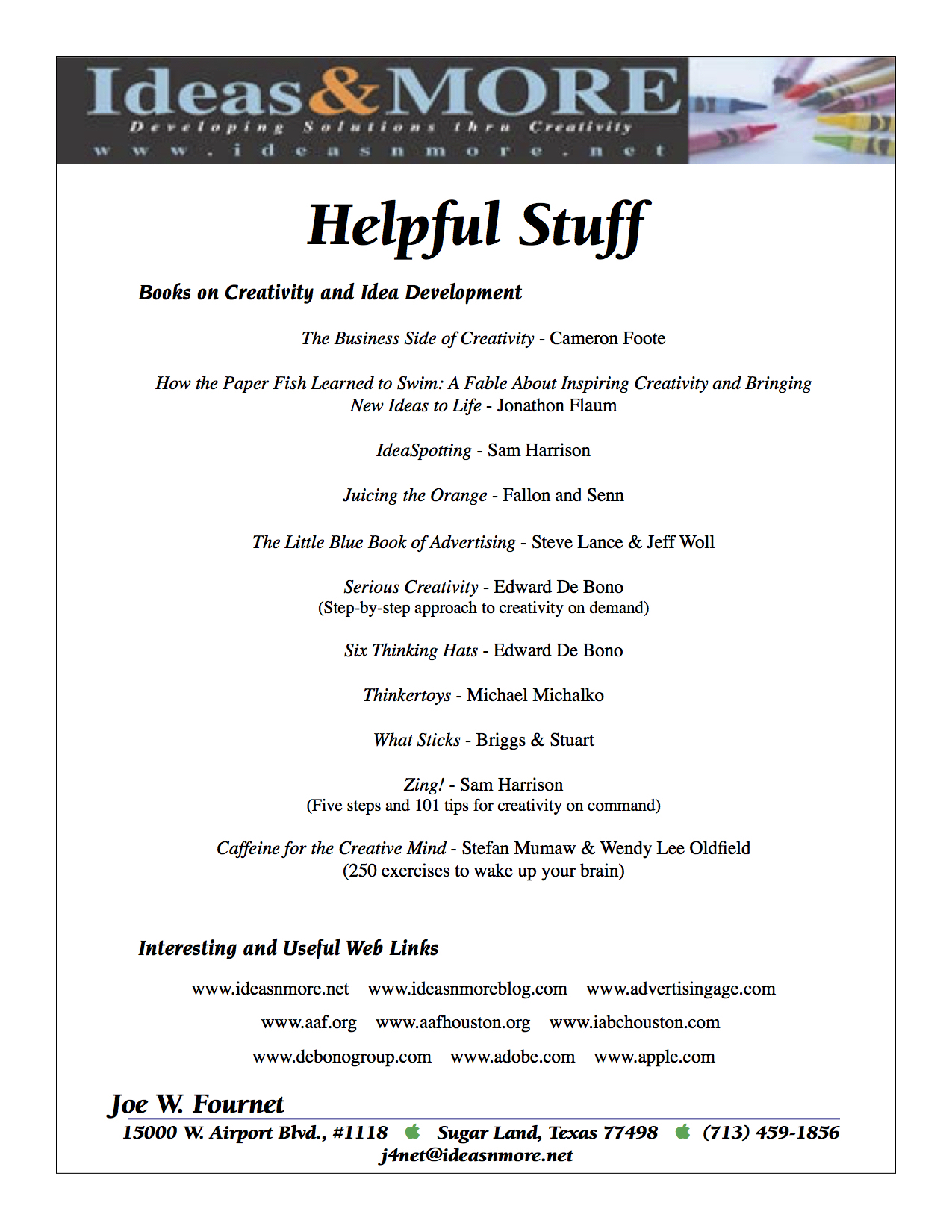
And, check out creative selections from ideasnmore.net.

Jolan tru!


It’s that time of the month again . . .

. . . when we see and read what others have said that made an impact. May these quotes bring about an impact for you as well. Enjoy!


All of us who professionally use the mass media are the shapers of society. We can vulgarize that society. We can brutalize it. Or we can help lift it onto a higher level.William Bernbach, member, Advertising Hall of Fame

The voyage of discovery is not in seeking new landscapes but in having new eyes.Thomas Alva Edison

Nothing comes merely by thinking about it.John Wanamaker, member, Advertising Hall of Fame

I would rather have a mind opened by wonder than one closed by belief. Gerry Spence

Ninety-nine percent of the failures come from people who have the habit of making excuses.George Washington Carver

Reading, conversation, environment, culture, heroes, mentors, nature—all are lottery tickets for creativity. Scratch away at them and you’ll find out how big a prize you’ve won.Twyla Tharp

Chaos is the only thing that honestly wants you to grow. The only friend who really helps you be creative.Dan Wieden, member Advertising Hall of Fame

What we are doing is satisfying the American public. That’s our job. I always say we have to give most of the people what they want most of the time. That’s what they expect from us.William Paley, member, Advertising Hall of Fame

Advertising is what you do when you can’t go see somebody. That’s all it is.Fairfax Cone, member, Advertising Hall of Fame

When a distinguished but elderly scientist states that something is possible, he is almost certainly right. When he states that something is impossible, he is very probably wrong.Arthur C. Clarke


Hopefully making a ruckus, one blog post at a time!

Be sure to check out my other blog, Joe’s Journey, for personal insights on life and its detours.

And, check out creative selections from ideasnmore.net.

Jolan tru!

Quotes – From Lee Clow’s Beard to Virginia Woolf

Leading off 2024 is this list of various quotes from those luminaries in and out of the advertising field. The quotes were selected by me from a variety of sources for the purposes of motivation, incitefullness and humor, among other things. Hope you get something out of them!


If you have a dream, don’t let anybody take it away. And you always believe that the impossible is always possible —Selena Quintanilla, singer-songwriter, businessperson, actor, fashion designer

Good advertising is written from one person to another. When it is aimed at millions, it rarely moves anyone. — Fairfax M. Cone, member, Advertising Hall of Fame

Good agencies understand advertising’s role within the four Ps. Great ones earn the right to influence the other three. — Lee Clow’s Beard

There is no such thing as ‘soft sell’ and ‘hard sell.’ There is only ‘smart sell’ and ‘stupid sell.’ — Charles H. Brower, member, Advertising Hall of Fame

Everything is reduced to facts and figures but the things that count. — George Gallup, member, Advertising Hall of Fame

Every area of trouble gives out a ray of hope, and the one unchangeable certainty is that nothing is certain or unchangeable. — John E. Kennedy, member, Advertising Hall of Fame

Meetings are all too often the burial grounds of great ideas. — Keith Reinhard, member, Advertising Hall of Fame

Creativity is no longer about grabbing attention or raising consumer awareness. Its goal is to remind consumers about what is fundamental and gratifying about a brand. — Peter A. Georgescu, member, Advertising Hall of Fame

Security is mostly a superstition… Life is either a daring adventure, or nothing. – Helen Keller

SO LONG AS YOU WRITE WHAT YOU WISH TO WRITE, THAT IS ALL THAT MATTERS; AND WHETHER IT MATTERS FOR AGES OR ONLY FOR HOURS, NOBODY CAN SAY. — VIRGINIA WOOLF


Hopefully making a ruckus, one blog post at a time!

Be sure to check out my other blog, Joe’s Journey, for personal insights on life and its detours.
And, check out creative selections from my website.

Jolan tru!

At the Intersection of Curiosity and Creativity

Seems like I’ve run across a number of articles over the past month or so dealing with a variety of topics in the realm of creativity. This posting is no different, and, yet, it is, uh, different. While many may find it difficult to define what creativity is, many will no doubt have an easy time knowing about curiosity. While everyone is curious, not everyone sees themselves as creative. Well, maybe this post will alter your perspective.

An article I recently came across by Helge Tennø discusses what happens at the intersection of creativity and curiosity, and what doesn’t happen.

He states the reason we struggle to come up with original ideas is not for a lack of creativity but a lack of curiosity.

“Every year we go into the same room with the same information and the same questions .. what do you think happens? Every year we come out with the same ideas” — frustrated workshop facilitator.

Creativity is limited to what we already know, it is only the re-combination of available information and experience. Creativity is not magic, it doesn’t produce ideas out of thin air.

In addition, most competitors think the same way, because they use the same methods and the same questions to find the same insights.

Outperforming your competition is not as much about who is the most creative or who has the deepest data. It’s as much about who can see something nobody else can.

Currently the trend is to apply a lot of data to buy our way out of this problem. Hoping that the machine will magically see connections our human brains can’t.

But machines are only reflections of our own values, ideas and biases. If we are staring down one rabbit hole the machine will only help us dig deeper.

We should therefore redesign our creative workshops. From combining information into ideas, to exploring questions we need to ask and information we don’t have.

There is a simple way to unlock this behavior: just ask “what has to be true for x to be true”, where x is your strategy, an existing product, something you are already doing .. anything.

One of the most productive ways to learn something new is experimentation.

The purpose of an experiment is not to confirm that you are correct (sometimes it is), but it should most often be used to surprise you.

To help you learn something that you didn’t know two minutes prior.

And the way to do that is to reduce the cost of an experiment to almost zero (because if experiments are expensive the organization will more likely prioritize experiments confirming their existing knowledge).

The real measure of success is the number of experiments that can be crowded into 24 hours.” — Thomas Alva Edison

With cheap and fast experiments the company can explore hypotheses and assumptions they never tested before, learn new things, capture new insights, venture into new areas.

With their new learnings they can combine both information they never had before with questions they never asked before.

“Researchers suggest it is uncertainty, or when you think you know something then discover you don’t, that leads to curiosity and learning outcomes.” — Celeste Kidd, assistant professor of psychology at UC Berkeley.

In short:

We only know what we know, and we know very little. (But we know a lot more than we think we do.)

We need to shift our focus from creativity to insights and questions. And experimentation is a low hanging fruit and one of the fastest tracks we can use to get us there.

Recommended places to start your experimentation journey:

(4). Experimentation works, Stefan H. Thomke

(5). How managers can build a culture of experimentation, Frank V. Cespedes and Neil Hoyne

(6). Why Business Schools Need to Teach Experimentation, by Elizabeth R. Tenney, Elaine Costa, and Ruchi M. Watson

(7). Get Comfortable Breaking Your Product, Rik Higham


While I agree with most of what the author states, creativity should always embrace insights and questions. Creativity is not borne out of thin air but rather from the insights and experiences we have within us. Curiosity can definitely spur on creativity and vice versa.


Hopefully making a ruckus, one blog post at a time!

Be sure to check out my other blog, Joe’s Journey, for personal insights on life and its detours.

And, check out creative selections from my website.

Jolan tru!

From Rod Serling to Frank Lloyd Wright

Here they are again, quotes for November this time. As usual they represent a variety of viewpoints from various folks, some better known than others. Enjoy!


The writer’s role is to menace the public’s conscience. He must have a position, a point of view. He must see the arts as a vehicle of social criticism and he must focus on the issues of his time. — Rod Serling

Nothing splendid has ever been achieved except by those who dared believe that something inside of them was superior to circumstance. — Bruce Barton, member, Advertising Hall of Fame

Advertising promotes that divine discontent which makes people strive to improve their economic status. — Ralph Starr Butler, member, Advertising Hall of Fame

Brands that keep us invisible to appease anti-LGBTQ activists … are missing a future generation of consumers and employees who demand that brands include LGBTQ people and other diverse communities in authentic and organic ways. — Sarah Kate Ellis, GLAAD’s president and CEO, as quoted by MediaPost Communications

It is easier to tone down a wild idea than to think up a new one. — Alex Osborne, member, Advertising Hall of Fame

Violence does not spring from a vacuum. It’s born out of other men’s violence. It gets nurtured and it grows in a soil of prejudice and of hate and of bigotry. ~Rod Serling

Fun without sell gets nowhere, but sell without fun tends to become obnoxious. — Leo Burnett, member, Advertising Hall of Fame

An important idea not communicated persuasively is like having no idea at all. — William Bernbach, member, Advertising Hall of Fame

When we are too timid to risk failure, we reduce the opportunities to succeed. And we eliminate the chance to learn. — Keith Reinhard, member, Advertising Hall of Fame

An idea is salvation by imagination. – Frank Lloyd Wright


Hopefully making a ruckus, one blog post at a time!

Be sure to check out my other blog, Joe’s Journey, for personal insights on life and its detours.

And, check out creative selections from my website.

Jolan tru!

“Weirder, more human, less serious”

As the creative community still grapples with how best to get their collective hands around AI, a group of creatives interviewed by Chelsea Pippin of Creative Boom, one of the UK’s leading platforms dedicated to the creative industries, give their vision for creativity’s future. I think it pertinent and interesting enough to share with you.


AI is here to stay, but the future of creativity still depends on human ingenuity

Advances in AI are unsurprisingly top of mind for most creatives trying to imagine the future of their work. They seem to agree that the next five years will be about finding ways to make AI work in service of human creativity.

Lawrence Jones, creative director for Framestore, anticipates we’ll see “greater integration of AI and machine learning in the creative process, helping artists and designers to automate routine tasks, freeing them up to accelerate the generation of new ideas.

Found Studio’s Clayton Welham agreed, suggesting that discovering the nuance of AI-creative partnership will be a major theme in the working lives of artists and designers in the coming years. Welham told Creative Boom: “With all the talk of automation, AI assistance, and tools that cut corners and make us more efficient on a day-to-day basis – I think it’s important that we continually reflect on the fundamentals of our practice and our industry. We have to embrace the new, but I feel strongly that we have to do so with our own ideas in hand and with respect for the craft aspect of our work. It will ensure any advancements remain rich, surprising and engaging and avoid becoming formulaic, predictable and machine-made.”

David Sedgwick, meanwhile, remains wary but ultimately cautiously optimistic about what AI can do in the right hands – or when partnered with the right brain. He said: “I just hope that there’s still room for ideas and concepts and that the role of AI doesn’t leave us all totally redundant. As things currently stand, I still feel we have a big role to play in the way we use AI in our jobs, and we mustn’t confuse AI as a tool to help us work better or quicker with the best tool we will always have, which is our brain.”

Ben Tallon
Ben Tallon

Creatives also need to stay on top of, and curious about, other tech advancements

Framestore’s Lawrence Jones is also betting on other technological innovations playing a crucial role in the evolving roles of creative professionals. He told Creative Boom that he expects the next few years will bring about “advancements in 3D printing technology enabling artists and designers to inexpensively create more complex and intricate designs, sculptures, and products.”

Beyond that, Jones is also keenly following the “invention and use of new types of input devices like neural interfaces and brain-computer interfaces in creating art forms such as motion design and VFX, allowing artists to create works that reflect their thoughts and emotions.”

Continue reading