The subject matter may vary. The speaker may vary. The quote may still be memorable no matter who says it. Keep that in mind when reciting any one of the quotes below. It will make for a memorable occasion.
Advertising becomes a dialogue that becomes an invitation to a relationship. — Lester Wunderman, member, Advertising Hall of Fame
Thinking about ourselves isn’t related to knowing ourselves. — Lauren Esposito, arachnologist, co-founder of 500 Queer Scientists
Nothing comes merely by thinking about it. — John Wanamaker, member, Advertising Hall of Fame
Regardless of the moral issue, dishonesty in advertising has proved very unprofitable. — Leo Burnett, member, Advertising Hall of Fame
Attract attention, maintain interest, create desire and get action. — E. Elmo St. Lewis, member, Advertising Hall of Fame
Rules are for people who don’t know what to do. — Keith Reinhard, member, Advertising Hall of Fame
I don’t like closed doors. Creativity flourishes best in an environment of open doors and open minds. — Keith Reinhard, member, Advertising Hall of Fame
Advertising is what you do when you can’t go see somebody. That’s all it is. — Fairfax Cone, member, Advertising Hall of Fame
Hopefully making a ruckus, one blog post at a time!
Be sure to check out my other blog, Joe’s Journey, for a different kind of playground for creativity, innovation and inspiring stuff.
Usually every week I come across an article or narrative on creativity, its many facets and how better to utilize one’s own creativity. Such is the case this week.
One of the subscriptions I maintain (zero cost, but there is an option for minimal cost) is with Medium. I’ve even posted some of my writings on the site.
This week I came across a posting having to do with noise and the role it plays in creativity. It was written by Donald Rattner, Architect, and since it has some very interesting points, I’d like to share it with you. . .
. . .Maybe it was inevitable, but after years of touting the virtues of the open workspace, people who plan and use them appear to be having second thoughts about its effectiveness. Among the biggest drivers behind the mounting backlash are complaints about noise, especially in the form of overheard conversations, ringing phones, and clattering machines.
But before you jump on the “silence is golden” bandwagon, it might be worth taking a step back to assess the problem with a cooler, more objective eye, especially if you spend some part of your day in creative problem solving. The reason? A modicum of noise has been found to boost idea generation, rather than interfere with it.
Noises Off or Noises On?
Credit a team of researchers drawn from several different universities for daring to challenge status quo thinking.
In 2012, the trio published a paper documenting a series of lab experiments they ran to study the effect of noise on creative task performance. Their methods were pretty straightforward: Subjects performed various exercises designed to measure ideational fluency and open-mindedness while a soundtrack played in the background.
The track played at either a low (50 decibels), middle (70db), or high volume (85db). A fourth group performed the same exercises without any accompanying soundtrack to establish a baseline from which to measure the collected results.
Contrary to expectation, the people in the quiet sessions did not achieve the top scores. That honor went to subjects exposed to midlevel noise (70db).
Illustration: The author
As a point of reference, 70db is the rough equivalent of the din at a bustling restaurant or coffee shop. It also approximates the loudness of a running shower, which is probably one reason why we so often get good ideas while under the spigot.
It’s evident from the data that the right type and level of noise can literally change the way our creative minds work. But how? And why? And how do we harness this information to boost our creative output in real-world settings?
Guilford’s Model of Creative Thinking
A model of creative thinking first developed in the 1950s might be the most effective vehicle for providing answers to these questions.
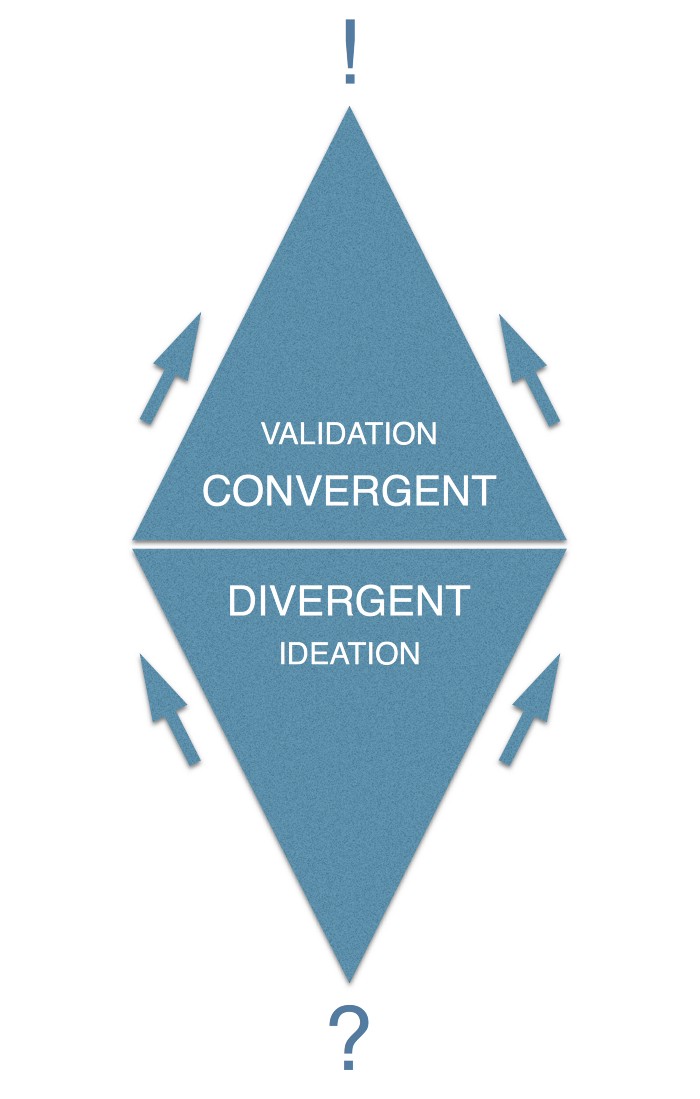
The model was the brainchild of the psychologist J.P. Guilford, an important figure in the history of modern creativity studies. Its basic premise is that creative thinking comprises two styles of cognitive processing: divergent andconvergent.
Divergent thinking corresponds to what we variously call right-brain or generative thinking. It is generally abstract, big-picture, intuitive, nonlinear, and inward-focused in nature. It induces us to see things as they could be, rather than as they are.
Convergent thinking is nearly the mirror opposite. Unlike divergent thinking, it is rational, objective, sequential, narrowly focused, highly detailed, and concrete in character. It looks outward rather than inward for answers, such as when we apply the external laws of mathematics to calculate the sum of two plus two, instead of drawing from our imagination.
For Guilford, the creative process is neither one nor the other alone, but both styles working in tandem, and nominally in sequence.
Illustration: The author
As a linear progression, Guilford’s model translates into a five-stage process composed of the following phases:
Definition of the problem to be solved: (?).
A period of divergent thinking, during which you open up your mind to as many ideas for potential solutions as time, budget, energy, or creative capability allow. Brainstorming is a technique for inducing divergent thinking.
A point of inflection where divergency ceases and convergency begins.
A period of convergent thinking, during which you narrow down your options to zero in on a potential solution, which is then tested and validated.
Realization of a final solution: (!).
In real life, of course, the creative process rarely travels in an uninterrupted straight-line trajectory from (?) to (!). More often than not, you find yourself going backwards one or more steps before getting to your goal — if you reach it at all.
But as a conceptual model, Guilford’s paradigm gives a pretty accurate picture of how our minds work in the course of working out feasible solutions to creative problems.
It comes around only once a year. However, research and breakthroughs take place 24/7/365. Tomorrow, February 4, is World Cancer Day and as a survivor I thought it best to interrupt my weekly creativity posts with this special alert.
Those of you currently battling cancer or know of someone who has cancer, this info is for you. Dealing with cancer is traumatic and expensive or it can be. Seek out a clinical trial and a non-profit foundation for support and assistance. Your oncologist and the social services department of the hospital can be of tremendous help.
World Cancer Day held every 4 February is the global uniting initiative led by the Union for International Cancer Control (UICC). By raising worldwide awareness, improving education and catalysing personal, collective and government action, we are all working together to reimagine a world where millions of preventable cancer deaths are saved and access to life-saving cancer treatment and care is equitable for all – no matter who you are or where you live.
So this year’s World Cancer Day’s theme, “Close the Care Gap”, is all about raising awareness of this equity gap that affects almost everyone, in high as well as low- and middle-income countries, and is costing lives.
Hopefully making a ruckus, one blog post at a time!
Be sure to check out my other blog, Joe’s Journey, for a different kind of playground for creativity, innovation and inspiring stuff.
A lot of people have, over time, written about creativity. They’ve tried to define it, rationalize it and better understand it. There are opinions galore. The article I reference in this post offers another perspective on the subject of creativity in the here and now.
Creativity can be wonderful in its use and experience. Everyone enjoys that potential even if they don’t recognize it as one of their assets. It can also be quite frustrating during its process. Just think of giving birth to an original idea. Then developing that idea into something useful and meaningful. That can be rough sledding. It can also be a helluva lot of fun!
In so far as the state of creativity in the 21st Century, I ran across an article posted on Medium.com that addresses this subject. It’s quite interesting and I want to share it with you. See link below.
In his discussion, the author elaborates on three traits he feels are essential to develop a creative process that works for us and the people we serve:
Harnessing Flexibility is a Prerequisite
Seeking Collective Confidence and Collaboration
Having Empathy is the Key
Also, here’s a video clip from the late Sir Ken Robinson who was an expert on various aspects of creativity, especially how best to apply it in education.
Here’s a sample of select quotes from some of the great minds in advertising and education.
The arts, sciences, humanities, physical education, languages and maths all have equal and central contributions to make to a student’s education. – Ken Robinson
You can be creative in anything – in math, science, engineering, philosophy – as much as you can in music or in painting or in dance. – Ken Robinson
Whether or not you discover your talents and passions is partly a matter of opportunity. If you’ve never been sailing, or picked up an instrument, or tried to teach or to write fiction, how would you know if you had a talent for these things? – Ken Robinson
You can’t be a creative thinker if you’re not stimulating your mind, just as you can’t be an Olympic athlete if you don’t train regularly.– Ken Robinson
Every area of trouble gives out a ray of hope, and the one unchangeable certainty is that nothing is certain or unchangeable. -John E. Kennedy, member, Advertising Hall of Fame
Brand value is very much like an onion. It has layers and a core. The core is the user who will stick with you until the very end. – Edwin Artzt, member, Advertising Hall of Fame
When you are through changing, you are through. – Bruce Barton, member, Advertising Hall of Fame
If you can’t turn yourself into your customer, you probably shouldn’t be in the ad writing business at all. – Leo Burnett, member, Advertising Hall of Fame
Creativity is no longer about grabbing attention or raising consumer awareness. Its goal is to remind consumers about what is fundamental and gratifying about a brand. – Peter A. Georgescu, member, Advertising Hall of Fame
We pay just as dearly for our triumphs as we do for our defeats. Go ahead and fail. But fail with wit, fail with grace, fail with style. A mediocre failure is as insufferable as a mediocre success. – Bruce Barton, member, Advertising Hall of Fame
Research shows that creatives are faced with fewer resources and greater demand. They helped their businesses pivot to remote work last year by improving productivity and learning new technical skills. Further, and in contrast to the trend of bringing design talent and work in-house for the past several years, in-house creative teams are more inclined to partner with outside creative agencies and freelancers.
That’s according to key findings in a new report based on a survey of 400 creatives and marketers. The fourth annual Creative Management Report by inMotionNow and InSource, a professional association for creatives, identified industry changes stemming from the pandemic, along with creative trends to watch over the next year.
These findings demonstrate just how much creative teams have evolved. More importantly, it underscores why marketing and business leaders have become increasingly reliant on creatives for that vital Design Thinking, a process that starts with user insights, challenges assumptions and redefines problems, not just for design and deliverables.
Below are three takeaways for marketing leaders.
1. Providing Strategic Value Is Now Table Stakes for Creative Teams — Balanced with Speed, Resource and Volume Constraints
The study identified the top three challenges facing creatives as follows:
The speed at which they are expected to work (73%)
Too few resources to accomplish the work (61%)
High demand for more creative content (59%)
While those are all familiar challenges to most creatives, what they did not identify as a top challenge is of equal interest: Respondents didn’t identify “being seen as a strategic contributor” as among the top three—for the first time in the four-year history of the survey.
“We have a seat at the strategic table, but that’s because we’ve earned it and we continue to earn it every day and raise the bar on what we can contribute,” said Hank Lucas, head of creative services at global life sciences organization MilliporeSigma.
Lucas was one of five outside experts who contributed written analysis about the survey’s findings to the report.
“We’re not just here to make some pretty stuff,” he said. “Tell us what you’re trying to achieve and let us help you move the needle.”
2. Creative Problem-Solving and Adaptability Were Crucial to Remote Work
In subsequent questions, respondents were more precise about the specific resource constraints presented as the pandemic unfolded. While 58% said their workloads had increased, about one-third said their teams experienced layoffs and furloughs. In addition, another 31% faced budget cuts which eliminated some of the technology tools that facilitate the creative process.
Despite the adversity, creatives rose to the occasion and brought their problem-solving talents and adaptability to bear. Most creatives (57%) claimed they “became more productive” despite cuts to budget and staff. Another two-thirds of respondents learned new skills such as video, livestreaming and podcasting, all of which proved pivotal to business continuity during remote work.
The resource constraints may have also prompted creative and marketing leaders to rethink the in-housing trend—that is, bringing design talent and work in-house rather than using external agencies—that’s unfolded in recent years.
While in-house creative teams still manage much of the work, the majority (86%) reported that they currently partner with agencies and freelancers. Further, in 2021 about one-third of teams are planning to increase the work they send to outside resources. This creates new opportunities and demands for tools and processes for collaboration.
When prompted why they hire outside agencies, respondents stated that their top reason was in order to access specialized skills (64%). Subsequent responses were a need for increased capacity (44%), assistance with strategy development (24%) and quicker completion of work (20%).
“The beauty of working with freelancers is that you don’t have to go through this whole hiring and onboarding process,” says April Koenig, founder and CEO of Creatives on Call. “You can find people who have the targeted skill sets that you need and get them in and get the work done quickly.”
She notes that approach may also help with fatigue and burnout, which have become critical leadership issues over the past 12 months. “This really helps alleviate some of the physical and emotional pressure that teams face when the organization is so reliant on them,” she says.
New Year’s has a lot of tradition surrounding it. Champagne and toasts are usually at the top of the list, right alongside resolutions. It takes a certain amount of creativity to come up with a toast, so when I came upon this toast the other day I thought it somewhat appropriate to share. I couldn’t help it, given that I’m from the Bayou State of Louisiana.
Enjoy! Cheers!
Hopefully making a ruckus, one blog post at a time!
Be sure to check out my other blog,Joe’s Journey, for personal insights on life and its detours.
4 Ways Play Gets You Out of a Brain Rut, and Helps One Deal with a Crisis.
The human brain can get stuck in a rut thanks to neural pathways and a fondness for the familiar. So how can you free your brain and lead it on a path to innovation? Based on research and real-life examples from great minds, here are four ways Play can get you out of a brain rut:
1. Cross Train Your Brain
Each cross-training activity works a different, but complementary, part of the body that will help get you stronger in the overall event, task or project. In other words, if you’re a novelist, try your hand at poetry. If you’re a painter, dabble in sculpting. If you’re a computer scientist, play around with web design. For instance, how did playing violin help Einstein theorize about matter and energy?
A study from UC Irvine and the University of Wisconsin found that giving piano lessons to preschoolers significantly improved their spatial-temporal reasoning— a key skill needed for math and science—much more than giving computer lessons, singing lessons, or no lessons at all. So try a new activity within your field or related to it; you’ll expand your neural connections and strengthen your brain overall.
2. Take a Shower, Go for a Walk or Do Some Other Mundane Activity
First, creativity and relaxation could be linked. I’ve found that whenever I’m really tired, my creativity just hits a wall. Trying to go on is fruitless. Wrap it up and go to bed or walk away from whatever it is you’re working on and come back to it in several hours or the next day. Depending on when you’re doing this, try something boring, like showering or taking a walk (though some folks would argue that this exercise is not boring) or go for a swim. These tasks don’t require substantial cognitive effort, so our brains are free to wander. And contrary to popular belief, a brain “at rest” isn’t really resting at all.
Second, distractions may boost creativity. Research by Harvard professor Shelley Carson found that high creative achievement was associated with low latent inhibition, or the capacity to screen out irrelevant information, especially if the participants had a high IQ. For the creative mind, inspiration can be found everywhere. Sometimes, you just need to distract yourself long enough to notice it. Continue reading →
How would a “productive day” compare to a “creative day”? What would, if anything, they have in common? Chances are not much. One might think a productive day would be closely aligned with scratching off items on a to-do list. On the other hand, someone’s idea of a creative day might not even have a to-do list.
Our current work world is obsessed with productivity. We are inundated with books, articles, white papers, to time block this and time block that; all just to do more work. But our relentless quest to be productive is undermining one of the most important abilities in today’s workplace: creativity.
What of the future, though? Will machine learning and artificial intelligence perform the routine aspects of our work at the expense of our ingenuity and creativity? So how do we create the right conditions for creativity, particularly when we are trying to deal with a to-do list?
Consider this comment from screenwriter Aaron Sorkin (the mastermind behind the television show West Wing and films like Moneyball and The Social Network). He told The Hollywood Reporter that he takes six showers a day. “I’m not a germaphobe,” he explains but when his writing isn’t going well, he’ll shower, change into new clothes, and start again.
Sorkin’s trade relies on him minting something fresh on a regular basis. And it occurred to him that his best thoughts were not happening in moments of fevered concentration, but when he was in the shower. So he had a shower installed in the corner of his office and makes regular use of it. He has described the process as “a do-over” for triggering original ideas.
In 1939, James Webb Young, a Madison Avenue advertising executive, wrote a definitive guide to the process of creativity, A Technique for Producing Ideas. In this short book, Webb Young reminds us, “that an idea is nothing more nor less than a new combination of old elements.” In his view, the skill of creativity is the ability to spot new connections between familiar thoughts, and the art is “the ability to see [new] relationships.”
Fifty years later, Steve Jobs observed something similar: “Creativity is just connecting things. When you ask creative people how they did something, they feel a little guilty because they didn’t really do it, they just saw something. It seemed obvious to them after a while. That’s because they were able to connect experiences they’ve had and synthesize new things.” Webb Young also lays out a remarkably simple technique for creative thought. It involves stimulation. Continue reading →







 ideasnmoreblog