Creativity as a Problem Solver

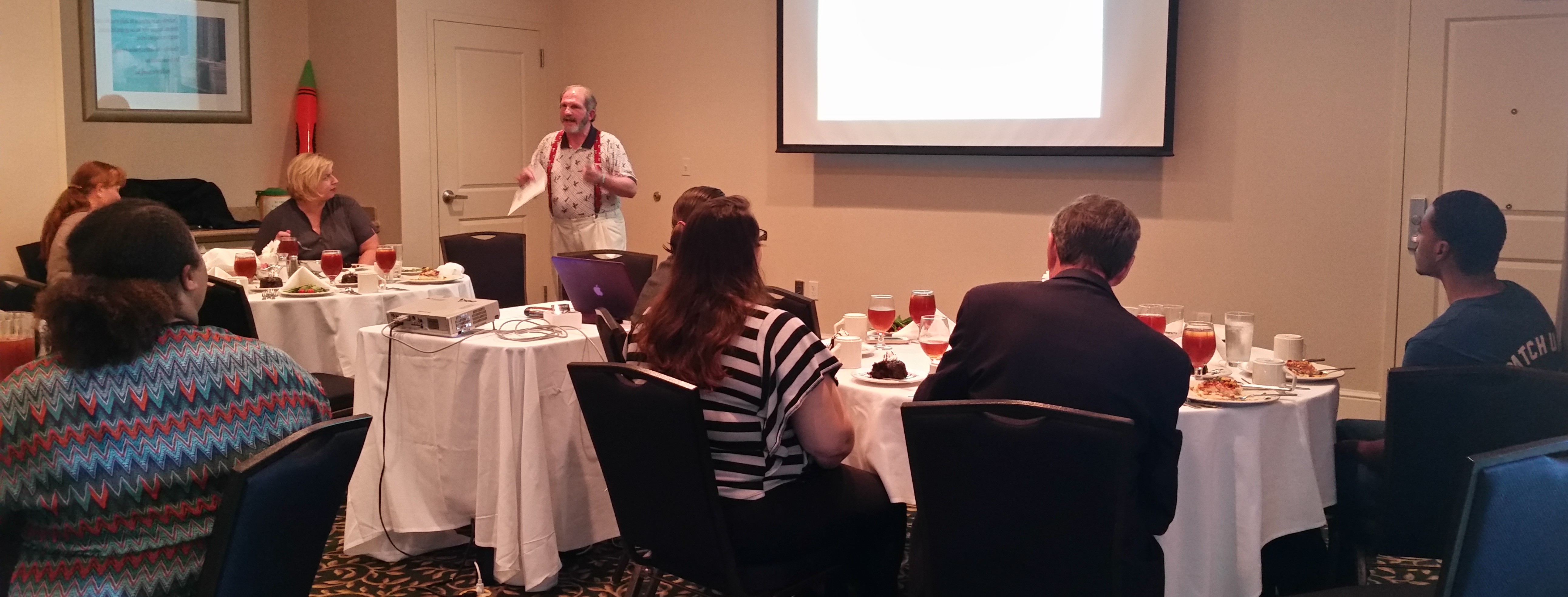
During my recent presentation on creativity and creative thinking to the AAF Rio Grande Valley, I referenced using creativity to help solve problems. No matter how cutesy an ad looks or what kind of special effects one uses, if a problem does not get closer to being solved, the process is not doing any good.

The following video is one I suggested that interestingly addresses how creativity helps solve problems. It’s an excerpt from this year’s Aspen Ideas Festival, where a group of people who work in media, design, and the arts were asked about how the creative process can lend itself to unlocking solutions.


Kick Starting Creativity in the Rio Grande

I recently had the honor and pleasure to present “Kick Starting Creativity Without Screwing Up the Idea” to the American Advertising Federation Rio Grande Valley. As with my other presentations in this series, I did some fine-tuning with this version.

I was last in the Valley before this same group back in 2008. The landscape and development may have changed (more of it) but the people have not – still friendly, wonderful, courteous . . . and, of course, creative!

Those of you who were in the audience can, hopefully, enjoy it again and get some useful tips. Those of you who did not experience it that day, may learn a few things. Naturally, what follows is just the visual and not, unfortunately, the experience itself.

Kick-Starting Creativity Without Screwing Up the Idea

Keynote version (no audio)

PDF version (no audio)


Kick Starting Creativity: A Presentation to AAF – Central Texas

Last Friday, August 7, 2015, I had the pleasure of speaking at the professional development luncheon of the American Advertising Federation of Central Texas in Temple, Texas. My topic was a fun one to present, “Kick Starting Creativity: Ye Olde Creativity Survival Kit.”

Joe Fournet stresses a point in his Kick Starting Creativity presentation at American Advertising Federation of Central Texas.

I had presented a similar talk several years ago for both a chapter luncheon and a Creative Summit hosted by AAF Central Texas. Friday’s presentation was updated and included new items.

Although the audience was primarily made up of advertising and marketing professionals, “Kick Starting Creativity” centered on the way one thinks and applies one’s imagination. Thus, anyone can put these tips and techniques into practice. I like to say that we’re all creative; we just have different perspectives in how we apply our creativity.

“Kick Starting” was done in Keynote but the size of the file prevents me from uploading it here. I’ve included a PowerPoint version on SlideShare as another option. Here are three handouts referenced in the presentation along with the presentation itself, all in PDF:

Top Tips- Rev

HelpfulStuff – Rev

39 Ways to Kick-Start Creativity copy

Kick Starting Creativity – AAF Central Texas

Kick Starting Creativity – AAF Central Texas (PPT)

Could This Be the “iYacht”?

New Photos of Steve Jobs’ Yacht

American Luxury Magazine (from which you can view additional photos) recently sent out an e-newsletter featuring a variety of super-luxurious items. Among them was a select group of photographs featuring Steve Jobs’ yacht. Yet again, creativity and innovation done the Apple way.

A 256-foot yacht designed for the late Steve Jobs was captured in numerous photographs as it sailed in to the British Virgin Islands.

Steve Jobs Yacht

The yacht, called Venus, was designed by Philippe Starck. Jobs reportedly commissioned the building of the yacht after sailing on his friend Larry Ellison’s Yacht. The yacht was not finished until 2012, nearly a full year after Jobs’ passing.

The yacht has six bedrooms and features high-tech automation systems. The exterior is crafted from aluminum and steel and looks strikingly similar to an Apple product.

The yacht is now owned by Jobs’ widow Laurene Powell Jobs.

(Photo credit: Beth Colt, photographer and owner of Woods Hole Inn, @woodsholeinn on Instagram) 

So How Did They Make that Penguin so Realistic?

Okay, I admit it. I was captivated by the John Lewis Christmas commercial and wondered, “How’d they do that?!”

Creativity went behind the scenes to find out. I’m glad they did.

Love it or hate it, John Lewis’s Monty the Penguin holiday ad is an unstoppable seasonal juggernaut, with YouTube views now exceeding 17 million. One of the reasons for the appeal of the U.K. retailer’s ad is its realistic depiction of an Adelie penguin, created completely in CGI.

Behind the scenes of the making of Monty the Penguin

In this fascinating behind-the-scenes film from VFX house MPC, you can find out exactly how Monty was dreamed up, created and rendered. It’s full of interesting nuggets — for instance, Monty picks up the Lego bricks the way that real penguins pick up fish — as well as providing an insight into the film’s production, casting and more.


A Boy and His Penguin: Different Slant on Holiday Ads

When it comes to holiday TV ads, very few here in America have the emotional ring  to them compared to those in the U.K. Creativity magazine highlighted one such holiday ad and I thought it was appropriate to share on this blog.

According to Creativity, retailer John Lewis’ Christmas commercial — the most anticipated ad of the year in the U.K. calendar — is here, and you’d have to be a real Scrooge not to like it. It has all the elements of a winner: a wonderful child actor, a cute animal (the kid’s pet Adelie penguin, brought to life in amazing CGI by MPC) and a heartwarming twist. It’s the music, though — a cover of John Lennon’s “Real Love” sung by John Odell — that gives it that extra touch that might make you keep the Kleenex close.

John Lewis' Christmas ad, a boy and his penguin

Like the department store chain’s previous much-lauded efforts “The Long Wait” and “The Snowman,” the ad, by Adam & Eve/DDB, was directed by Dougal Wilson.

John Lewis is also launching an in-store experience featuring Monty, the penguin from the ad, in partnership with Samsung. Kids will be able to see their own favorite toys animated in 3D using Microsoft scanning technology in “Monty’s Magical Toy Machine” and interact with the characters from the ad in a virtual world with “Monty’s Goggles,” using Google Cardboard, an experience created by Stinkdigital. They’ll also able to create their own Monty Christmas card, and of course there will be Monty-inspired merchandise.

New Yorker Cartoonist Offers Views on Creative Process

Matthew Diffee, whose cartoons you may have seen in The New Yorker and Texas Monthly, recently offered his views on idea generation and the creative process. He was in Houston presenting to the American Advertising Federation.

Matthew Diffee promo ad

Matthew, not unlike a lot of us in a creative industry, has a quirky sense of humor and sees things (or at least thinks about them) from a different perspective. This helps in generating ideas.

One of the first things he believes in is to make it easy to “do ideas.” If you’re a coffee drinker, make sure you’ve got a fresh pot to start things off.

Second, or at least this is what I jotted down as second, is a list of five verbs that he uses when he reviews his ideas: Add, Subtract, Switch, Invert, Mash up. These may lead to some sort of visual and/or a caption for the visual. The interplay between words and pictures can be fun!

An example he gave of taking a traditional question oft times used in job interviews, “Where do you see yourself in five years?,” and, instead, coming up with “Where do you see yourself in ten minutes?”. Try that in your next interview.

The best thing one can do is to maintain momentum – keep going in your process. I’ve learned from experience that stopping and starting does no good. You really have to get into some sort of flow.

Another one of his takes on a traditional phrase goes like this: “A penny saved is a penny who has accepted Jesus Christ as its Lord and Savior.” I know, I know, not everyone will find this humorous. I guess it depends on one’s sense of humor. 😉

Other elements and observations from of his creative process:

The Zone – easy to start, hard to stop. We’ve all found our “zone” before. Once you’re in it, don’t let up until you’ve got what you set out to get.

Flip Funnel – large end to finely tuned. Seeing an idea in a broad sense and developing it to a specific angle or perspective. Going from concept to a single cartoon cell in Matthew’s case.

Generating Ideas – quantity over quality. You can sort through these later. You need ideas and lots of them. Never critique when generating ideas.

Can’t make a great idea just by working harder – inspiration hits like a turd. Though somewhat crudely put, his thought is true. We can’t plan to have a great idea by a certain time. It’s not like we have an On/Off switch. We may take five minutes or two days.

Dull Bulbs – assume your work could be better. Don’t let your ego get in the way. No matter how wonderful we may think our idea is, there’s something about it that can be improved.

So whether you’re a budding cartoonist, experienced writer or designer or someone who needs to come up with a bunch of ideas for the next mode of transport to Mars and beyond, some of these techniques may help.

And when you review what’s been discarded at week’s end, don’t throw them away. Who knows what other uses may be made of them.

What has Matthew done with all his ideas which have been rejected? He’s made them into a book, an archive of sorts, entitled “The Cream of the Crap.”

 

Creativity and Fear: Seth’s Take

Last month I posted a blog on creativity and fear. Interestingly, two days following my posting Seth Godin posted this:

 “How do I get rid of the fear?”

Alas, this is the wrong question.

The only way to get rid of the fear is to stop doing things that might not work, to stop putting yourself out there, to stop doing work that matters.

No, the right question is, “How do I dance with the fear?”

Fear is not the enemy. Paralysis is the enemy.

* * * * * * * *

I’m a follower of Seth’s and subscribe to is blog (linked above). There are times, however, when I wish he’d get into more detail or provide more insight about his points. This is one of those times.

In his brief post referenced above, he’s right. Paralysis is our enemy. We can do nothing when it envelopes us. We have to meet it head on and that can be scary. How do we do that? Well . . .

My earlier posting of “13 ways to deal with fear” also touches on the paralysis factor. We need to do something to jar ourselves out of this newly immobilized state.

When Seth states that paralysis is the enemy, how would one deal with one’s enemy. You can’t ignore him (the enemy), but you could go in another direction to get around him. You’ve faced him before and you’ll face him again. How each of us reacts depends on us. There is no one solution or antidote.

What do you think? How have you dealt with paralysis?

Creativity: Not Your Typical Loaf of Bread

As Rodney Dangerfield would say, “I don’t get no respect.” Creativity is like that, as are, for the most part, the artisans and thinkers who practice it everyday.

Creativity is not a commodity, like a loaf of bread or a carton of milk. Those items are commodities.

But what if that bread was a special blend of pumpkin, barley, cranberry and wheat? It would still be a loaf of bread but the process of blending different ingredients to make the loaf atypical (and still tasty) is creative. A lot more than just adding ingredients goes into making this special bread loaf. The baker has to know what he or she is doing, what may work and what may not. It’s a process, and a creative one.

Do they teach that in culinary school?

Thanks to iStockPhoto

Thanks to iStockPhoto

The art of creativity is a disruption to the normal way of thinking. As a society, we need to be more disruptive, more open to solving problems while exploring opportunities. In being creative, one doesn’t accept the status quo; one wants to change and improve upon it.

This frightens some folks. They don’t like change, and don’t have a great deal of respect for those who do. They don’t understand the creative mind or the process. They merely view it as a commodity.

How do we change that? Maybe we don’t. We can educate and explain, and that will help, but we need to do that with the right audience – folks who are at least open to dialogue, are curious. They may even ask “Well, instead of pumpkin and cranberry, what about pineapple and mango blending with the barley and wheat?”

Hmmmm, a showing of respect for the process?

Who knows, if they’re really daring, they may consider introducing a new line of baked breads. Heaven forbid that the consumers get another choice!

This creative thinking is a disruption to the status quo. This won’t set well with those who don’t want the status quo changed.

Respect for those of us who do? Forget it!

Yet, creative ideas for the most part have flourished over the years. Along with this, various media have caused a different type of playing field to be formed with creativity serving up some new and different rules.

Creative options equal what-ifs. Commodities don’t care about what-ifs.

Creativity lends itself to storytelling. Commodities don’t (I suppose they can but it would be rather challenging). Creativity allows for storytelling to be transformed into Web, mobile, social, broadcast, print, wherever.  There’s a disruption in the creative process, and the art of storytelling is leading the way.

You can’t do that with a commodity. Long live creativity. Long live disruption.


13 Ways to Handle Fear When It Attacks Creativity

We’ve all been there. We’re never quite sure what do to but we feel like we’ve gotta do something. NOW.

But we can’t. We can’t think other than in scattered ways. Incomplete. Disjointed. Frustration sets in. We feel stymied because our creativity has stopped flowing for whatever the reason.

Uh-oh, what’s that. A strange sound. It’s him! Fear comes a’knockin.

Thanks to iStockPhoto

Thanks to iStockPhoto

Fear, as in being afraid (what if the client hates my ideas), being scared (what if I can’t come up with any ideas), feeling intimidated (there’s always someone lurking in the shadows with better ideas).

Fear is also what you get when you sense F.E.A.R. – Failure to Execute Achievable Results – with the key word here being  “achievable.” The results need to be just that and not unattainable.


The three F” words: Fear, Failure, Fun

Up to now, we’ve referenced two of the three “F” words, fear and failure. The third one we don’t experience nearly enough. That would be fun.

As long as you have fear of failure, you’ll never have any fun!

Dealing with failure is easier than dealing with fear; not that dealing with failure is ever easy. It’s not. It’s embarrassing, even humiliating at times. But failure tends to be short­ lived, relatively speaking.

Society and corporate culture-wise, we talk much more about weaving failure into our systems, our processes. Sometimes it’s all talk and not nearly enough practice. Many successful and innovative companies build and accept failure as a natural way of doing business. More companies should but probably will not. They don’t seem to understand that in order to achieve success, failure is part of the journey.

Fear, on the other hand, can torment, destroy, self-inflict. It can absolutely kill creativity.

You’re angry (about a shortened, possibly unrealistic new deadline), depressed, distraught (you do not want to fail to execute anything). You may even be mystified as to why this happened to you.

Ever receive a phone call late on a Friday from an upset client telling you that new and much better creative needs to be on his desk by first thing Monday morning . . . or else (he doesn’t have to say “or else;” the intimidation suffices)? And nothing you can say will alter how he’s feeling at that point in time.

Hell’s bells, you didn’t have plans for the weekend anyway, didja?!

How do you deal with fear when it attacks creativity, especially when on a deadline (realistic or not)?

13 ways, in no special order, to handle fear when it comes a’callin:

–Walk away – change your surroundings, get into another room or leave for a bit

–Talk it out – if possible, share what’s going on with a colleague, friend or spouse

–Write it down – capture what you now know or understand needs to be done within the new timeline

–Pray – this may be first on some lists and as you’ll see, it’s on mine more than once

–Focus – look at your project from another perspective and focus on different portions of it, thus making it more manageable and doable

–Pray some more – you can never do this one too many times (but you still have to do the work)

–Get more focused – set  realistic parameters that allow you to work on specific aspects of the project without getting overwhelmed

–Think positively Amen! Repeat this step as often as needed

–Remember past good results – remind yourself that you’ve done this before; that’s why they hired you in the first place

–Acknowledge worry and anxiety – this one is tricky because you need to face what’s happening to you, acknowledge it, then move on

–Get to work – actually doing the work can be therapy in itself and when the thoughts start flowing, creativity will thrive

–Don’t give in to what-ifs – try to avoid thinking too much about that over which you have no control or you simply don’t yet know; this is wasted energy

–Pray for the others – I actually mean the clients (or whoever is giving you grief) who are putting you through this; remember, they may not know (or care) what they do

Fear is hardly ever dealt with, but is dished out way too easily and usually without a care. That’s unfortunate since fear is a dangerous and deadly poison to the creative mind and process.

Now, you may have your own way of dealing with fear. Whatever works! We can’t stop it from happening but we need to try our damndest from letting it totally shut us down.

I have fun when I’m head over heels in the creative process, and I try and remember that when fear comes a’knockin.

Come to think of it, I guess I could also change the locks!