This is one Whopper we pray will never find its way onto BK’s menu.

WARNING: If you’re squeamish, prepare yourself and, please, don’t throw up on your computer monitor!

burger-king-moldy-whopper-2020

        Burger King highlights “the beauty of no artificial preservatives” in its Moldy Whopper campaign.
Burger King

In a word, BLEAHHHHH!!!

Last week, according to Adweek, Burger King unveiled a global ad campaign  highlighting its commitment to dropping all artificial preservatives. Such campaigns, while laudable, come and go somewhat often without generating much more than passing interest.

This one is truly bizarre. It tests just how far Burger King can virtually thrust its product down its customers’ throats before they gag.

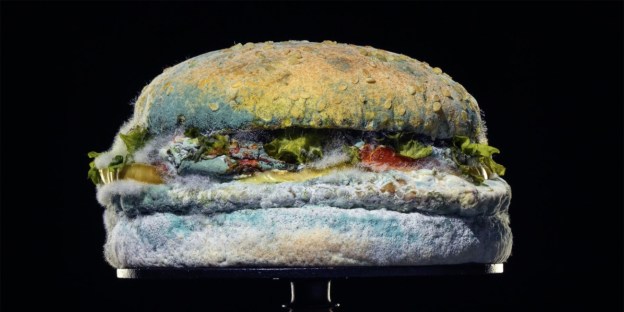
The Moldy Whopper campaign, created through a partnership between three agencies, features intriguingly high-resolution photography and video of a Whopper being consumed not by humans, but rather by the horribly incredible passage of time itself. In other words, we get to see a Whopper rotting. Lovely!

Adweek reports that each ad shows a Whopper whose ingredients are being engulfed in mold, alongside a date stamp letting you know how long the burger has been exposed to the elements (too long, but typically about a month). The tagline, are you ready for this, describes the images as “the beauty of no artificial preservatives.”

Is beauty really in the eye of the beholder?

The work promotes the brand’s pledge to drop all artificial preservatives, which it has accomplished across much of Europe and 400 locations in the United States. By the end of the year, Burger King says it will have removed artificial preservatives from Whoppers in all U.S. locations. That’s nice and laudable.

I’m still feeling nauseous.

“At Burger King, we believe that real food tastes better,” (no kidding) said Fernando Machado, CMO for Burger King parent company Restaurant Brands International. “That’s why we are working hard to remove preservatives, colors and flavors from artificial sources from the food we serve in all countries around the world.”

burger-king-moldy-whopper-outdoor-1-2020

Burger King

I’m sorry but this just looks gross! It’s certainly not appealing at all. I get what they’re trying to convey but I wonder if BK ever considered giving out Tums, Alka Seltzer or nausea tablets with their meals.

In addressing reality, Adweek posits that the mold campaign might be challenging to common sense, but it was also a difficult one to accomplish in terms of craft and required months to achieve.

“We are very proud of crafting this idea,” said Björn Ståhl, executive creative director for Ingo, one of three agencies involved. “Mold grows in a very inconsistent way. We had to work for several months, with different samples, to be able to showcase the beauty of something which is usually considered undesirable.”

” . . . the beauty of something undesirable.” Really? Sort of sounds like a contradiction in terms. I’m still feeling nauseous.

burger-king-moldy-whopper-outdoor-2-2020

Burger King

So how will it go over? According to Adweek’s reporting, in the short term, the likely answer is: not great. Head-scratching advertising tends to generate quite a bit of short-term negative publicity, usually thanks to morning talk shows and late-night monologues.

And some within advertising will call the work “awards bait,” knowing that juries at Cannes Lions and other awards festivals tend to swoon over concepts that challenge every seemingly obvious but unwritten rule of advertising, such as “Don’t make your food look like it will literally kill people.”

But in the process of sparking debate and consternation, the campaign is also likely to resonate across the industry and encourage other brands to take similar moves, knowing that the ideas will be easier to sell when something so “off the wall” (that’s one way to put it) has already been sold to a major global corporation.

burger-king-moldy-whopper-vertical-1-2020

Burger King

This campaign will indeed show something else:  How strong are BK’s customers’ stomachs? This is revolting no matter how “beautiful” the photography. Just because a global corporation has gone along with this hideous idea doesn’t make it one to copy. After all, how many global CEO’s have signed off on something that should never have come out of committee?

What will definitely be interesting to see will be the types of “toned down” ideas and executions coming forth that are based on the Moldy Whopper campaign.

In the meantime, BK needs to supply their restaurants with plenty of Tums and barf bags, just in case.


PS . . . Thanks to David Griner (@griner), creative and innovation editor at Adweek and host of Adweek’s podcast, “Yeah, That’s Probably an Ad” for source material for this blog.

And the Easter Bunny Went Hop. . .Hop. . . Fart. . .Hop Along the Way!

Easter’s coming and with it the crunch of candy selling. Most will be customary and traditional, with some even being kinda cute. Yet, customary and traditional are not exactly what this blog is about. Innovation and creativity, with a tip ‘o the hat to weirdness, is more in line with what we like to showcase.

This year I’ve come across a bit of untraditional marketing, via a Business Insider article, utilizing Mr. Bunny and his, uh, hopping. Yet, kids should get a kick (hop?) out of the Bunny’s candy while parents should get a bit of a chuckle out of the Bunny’s offering.

Both would agree it’s a bit silly, but so what?

What am I talking about? Why it’s Bunny Farts, that’s what. What are Bunny Farts, you ask? Well . . .

Bunny Farts

According to the description for the fruit punch-flavored pink cotton candy, the Easter Bunny consumes a “magically unique diet of apples, carrots and candy […] known to produce farts that are sugary and delicious.” Sorry, but that just sort of makes me grimace a bit.

Little Stinker, the maker of Bunny Farts, also sells products like “Unicorn Farts,” “Dinosaur Farts,” and “Reindeer Farts.” The company pledges to donate 10% of profits from each product — including those purchased on Amazon — to a specific cause.

This type of marketing, though, makes me wonder. What if the company approached the Charles Schultz Foundation (you know, Peanuts) to see about a tie-in with you-know-who for a possible product named Beagle Burps? However, the connotation here suggests that  the famous feline Garfield might be better suited for the promotion. Just a thought.

“We are proud to have donated over $130,000 to various charities since we began three years ago,” Little Stinker Vice President Melanie Simpson. told INSIDER via email. “Our mission is Making the World a Sweeter Place, one bag at a time.”

Sales of the Bag of Bunny Farts along with sales of the Bag of Unicorn Farts have benefited children through donations to the Unicorn Children’s Foundation, The Next Step Academy, Ovarian Cancer Connection and KultureCity.

You can buy a package on Amazon for $8.95, or on Little Stinker’s online store for $9.95.

More information on this and other Easter related and interesting news can be found at Business Insider.