In a world where everything can be personalized and optimized, there’s only one true differentiator left: ideas. (Adobe Stock)
AI will undoubtedly shrink the marketing services industry. Or so that’s the opinion of industry paper Ad Age via author Barry Lowenthal in a recent piece a few weeks back. Thought it worthwhile to share again especially to those of you who may not have seen it yet.
Many of the functions agencies are paid for today—targeting, media planning, asset versioning — are already being handled faster and cheaper by machines.
Yet the most successful agencies in 2030 won’t be those with the biggest AI budgets; they’ll be the ones still capable of original thought.
Since the explosion of generative AI, holding companies have raced to future-proof themselves, pouring hundreds of millions of dollars into the technology. They’ve hired engineers, signed vendor deals and built proprietary tools. The logic is that automation improves margins by enabling more work to be produced with less overhead, and it’s attractive to clients.
But here’s the problem: Everyone is doing the same thing.
AI platforms might look different, but they’re powered by the same foundation—similar models, trained on similar data, offering similar outputs.
AI is a great equalizer. While early investment and enterprise deals offer short-term advantages, the tools are ultimately accessible to all. As technology becomes commodified, there’s only one true differentiator left: ideas.
In a world where everything can be personalized and optimized—where every ad element, from celebrity to color palette to music cue, is engineered for conversion—what cuts through is the unexpected.
Zany, emotional, human ideas. The kinds that make people laugh out loud, tear up or text a friend because it hit a nerve. The kind no algorithm can predict because they come from life experience, not data.
Those ideas aren’t born from prompts or dashboards, but from humans living messy, interesting lives—wandering museums, walking unfamiliar streets, swapping stories at a dive bar.
The agencies that stay relevant in an AI era will be the ones that protect this kind of cultural immersion. They’ll hire for life experience, not just technical literacy. They’ll measure inspiration like they do performance, instead of grinding their teams into creative exhaustion. They’ll reward originality over speed and efficiency.
If the goal is to survive the next five years, curiosity and creative instinct must be treated as core competencies.
That means rethinking workflows to allow time for discovery, not just delivery. It means protecting those unproductive long walks and deep rabbit holes.
The payoff won’t always show up neatly in a dashboard, so it will be a challenging pitch to the CFO. But in a world where AI devours everything else agencies in once thought made them valuable, it’s the only bet worth making.
That’s the future. And no, you can’t buy it; you have to nurture it.
********
I agree with Mr. Lowenthal, original thought leading to creatively inspired ideas will and must lead the way. I’ve been involved in this business for several decades and I realize that the industry has turned into a young person’s game. Most have grown up with AI and consider it the “standard.” That is unfortunate. It still must be considered a tool in the work belt of the creative person who’s developing the idea. It can’t be used as the end-all. That is unless sameness is one’s idea of creative thought.
Hopefully making a ruckus, one blog post at a time!
Be sure to check out my other blog, Joe’s Journey, for selected short stories and personal insights on life and its detours.
An unlikely pairing some would surmise but they’re actually made for each other. In another of various selected articles from AdAge, this article I read recently by Matt Kaupa discusses how best for brands to align data with creative and do so from the beginning. Developing and studying one or the other separately won’t do any good.
At first glance, “data” and “creative” feel like opposites. One loves structure, the other color. One obsesses over decimal points, the other ellipses. But when they team up, the results can be surprising. And the best work happens when they collaborate from the start—not when data shows up at the end to judge. Here’s how to get there.
Don’t wait until after launch
Too often, data gets invited to the party only after a campaign is out in the world. At that point, it’s just there to grade the work, not shape it. Data and creative are two ingredients in the same dish. If you taste the soup only after it’s served, you can complain about the flavor—but you missed your shot to add the seasoning.
Strategy: Bring analysts into the creative kickoff. Audience insights—demographics, psychographics, behaviors, even reactions to past campaigns—can shape tone, format and story direction from day one. If you want to measure success, then why wouldn’t measurement help guide the strategy?
Example: Want to talk to busy moms in Charlotte? Don’t guess. See what they actually engage with at 10 p.m. Trying to position a brand as “premium” but still “relatable”? Let sentiment data show the words they use—not the words you wish they used.
Speak in the audience’s words
Every brand has its own vocabulary, but if your audience doesn’t speak that language, you’re basically shouting into the void. It doesn’t matter how clever your copy is if no one understands it—or worse, if it feels out of touch.
Strategy: Pull top organic search terms and social comments into the copy deck. Use their words, not yours.
Example: In industries like health care or finance, expert language doesn’t always translate. Otolaryngology? That’s just an ENT.
Don’t ignore A/B test losers
Everyone loves a winner, but the losing versions of a campaign are often way more interesting. They show you where instincts clashed with reality—and that tension is where new ideas live.
Strategy: Treat every test as a learning lab, not just a scoreboard. Every version has a story to tell—whether it’s what to do, or what to avoid.
Example: Sometimes insights come from a single weird data blip. Why did that version spike in Wisconsin? It didn’t have anything to do with cheese—or overrated football teams (skol!).
Let dashboards tell a story
Dashboards don’t have to be painful. But let’s be honest: They usually are. They’re dense, ugly and built for people who already live and breathe numbers. For everyone else? They’re more like a punishment than a resource.
Strategy: Co-build reporting visuals with designers so your dashboards are as compelling as your campaigns. When data looks like a story, people actually use it. Also, dummy-proof your insights: structure data and visuals in a way that reduces the number of assumptions—especially wrong ones—that your audience has to make.
Example: Imagine if your media dashboard looked less like a spreadsheet exploded and more like an infographic—highlighting trends, telling a narrative, and pulling out the “so what” at a glance. One client stopped ignoring their reports entirely once we reframed their monthly dashboard like a campaign storyboard. Suddenly, the CFO wasn’t just tolerating the data—he was quoting it in meetings.
Flip feedback into fuel
Brands collect mountains of feedback but rarely use it for anything more than “good job” or “try again.” What if, instead of treating it like a report card, you treated it like raw material? Customers are basically writing copy for you every day.
Strategy: Use real-time listening tools to turn survey responses or social reactions into iterative campaign content.
Example: Imagine a spot stitched together directly from customer feedback. Or a campaign whose copy comes entirely from what people are saying online.
Wrap smarter
When the campaign’s over, most people move on to the next thing. But the wrap-up is where the hidden treasure lives. Go beyond “what performed” and dig into why—because those answers set you up for the next win.
Strategy: Cluster analysis can reveal new audience segments. Performance patterns can challenge assumptions. Maybe Gen Z does like long-form after all—just not when you lead with product shots.
Data shouldn’t chase creative, and creative shouldn’t wait for data. The smartest work happens when both teams co-own the problem from day one. Remember that data isn’t just numbers. Just as we need to speak our audience’s language, we also need to speak the creatives’ language. Incorporate qualitative data—social comments, organic searches, reviews, surveys—to make sure we don’t lose the forest for the numbers.
Hopefully making a ruckus, one blog post at a time!
Be sure to check out my other blog, Joe’s Journey, for selected short stories and personal insights on life and its detours.
Some say yes but CMOs are still chasing ads while consumers crave something beyond a screen. I recently ran across an article in AdAge about this and thought it worthwhile to pass on. Seems like the industry is changing right before our eyes. It’s difficult to keep up let alone try to figure out where it’s headed years from now. Hopefully this article will clarify some of the mystery.
The rules of attention have changed. Ads cost more than ever but work less than ever. People are paying to skip, block or scroll right past them. But experiences? They’re lining up for those and sometimes paying to get in.
Look at Lollapalooza, Coachella or the US Open, where the brands aren’t a backdrop, they’re part of the headline. Festivals and big cultural moments aren’t just about music or sports anymore; they’re about the branded experiences people talk about long after the event ends.
The disconnect is clear. Netflix has 247 million subscribers paying to avoid ads. Spotify Premium has 220 million doing the same. Every one of those subscriptions is a consumer saying: “My attention is valuable enough that I’ll pay to protect it.” Yet advertisers keep pouring money into channels people are actively opting out of. That’s not a strategy; that’s a slow leak.
Meanwhile, experiential is thriving. The category grew 10.5% last year to $128 billion. Why? Because instead of interrupting what people want, it is what people want. A great branded experience doubles as entertainment, content and memory. It creates emotion, builds loyalty and turns people into advocates.
Vibrant Urban Pop-Up Storefront Transforms Cityscape with Interactive Marketing and Philanthropy – Adobe Stock
Younger consumers are driving this shift fastest. They don’t just want to sit back and watch a brand throw messages at them. They want to take part, contribute, belong. Creator culture proves it, and experiential is the live version of that same energy.
Action above ads. Experience above everything. The brands that win are the ones that stop interrupting what people care about and become what people care about.
The shift is already happening. The only question is: Will you lead it, or watch it pass you by?
Well?
Hopefully making a ruckus, one blog post at a time!
Be sure to check out my other blog, Joe’s Journey, for selected short stories and personal insights on life and its detours.
Ethics. A word that is at times used too little because most people don’t think ethics exists any longer. It has been said that a man or woman is not truly whole if he or she does not possess ethical behavior within. It’s has become painfully obvious that some of us don’t. That’s sad.
It’s particularly troubling in marketing and advertising. For years those industries, especially advertising, had a lower ethics image than used car salesmen. Fortunately, that image is not as bad as it was. Today’s environment and enhanced creativity has increased the need for a true belief and practice of ethical behavior in what the industry puts forth to the consumer.
The following article is a good dissertation on the importance of ethics in advertising and its crucial need when developing creativity.
*******
If the world’s most prestigious stage for creativity can be gamed, what does that say about the structures behind the stories we tell?
There are still advertising professionals who treat ethics as something to call in after the crash, never to integrate into the system.
The Cannes Lions cheating scandal has exposed a fracture at the heart of advertising: a growing contradiction between the public ideals that the advertising industry promotes and the problematic business behaviors behind the scenes.
In the advertising industry, we like to think of ourselves as storytellers. But in truth, we are choice architects. We shape how people see, feel and decide, often invisibly, powerfully and at scale. That is a position of enormous influence, and it carries a moral impact.
As legal scholar Cass Sunstein has long argued, even small nudges can have major consequences. What we design into our messaging, the defaults, the frames and the incentives, can improve lives or quietly exploit them. In advertising, as in public policy, how we shape choice matters as much as what we say.
Yet, astonishingly, there are still advertising professionals who treat ethics like outsourced IT support: something to call in after the crash, never to integrate into the system.
This is not just shortsighted. It’s reckless. Ethics is not a bolt-on; it is the foundation. No trust, no transaction. Ethics cannot be outsourced; it must be embedded into every campaign as a priority capability.
The ethical advantage
Advertising thrives when people believe in it. Yet today, surveys show consumer trust in advertising hovering near historic lows. Greenwashing, data misuse and AI-manipulated content have all made audiences wary of what they see. Worse, new entrants to the profession increasingly ask: Does this industry reflect my values?
The answer must be yes. But only if we earn it.
Ethical advertising isn’t a compliance checkbox; it’s a design choice. And it can be a competitive edge. Agencies and brands that adopt clear ethical standards, disclose targeting criteria, evidence-backed sustainability claims and consent-based personalization are not only preempting legal risk, but signaling integrity. And integrity is sticky.
Consumers, employees, shareholders and customers all want to work with firms they can trust. That trust must be built by actions, not taglines.
The role of learning and professional development
Ethical decision-making in advertising isn’t instinctive; it’s learned. As the landscape evolves, so too must the frameworks and training that guide professionals in the field. We are entering an era where fluency in ethical reasoning is as essential as creative talent or data literacy. This is the professional norm in law, finance, medicine, architecture, engineering, real estate and most other major professions.
That’s why continuous learning matters. Whether you’re navigating consent-based data use, sustainability claims or AI-generated content, knowing how to assess what’s fair, transparent and responsible requires both study and structure. Ethical practice is not just a matter of personal judgment; it’s a professional discipline.
What comes next
Ethical practice doesn’t constrain creativity; it liberates it. When boundaries are clear and trust is high, bold ideas flourish. When young professionals believe they’re part of something credible, they stay. And when clients see ethics as a lever, not a liability, better work gets made.
The Institute for Advertising Ethics is an organization that spearheads ethical standards in education of our profession. I am a founding member and firmly believe in the continued development of the professionals in our industry. Ethics is a standard of practice we dare not let go to the wayside. After all, excellence in creativity is at stake, along with our reputation as practitioners of the industry.
The marketing leader opened Cannes Lions by arguing for human craft as the industry’s superpower.
“There’s no AI more capable of making us feel than the human mind,” Myhren told Cannes Lions attendees. (Tim Nudd/Ad Age)
This is the week of the Cannes Creativity Festival in Cannes, France, which some of you are aware. As such, commentary and opinions on the global advertising and creative community are being espoused far and wide. This blog shares some of that with you like this piece from BRITTANEY KIEFER. Brittaney is Adweek’s creative editor based in London.
Like advertisers from Coca-Cola to Google, Apple has previously caught backlash for seemingly elevating technology’s power above human creativity.
But on the first day of Cannes Lions, Apple marketing leader Tor Myhren made a case for human creativity as the industry’s savior and superpower.
Like last year, AI will likely be a hot topic at Cannes Lions. There’s both good news and bad news when it comes to AI, according to Myhren, vice president of marketing communications at Apple, which is Cannes Lions’ 2025 Creative Marketer of the Year.
“The good news is AI is not going to kill advertising,” Myhren said on stage Monday. “The bad news is AI is not going to save advertising. We’ve got to save ourselves, by believing in what’s always made this industry special: human creativity.”
Apple has long been a creatively esteemed brand, so Myhren’s talk drew a large crowd. But his comments were also notable after the company drew backlash last year for its “Crush” ad, which depicted a hydraulic press flattening artistic objects such as musical instruments, paint cans, and a camera.
Some critics called the ad “soul-crushing” for its portrayal of the destruction of creative tools, and it tapped into creative people’s fear about how tech like AI could jeopardize their professions. Myrhen apologized for “Crush” at the time, saying, “We missed the mark.”
In his Cannes remarks, Myrhen shifted the focus away from technology to the human talent at the heart of the industry. “Human touch is our superpower,” he said. “It’s the secret to building long-term brand love.”
For those still fearful about AI’s potential destructive power, Myhren ended his speech with a call to action: “AI will ride shotgun and be the best creative partner this industry has ever seen,” he said. “But we’ve got to drive.”
Hopefully making a ruckus, one blog post at a time
Be sure to check out my other blog, Joe’s Journey, for selected short stories and personal insights on life and its detours.
The advertising industry has seen beaucoup changes over the past few years. One recent change that is sweeping the ad scene is Artificial Intelligence or AI for short. We’re still grappling with it.
Man and AI robot waiting for a job interview: AI vs human competition Credit: Adobe Stock
With this in mind, I came across an article written by the Op-Ed Contributor of MediaPost, Manjiry Tamhane, who sheds a fairly comprehensive take on AI and how best to understand it and cope with it to enhance our creativity and, in turn, our marketing and advertising. It’s a bit of a long read but worth it.
Writes Manjiry . . .
The marketing landscape is undergoing a seismic shift. The rise of artificial intelligence (AI) is not just transforming how brands engage with consumers—it’s revolutionising how we measure, optimise, and ultimately prove the value of creativity itself. For marketers eager to demonstrate the tangible impact of their creative work on sales, AI-powered measurement techniques offer an unprecedented opportunity.
This is an exciting, future-focused moment for our industry. Creativity has always been at the heart of effective marketing, but now, thanks to AI, we can finally unlock its full commercial potential with scientific precision.
Why Creative Effectiveness Is More Important Than Ever
In a world where consumers are bombarded by thousands of messages every day, creativity is what cuts through the noise. It shapes perceptions, drives engagement, and builds lasting brand equity. However while media optimisation—deciding where and when to place messages—has long been a focus, it’s increasingly clear that creative quality is just as critical. In fact, research from the Institute of Practitioners in Advertising (IPA) suggests that up to 49% of a campaign’s sales uplift can be attributed to creativity.
Yet, for years, measuring the true impact of creative ideas and executions has been notoriously difficult. Marketers have often relied on intuition, anecdotal evidence, or basic metrics such as impressions and click-through rates. While tools like ad recall surveys, focus groups, and creative awards offer some insight, these methods frequently fall short of capturing the full contribution of creativity to business outcomes. Traditional measures tend to overlook how creative quality drives emotional engagement, brand equity, and importantly, sales impact.
Enter AI. With the advent of advanced data analytics and machine learning, we now have the tools to decode what makes creative work effective—and, crucially, to link it directly to sales performance.
The Evolution of AI in Marketing: From Data Mining to Generative Models
To appreciate the transformative power of AI, it’s worth reflecting on how far we’ve come. In the 1990s, AI in marketing was largely limited to rule-based systems—useful for direct marketing, credit scoring, and basic customer segmentation. The 2000s saw the rise of machine learning and web analytics, enabling marketers to understand online behaviour in new ways.
The 2010s ushered in the era of deep learning and personalisation. AI could now analyse unstructured data—images, text, even video—at scale, powering everything from chatbots to personalised recommendations. Fast forward to today, and generative AI models like ChatGPT, Gemini, and Llama are producing compelling copy, visuals, and even video content tailored to specific audiences and platforms.
What’s changed most dramatically is speed and scale. Since 2010, the cost of computing power has plummeted, while the volume of global data has exploded. This abundance of data fuels ever more sophisticated AI systems, capable of processing information and generating insights in real time. While AI has enabled marketers to analyse vast datasets and uncover patterns, we are now entering an era defined by ‘agentic AI’—artificial intelligence systems that can act with autonomy and initiative. These AI agents are capable of proactively managing tasks, making decisions, and optimising campaigns in real time.
For marketers, this means moving beyond hindsight (what happened) and insight (why it happened), to true foresight—predicting what will work best before campaigns even launch.
Cracking the Code: How AI Measures Creative Effectiveness
So, how does AI help us truly understand the effectiveness of creative work?
The answer lies in the ability to analyse vast numbers of creative assets—across multiple channels, formats, and iterations—and extract the features that drive results. With agentic AI, intelligent agents can autonomously evaluate creative assets, identify high-performing elements, and recommend improvements, freeing up human teams to focus on strategy and ideation.
Here’s how next-generation AI-led techniques are transforming creative measurement:
1. Feature Importance
Machine learning models can automatically score each creative feature—be it a visual element, tone of voice, messaging, or format—against key business outcomes such as sales or brand lift. By connecting creative features to end-market measurement, marketers can pinpoint which elements have the greatest impact, and which may be holding back performance.
2. Feature Testing
With thousands of creative variations running across different channels, it’s impossible for humans to keep track of what works best. AI analyses past campaigns to identify which combinations of features consistently perform well. AI agents can continuously test and learn from past campaigns, autonomously adjusting parameters to find optimal combinations. This enables teams to establish rules and guidelines for future creative development, ensuring that each execution is built for success.
3. Predictive Modelling
Perhaps most excitingly, AI allows marketers to simulate and predict the likely performance of creative assets before they go live. If a particular advert underperformed, predictive modelling can reveal which features—if added or emphasised—would have boosted its impact. This empowers creative teams to experiment boldly, iterate rapidly, and optimise campaigns with confidence.
4. Content Recommendations
Advanced AI models don’t just diagnose problems—they prescribe solutions. By analysing patterns across successful campaigns, AI can recommend specific changes to creative content, such as introducing the brand name earlier in a video or adjusting the call-to-action for greater clarity. Crucially, these recommendations respect brand guidelines and ensure consistency across all touchpoints.
5. Visualising the Brand Space
AI can also map out the “creative execution space” for a brand and its competitors, revealing who owns which creative territories and where there may be opportunities for differentiation. For example, analysis of fast-food advertising in the US has shown how one brand’s creative approach began to encroach on another’s distinctive territory—insights that would be nearly impossible to glean manually.
AI Across the Funnel: Precision at Every Stage
While AI is transforming creative measurement, it’s important to remember that the fundamentals of marketing remain unchanged. At its core, marketing is about guiding customers through a journey—from awareness and consideration to conversion, retention, and advocacy.
What’s changed is how AI enables us to execute each stage with unprecedented precision and agility:
Top of Funnel: AI analyses massive datasets to segment audiences and optimise ad placements, maximising reach and impressions.
Mid-Funnel: Personalisation engines ensure that potential customers see content tailored to their needs, while predictive analytics anticipate what information or incentives will move them closer to purchase.
Bottom of Funnel: AI streamlines the conversion process, optimising landing pages, personalising calls-to-action, and automating follow-ups.
Post-Conversion: AI-driven customer service tools provide instant support, while predictive models trigger retention strategies and suggest complementary products.
At every stage, AI helps marketers model key performance indicators (KPIs), attribute value accurately, and optimise investments for maximum growth. Crucially, it is creative that acts as the catalyst, moving consumers seamlessly through the funnel—from capturing attention at the awareness stage, to sparking interest and consideration, driving action at conversion, and fostering loyalty post-purchase. By harnessing AI to measure and refine creative effectiveness at each touchpoint, brands can ensure their messaging not only reaches the right audience but also resonates powerfully, guiding consumers along the journey and maximising the impact of every marketing investment.
Taking Action: How to Embrace the Future of Creative Measurement
To harness the full potential of AI-led creative effectiveness measurement, brands should consider the following actions:
Adopt a Data-Driven Mindset: Invest in AI-powered tools and talent to move from intuition to evidence-based creative strategies. Make data central to every decision.
Foster Experimentation: Encourage rapid testing and learning, using AI to simulate and refine creative concepts before launch. Create a culture where experimentation is celebrated and failure is seen as a step towards improvement.
Align Creativity with Business Goals: Use AI insights to ensure every creative decision is linked to measurable sales impact, not just aesthetic appeal or awards.
Assess Organisational Readiness: Evaluate your organisation’s data, technology, and people to ensure you’re equipped for sustainable, AI-driven growth. Tools like the Marketing Impact Readiness Assessment (MIRA) can help benchmark your capabilities.
Prioritise Privacy and Ethics: As you embrace AI, ensure robust governance and transparency around data usage. Build trust with customers by being clear about how their data informs creative targeting and measurement.
A Bold New Era for Creative Effectiveness
AI isn’t just reshaping creative development—it’s redefining how we measure, optimise, and prove the value of creativity. However, the true power of this new era lies in the collaboration between human ingenuity and AI-driven insight. While AI brings speed, scale, and analytical precision, it is human creativity, intuition, and strategic thinking that inspire ideas, craft compelling narratives, and connect emotionally with audiences.
Credit: Adobe Stock
Brands that embrace these future-focused techniques—harnessing the best of both human talent and artificial intelligence—will lead the way, delivering campaigns that don’t just look great, but drive real business results. The future of creative effectiveness is bright, bold, and powered by a partnership between imagination and intelligence.
Now is the time to combine your team’s creative vision with the transformative capabilities of AI, creating marketing that inspires, engages, and delivers measurable growth.
Are you ready to seize the opportunity? The next chapter of creative effectiveness starts now—with humans and AI working together.
What form that will take, who knows. One thing’s for sure; it’s the next stop on Creativity’s journey to persuasive excellence.
Hopefully making a ruckus, one blog post at a time!
Be sure to check out my other blog, Joe’s Journey, for selected short stories and personal insights on life and its detours.
Periodically I come across articles of interest that I want to share. Below is one such piece. It’s written by Aaron Baar and delves into the mindsets of marketers and their respective brands when it comes to taking risks. Given the current socio-political environment, it’s no wonder that companies are backing away from and giving second thought to creative risks. So, let’s get to it, shall we?
Among marketers, 63% are focused on short-term tactics rather than long-term brand building, up from 53% in 2023. Photo via Adobe Stock
Dive Brief:
Only 13% of brand marketers and creatives view their companies as “risk-friendly” when it comes to creativity, while 29% are highly risk averse, according to the 2025 State of Creativity report from Lions, which produces the annual Cannes Lions creativity festival.
The report, now in its fifth year, surveys more than 1,000 marketers and creatives around the world and includes qualitative information from one-on-one industry leaders. More than half of respondents (51%) said their customer insights are too weak to develop bold creative, and 57% said they struggle to react quickly to cultural moments.
The survey also revealed that brands are increasingly focusing on short-term marketing activities, rather than long-term brand building. In the 2025 survey, nearly two-thirds (63%) of respondents said their brands were focusing on such tactics, up from 53% in 2023.
Dive Insight:
Brand and agency executives are becoming more risk-averse when it comes to marketing creative, which could negatively impact growth, according to the largest creativity festival. Outside data cited in the report backs up the assertion that stronger creativity leads to better business results. Brands that take creative risks generate four times higher profit margins than those that don’t, per WARC and Kantar. Additionally, brands with an appetite for creative risk are 33% more likely to see long-term revenue growth, according to Deloitte.
The aversion to “creative risk-taking,” defined by the survey as “bold, unconventional ideas that challenge norms and engage audiences in unexpected ways,” boils down to issues marketers face like poor insights and an inability to respond to cultural moments quickly, per the report.
With regard to insights, 51% of respondents said their ability to develop high-quality insights was poor or very poor. Conversely, only 13% said their ability was very good or excellent. The main barriers to developing quality insights were a lack of understanding and clarity as to what makes a good insight, not enough priority on insight development and insufficient time allocated to insight exploration.
The report noted that strong agency-brand relationships and more diverse teams and methods yielded better, more actionable insights. Additionally, AI use also increased efficiency and reduced bias.
A lack of confidence in consumer insights is also leading to brands’ inability to respond to cultural moments. According to the report, 57% of brands struggle to react quickly when something happens, and only 12% rate their ability to do so as “excellent.” Other challenges include too many layers in the approval process and limited resources and investment. Recommendations include streamlining internal processes and shaping culture rather than chasing it.
Interesting take, wouldn’t you say? I’d be curious as to your take on this report and, given your perspectives, what comments you may have. Let me know, okay?
Hopefully making a ruckus, one blog post at a time!
Be sure to check out my other blog, Joe’s Journey, for selected short stories and personal insights on life and its detours.
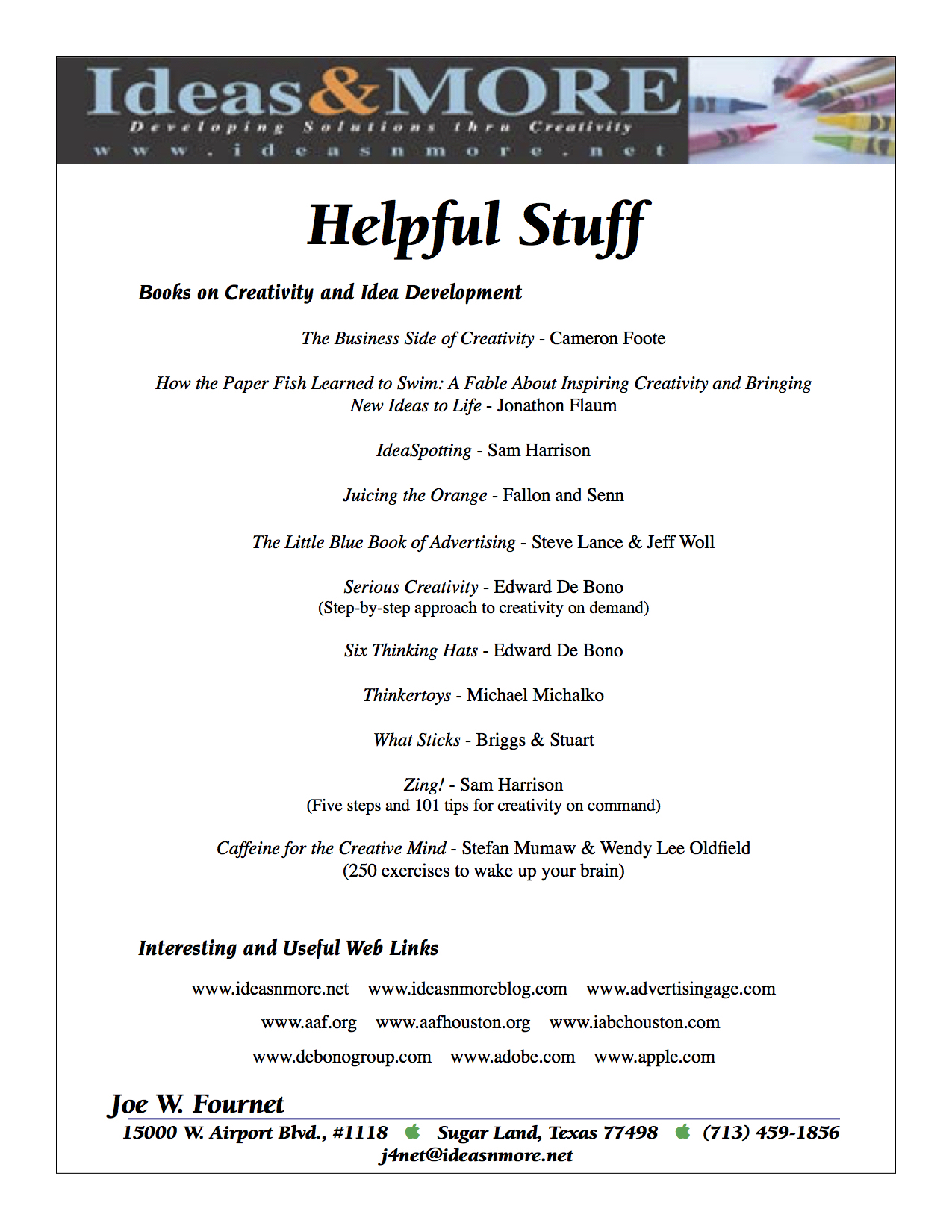
Some times we all need a kick in the pants to get our creative juices to start flowing. Perhaps the attachments in this post will help in that regard. I wrote these years ago in preparation for some speaking engagements. Given their nature, I’d bet they’re still valid today.
Hopefully making a ruckus, one blog post at a time!
Be sure to check out my other blog, Joe’s Journey, for personal insights on life and its detours.
In my continuing effort to share pertinent information regarding the value that creativity plays in today’s marketplace, I share the following interview from LinkedIn as it relates to business-to-business advertising.
As part of a multi-year partnership between LinkedIn and Cannes Lions, LinkedIn along with its think tank, the B2B Institute, worked with the Cannes Lions as a strategic thought partner to develop the Creative B2B Lions Awards. Below are excerpts from a LinkedIn interview with Tyrona Heath, Director of Marketing Engagement at LinkedIn’s B2B Institute. It is aimed at celebrating and championing B2B excellence to drive creativity and excitement amongst B2B brands, marketers, and advertisers.
Summary:
Creativity is a key driver of profitability in B2B marketing and plays a crucial role in building brand recognition, differentiation, and market share
B2B brand building has a massive untapped opportunity, with significant growth potential in the marketing services industry
When you talk about creativity in B2B, it can feel abstract. Can you explain it in a tangible and relatable way?
For a long time, people have associated B2B with purely business-related content, detached from the principles that influence decision-making. However, B2B content is consumed by human decision-makers who are influenced by the same factors as any other audience. Emotion, storytelling, music, characters, and persuasive techniques are all necessary in B2B to inspire decision-making. Ultimately, it’s about creating a memorable brand that stands out and drives effective outcomes, with creativity at the center.
Is B2B advertising facing a crisis of creativity? And if so, how did we get here?
In the case of B2B advertising, there is a significant opportunity for improvement. Research indicates that the majority of B2B ads lack memorability and effectiveness. According to an analysis with our creative effectiveness partner, System1, a staggering 75% of B2B ads received a low effectiveness rating of one star out of five. These ads failed to leave a lasting impression, effectively communicate the message, or evoke an emotional response. This means they were not effective in building brand awareness or generating a return on investment.
How do you sell the need for brand building and creativity to senior marketers or budget holders?
That’s a great question, and it relates to our previous discussion about marketing to the CFO. Ogilvy Rory Sutherland once compared discussing brand with a finance director to talking about the healing power of crystals to a head surgeon. To finance-focused individuals, brand discussions may come across as fluffy and irrelevant. The best ads are effective because they better encode an association in a buyer’s memory, and brand building is one of the most powerful levers for driving business growth by building memories. We need to shift our mindset to effectively communicate the connection and value of brand building and creativity.
Well, another Super Sunday has come and gone and millions of dollars spent on items promoted to us in trying to have us believe that we need them. Most were well intended and some were pretty good. Others were a waste of money and/or talent.
The game itself even delivered a stomach-churner of an event in that the winner wasn’t known until the very last in a rare overtime. The money spent on this year’s Super Bowl XVIII was astronomical as was the price of admission. The money spent on the commercials was a tidy sum as well.
While I didn’t take time to rank the commercials I saw, I devised a list of those I thought memorable, meaning mostly positive and creative. Those I didn’t think so much of didn’t make the list, with one exception.
All told, I selected thirty spots that impressed me for one reason or another. They are listed below in no order of preference mostly in the order of appearance.
They are:
Wicked He Gets us Lindt Apartments.com Ultra-Messi BMW State Farm-Arnold Nerds Oreo E-trade Hellman’s Reese’s Jewish Hate Dunkin Google Poppi Etsy Pluto TV Paramount plus Uber eats Pfizer Bud Light Doritos Volkswagen If HEB United Kia Microsoft Copilot Door Dash
The one exception to my list of memorable spots was indeed memorable but for the wrong reason. I’m still trying to erase it from my memory. “Dude Wipes” presented a supposedly better way to go to the bathroom, being a substitute for toilet paper. While not gross or horrendous in execution, I found it embarrassingly stupid. I won’t dwell on it because that would be a waste of virtual paper.
The nail-biter game and mostly interesting and humorous commercials made for a pleasant experience this year. Let’s hope next year’s event will be equally entertaining.
A post script here: It’s not lost on me that today is Fat Tuesday, aka Mardis Gras. May your celebrations be rich in revitalization of spirit and, for those of us preparing for Lent, be true to yourself and your inner being so that you can enjoy a more prosperous and fulfilling life.
And now, laissez les bons temps rouler!
Hopefully making a ruckus, one blog post at a time!
Be sure to check out my other blog, Ideasnmoreblog, for a different kind of playground for creativity, innovation and inspiring stuff.
And, check out various creative selections from ideasnmore.net.