AI’s Impact on Creativity in Ad industry: A Panel Review

How do you think AI will impact creativity in the ad industry – positively and negatively – in the near future? This is the question put forth to a panel of nine industry gurus, moderated by one Carol Cooper of Shots, in a recent article. There’s been so much written already about AI that I felt it appropriate and timely to share this panel discussion since it relates to creativity and advertising.


Johnny Vulkan, Founding Partner, Anomaly

The first photograph was allegedly taken in 1826 but it wasn’t until just shy of 100 years later that an American gallery deemed photography worthy of inclusion in their collection. After all, what artistic skill does it require to create a mechanical and chemical replication of reality?

We’re now, hopefully, more enlightened about photography and the still; moving and digitally manipulated form has become a central part of our industry. And now we have a new tool, AI.

Whilst it can be crude, nascent, often clumsily disappointing and inaccurate, we’re already seeing exquisitely crafted images and concepts brought to life. Some of these outputs would’ve taken weeks to achieve using more conventional methods, and maybe only the finest of today’s craftspeople would be able to even come close. Now, like so much software before it, seemingly impossible ideas can take seconds to render, and that democratizing of creation is exciting and terrifying in equal measure.

Jobs will be lost. New jobs will be created, but it’s clear that the best insurance anyone can have would be to experiment, learn and play. 

AI is not without problems and it’s natural for us all to experience some discomfort as ‘bad actors’ have the same access to tools as people with less malicious intent, but this genie will not be going back in the bottle. We can probably predict a few years of highly litigious legal jeopardy as all industries struggle to define new rules and concepts in intellectual property and rights but this will only slow rather than reverse the direction of travel.

It won’t take 100 years for AI creativity to appear in gallery collections, in fact it’s already controversially helping to win awards and competitions. But it’s still ultimately a tool. One that any one of us can wield and learn to master. What a great chance for us all to learn.

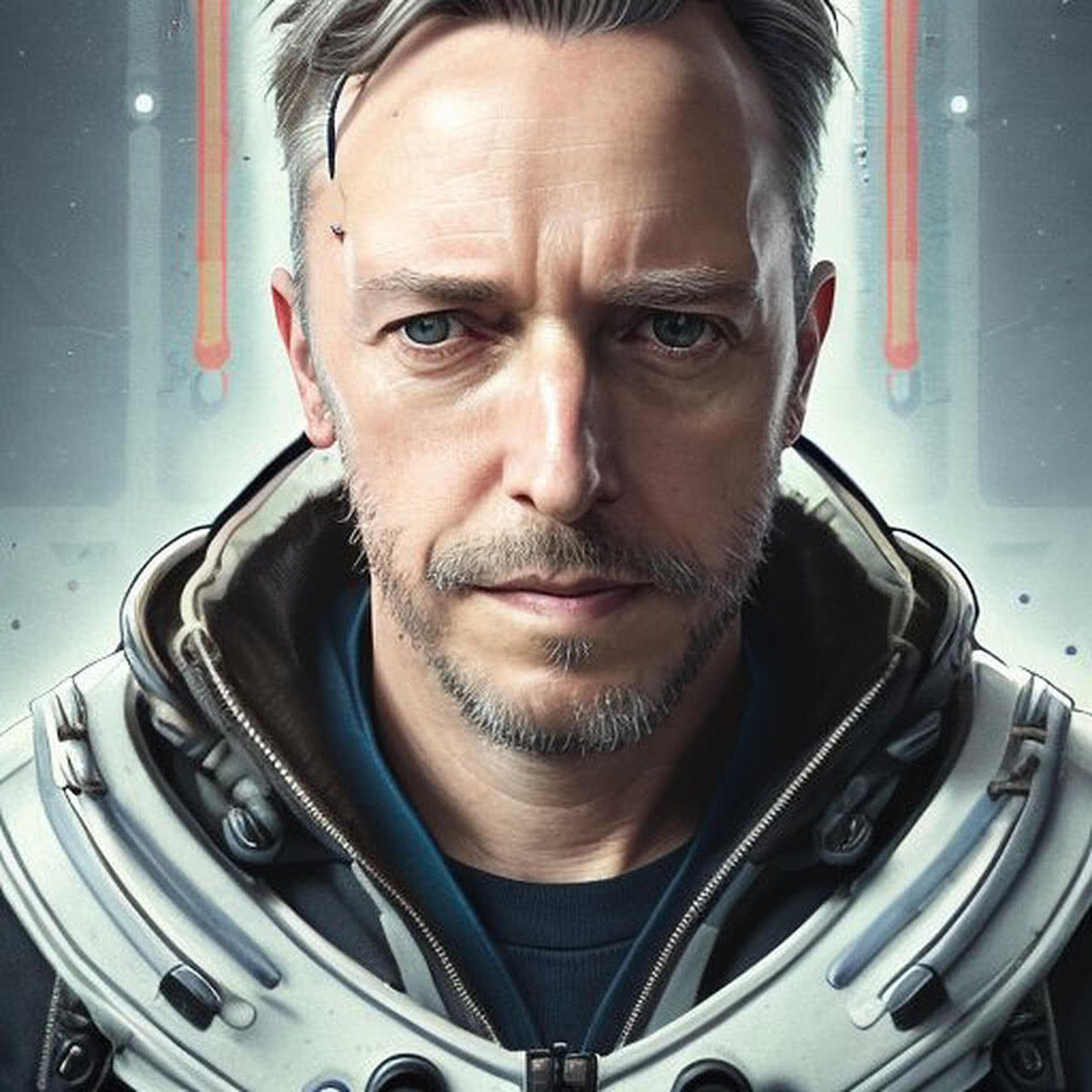
Above: Anomaly founder Johnny Vulkan, made by AI with Lensa.


Johnny Budden, Executive Creative Director at AKQA

As with any new technology, you could choose to limit human advancement or take people to the moon. When cars were invented we didn’t change our previous methods of transportation – we still walked, cycled and moved around as before. We simply had access to technology that improved our method of getting around.

There are countless possibilities of using AI to add creativity to our work – not replace it. And we are now harnessing those possibilities to advance civilization. For example, HeyPi.com is a compassionate AI that cares about your needs. GoFundMe used AI animation to bring donation stories to life.

The power of machine learning created a match between Serena Williams and her past self, from her first Grand Slam at the 1999 US Open versus her most recent at the 2017 Australian Open. We are going to the moon, everyday.

The advantages of AI means that our boutique team is expanded now into a team of a million. We are still driven by the same imagination and passion as before, only now with access to an infinite resource of information to help us achieve the future faster.

Continue reading

The Big Idea: Do We Still Need It?

Sometimes I play the creator. Other times I play the curator. This week I, again, play the curator and offer up an unexpected article I found that proposes a different point of view from the one expressed just last week.

The Big Idea. Is it still needed? Some advertising practitioners say yes while others are doubtful. While last week’s post revealed the rationale that the Big Idea is not necessarily Better. This week’s post maintains the POV that the Big Idea is still important and that it should always be sought after.

Now, for the article . . .

Through a thousand tiny cuts, the building blocks of historical media have been broken into millions of pieces.

But those pieces must be managed somehow. If we zoom out and see them as a single territory (instead of micro-managing every mini experience), the pieces are more similar than different. Which hints at a full circle. The pendulum has begun its return swing and we’re about to see a fresh bloom of imagination and excitement to command brands’ millions of interactions.

But have we still got the know-how? And who has the big ideas to transcend the granularity of today’s media mix?

How little clicks superseded the big idea

Being in the right place at the right time was always marketing’s core strategy. For most of its history, that meant renting room in everyone’s heads so your brand would be at the top of the pack when someone was ready to buy. Crystal-clear and well-wrought propositions conveyed through imaginative, emotional executions allowed brands to occupy well-defined emotional territories for that magical moment of purchase.

This was the ‘big idea’.

With each media innovation, from radio to smartwatches, the battleground expanded, and budgets tried to keep up. In the early days of the internet, it was still just posters on the screen, with Alex Tew’s Million Dollar Homepage representing peak experiential pandemonium.

But then, the entirety of human knowledge got squeezed into people’s hand-held devices. For brands, being in the right place at the right moment became operational rather than psychological.

Presence became the ‘big idea’, and everybody had it at the same time. Everything became a numbers game; clicks, hits, and likes were the new money. Measurement became all-important and promised the end (again) of the missing half of John Wanamaker’s advertising spend.

Suddenly, if it could not be counted it didn’t count. Data floated to the top of an increasingly unfathomable ocean of media possibilities. Data, data, data. At a time when we have more media options than ever before, the strategic playing field has narrowed almost to the point of singularity.

Continue reading

Big Ideas Don’t Always Equal Better

I recently came across an article about generating ideas and the belief that generating the Big Idea will produce the Best Idea. This isn’t necessarily so, as the article points out. Also, the Big Idea isn’t, and rarely is, the Best Idea.

Arriving at the Big Idea is usually the end result of utilizing one of several exercises. When one settles on the Big One, several smaller ideas have usually already been introduced. Don’t discard these. They might yet be useful even if leading into a different angle. This is where due diligence comes into play. But, I digress; this is the subject of a different blog post.

Now, about that article by Ahab Nimry . . .“Big Idea” is often a misnomer. Big Ideas can actually be small ideas, and most of the best ones are. They do not necessarily point to unique selling propositions (USPs), but rather single out a small aspect of what a brand does and elevate it. Such an approach works in many categories, from the probably insignificant additives in brand name gasoline to the distinctive but largely unused camera features in cell phones. But when treated with creativity and ingenuity, they can become touchstones for a brand that symbolizes far more. 

One of the best campaigns is All State’s “Mayhem.” In the spots, Mayhem is a middle-aged man who acts out likely causes of chaos. Sometimes he’s a teenager distracting you with social media, other times he’s the latest hashtag campaign or even a dopey, former frat boy who ruins a wedding. Typically, he intervenes in the lives of ordinary people, resulting in crashed cars, smashed windows, and destroyed dreams. At the end of each commercial, he explains that if you have discount insurance rather than All State, you might have to pay for it all yourself.

While the commercials are humorous, the concept is not unique to the company. Protecting against the results of random mayhem is what insurance companies do. All State has merely taken a creative approach to an ordinary function of every company in its category. Of course, this process is much easier said than done.  

Start with (and reject) the first big idea

When you look at a brief, it’s a good idea to take careful note of the first idea that springs to mind. The really obvious one. The amusement park with the happy family. The extreme ski resort with someone doing a backflip off of a jump. The cruise ship with a gorgeous model emerging from a crystal-clear pool. Identify this idea as quickly as possible because it’s exactly what you don’t want to do. 

Continue reading

Ask Wicked Questions to Enhance Your Creativity

Enhancing one’s creativity is not difficult when you utilize various tools. One such tool is the art of questions. A recent article I read by Lee Duncan, IBM Enterprise Design Thinking Leader, explores this practice. He aims it toward designers but, in fact, all creatives should learn from it and profit by it.

I’ve heard it described by asking Better questions, too. Whichever you select, dig deeper into the problem to get to the soul of the matter to uncover more options to deliver the solution. In this post, I pass along Lee’s contribution so that you may also glean some suggestions that will help you derive better solutions to enhance your creativity.


As designers, we often get caught up in the details of our work and lose sight of the big picture. It’s easy to get bogged down in the nitty-gritty of design, but sometimes what we really need is a fresh perspective. This is where wicked questions come in.

Wicked questions are questions that challenge assumptions and shake up our thinking. They don’t have simple answers, and they force us to think deeply and creatively. By asking wicked questions, designers can gain a better understanding of the problem they are trying to solve, and ultimately create better solutions.

Why a Beginner’s Mind Matters

One of the keys to asking wicked questions is to approach a problem with a beginner’s mind. This means letting go of preconceptions and assumptions and approaching the problem as if you were completely new to it. By doing this, you open yourself up to new possibilities and ideas that you might not have considered before.

When you approach a problem with a beginner’s mind, you are more likely to ask questions that challenge assumptions and push boundaries. You are also more likely to see the problem from a fresh perspective, which can lead to innovative solutions.

The Value of Being Curious

Curiosity is an essential trait for designers. It’s what drives us to explore new ideas and try new things. By being curious, we can ask questions that lead to new insights and discoveries.

When you are curious, you are always asking questions. You want to know more about the problem you are trying to solve, the users you are designing for, and the world around you. This curiosity fuels your creativity and helps you come up with innovative solutions.

Continue reading

September’s Quotes

Because we’re starting a new month, I thought I’d change things up a bit. Hence, submitting this month’s quotes at the beginning of the month. As per usual, this post, along with others forthcoming in this blog, center around some aspect of creativity.


Everything is reduced to facts and figures but the things that count. — George Gallup, member, Advertising Hall of Fame

Creativity is no longer about grabbing attention or raising consumer awareness. Its goal is to remind consumers about what is fundamental and gratifying about a brand. — Peter A. Georgescu, member, Advertising Hall of Fame

Every area of trouble gives out a ray of hope, and the one unchangeable certainty is that nothing is certain or unchangeable. — John E. Kennedy, member, Advertising Hall of Fame

When we so cheapen the concept of human life that we can be permissive to the occasional bomb or bullet, I think we’ve taken a giant step back into the Dark Ages. And I don’t think there’s a light at the end of that tunnel. ~ Rod Serling

There is a cult of ignorance in the US, and there always has been. The strain of anti-intellectualism has been a constant thread winding its way through our political and cultural life, nurtured by the false notion that democracy means that ,y ignorance is just as good as your knowledge. — Isaac Asimov

Advertising becomes a dialogue that becomes an invitation to a relationship. — Lester Wunderman, member, Advertising Hall of Fame

A deadline is negative inspiration. Still,it’s better than no inspiration at all. – Rita Mae Brown

Our imagination is stretched to the utmost, not, as in fiction, to imagine things which are not really there, but just to comprehend those things which are there. – Richard Feynman

The only means of strengthening one’s intelligence is to make up one’s mind about nothing —to let the mind be a thoroughfare for all thoughts. – John Keats

I doubt that the imagination can be suppressed. If you truly eradicated it in a child, he would grow up to be an eggplant. – Ursula K. Le Guin


Hopefully making a ruckus, one blog post at a time!

Be sure to check out my other blog, Joe’s Journey, for personal insights on life and its detours.

And, check out creative selections from my website.

Jolan tru!

Quotes by Ogilvy, Voltaire, Jobs, et. al.

As it’s the last Tuesday in July and since I accidentally skipped June, I thought it time for Quotes. From Bernbach and Barton to Serling and Steinem . . . enjoy!


Innovation is the ability to see change as an opportunity — not as a threat. – Steve Jobs

We pay just as dearly for our triumphs as we do for our defeats. Go ahead and fail. But fail with wit, fail with grace, fail with style. A mediocre failure is as insufferable as a mediocre success. — Bruce Barton, member, Advertising Hall of Fame

The heart of creativity is discipline. — William Bernbach, member, Advertising Hall of Fame

Nobody has ever built a brand by imitating somebody else’s advertising. — David Ogilvy, member, Advertising Hall of Fame

Judge a man by his questions rather than by his answers. – Voltaire

Discussion is an exchange of knowledge; argument an exchange of ignorance. – Robert Quillen

Consumers are statistics. Customers are people. — Stanley Marcus, member, Advertising Hall of Fame

Without leaps of imagination, or dreaming, we lose the excitement of possibilities. Dreaming, after all, is a form of planning. – Gloria Steinem

The soul without imagination is what an observatory would be without a telescope. – Henry Ward Beecher

I think that the singular evil of our time is prejudice. It is from this evil that all other evils grow and multiply. In almost everything I’ve written there is a thread of this: a man’s seemingly palpable need to dislike someone other than himself. — Rod Serling, LA Times, 1967


Hopefully making a ruckus, one blog post at a time!

Be sure to check out my other blog, Joe’s Journey, for personal insights on life and its detours.

And, check out creative selections from my website.

Jolan tru!
Creativity is Productivity

Recently I came upon an article about creativity and productivity by Wall Street Journal best selling book author Scott Young. In it he explores various traits of creative people and how they transition into productivity. Below is an interesting excerpt of his findings.

Nearly two centuries ago, the Belgian sociologist Adolphe Quetelet observed the impressively tight link between personal productivity and creative success.

More recently, Dean Simonton has analyzed the creative output of individuals across many domains and suggests an “equal-odds” rule best describes it: once a creative individual starts publishing in a field, each piece of work they produce has roughly equal odds of world-breaking impact.


The Surprising Equipotential of Creative Success

 Consider, for a moment, what this theory rejects:

  1. Accumulating expertise. We might expect steadily improving skills through deliberate practice and a widening knowledge base would lead to increased creative success. Except, this is not what we see outside of the initial preparatory training to enter a career.
  2. Youthful genius. Alternatively, we might expect creativity to decline as thinkers become burdened by old ways of doing things. Were this true, we would predict a reduced rate of creative success over time. But this wasn’t observed in Simonton’s research.

Instead, it looks like the most important determinant of creative success is simply how much work you produce.


Creative Success as Randomness

A simple model might capture the essential details of this trend:

  • Be at a knowledge frontier. You can’t contribute anything new if you’re not at the boundary of knowledge for a discipline. In academia, this usually prevents undergraduates from publishing many papers; in technology, this prevents unskilled inventors from obtaining new patents. Other work suggests painters and composers have similar ramp-up periods where their work is initially unremarkable. Getting to this threshold is non-trivial and takes considerable time and training.
  • Idea generation and public reception are randomly determined processes. Once you reach the threshold, further advances have a significant random component. This might be due to the trial-and-error process of finding new advances. Or it might come from the unpredictability of public taste as to what work receives acclaim.

The randomness of creative success favors those who are the most prolific. Price’s Law captures this relationship in scientific output. So in a field with 100 contributors, ten will produce half of the published output. If every paper in the field has a roughly equal probability of being cited, these ten highly prolific authors will capture approximately half of all citations in their field.


To Produce Better Work, Increase Your Output

Photo by Avi Richards on Unsplash

Intuitively, it feels like there ought to be a strong quality-quantity trade-off in one’s work. You can make a few excellent things, or you can produce a lot of mediocre work. Certainly there are lots of things that increase productivity at the expense of quality. Typing random words on a page and hitting publish would increase essay count at the cost of writing quality dropping to zero. However, it’s interesting to note that Mr. Young’s most-viewed articles have tended to come from his more prolific writing periods.

We prefer to attach creative success to a combination of innate talent, acquired ability and passionate commitment. Placing such significance on chance appears to cheapen the achievements of great artists, inventors and scientists.

Yet perhaps it’s because we’re so uncomfortable likening creativity to a lottery that this perspective is undervalued. Over a surprisingly wide range of pursuits, creativity is productivity, and we will have more hits if we take more swings.

That may seem quite obvious but one still should not downplay raw talent and determination, as Scott points out.

Scott H. Young, author of WSJ best selling book: Ultralearning www.scotthyoung.com


Hopefully making a ruckus, one blog post at a time!

Be sure to check out my other blog, Joe’s Journey, for personal insights on life and its detours.

And, check out creative selections from my website.

Jolan tru!

 

Quotes for May, Graduation and Enlightenment

Tis that time of year again when graduation ceremonies and insightful speeches are given to enlighten the crowd. Other notables are included here for their wisdom and foresight within the advertising industry and beyond. So, take note; it’s time for May quotes!


Attract attention, maintain interest, create desire and get action. — E. Elmo St. Lewis, member, Advertising Hall of Fame

That which is good or great makes itself known, no matter how loud the clamor of denial. That which deserves to live — lives. — Theodore Francis MacManus, member, Advertising Hall of Fame

The saddest aspect of life right now is that science gathers knowledge faster than society gathers wisdom. – Isaac Asimov

It’s really hard to design products by focus groups. A lot of times, people don’t know what they want until you show it to them. – Steve Jobs

The world of reality has its limits; the world of imagination is boundless. – Jean-Jacques Rousseau

Click on the image to get a better view of the quote

Commencement Address/ Ithaca College May 1972

The place to start in advertising is the basic selling appeal. An appeal that fulfills some existing need in the prospect’s mind, an appeal that can be readily understood and believed. — Morris Hite, member, Advertising Hall of Fame

I have learned that any fool can write a bad ad, but that it takes a real genius to keep his hands off a good one. — Leo Burnett, member, Advertising Hall of Fame

Art is not just our expression of life and of ourselves. It is not just our internal cry: Art is the lie we need about the world and ourselves. When we write or paint or act or compose, we are imposing an order, yes, but we are also crafting a world we can control, and usually it is one we can admire–or at the very least recognize. Art is not elite; art is not on a high shelf for a chosen few. Art is, like religion, a primary narcotic. — Marlon Brando

We have a need for an enlightened, watchful articulate opposition. We have no need for semi-secret societies who are absolutist, dictatorial, and would substitute for a rule of law and reason an indiscriminate assault on the institutions that must be held sacrosanct. — Rod Serling


Hopefully making a ruckus, one blog post at a time!

Be sure to check out my other blog, Joe’s Journey, for personal insights on life and its detours.

And, check out creative selections from my website.

Jolan tru!

Can AI and Creativity Coexist? An AI Followup

Recently we have been hearing a great deal about Artificial Intelligence (AI) and its impact on society. Last week this blog posted some of that information and this week shares with you a followup of sorts. Below is part of an interview with two professors from UCLA, Jacob Foster and Danny Snelson, and their take on AI’s influence on us. Thanks to Jonathan Riggs for spearheading the effort.


One of the Writers Guild of America’s demands in its current strike is for studios to regulate the use of artificial intelligence for creating, writing and rewriting TV and movie scripts and other material.

That might have sounded like a far-fetched concern just a few years ago. But with increasingly sophisticated, easily accessed AI tools already making inroads in other creative fields — literary magazines and fine arts competitions have lately had to contend with a glut of AI-generated submissions — there is a very real concern that expensive, time-intensive human creative labor could soon be outsourced to machines.

Higher education has reached an inflection point, too, now that AI tools can pass graduate-level exams and write serviceable essays at the touch of a button. Already, UCLA has posted a faculty guide and held a virtual town hall on the subject.

“We in the humanities have long thought about these kinds of questions, especially at the experimental limits of what constitutes creativity,” said Danny Snelson, a UCLA assistant professor of English and a writer, editor and archivist. “Lately I’ve been thinking about this artwork by Robert Rauschenberg from 1961 in which he sent a one-line telegram: ‘This Is a Portrait of Iris Clert if I Say So.’ It’s a perfect rejoinder to where some of the debates about creativity and AI are right now.”

Jacob Foster is a UCLA associate professor of sociology, computational social scientist and co-director of the Diverse Intelligences Summer Institute, which unites scholars to explore cognition in all forms. He also has pondered the revolution that appears to be unfolding.

“Something terrible and amazing is about to happen, but no one has a full idea what these systems are capable of — or an entirely clear picture of how they do the things that they do,” he said.

In a joint interview, Foster and Snelson spoke about how chatbots could be used in teaching, offered historic analogs for the current AI explosion and opined about whether technology is actually capable of creativity. Answers have been edited slightly for length and clarity.


Are you excited or concerned about where AI is headed — or both?

Jacob Foster: I’m excited, given my broad interest in how complex wholes become smarter than their parts. I agree with the school of thought that says AI creates opportunities to get at a more fundamental understanding of — and clarity about — things like intelligence and creativity.

Danny Snelson                                                        David Esquivel/UCLA

Danny Snelson: I’m tremendously excited watching these developments unfold, but in a physiological sense — an excited state of fight or flight. Things are moving faster than we can understand them. These developments change things in ways that matter. The effects of algorithmic bias are real and the harms of technological development are never equally distributed.

Foster: To that point, I recently asked ChatGPT to write short plays about the nature of creativity. Until I explicitly told it that the expert on creativity had to be a woman, it always came up with a story about a singular male genius interacting with a female muse or with a female petitioner seeking his advice.

When you read the technical report for GPT, they have worked very hard to tamp down on problematic responses — for example, using reinforcement learning with human feedback — but even this neutral prompt resulted in a gender-biased response. AI is a mirror of the things we’ve written and the stories we’ve told, and that becomes a much bigger deal when it’s potentially determining who gets jobs or certain insurance rates.

I’m helping to organize a program at our Institute for Pure and Applied Mathematics on the mathematics of intelligences, and trying to develop the theoretical foundations of AI is obviously a big motivation. I don’t think we have the resources within social theory to think about the possible rearrangements of society that such technologies could enable. We don’t know how to deal with social change that’s happening so quickly and pervasively.


Is AI capable of creativity?

Foster: We often reserve the notion of creativity for the capacity to generate interesting, novel things. But the contrarian part of me wants to argue when people say, “Large language models aren’t creative; they’re just putting things together.” Humans do that, too — look at many of the papers produced by students or academics!

Snelson: These systems reveal just how formally consistent most writing is. The more generic the formats that these predictive models simulate, the more successful they are. These developments push us to recognize the normative functions of our forms and potentially transform them.

Jacob Foster                                                           David Esquivel/UCLA

Foster: I think of the short film “Sunspring,” directed by my friend Oscar Sharp, which came out in 2016 and was the first movie written by AI. The script itself is only borderline coherent — this was a much earlier iteration of the technology — but it becomes something much more elevated when interpreted by the human actors, director and viewers.

Snelson: William S. Burroughs would cut up different texts and smash them together to produce a kind of surrealist energy. And he said this beautiful thing, which is that by using this cut-up method, you’re cutting into the present for the future to leak out. Right now, we have an opportunity to think about these new forms of fluid, coherent, algorithmic writing and how we might cut into them to see what they might reveal.


Can ChatGPT actually be an asset in teaching at the university level?

Snelson: In my Intro to Comics course, my students collectively wrote a full book in the first week, before they knew anything about the subject, using ChatGPT. I think it’s useful for them to experiment with the essay, and then for the rest of the course we instead use comics formats to produce new knowledge about comics.

We want our students to use modes of critical thinking to navigate the world around them, which now includes these AI tools. Experimenting and playing with them will prepare students, hopefully, to think critically in a technological environment that’s always changing and shifting.

Foster: That’s a very helpful tonic for the prejudice that the essay is a necessary gym to build the skills we want students to have. It’s of a type with my faintly ludicrous “old person” attitude that me learning how to use card catalogs made me uniquely capable to deal with the internet age.

Snelson: Right now, for example, there’s a moral panic in academe about essays. Having taught the fundamentals of argumentation, evidence and rhetoric for over a decade, I can tell you essay writing is not a mysterious formula. The essay has stood strong for a while now; it has limitations that other modes — some of which are still to be invented — may yet be better at when it comes to inspiring students to develop the kind of critical thought needed to address generative algorithms.

Foster and Snelson chatting in the UCLA Court of Sciences                                                                            David Esquivel/UCLA


How will we look back on this moment in time?

Snelson: If the history of major technological inventions is any indicator — I’m thinking here of the printing press and the internet — we’ll look back at this time as a moment of confusion and flux with a huge amount of widespread misunderstanding, and, hopefully, with unexpected avenues toward a better future.

It makes me think of this great anecdote by Rudy Rucker, who helped invent the genre of cyberpunk fiction in the 1980s. At some point, he woke up with this universal computing device in his hand that could access all of human knowledge while still living in the extreme disparities of contemporary America and he realized that a cyberpunk future was already well underway.

Foster: In some sense, this is a generalization and acceleration of the experience humans have always had negotiating a world of vast forces far beyond themselves.

As folks like the computer scientist Danny Hillis and mathematician Norbert Wiener have remarked, we’ve been dealing with artificial intelligence for centuries, in the form of corporations and bureaucracies that take human beings as their parts and turn them into vast, impersonal collective machines. Will we be able to tame or resist these new machines? I hope so.


On a side note: The Houston Area Apple Users Group will meet on May 20, 2023, with the main meeting topic being AI Chatbots. We will be comparing Google Bard, Microsoft Bing, and OpenAI ChatGPT. This meeting will be held via Zoom. 

Artificial Intelligence: A Blessing or Curse?

Artificial Intelligence or AI should have creative people concerned for their jobs, right? Umm, not so fast or at least not yet. Alex Collmer, CEO and Founder of VidMob believes that, without humans, AI could not be creatively effective. But, by embracing AI, humans’ creativity could increase. Thanks to Alex’s input, we explore this topic in this post.

When attending a recent tech conference, an investor expressed the opinion that, in five years’ time, all creative jobs will have vanished. Seriously!?

They predicted that advances in AI and machine learning would lead to the invention of tools that could do creative jobs better than any human. This is not a limited viewpoint. In fact, it’s increasingly prevalent throughout the advertising industry and beyond, according to Mr Collmer. 

In December 2022, The Atlantic’s Derek Thompson wrote an article entitled Your Creativity Won’t Save Your Job From AI; arguing that with AI already capable of certain cognitive tasks, there was potential that, in the near future, it could “master the art of generating high-quality advertising concepts”. 

It’s an interesting perspective, but there is an equally engaging counterargument — that AI and creativity are not fundamentally at odds and, in fact, AI can actually enhance human creativity. However, that statement should have a caveat with a word or two of warning.

While AI itself isn’t what marketers and creators need to fear, it’s other companies employing staff with the ability to leverage AI-generated data and use it cleverly that they should be worried about. Brands who fail to embrace the technology should be looking over their shoulders, as businesses that do leverage AI will achieve stand-out content and establish their competitive advantage. Hmmmm.

Responding to increasing content consumption

In an age where we spend more and more of our time looking at a screen, our digital content consumption has risen dramatically, especially when it comes to video. It’s little wonder, given the growing number of devices and platforms we have to choose from, and with each platform having its own creative nuances, marketers are under pressure to create more content to meet this demand. 

AI can be extremely helpful to under-pressure marketers tasked to create an increasing amount of content. But it is a misguided belief that algorithms can be deployed to simply solve all challenges faced by brands looking to scale their content production. When considering the ultimate goal of marketing success, volume should not be judged as the pinnacle. Rather, creative effectiveness is what matters and brands should be aiming to foster genuine, unique emotional connections with audiences — and AI can’t do this on its own. 

While AI can accurately measure the impact of multiple creative elements in a video ad — emotions portrayed by a model, the audio accompanying imagery, the logo placement, and so on — it’s not until humans analyze this data that meaningful strategic insights are derived to help fully understand audience reactions and the context around them. Once a deeper level of understanding is established, these insights can help optimize current campaign creative for success and assist with efficient planning. Without a human eye, the data itself carries limited value.

Augmenting creative with AI

Before AI-driven creative data, the production conversation has been primarily a conversation about building faster and cheaper creative. Sigh! The first step towards scaling meaningful creative content must be to understand it. 

Once marketers grasp which creative elements work well and why, and on which platforms, they can ramp up their content production while continuing to make the appropriate adjustments for each unique audience in every channel where they will be met. Every frame of an ad contains a myriad of creative decisions. AI-powered tools have the capacity to capture all of these data points in real-time – not just of a single ad, or whole campaign, but from all of the video content a brand has ever created. And while marketers may have a reasonable understanding of which of their ads worked and to what extent, AI provides an answer to the million-dollar question: Why? Good point.

By tracking all the behavioral signals from audience reaction to each creative element, AI collates the data that marketers require to build learning models to fully inform and enhance their future creative decisions.

Why AI needs creatives

The AI-powered creative platforms used in the business world all require an element of human input. When applied to marketing, human intervention can help ensure brand safety when using AI. For example, AI was used to draw insights from a luxury cruise liner’s campaign which revealed that under-30s responded positively to waterfalls, horses and beards.

If we assume all creativity is going to be replaced by AI systems, we could simply input all of this data into a generative AI tool and expect it to produce an effective ad. However, based on data alone, the output could end up ticking all the boxes – waterfalls, horses and beards on paper; however, in reality, the ad wouldn’t make sense. Bottom line, the outputs are only going to be as good as the prompts that an educated human can provide. 

Combining a human perspective and the context in mind, it enables the analyst to understand that the cruise line is viewed by under-30s as a mode of transportation to explore the world. They are more interested in getting off the boat. Waterfalls and horseback riding are merely examples of adventures that can be experienced when they are off the ship. When this strategic insight was applied to the campaign, the resultant creative was able to nearly triple the creative effectiveness. Insights are valuable to creative teams producing new ads, but without human interpretation the data alone fails to achieve this strategic impact and often leads to little sustainable performance improvement.

According to Collmer, AI tools open up a host of creative teaching to marketers and brands who have the ability and expertise to use the data. These teams will still need to maintain control of design oversight and ensure findings are considered in context with AI capabilities guiding their decisions. Where AI really shines and supports the human team beyond their own capacity is in efficiently generating a higher volume and variety of content to meet audience needs and platform requirements. The time saved by AI solutions affords creators space to indulge their creativity further and apply their expertise in different ways. 

Fears that AI is here to replace creators are ill-founded: the real threat posed by AI is to those who fail to embrace a human and AI partnership. Rather than reducing the creative roles available to humans, brands that embrace data and technology will require an expertly-trained workforce to interpret findings and apply insights creatively, eliminating guesswork and optimizing creative content. 

As a result, the next generation of marketers will evolve alongside AI capabilities and will require data analytics skills to enable a new level of creative efficiency based on data-driven decisions. Brands that embrace this new reality will find that they have a significant competitive advantage over those that continue operating the same way they have been for decades.

Thanks to Mr. Collmer for his AI insights and its influence on creativity. In my view AI is a tool, a tool that can enhance our creative efforts, not replace them. From a creative’s perspective, it’s always nice to have extra tools in one’s creative toolkit.


Hopefully making a ruckus, one blog post at a time!

Be sure to check out my other blog, Joe’s Journey, for personal insights on life and its detours.

And, check out creative selections from my website.

Jolan tru!