It’s that time of the month again when we feature different quotes from a variety of people in the fields of creativity, the arts, psychology, advertising and many more. Some are very well known while others not so much. In any event, they are thought-provoking, interesting and in some cases, rather surprising.
Creators, makers of the new, can never become obsolete, for in the arts there is no correct answer. The story of discoverers could be told in simple chronological order, since the latest science replaces what went before. But the arts are another story — a story of infinite addition. We must find order in the random flexings of the imagination. – Daniel J. Boorstin
The writer’s role is to menace the public’s conscience. He must have a position, a point of view. He must see the arts as a vehicle of social criticism and he must focus the issues of his time. — Rod Serling
Rod Serling on set
Creativity comes from a conflict of ideas. — Donatella Versace
An essential aspect of creativity is not being afraid to fail. — Edwin Land
If you can’t turn yourself into your customer, you probably shouldn’t be in the ad writing business at all. Leo Burnett, Advertising Hall of Fame
Creativity is no longer about grabbing attention or raising consumer awareness. Its goal is to remind consumers about what is fundamental and gratifying about a brand. — Peter A. Georgescu, Advertising Hall of Fame
If opportunity doesn’t knock, build a door. – Milton Berle
Passion is one great force that unleashes creativity, because if you’re passionate about something, then you’re more willing to take risks. – Yo-Yo Ma
Meetings are all too often the burial grounds of great ideas. — Keith Reinhard, Advertising Hall of Fame
The more complex the world becomes, the more creative we need to be to meet its challenges. – Sir Ken Robinson (Mar 04, 1950 – Aug 21, 2020)
Hopefully making a ruckus, one blog post at a time!
Be sure to check out my other blog, Joe’s Journey, for a different kind of playground for creativity, innovation and inspiring stuff.
Whether or not you agree with the premise, I found the following essay from Psychology Today an interesting take on a myth that still finds itself debatable in certain circles. Where do creative ideas come from? Are they truly original? Well, according to the essay . . .
One of the most persistent myths is that a creative idea is a totally original idea. That is, to be creative one must be able to create ideas that have never been thought before, ideas that never existed before, absolutely original. {Personally, I don’t buy this.}
{One could consider saying that all original ideas are creative but not all creative ideas are original. I would not necessarily agree with the first part of that statement but I would agree with the second part.}
The truth is that most innovative ideas are not original ideas. In most cases, they are simply the combination of previous ideas into a new concept or format. It’s about making connections with stuff that’s already there. Steve Jobs, the founder of Apple, brought this all into perspective when he said:
Creativity is just connecting things. When you ask creative people how they did something, they feel a little guilty because they really didn’t do it, they just saw something. It seemed obvious to them after awhile. That’s because they were able to connect experiences they’ve had and synthesize new things. And the reason they were able to do that was that they’ve had more experiences or that they have thought more about their experiences than other people.
One of the most-oft cited cases of creativity centers around Johannes Gutenberg who, in 1450, combined the wine press and the coin punch to create movable type and the printing press. Movable metal pieces allowed pages to be printed much more quickly than the standard wooden blocks used to press ink onto paper.
His “combination of pre-existing technologies” created printing presses that could print thousands of pages a day. This revolution allowed books to be printed more quickly and more efficiently, allowing the middle class to obtain them as never before. The result was the rapid spread of knowledge across the European continent. That intellectual revolution came about due, in large measure, to the combination of two previous (and seemingly unconnected) ideas: a wine press and a coin punch.
Creative Combinations
Ancient Greeks were also aware of the power of creative combinations. For example, it was the Greeks who combined soft copper with soft tin to create hard bronze. At their most basic levels, Gutenberg’s printing press and the creation of bronze were simply a combination of already existing ideas. History also records these interesting combinations of pre-existing concepts:
1. Copier + telephone = fax machine
2. Bell + clock = alarm clock
3. Trolley + suitcase = suitcase with wheels.
4. Igloo + hotel = ice palace
5. Mathematics + biology = laws of heredity
We like to believe that creativity is the result of a determined, focused, and solo entrepreneur who, through a flash of inspiration solves a problem for the betterment of humankind. It’s a great plot line for a TV special, but it ignores a basic fact of life about the stories of most innovations: They rarely include the human networks that sustain (and make possible) radical new ideas or changes. In fact, history is frequently edited in order to recognize a sole genius or innovator. Phil McKinney, host of the nationally syndicated radio show, Killer Innovations, puts it this way:
We have a saying in the innovation industry: “There’s no such thing as a truly new idea. Ideas are the result of building on the work of others.” Many of the creative ideas that led to creating great companies were the result of a team. Some examples: Microsoft, Intel, Google, Skype and many more.
We continue to think that to be creative is to have the ability to create new ideas rather than to combine old ideas into new configurations. It’s a persistent myth that frequently blocks us whenever we’re faced with a personal challenge or work-related endeavor. To the contrary, however, creativity is not always a series of “brilliant new ideas,” but often is the result of a lifetime of experiences and diligence in working on combinations of those ideas (instead of giving up on them after one or two failures). The myth that every idea must be an idea never considered before (in the history of humankind) is a significant impediment to our ability to think creatively.
Key Takeaways
We often make the mistake of assuming that creative ideas are always original ideas.
Creativity is, quite often, a combination of two “old” ideas.
One’s creativity can be enhanced by linking two or more disparate concepts.
Regardless of one’s viewpoint, never be afraid to brainstorm with your own imagination and consider borrowing from other ideas. Those ideas can always be improved upon and/or give birth to a totally new and different idea. That’s being creative.
Thanks to Dr. Fredericks for the essay and for the various examples of original thought on which this post is based. Anthony D. Fredericks, Ed.D., is Professor Emeritus of Education at York College of Pennsylvania and the author of From Fizzle to Sizzle: The Hidden Forces Crushing Your Creativity and How You Can Overcome Them.
Hopefully making a ruckus, one blog post at a time!
Be sure to check out my other blog, Joe’s Journey, for a different kind of playground for creativity, innovation and inspiring stuff.
I recently ran across a newsletter article on creativity and wanted to share some interesting aspects of it with you. Though the main source seems to be the Monitor of Psychology and its author, Kirsten Weir (see footnote below), there are numerous additional sources cited to supplement the creativity aspect.
Creativity means different things to different people. Seemingly, creativity is mostly aligned with marketing, design and the arts. But, what about science and engineering? Literature? Man’s simple ability to think? Let’s explore this to get a better feel for where creativity comes from and how best to enhance our own experience.
Creativity in the brain
What, exactly, is creativity? The standard definition used by researchers characterizes creative ideas as those that are original and effective, as described by psychologist Mark A. Runco, PhD, director of creativity research and programming at Southern Oregon University (Creativity Research Journal, Vol. 24, No. 1, 2012). But effectiveness, also called utility, is a slippery concept. Is a poem useful? What makes a sculpture effective?
Runco is working on an updated definition and has considered at least a dozen suggestions from colleagues. One frequently suggested feature is authenticity. “Creativity involves an honest expression,” he said.
Meanwhile, scientists are also struggling with the best way to measure the concept. As a marker of creativity, researchers often measure divergent thinking—the ability to generate a lot of possible solutions to a problem or question. But measures of divergent thinking haven’t been found to correlate well with real-world creativity.
Does coming up with new uses for a brick imply a person will be good at abstract art or composing music or devising new methods for studying the brain?
Maybe we move away from defining creativity based on a person’s creative output and focus instead on what’s going on in the brain, ponders Adam Green, PhD, a cognitive neuroscientist at Georgetown University and founder of the Society for the Neuroscience of Creativity. “The standard definition, that creativity is novel and useful, is a description of a product,” he noted. “By looking inward, we can see the process in action and start to identify the characteristics of creative thought. Neuroimaging is helping to shift the focus from creative product to creative process.”
Creativity often involves coordination between the cognitive control network (of the brain), which is involved in executive functions such as planning and problem-solving, and the default mode network, which is most active during mind-wandering or daydreaming. The cooperation of those networks may be a unique feature of creativity, Green said.
Green’s work suggests that targeting specific areas in the brain could enhance creativity. Yet no one is suggesting that a single brain region, or even a single neural network, is responsible for creative thought.
In search of the eureka moment
Creativity looks different from person to person. And even within one brain, there are different routes to a creative spark, explained John Kounios, PhD, an experimental psychologist who studies creativity and insight at Drexel University in Philadelphia. One involves what cognitive scientists call “System 1” (also called “Type 1”) processes: quick, unconscious thoughts—aha moments—that burst into consciousness. A second route involves “System 2” processes: thinking that is slow, deliberate, and conscious. “Creativity can use one or the other or a combination of the two,” he said. “You might use Type 1 thinking to generate ideas and Type 2 to critique and refine them.”
Which pathway a person uses might depend, in part, on their expertise. “It seems there are at least two pathways to get from where you are to a creative idea,” he said.
Coming up with an idea is only one part of the creative process. A painter needs to translate their vision to canvas. An inventor has to tinker with their concept to make a prototype that actually works. Still, the aha moment is an undeniably important component of the creative process. And science is beginning to illuminate those “lightbulb moments.”
The rush you get from an aha moment might also signal that you’re onto something good, said Jonathan Schooler, PhD, a professor of psychological and brain sciences at the University of California, Santa Barbara. “Creativity is at the core of innovation. We rely on innovation for advancing humanity, as well as for pleasure and entertainment,” he said. “Creativity underlies so much of what humans value.”
He and his colleagues studied these flashes of insight among creative writers and physicists. They surveyed the participants daily for two weeks, asking them to note their creative ideas and when they occurred. Participants reported that about a fifth of the most important ideas of the day happened when they were mind-wandering and not working on a task at hand. “These solutions were more likely to be associated with an aha moment and often overcoming an impasse of some sort,” Schooler said.
Six months later, the participants revisited those ideas and rated them for creative importance. This time, they rated their previous ideas as creative, but less important than they’d initially thought. That suggests that the spark of a eureka moment may not be a reliable clue that an idea has legs. “It seems like the aha experience may be a visceral marker of an important idea. But the aha experience can also inflate the meaningfulness of an idea that doesn’t have merit,” Schooler said. “We have to be careful of false ahas.”
Every summer the advertising world treks to France and pays tribute to its version of Mecca, the Cannes Creativity Festival. In the words of a UK publication who was onsite last week, “Cannes Lions is a circus, a meeting of minds, a place to hear the same buzzwords again and again and a chance to listen to celebrities try to explain how to do advertising to rooms full of people who do advertising for a living.
But it’s also a chance to take the temperature of creativity once a year. Seeing all the work that’s winning and being surrounded by people talking about creativity gives people a unique bird’s eye perspective for just one week.”
So, while talking to the cross section of creative leaders, a very broad, but pertinent question was asked: “what is the state of creativity in 2022?”
Here’s what some of them said.
Caitlyn Ryan VP, Meta
There’s much more optimism and real celebration. We were seeing lots more joyful work. There was one piece that won Gold [in Social & Influencer], for BMW China for the Lunar New Year. The team worked out that the word for BMW in China includes the word horse, and it was the year of the Tiger. It’s properly bonkers but it’s also so joyful. I think it’s a really great example of a couple of things, this celebration and joyfulness, but also as a social campaign. They created all of these assets that then they gave over to the community that allowed them to socialise the idea. I think it’s quite complex but it looks simple and fun.
Yes, there of course is social purpose work – and there was amazing work, especially the charity work The Lost Class, which was just beautiful. That definitely triggers a reaction and wanting to sign up to a social purpose activation. Also we can sell products through joyfully co-creating with the community. I think that’s a really important next step out of the pandemic. It’s incredibly important that we get the economy up and running again, and we use creativity to do that.
Bruno Bertelli Global Creative Director, Publicis WW and CEO, Le Pub
On one level, there’s a little bit of dated work. Still purpose-led, still a little bit from the past. But on the other hand, there is a trend which is interesting, which is that today brands cannot tell people [things] or inspire people, it’s much more about supporting people doing things. Even if it’s for a small issue, it’s much more about supporting people in what they want to achieve. Story-doing has become much more societally relevant and less strategic – what’s your purpose, what’s your message? Some of these activations don’t even need a message because it’s clear that ‘here’s an issue and I’m just here to help’. It’s a very gen-z attitude. The other thing is not all brands are understanding the importance of being topical today. It’s so important after covid. If you’re not topical, you’re not going anywhere.
Anna Qvennerstedt Senior Partner and Chairman of the Board, Forsman & Bodenfors
Last year I was judging brand experience and activation. And I think that my big takeaway from last year was that there are so many really ‘nice’ ideas, but you can feel how quite a few of them are just… very reasonable. You look at it and it’s well done… but there’s no tension in it. There’s no element of surprise. It’s just basically very, very clever. And I think in the jury, when you look at it, you know that it’s going to do well, but then you see something where there’s an actual idea that is expected and no one saw coming, and that sort of changes you a little bit. Those are the ones that win the big awards, I think, and there are not many of them. I mean, again, lots of great work, but those really unexpected ones felt quite rare.
But I think there’s a renaissance for really creative ideas, that we’re sort of starting to see a little bit in the requests from clients.
Rod Sobral Global CCO, Oliver
I am a paranoid optimistic. I know it’s a cliche, but I use it all the time. I think every leader should be a bit of a paranoid optimistic. You have to believe that things are going to change, that it’s going to evolve in order for you to be in the right state of mind, and to take some risks.
My view on that is absolutely, still the most important thing in the marketplace – and I don’t think this will ever change – is the idea. And an idea that connects with you on an emotional or a rational level, sometimes both.
I think we do have this superpower in our industry to change people’s lives. It can be an ad that’ll put a smile on your face or remind you to call your mom or it can be an app that will help you to deal with your asthma or to run better. So I know that this is possible. And I think we should be doing that.
I believe, when it comes to the state of creativity, we are in a very exciting place, frankly, because I feel that there’s a lot of energy to try things. Let’s be honest, with digital, with commerce, we have so many platforms, we produce so much. Any creative can relate to the many times you create something and you end up with one asset that people see for a fraction of a second. There is a lot of vision from people saying, ‘I don’t want to be part of the clutter, I want to be part of the signal’. The more clutter there is, the more anxious people get to change, to try to do something to break the mould.
John Berghdal Global Creative Lead, Forsman & Bodenfors
There was so much fear in the last few years and everybody was thinking about just controlling things, not wanting things to get out of hand. And of course, then you lean on data, and you’re like, ‘OK, Facebook, Google, what can you give me? This is my budget and let’s just use programmatic. Let’s just steer this thing to not have a catastrophe, we’re going to control the situation’. Through creativity and unexpectedness, you have to be bold. You have to risk something – and I don’t think people have been in a risky kind of mood… [We were talking earlier] about the pendulum and maybe this is when people are waking up and coming out and saying, ‘OK, wait a minute, let’s build brands that people care about.’
Hopefully making a ruckus, one blog post at a time!
Be sure to check out my other blog, Joe’s Journey, for a different kind of playground for creativity, innovation and inspiring stuff.
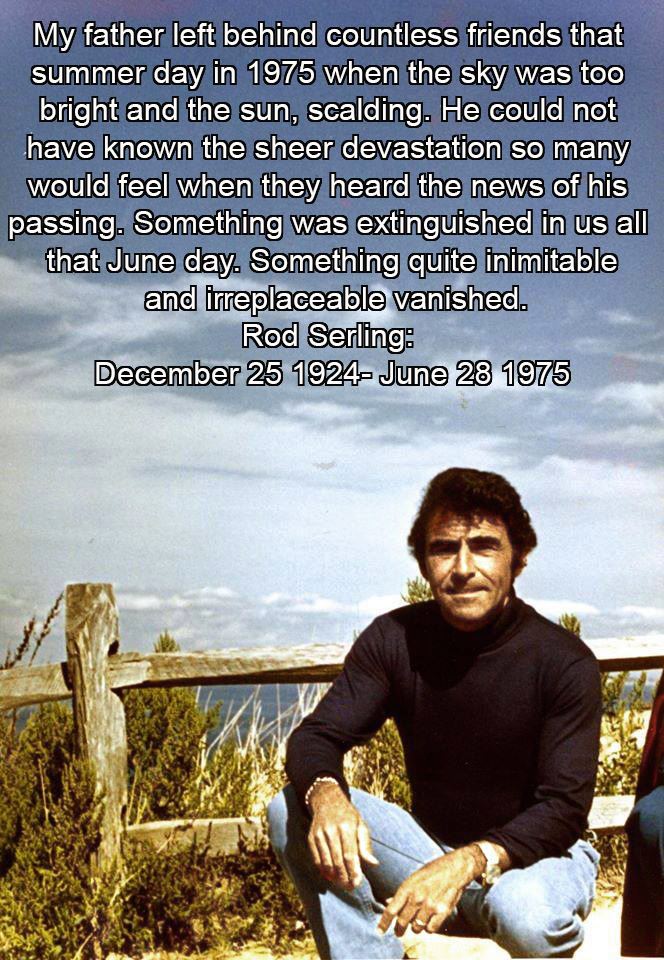
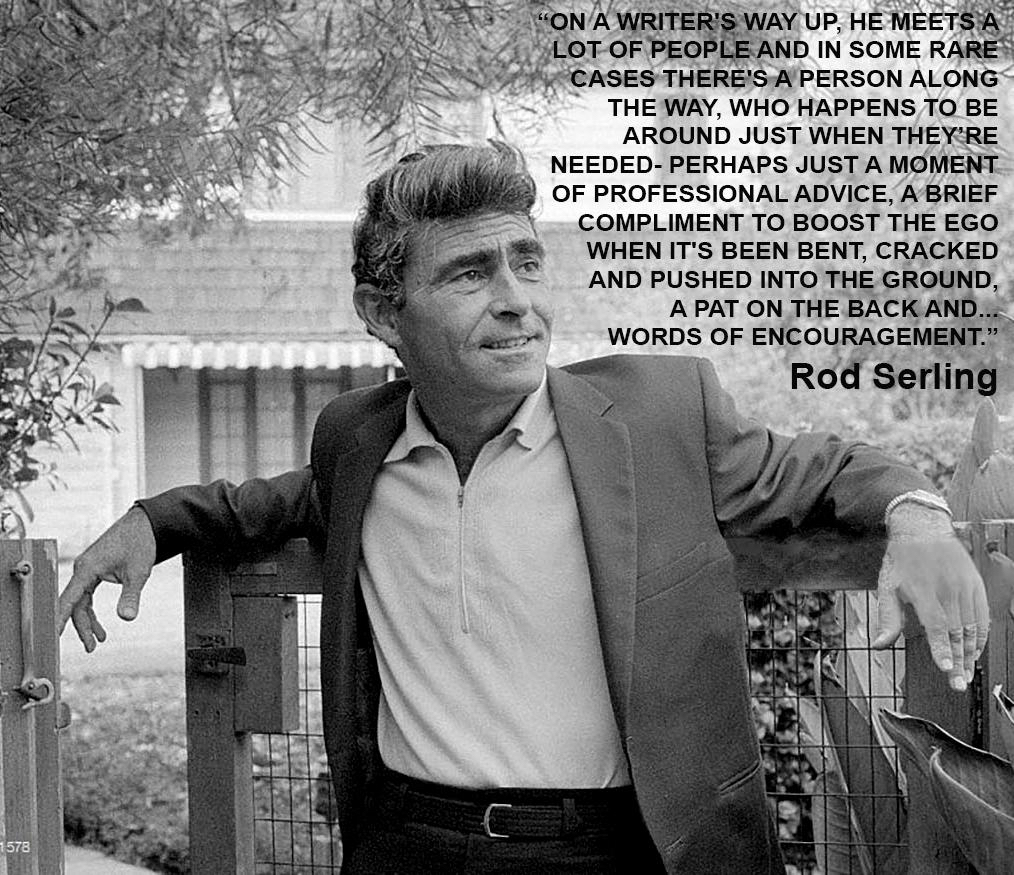
Forty-seven years ago this week, June 28, 1975, creativity lost an icon. A mentor to many both near and afar and an inspiration to those of us putting “pen to paper.” Rod Serling, creator and host of the TV series, The Twilight Zone, was a master at utilizing one’s imagination and turning it on its ear. And we loved him for it!
These quotes pay tribute not only to Rod but to various creative artists and thought leaders who have also played a role in tweaking our imagination and how we think.
Ijust want [people] to remember me a hundred years from now. I don’t care that they’re not able to quote any single line that I’ve written. But just that they can say, ‘Oh, he was a writer.’ That’s sufficiently an honored position for me. – Rod Serling
An important idea not communicated persuasively is like having no idea at all. — William Bernbach, Advertising Hall of Fame
Human beings must involve themselves in the anguish of other human beings. This, I submit to you, is not a political thesis at all. It is simply an expression of what I would hope might be ultimately a simple humanity for humanity’s sake. ― Rod Serling
Like the musical score, a mission statement is only as good as the performance it inspires. — Keith Reinhard, Advertising Hall of Fame
Let’s gear our advertising to sell goods, but let’s recognize also that advertising has a broad social responsibility. — Leo Burnett, Advertising Hall of Fame
Treasure diversity. Seek unity, not uniformity. Strive for oneness, not sameness. — Dan Zadra, American businessman and author
Human history becomes more and more a race between education and catastrophe. – H. G. Wells
Good advertising is written from one person to another. When it is aimed at millions, it rarely moves anyone. — Fairfax M. Cone, Advertising Hall of Fame
In order to attain the impossible, one must attempt the absurd. – Miguel de Cervantes
I think, at a child’s birth, if a mother could ask a fairy godmother to endow it with the most useful gift, that gift should be curiosity. – Eleanor Roosevelt
Failure is the condiment that gives success its flavor. – Truman Capote
Hopefully making a ruckus, one blog post at a time!
Be sure to check out my other blog, Joe’s Journey, for a different kind of playground for creativity, innovation and inspiring stuff.
When last we visited, the year was 1965 and our two strangers were chatting up one another in the lobby of the Majestic Hotel, just before it was to be torn down. One of the strangers is Timeline Police. The cop knows our Time Traveler is not from 1965 but the closely guarded Timeline has been disrupted; how is not known. The police are investigating. Could our time-traveling Stranger end up being trapped in 1965 at the Majestic? After their conversation, our Time Traveler, Mr. Curtis, decides it is time to move on. So with a doff of this hat and a swirl of his cane, he does and in a flash, he’s gone. Again. Only to encounter unexpected twists along his journey through time.
The year is 3068 and Mr. Curtis is now visiting another world in the Gamma Quadrant of the Solexa Solar System. The planet, similar to Earth, is not all that old. However, the surface is desolate except for one large city. Mr. Curtis, it seems, has been drawn here to see the city’s largest building. He is, among other things, a curiosity seeker.
The building is a relatively old hotel, rather grandeur in stature. Upon first glance, he thought he recognized it but he’s never been here before. Then it hits him: It’s a replica, an exact replica but a working replica nonetheless of the long-ago demolished Majestic Hotel in Lake Charles, LA, back on Earth in 1965.
How could that be? Who built it and why the Majestic?
As he stands there in front of the lobby admiring its architecture, he feels a tap on his shoulder and a voice, “Hey there. Fancy meeting you here.”
Startled, Mr. Curtis swings around to see who is disturbing him.
It’s the Timeline Police cop from Earth!
“I’m investigating the breakdown of the Timeline back in 1965, when you and I first and last met,” says the cop. “You seemed to have left the Majestic awfully quickly. And now I see you here in front of another Majestic Hotel more than 200 years in the future. Curious! What gives?”
“I could say the same thing about you,” retorts Mr. Curtis. “What are you doing here?”
“Well, it is curious. I felt a strange yearning to come to this planet and when I arrived, I was drawn to this spot, where the hotel is. Believe it or not, I did not expect to see another Majestic Hotel,” explained Mr. Curtis.
“You said you were investigating the breakdown of the Timeline back in 1965,” inquired Mr. Curtis. “Have you any answers?” he asked. “I know I did nothing to impact the Timeline. That’s not to say I wasn’t tempted, mind you.”
“Well,” intoned the cop, “something happened to the Timeline because the Majestic Hotel back then was not torn down in 1965. Oh, sure, a parking lot is in its place or was but that was later.”
Mr. Curtis interrupted, “But, all the history books say the hotel was torn down in 1965 and show photos of its demolition. How could that be if it was not torn down then?”
“Trust me,” said the cop. It wasn’t. And the only way for that to have happened was for someone to adjust the Timeline. I don’t know who and I don’t know how but it was done. The evidence is where we are standing. This is not merely a replica of the Majestic, Mr. Curtis. It is the Majestic. Somehow when the Timeline was altered, the hotel was transported to 3068, right where we are standing.”
“Okay,” sighed Mr. Curtis, “now I feel like I’m in the Twilight Zone. Before we know it, Rod Serling is going to come out from behind the Concierge Desk!”
“So where does this leave you in you investigation, Mr. Timeline Policeman?,” asked Mr. Curtis. “Since this happened back in 1965, wouldn’t it make sense to return to that time and ask around?” he said.
“I’ve considered exactly that, but I may need some help to draw out our Timeline provocateur,” said the cop.
“What did you have in mind?,” inquired Mr. Curtis.
“Come join me for a cocktail at the Majestic Bar and I’ll fill you in with my plan,” invited the cop.
“You see, I figure it this way,” started the cop. “We’ll need to look around the lobby of the 1965 Majestic and see if we spot anyone who looks slightly out of place. The more I think about it, the more I’m convinced the Timeline was altered back in ’65 somehow and we’ve got to correct it,” he continued.
“You keep saying ‘we’,” said Mr. Curtis. “How can I help?,” he inquired.
“Simple,” said the cop. “You know or at least suspect what a time traveler looks like, how he acts. I need an extra pair of eyes to help me, and you’re it,” affirmed the cop.
Once back in the lobby of the 1965 Majestic Hotel, the two sat pensively in great high-back chairs, surveying the area and trying not to appear conspicuous. That is until Mr. Curtis suddenly arose from his chair and said “I need to gradually move around some. Maybe I can pick up some chatter from some unsuspecting chap who might provide us with a clue or two.”
As Mr. Curtis meandered around the lobby area, the cop stayed seated but struck up a conversation with a fellow who had just sat down by him. After awhile, and with this conversation going nowhere, the cop noticed Mr. Curtis making his way back towards him. Then he noticed Mr. Curtis stopping and looking over near the Concierge desk.
The cop noticed what appeared to be a conversation with the General Manager and the Concierge, but the GM was holding something that appeared to be quite familiar. It was a walking stick just like the one used by Mr. Curtis to travel in between times.
Mr. Curtis, seeing the same thing, gradually started walking over to the pair to strike up a conversation. He naturally wanted to compare walking sticks and also gauge how nervous the GM would be to see someone else with what appeared to be an identical “stick.”
Once within speaking distance of the GM, Mr. Curtis noticed out of the corner of his eye that the cop was meandering over to speak with the Concierge so the two of them would not appear suspicious to the GM.
“I see you have a walking stick just like mine,” said Mr. Curtis. A rather startled GM responded that the two “sticks” were not exactly alike but very similar. That’s when Mr. Curtis noticed that instead of a green inset jewel on the very top as his stick has, the GM had a red jewel.
That could mean only one thing: Time Travelers with red jewels are evil. They live to upset the Time Line. Mr. Curtis knew he had to act quickly. He also knew that the cop was unaware of what had just been noticed. More significantly, the GM now knew that Mr. Curtis had him pegged as the one who upset the Time Line that sent the 1965 Majestic into the 31st Century.
In less than an instant, all hell broke loose. An explosion from somewhere in the hotel rocked the lobby and smoke started to fill the area. People began running toward the exits while screaming “FIRE!”. As Mr. Curtis was regaining his wits about him, he noticed through the smoke haze that the Concierge had been knocked out and the cop was laying on the ground unconscious. He immediately turned to where the GM had been standing, but there was no sign of him. He’d disappeared.
The lobby was a scene of chaos. Mr. Curtis, still somewhat dazed, began to slowly move around and see to the cop. It would be a few minutes before emergency personnel would appear on the scene. In the midst of all this, Mr. Curtis wondered if the explosion were merely coincidental or if it was a plan by the GM to help him get away and remain on the Galaxy’s Most Wanted List.
That would have to be a question left for another day. Why was the GM/Time Traveler doing all this? Why did he want the Majestic transported to another time? Why be so reckless? Too many questions. Too few answers, thought Mr. Curtis. Now what?
As he tried to make his way around the immediate chaos where the cop lay, Mr. Curtis felt unsure of himself. He got more woozy and unsteady. Then as he got to the cop, Mr. Curtis suddenly fell to the floor, unconscious. Their search for answers would have to wait.
To Be Continued . . .
Be sure to check out my other blog, Joe’s Journey, for a different kind of playground for creativity, innovation and inspiring stuff.
Images, works of art. Striking. Unsettling. Amazing. Jaw dropping. Awesome.
Creativity in its different forms.
Below are a few examples of spaces that accommodate large scale installations.
Going big in small spaces. Irrespective of the environments we design, there are always opportunities to create unexpected scale through architectural intervention. It’s a strong and powerful way for brands to transport an audience to another world.
Credits:
Artist Matthew Mazzotta has designed HOME at Tampa airport
AC Milan HQ by Fabio Novembre
Sophie’, 2009 in Germain Restaurant, Paris by Xavier Veilhan
‘Karma’ is by the Korean sculptor and installation artist DO HO SUH STUDIOS LLP
Hopefully making a ruckus, one blog post at a time!
Be sure to check out my other blog, Joe’s Journey, for a different kind of playground for creativity, innovation and inspiring stuff.
Last week my post dealt with emotions and their interplay with creativity. This week I found a “sequel” if you will regarding creativity and how trauma affects it. The input that follows is by the same therapist as last week, Mihaela Ivan Holtz, Doctor in Clinical Psychology. It’s an interesting read and one in which I hope you’ll get as much out of as I did.
Mihaela Ivan Holtz
During my creative endeavors, I have experienced most if not all of what Mihaela talks about. When I’m in a slump, it’s not fun. When I experience a setback, it’s definitely not fun. In fact, it’s quite stressful. That’s why I have a weekly talk with my therapist to go over what’s bothering me.
Take it away, Mihaela . . .
Creativity is a vital life force energy. We connect with that energy within us and use it to express art that comes from the deepest parts of the self.
Creativity feeds off of other vital energies that exist inside of us, including imagination, courage, authenticity, and vulnerability. Creativity requires our passion, love, and playfulness. It requires our curiosity and our spirit of exploration. It requires us to show up and do the work of creating in order to keep it alive.
Creativity asks us to trust in our abilities and our vision. It asks us to call on our talents, skills, and unique gifts and use them to make that inspiration into reality. It asks for our determination and devotion. It asks us to invest in ourselves and to commit to our own sense of agency.
Our creativity is there at all times. It’s a flicker ready to be ignited by our life experiences and turned into a great flame. It wants to guide us along the quest to create a life inspired by our dreams and goals.
All these – our imagination and passion, vulnerability and courage, curiosity and playfulness, trust and determination, talents and skills, exploration and commitment, and our sense of agency – come together to make up our creative emotional space.
The creative emotional space is a beautiful, powerful space that every artist and creative hopes to be in just about all the time. Unfortunately, it can be diminished or destroyed by our unhealed backstories. Unresolved emotional trauma can hold us back and take us off track.
Creatives and Artists Respond to Trauma in Different Ways
Someremarkably productive creative people can actively transform their pain into creative endeavors. Their creativity becomes a vehicle for healing. Their internal healing and growth continues to inspire and motivate them to be more creative.
Their creativity and emotional healing work together in a synergistic relationship. They are healed and transformed by their creative work, and become more and more creative as they face their pain.
Some people can be very creative despite trauma, but they are not engaged in a healing process. They can access their emotional creative space and make music, movies, novels, books, paintings, fashion, or build businesses, and consistently turn their ideas into reality.
But, when they move outside that creative space, they live with unmetabolized emotional pain. This often shows up as with anxiety, depression, and/or addictions.
Then there are those who can access their emotional creative space but the exposure to their inner world causes them to be re-traumatized, over and over again. Their stories or creative endeavors trigger unhealed trauma and they get trapped in old, painful patterns. Sometimes, very successful creatives get stuck in this unproductive emotional creative space when they least expect it.
Despite years of success, depression, anxiety, or addictions can emerge from those unresolved emotional wounds and trap an individual in a loop of creative decline.
There are some who can’t access their emotional creative space, and that in itself feeds their emotional pain, depression, anxiety, and addictions. They can’t realize their creative potential and feel unable to access and use their true resources. This sense of being cut off from their creative self is traumatic in itself.
They feel they’re living a small life in which they don’t belong. They know they could accomplish more and experience a more fulfilling life, but they are trapped in longing.
Perhaps you see yourself in one of these profiles? Whatever experience most closely matches yours, there is support.
What else do creatives need to know about the role of trauma can play in work and life?
Every once in awhile I run across an article that really speaks to me about my creativeness and my own psychological workings. This particular article by Dr. Mihaela Ivan Holtz speaks to that. I’ve highlighted her work in some of my previous blog posts. You may very well already enjoy a good relationship with a psychotherapist who understands your background and troubles. If not, seek one out. And refer to the link at the end of this post for more insightful information.
Now, Dr. Holtz, the floor, er, uh, post is yours . . .
As a creative, you use your emotions to tell compelling stories. When your art is born from a genuine emotional expression, you offer your audience a glimpse of the unique you – your interpretation and manifestation of human experiences.
There’s something about living in the full depth of human experience that is conducive to creativity. The extent to which one can step into the full breadth of their emotions is what makes them a true artist. The ability to be with and use complex and mixed layers of emotions is important for creativity.
It’s through the moments of deep insight and states of intimate connection to your inner world that your craft comes alive.
When you are intimately connected to your emotions’ texture, nuance, and depth, it comes through your art. Your audience can feel the depth of your feeling, and your work truly speaks to their hearts.
Thanks to the expression of pure emotion, others can find a piece of themselves in your art. When art comes from an intimate connection to your internal world, the people who witness it can feel seen, heard, or validated. They are transformed when you share your own experience of transformation.
Unfortunately, it’s not always easy to find and maintain this connection with your emotions and convey them in your art. Unhealed emotional trauma, unconscious conflicts, and unhealthy defensive strategies that you may have developed to cope with life’s challenges can all interfere with your creativity.
When you hit a creative block or a prolonged dry spell, you may find yourself wondering: “Why do my emotions mess up my creativity?”
Many times, unprocessed trauma causes your emotions to feel too intense, overwhelming, or painful. You can’t stay present with such feelings and you disconnect from your own inner emotional world. You may feel like you can only tiptoe around the edges of your experience, but can never go too deep. You keep a safe distance from your own emotional experiences. It doesn’t seem possible to tap into the depth and beauty of your emotions and use them to further your creativity.
This inability to engage your emotions and go deep are all signs that you may need to do some emotional work to help you process trauma, conflicts, or defenses that are locking you out of your emotional creative space.
If you’re someone who feels comfortable in your inner creative world some of the time but then loses touch with that place at other times, you may find yourself confused and looking for answers. You may be grieving the loss of your creativity since it has been so long since you were able to access your creative emotional space.
To reconnect to your creativity, you need to do your own inner healing work. Your current struggles are a sign that emotional trauma from your past needs to be examined, processed, and integrated.
How can doing your “emotional work” help you regain your creativity?
When you do your emotional work to heal old conflicts and trauma, you can access the full spectrum of your emotions and use them to enhance your art. You can remove the barriers to creativity and find that you can organically enter your artistic flow.
Thanks to the healing process, the “emotional work” you can do with a trained psychotherapist, you can connect with all that you are. Your emotions, talents, and skills can come together and you can express yourself and you trust your creativity.
The creative brain is unique, and that is why therapy for creative people needs to be sensitive to your specific needs.
Creative people have greater connections between two areas of the brain that are typically at odds with one another. The brain regions associated with focus and the brain network of regions associated with imagination, spontaneity, and emotions are in conversation in the creative brain.
Unfortunately, these connections usually tend to be impaired by unhealed trauma. Psychotherapy can help you reconnect these parts of your brain so you can regain your creativity and discover new creative energy.
When creative people commit to doing their emotional work, they develop their ability to stay in complex and even seemingly incompatible states of being. In other words, they can access the messiness of their minds and human experience with more comfort, ease, and focus. They can really dive into their old and present emotional experiences and internal world to create.
What kind of psychotherapy would help you?
There is no cookie-cutter treatment plan for creatives with emotional trauma. The treatment is a creative journey in itself. Together, we enter a meaningful process uniquely crafted to help you get in touch with your life experiences and reconnect you with your own artistic voice and expression.
When you process the emotional trauma and conflicts you will feel: “My creativity is the core of who I am. My past struggles do not define me. My past can inform what I create, but is not the core of who I am.”
That shift will help you stay intimately connected with your emotional world to make your authentic art that will touch audiences and, in some way either great or small, transform our world.
I am Mihaela Ivan Holtz, Doctor in Clinical Psychology. I help creatives face and shift emotional trauma, depression, anxiety, performance anxiety, creative blocks, and addictions – to be and live their own best version. You can read more about Therapy for Creatives and Performershere.
Hopefully making a ruckus, one blog post at a time!
Be sure to check out my other blog, Joe’s Journey, for a different kind of playground for creativity, innovation and inspiring stuff.
It’s that time of the month again wherein I present an array of quotes from a variety of well-respected folks offering numerous perspectives. From Obama to Burnett to Serling and more.
Take note. Take a listen. Take heed. Put ’em into practice if you can. Enjoy!
Promoting science isn’t just about providing resources, it’s about protecting free and open inquiry. It’s about ensuring that facts and evidence are never twisted or obscured by politics or ideology. It’s about listening to what our scientists have to say, even when it’s inconvenient, especially when it’s inconvenient. Because the highest purpose of science is the search for knowledge, truth and a greater understanding of the world around us.– Barack Obama
Don’t let anyone rob you of your imagination, your creativity, or your curiosity. It’s your place in the world; it’s your life. Go on and do all you can with it, and make it the life you want to live. – Mae Jemison
Nothing splendid has ever been achieved except by those who dared believe that something inside of them was superior to circumstance. — Bruce Barton, member, Advertising Hall of Fame
The place to start in advertising is the basic selling appeal. An appeal that fulfills some existing need in the prospect’s mind, an appeal that can be readily understood and believed. — Morris Hite, member, Advertising Hall of Fame
I have learned that any fool can write a bad ad, but that it takes a real genius to keep his hands off a good one. — Leo Burnett, member, Advertising Hall of Fame
Defeat is not the worst of failures. Not to have tried is the true failure. – George E. Woodberry
A teacher’s influence doesn’t stay in school. It goes out into the world and cannot truly ever be measured. Every student you inspire to do something great goes on to inspire others. There is no limit to your impact. – George Couros
It has forever been thus: So long as we write what we think, then all of the other freedoms – all of them – may remain intact. And it is then that writing becomes a weapon of truth, an article of faith, an act of courage. – Rod Serling
A good ad should be like a good sermon: It must not only comfort the afflicted, it also must afflict the comfortable. — Bernice Fitz-Gibbon, member, Advertising Hall of Fame
It is easier to tone down a wild idea than to think up a new one. — Alex Osborne, member, Advertising Hall of Fame
Hopefully making a ruckus, one blog post at a time!
Be sure to check out my other blog, Joe’s Journey, for a different kind of playground for creativity, innovation and inspiring stuff.













 ideasnmoreblog