Kick Starting Creativity in the Rio Grande

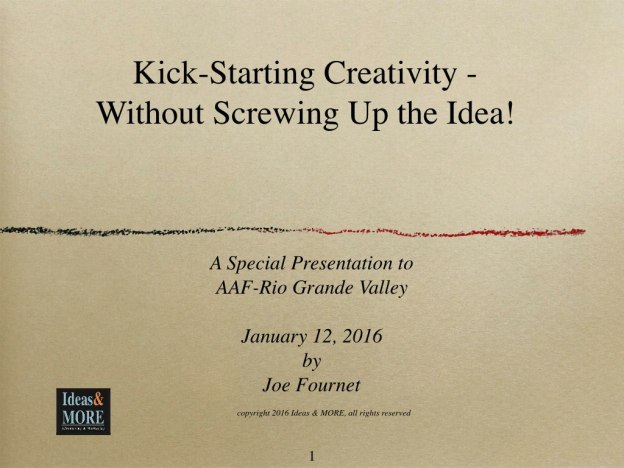
I recently had the honor and pleasure to present “Kick Starting Creativity Without Screwing Up the Idea” to the American Advertising Federation Rio Grande Valley. As with my other presentations in this series, I did some fine-tuning with this version.

I was last in the Valley before this same group back in 2008. The landscape and development may have changed (more of it) but the people have not – still friendly, wonderful, courteous . . . and, of course, creative!

Those of you who were in the audience can, hopefully, enjoy it again and get some useful tips. Those of you who did not experience it that day, may learn a few things. Naturally, what follows is just the visual and not, unfortunately, the experience itself.

Kick-Starting Creativity Without Screwing Up the Idea

Keynote version (no audio)

PDF version (no audio)


Kick Starting Creativity: A Presentation to AAF – Central Texas

Last Friday, August 7, 2015, I had the pleasure of speaking at the professional development luncheon of the American Advertising Federation of Central Texas in Temple, Texas. My topic was a fun one to present, “Kick Starting Creativity: Ye Olde Creativity Survival Kit.”

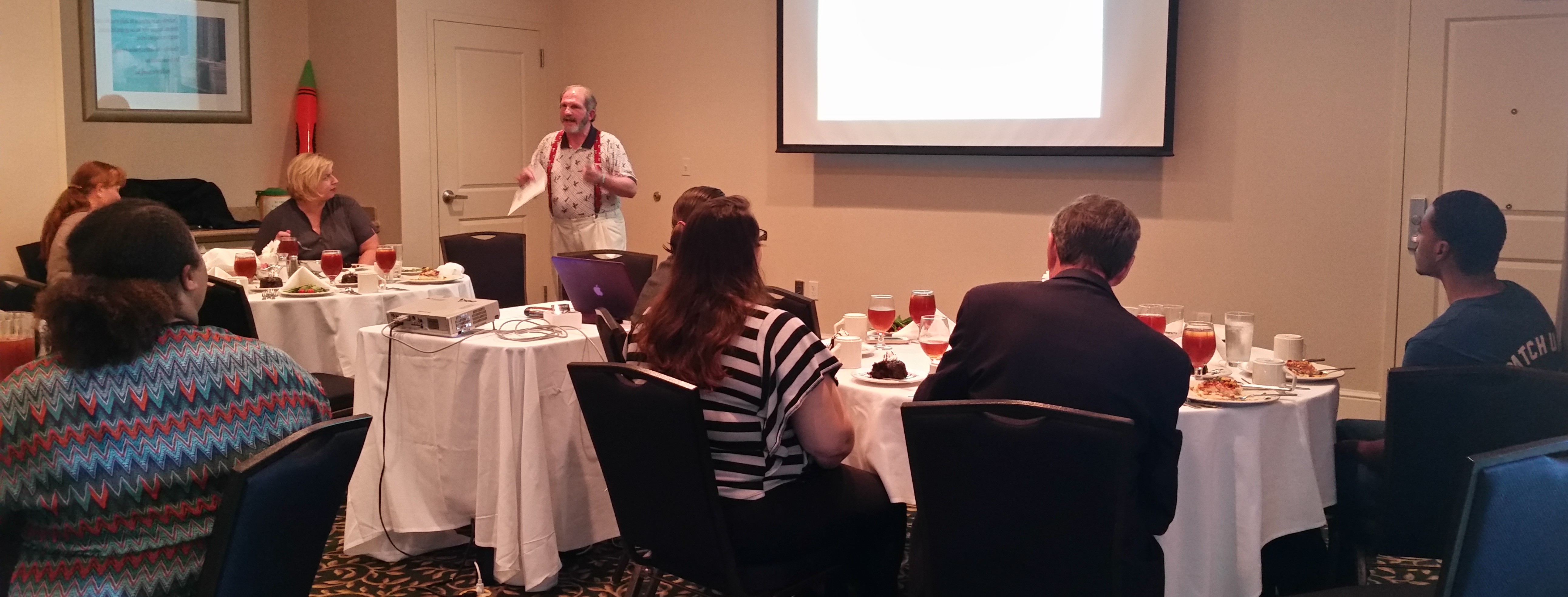
Joe Fournet stresses a point in his Kick Starting Creativity presentation at American Advertising Federation of Central Texas.

I had presented a similar talk several years ago for both a chapter luncheon and a Creative Summit hosted by AAF Central Texas. Friday’s presentation was updated and included new items.

Although the audience was primarily made up of advertising and marketing professionals, “Kick Starting Creativity” centered on the way one thinks and applies one’s imagination. Thus, anyone can put these tips and techniques into practice. I like to say that we’re all creative; we just have different perspectives in how we apply our creativity.

“Kick Starting” was done in Keynote but the size of the file prevents me from uploading it here. I’ve included a PowerPoint version on SlideShare as another option. Here are three handouts referenced in the presentation along with the presentation itself, all in PDF:

Top Tips- Rev

HelpfulStuff – Rev

39 Ways to Kick-Start Creativity copy

Kick Starting Creativity – AAF Central Texas

Kick Starting Creativity – AAF Central Texas (PPT)

Adobe’s Creative Cloud Conference Good for Creative Community and OiH

If you live and work within driving distance of Houston, you owe it to yourself to come spend a day or two listening to and learning from Adobe’s experts as they teach all you need to know about the various applications within the Creative Cloud.

As the one stop source for finding creative talent in the Houston area, Only in Houston (OiH) is proud to be take part in presenting this Creative Cloud Masters Conference. Thanks to a partnership with Future Media Concepts, OiH members can now save 25% on their registration. Use promo code OiH15 to redeem your discount.

OiH Logo

WHY ATTEND?
Advance your skills with cutting-edge sessions
Discover time-saving techniques
Learn from top instructors in the field
Network with peers and expand your professional network

A must-attend event created for graphic designers and other creatives to perfect and diversify their skills. Join top industry speakers to learn the latest Adobe print and web design tools, plus get started in video production. The conference agenda features 3 days of training on graphic design, print, web design and motion graphics. Organized in Houston on March 11-13. Use discount code OiH15 to save 25% on your registration. 

Creative Cloud Conference Logo


New Yorker Cartoonist Offers Views on Creative Process

Matthew Diffee, whose cartoons you may have seen in The New Yorker and Texas Monthly, recently offered his views on idea generation and the creative process. He was in Houston presenting to the American Advertising Federation.

Matthew Diffee promo ad

Matthew, not unlike a lot of us in a creative industry, has a quirky sense of humor and sees things (or at least thinks about them) from a different perspective. This helps in generating ideas.

One of the first things he believes in is to make it easy to “do ideas.” If you’re a coffee drinker, make sure you’ve got a fresh pot to start things off.

Second, or at least this is what I jotted down as second, is a list of five verbs that he uses when he reviews his ideas: Add, Subtract, Switch, Invert, Mash up. These may lead to some sort of visual and/or a caption for the visual. The interplay between words and pictures can be fun!

An example he gave of taking a traditional question oft times used in job interviews, “Where do you see yourself in five years?,” and, instead, coming up with “Where do you see yourself in ten minutes?”. Try that in your next interview.

The best thing one can do is to maintain momentum – keep going in your process. I’ve learned from experience that stopping and starting does no good. You really have to get into some sort of flow.

Another one of his takes on a traditional phrase goes like this: “A penny saved is a penny who has accepted Jesus Christ as its Lord and Savior.” I know, I know, not everyone will find this humorous. I guess it depends on one’s sense of humor. 😉

Other elements and observations from of his creative process:

The Zone – easy to start, hard to stop. We’ve all found our “zone” before. Once you’re in it, don’t let up until you’ve got what you set out to get.

Flip Funnel – large end to finely tuned. Seeing an idea in a broad sense and developing it to a specific angle or perspective. Going from concept to a single cartoon cell in Matthew’s case.

Generating Ideas – quantity over quality. You can sort through these later. You need ideas and lots of them. Never critique when generating ideas.

Can’t make a great idea just by working harder – inspiration hits like a turd. Though somewhat crudely put, his thought is true. We can’t plan to have a great idea by a certain time. It’s not like we have an On/Off switch. We may take five minutes or two days.

Dull Bulbs – assume your work could be better. Don’t let your ego get in the way. No matter how wonderful we may think our idea is, there’s something about it that can be improved.

So whether you’re a budding cartoonist, experienced writer or designer or someone who needs to come up with a bunch of ideas for the next mode of transport to Mars and beyond, some of these techniques may help.

And when you review what’s been discarded at week’s end, don’t throw them away. Who knows what other uses may be made of them.

What has Matthew done with all his ideas which have been rejected? He’s made them into a book, an archive of sorts, entitled “The Cream of the Crap.”


13 Ways to Handle Fear When It Attacks Creativity

We’ve all been there. We’re never quite sure what do to but we feel like we’ve gotta do something. NOW.

But we can’t. We can’t think other than in scattered ways. Incomplete. Disjointed. Frustration sets in. We feel stymied because our creativity has stopped flowing for whatever the reason.

Uh-oh, what’s that. A strange sound. It’s him! Fear comes a’knockin.

Thanks to iStockPhoto

Thanks to iStockPhoto

Fear, as in being afraid (what if the client hates my ideas), being scared (what if I can’t come up with any ideas), feeling intimidated (there’s always someone lurking in the shadows with better ideas).

Fear is also what you get when you sense F.E.A.R. – Failure to Execute Achievable Results – with the key word here being  “achievable.” The results need to be just that and not unattainable.


The three F” words: Fear, Failure, Fun

Up to now, we’ve referenced two of the three “F” words, fear and failure. The third one we don’t experience nearly enough. That would be fun.

As long as you have fear of failure, you’ll never have any fun!

Dealing with failure is easier than dealing with fear; not that dealing with failure is ever easy. It’s not. It’s embarrassing, even humiliating at times. But failure tends to be short­ lived, relatively speaking.

Society and corporate culture-wise, we talk much more about weaving failure into our systems, our processes. Sometimes it’s all talk and not nearly enough practice. Many successful and innovative companies build and accept failure as a natural way of doing business. More companies should but probably will not. They don’t seem to understand that in order to achieve success, failure is part of the journey.

Fear, on the other hand, can torment, destroy, self-inflict. It can absolutely kill creativity.

You’re angry (about a shortened, possibly unrealistic new deadline), depressed, distraught (you do not want to fail to execute anything). You may even be mystified as to why this happened to you.

Ever receive a phone call late on a Friday from an upset client telling you that new and much better creative needs to be on his desk by first thing Monday morning . . . or else (he doesn’t have to say “or else;” the intimidation suffices)? And nothing you can say will alter how he’s feeling at that point in time.

Hell’s bells, you didn’t have plans for the weekend anyway, didja?!

How do you deal with fear when it attacks creativity, especially when on a deadline (realistic or not)?

13 ways, in no special order, to handle fear when it comes a’callin:

–Walk away – change your surroundings, get into another room or leave for a bit

–Talk it out – if possible, share what’s going on with a colleague, friend or spouse

–Write it down – capture what you now know or understand needs to be done within the new timeline

–Pray – this may be first on some lists and as you’ll see, it’s on mine more than once

–Focus – look at your project from another perspective and focus on different portions of it, thus making it more manageable and doable

–Pray some more – you can never do this one too many times (but you still have to do the work)

–Get more focused – set  realistic parameters that allow you to work on specific aspects of the project without getting overwhelmed

–Think positively Amen! Repeat this step as often as needed

–Remember past good results – remind yourself that you’ve done this before; that’s why they hired you in the first place

–Acknowledge worry and anxiety – this one is tricky because you need to face what’s happening to you, acknowledge it, then move on

–Get to work – actually doing the work can be therapy in itself and when the thoughts start flowing, creativity will thrive

–Don’t give in to what-ifs – try to avoid thinking too much about that over which you have no control or you simply don’t yet know; this is wasted energy

–Pray for the others – I actually mean the clients (or whoever is giving you grief) who are putting you through this; remember, they may not know (or care) what they do

Fear is hardly ever dealt with, but is dished out way too easily and usually without a care. That’s unfortunate since fear is a dangerous and deadly poison to the creative mind and process.

Now, you may have your own way of dealing with fear. Whatever works! We can’t stop it from happening but we need to try our damndest from letting it totally shut us down.

I have fun when I’m head over heels in the creative process, and I try and remember that when fear comes a’knockin.

Come to think of it, I guess I could also change the locks!


29 Ways to Stay Creative

Being creative is fun. It’s also a challenge.

Staying creative can drive ya nuts!

Let’s face it, we’ve all seen lists of various ways to improve on our creativity. There is no all-encompassing list, and, no doubt, if we shared our lists with one another, there would be overlap.

I recently came across this video in a post by Kevin Allen on Ragan’s PR Daily and couldn’t help but smile and chuckle a few times because of their take on compiling the list, not so much the elements on the list (they’re all valid and we should take them to heart).

The video link below is from Japanese design firm To-Fu. It highlights 29 techniques designed to get the creative juices flowing. I’ve had good success with some of these techniques.

However, #4, Getting Away from the Computer,

#10 Be Open,

and #21 Break the Rules . . . we probably don’t do enough.

Enjoy! It’s a little different.


Wake Up Stupid and Stay That Way

Some of us may sense that we have no problem doing this; it comes naturally.

But there is a more serious aspect to this cute little title. It goes to one’s frame of mind.

Be open to anything today, any day. Don’t have preconceived notions about what’s going to happen.

I know – that’s easier said than done.

Listen more than you talk. For some of us, this really is a problem.

Observe and absorb.

Ask questions. Get clarity.

Ask more questions. Refine. Reflect. Reshape.

Now, see what you can discover.

The Future of Advertising: Up Close and Personal

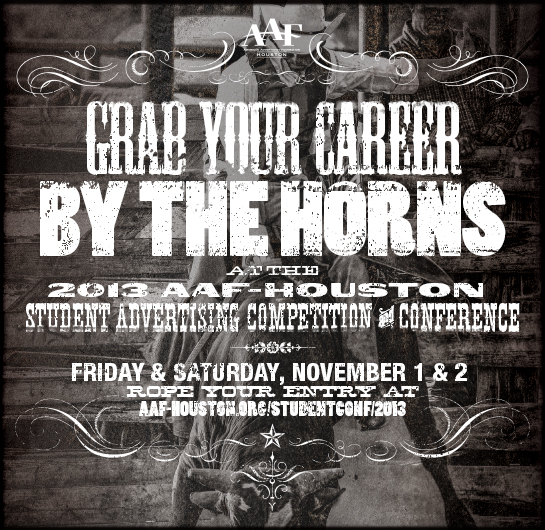
2013 AAF Houston Student Conference GraphicWorking and interacting with students, especially those of college age, is always interesting, entertaining and fun. Recently, I had the privilege of volunteering as a portfolio and resume reviewer during the annual American Advertising Federation Houston Student Conference. This is usually the prelude to the AAF District 10 NSAC (National Student Advertising Competition).

As with past years of doing this, my table quickly filled as students wanted me to review, comment and answer questions regarding their portfolios. The scene was the same at other tables set up in our hotel ballroom. This was cool, I thought. Then it hit me, “How in the heck was I going to cater to these students given the one hour allotted?” I told them I would give them all my attention if they were willing to wait for it – even to the end of the conference. And they did!

Like sponges, ready to soak up every last bit of information and critique they could get. Bless their little advertising hearts!

Like with some client presentations, some students (agencies) were better prepared than others. Technology is to blame for some of this. We get so caught up in what we’ll present, that we forget HOW we’re going to present. A “Plan B” didn’t seem to be part of the homework for some of these folks, no matter how well-intentioned. That’s okay. I made it known how they could be better prepared.

One needs to make the presentation as simple and engaging as possible. There’s no time to go searching for that now-illusive mp3 recording of your radio ad. Have them in one file for easy and quick access. And, have the script standing by just in case.

Along these lines, I strongly suggested they have a PRINT portfolio readily available, in addition to their digital files. One never knows when the power will go out or if the person to whom you’re presenting actually wants to touch and feel the work sample in their own hands. I suggest this for both students and non-students (the rest of us) as well. Contrary to popular belief, digital is not the end all.

Some of the young people had better explanations of their work, and why it was included, than others. Most wanted to know if their samples were good enough to be included, and how many samples they should include.

While I shared my observations with them, I also provided a few suggestions as to how to get feedback, but stressed that if they had any doubt about a piece, leave it out (unless feedback suggests otherwise). It might be included for the “interview after next.”

While all seemed to know precisely what they had included in their portfolios, I did not get a sense they knew their work “cold.” I suggested they be prepared to present it upside down while standing up. That’s just impressive when that’s done.

Now, I realize this form may be a little tricky to do when presenting digital samples from an iPad, but one should know about each piece and what’s special about it – why one is presenting it.

All in all, the students were very gracious, respectful, and personable.  We all had a wonderful time. They’re smart enough to realize that no matter one’s age, how one presents one’s creative credentials is just as important, if not more so, than the work itself.

Believe in yourself and convey that. Let your passion show. We should all be involved in this continuing education and refining of not only what goes in our portfolio but how we present it. These students are off to a very good start, which bodes well for the future of advertising.

Creativity Tip #98: Stupidity and Weirdness – Beware

Dealing with clients on all levels can be daunting. Requests made by them can at times make us think twice (if not more) regarding whether or not they’re serious. Alas, more times than not, they are.

The Creativity Tip here is to be on your toes with clients at all times. Keep your guard up, and never underestimate the power of weirdness – especially when it’s down right stupid. There are some “discussions” you’re not going to win.

I am a member of the Creativepool Network on LinkedIn. Below is an excerpt from a recent discussion with various creatives around the land talking about first-hand experiences of weird client requests.

 Warning: While humorous, remember, they are true. Sigh!            

“Could you do an actual LOGO instead of a font?” It was once said to me by a creative director.

“You make the logo as big as you can. (Now then) can you make the logo bigger”?

“They won’t allow us any more space. Can you make it look bigger without increasing the size?”

Client, after being asked for a payment for a month: “I am so sorry you need money so badly. If I can help you in any way, please let me know. I do not want you to go hungry!”

“Why do you want to reverse the type out of the background? Nobody will be able to read it backwards.”

“Why don’t we broadcast this commercial in black and white? That ‘ll save us a lot of money.”

“We want more but sadly the budget has been cut.” This was like going into a car showroom and saying, can I have that R8, but I’ll pay you for a TT. I wonder what the sales person would say?

On set for a TV spot, the client asks, “How come she isn’t wearing a red sweater? In the storyboard, the woman was wearing a red sweater.” 
We eventually lost the “it was an artist’s sketch in the storyboard” conversation, and got the woman a red sweater.

Can you make her younger?”

VP of Marketing demanding that our ad copy go from gutter to the very edge of the pub: “All this blank space! If we’re paying for it, we’re going to damn well use it!” 
 (We say) Then you’re paying for an ad that bleeds. It will cost more. 
”Bleeds? Cost more? You people are all full of BS.” 
And this from a VP of marketing.

An oldie but a goodie: “I’ll know it when I see it.”

A restaurant client would not allow the use of the word “savory” because he said it made him think of “unsavory characters.”

“We need a few more used condoms, I think.”

Blue logo request: “Can it be more blue?”

Anyone who’s ever worked for Coca Cola or Pepsi will have learned that Coke’s ice is ALWAYS grey and Pepsi’s is ALWAYS blue. Chrysler was like that with their Pentastar; it was always a certain shade of blue. “You don’t f#*k with the Pentastar,” I was once informed.

A name-brand winery commenting on a bill for rented ice cubes in an ad for their champagne: “Why should I pay for something I can’t see?”

From a client who didn’t understand why a low res photo would not work at a larger size on a spread: “Can you use the picture now? I opened the picture in Photoshop and made it bigger, so now it is the resolution you need.”

Remember, no matter how weird or stupid, take a breath and live to fight another day.

Creativity Tip #103: Your Creativity Sandbox

Whether or not we create anything for a living, there are times we just don’t feel very creative. Mostly, we create because we have to do so, to earn that paycheck, to satisfy the client. Granted, there’s nothing that says we can’t be happy about it or we can’t enjoy the process.

What do we do, though, when our creative juices start drying up or when we’re in between “have-to projects”?

Have you ever created something or begun a creative project simply for the helluv it, because you just wanted to do it?

little girl playing in sandbox

Thanks to iStockPhoto

There are probably various names or descriptors for this mindset like “unnecessary creative,”   “creative play time,” etc. Whatever you call it is up to you. I refer to mine as my Creativity Sandbox.

The point is to start something that will occupy your mind in a new or different creative endeavor so you can keep your creative juices flowing. Set aside some time (and maybe a special place) and just start.

I started this blog because I wanted an outlet for writing and expressing myself in ways other than what I mainly do for clients. I’m exploring different software packages (Adobe Muse for Web design, and Adobe’s Creative Cloud), listening to online webinars (CreativeLive), reading anything I can get my hands on relative to innovation and creativity as well as totally unrelated topics that simply interest me.

Anything to keep the brain alive and curious. It takes time and diligence, and some weeks I have neither. But I don’t want the juices to stop flowing. And neither should you.

Spend some time in your Creativity Sandbox as often as you can.