Kick Start Your Creativity

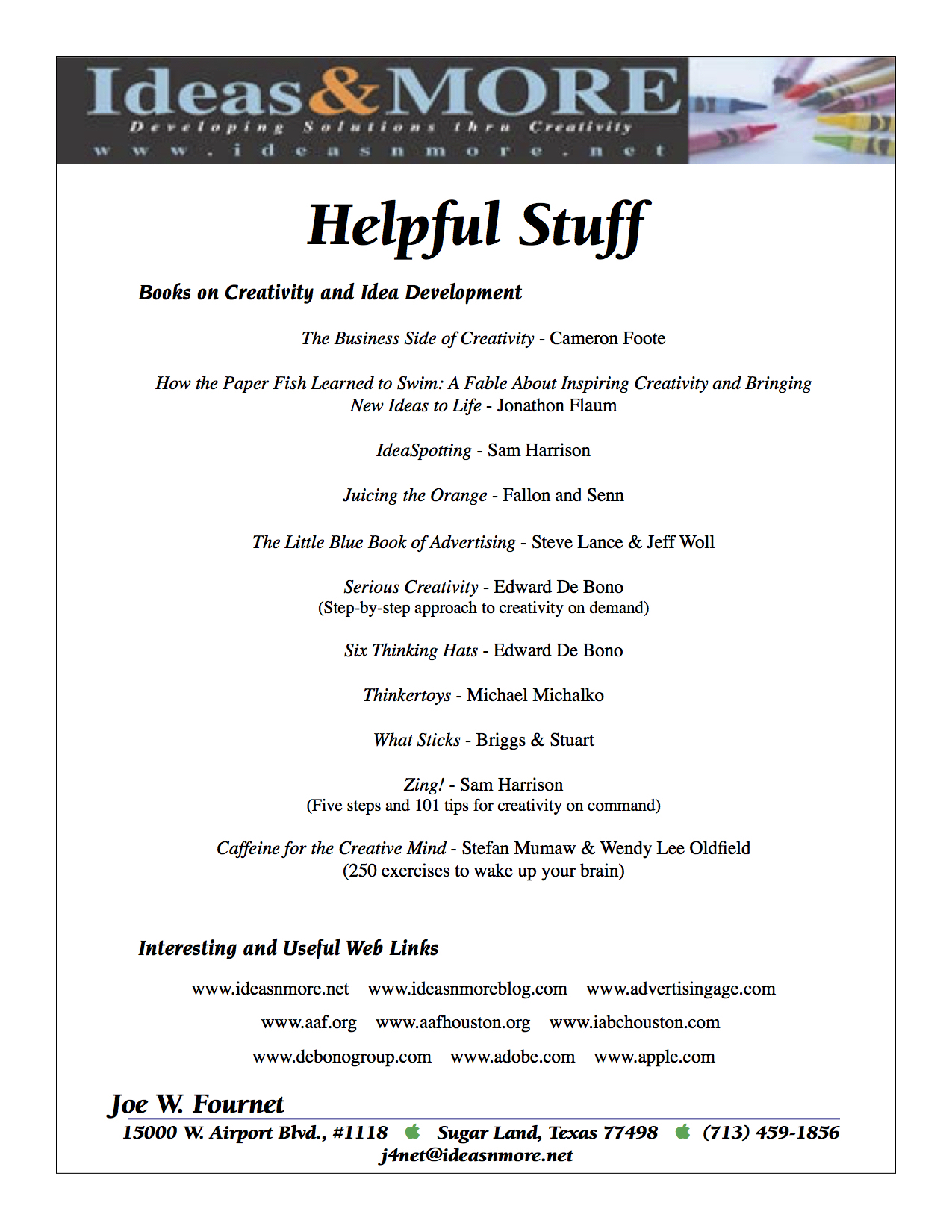
Some times we all need a kick in the pants to get our creative juices to start flowing. Perhaps the attachments in this post will help in that regard. I wrote these years ago in preparation for some speaking engagements. Given their nature, I’d bet they’re still valid today.

Hopefully making a ruckus, one blog post at a time!

Be sure to check out my other blog, Joe’s Journey, for personal insights on life and its detours.

And, check out creative selections from ideasnmore.net.

Jolan tru!


Creativity: Key Driver to Profitability in B2B Advertising

In my continuing effort to share pertinent information regarding the value that creativity plays in today’s marketplace, I share the following interview from LinkedIn as it relates to business-to-business advertising.

As part of a multi-year partnership between LinkedIn and Cannes Lions, LinkedIn along with its think tank, the B2B Institute, worked with the Cannes Lions as a strategic thought partner to develop the Creative B2B Lions Awards. Below are excerpts from a LinkedIn interview with Tyrona Heath, Director of Marketing Engagement at LinkedIn’s B2B Institute. It is aimed at celebrating and championing B2B excellence to drive creativity and excitement amongst B2B brands, marketers, and advertisers.

Summary:

  • Creativity is a key driver of profitability in B2B marketing and plays a crucial role in building brand recognition, differentiation, and market share
  • B2B advertising is facing a crisis of creativity, with research showing that 75% of B2B ads receive a low effectiveness rating
  • B2B brand building has a massive untapped opportunity, with significant growth potential in the marketing services industry

When you talk about creativity in B2B, it can feel abstract. Can you explain it in a tangible and relatable way?

For a long time, people have associated B2B with purely business-related content, detached from the principles that influence decision-making. However, B2B content is consumed by human decision-makers who are influenced by the same factors as any other audience. Emotion, storytelling, music, characters, and persuasive techniques are all necessary in B2B to inspire decision-making. Ultimately, it’s about creating a memorable brand that stands out and drives effective outcomes, with creativity at the center.

Is B2B advertising facing a crisis of creativity? And if so, how did we get here?

In the case of B2B advertising, there is a significant opportunity for improvement. Research indicates that the majority of B2B ads lack memorability and effectiveness. According to an analysis with our creative effectiveness partner, System1, a staggering 75% of B2B ads received a low effectiveness rating of one star out of five. These ads failed to leave a lasting impression, effectively communicate the message, or evoke an emotional response. This means they were not effective in building brand awareness or generating a return on investment.

How do you sell the need for brand building and creativity to senior marketers or budget holders?

That’s a great question, and it relates to our previous discussion about marketing to the CFO. Ogilvy Rory Sutherland once compared discussing brand with a finance director to talking about the healing power of crystals to a head surgeon. To finance-focused individuals, brand discussions may come across as fluffy and irrelevant. The best ads are effective because they better encode an association in a buyer’s memory, and brand building is one of the most powerful levers for driving business growth by building memories. We need to shift our mindset to effectively communicate the connection and value of brand building and creativity.

Continue reading

Another Super Bowl Sunday in the Books

Well, another Super Sunday has come and gone and millions of dollars spent on items promoted to us in trying to have us believe that we need them. Most were well intended and some were pretty good. Others were a waste of money and/or talent.

The game itself even delivered a stomach-churner of an event in that the winner wasn’t known until the very last in a rare overtime. The money spent on this year’s Super Bowl XVIII was astronomical as was the price of admission. The money spent on the commercials was a tidy sum as well.

While I didn’t take time to rank the commercials I saw, I devised a list of those I thought memorable, meaning mostly positive and creative. Those I didn’t think so much of didn’t make the list, with one exception.

All told, I selected thirty spots that impressed me for one reason or another. They are listed below in no order of preference mostly in the order of appearance.

They are:

Wicked
He Gets us
Lindt
Apartments.com
Ultra-Messi
BMW
State Farm-Arnold
Nerds
Oreo
E-trade
Hellman’s
Reese’s
Jewish Hate
Dunkin
Google
Poppi
Etsy
Pluto TV
Paramount plus
Uber eats
Pfizer
Bud Light
Doritos
Volkswagen
If
HEB
United
Kia
Microsoft Copilot
Door Dash

The one exception to my list of memorable spots was indeed memorable but for the wrong reason. I’m still trying to erase it from my memory. “Dude Wipes” presented a supposedly better way to go to the bathroom, being a substitute for toilet paper. While not gross or horrendous in execution, I found it embarrassingly stupid. I won’t dwell on it because that would be a waste of virtual paper.

The nail-biter game and mostly interesting and humorous commercials made for a pleasant experience this year. Let’s hope next year’s event will be equally entertaining.

A post script here: It’s not lost on me that today is Fat Tuesday, aka Mardis Gras. May your celebrations be rich in revitalization of spirit and, for those of us preparing for Lent, be true to yourself and your inner being so that you can enjoy a more prosperous and fulfilling life.

And now, laissez les bons temps rouler!

Hopefully making a ruckus, one blog post at a time!

Be sure to check out my other blog, Ideasnmoreblog, for a different kind of playground for creativity, innovation and inspiring stuff.

And, check out various creative selections from ideasnmore.net.

Jolan tru!

Quotes – From Lee Clow’s Beard to Virginia Woolf

Leading off 2024 is this list of various quotes from those luminaries in and out of the advertising field. The quotes were selected by me from a variety of sources for the purposes of motivation, incitefullness and humor, among other things. Hope you get something out of them!


If you have a dream, don’t let anybody take it away. And you always believe that the impossible is always possible —Selena Quintanilla, singer-songwriter, businessperson, actor, fashion designer

Good advertising is written from one person to another. When it is aimed at millions, it rarely moves anyone. — Fairfax M. Cone, member, Advertising Hall of Fame

Good agencies understand advertising’s role within the four Ps. Great ones earn the right to influence the other three. — Lee Clow’s Beard

There is no such thing as ‘soft sell’ and ‘hard sell.’ There is only ‘smart sell’ and ‘stupid sell.’ — Charles H. Brower, member, Advertising Hall of Fame

Everything is reduced to facts and figures but the things that count. — George Gallup, member, Advertising Hall of Fame

Every area of trouble gives out a ray of hope, and the one unchangeable certainty is that nothing is certain or unchangeable. — John E. Kennedy, member, Advertising Hall of Fame

Meetings are all too often the burial grounds of great ideas. — Keith Reinhard, member, Advertising Hall of Fame

Creativity is no longer about grabbing attention or raising consumer awareness. Its goal is to remind consumers about what is fundamental and gratifying about a brand. — Peter A. Georgescu, member, Advertising Hall of Fame

Security is mostly a superstition… Life is either a daring adventure, or nothing. – Helen Keller

SO LONG AS YOU WRITE WHAT YOU WISH TO WRITE, THAT IS ALL THAT MATTERS; AND WHETHER IT MATTERS FOR AGES OR ONLY FOR HOURS, NOBODY CAN SAY. — VIRGINIA WOOLF


Hopefully making a ruckus, one blog post at a time!

Be sure to check out my other blog, Joe’s Journey, for personal insights on life and its detours.

And, check out creative selections from my website.

Jolan tru!

At the Intersection of Curiosity and Creativity

Seems like I’ve run across a number of articles over the past month or so dealing with a variety of topics in the realm of creativity. This posting is no different, and, yet, it is, uh, different. While many may find it difficult to define what creativity is, many will no doubt have an easy time knowing about curiosity. While everyone is curious, not everyone sees themselves as creative. Well, maybe this post will alter your perspective.

An article I recently came across by Helge Tennø discusses what happens at the intersection of creativity and curiosity, and what doesn’t happen.

He states the reason we struggle to come up with original ideas is not for a lack of creativity but a lack of curiosity.

“Every year we go into the same room with the same information and the same questions .. what do you think happens? Every year we come out with the same ideas” — frustrated workshop facilitator.

Creativity is limited to what we already know, it is only the re-combination of available information and experience. Creativity is not magic, it doesn’t produce ideas out of thin air.

In addition, most competitors think the same way, because they use the same methods and the same questions to find the same insights.

Outperforming your competition is not as much about who is the most creative or who has the deepest data. It’s as much about who can see something nobody else can.

Currently the trend is to apply a lot of data to buy our way out of this problem. Hoping that the machine will magically see connections our human brains can’t.

But machines are only reflections of our own values, ideas and biases. If we are staring down one rabbit hole the machine will only help us dig deeper.

We should therefore redesign our creative workshops. From combining information into ideas, to exploring questions we need to ask and information we don’t have.

There is a simple way to unlock this behavior: just ask “what has to be true for x to be true”, where x is your strategy, an existing product, something you are already doing .. anything.

One of the most productive ways to learn something new is experimentation.

The purpose of an experiment is not to confirm that you are correct (sometimes it is), but it should most often be used to surprise you.

To help you learn something that you didn’t know two minutes prior.

And the way to do that is to reduce the cost of an experiment to almost zero (because if experiments are expensive the organization will more likely prioritize experiments confirming their existing knowledge).

The real measure of success is the number of experiments that can be crowded into 24 hours.” — Thomas Alva Edison

With cheap and fast experiments the company can explore hypotheses and assumptions they never tested before, learn new things, capture new insights, venture into new areas.

With their new learnings they can combine both information they never had before with questions they never asked before.

“Researchers suggest it is uncertainty, or when you think you know something then discover you don’t, that leads to curiosity and learning outcomes.” — Celeste Kidd, assistant professor of psychology at UC Berkeley.

In short:

We only know what we know, and we know very little. (But we know a lot more than we think we do.)

We need to shift our focus from creativity to insights and questions. And experimentation is a low hanging fruit and one of the fastest tracks we can use to get us there.

Recommended places to start your experimentation journey:

(4). Experimentation works, Stefan H. Thomke

(5). How managers can build a culture of experimentation, Frank V. Cespedes and Neil Hoyne

(6). Why Business Schools Need to Teach Experimentation, by Elizabeth R. Tenney, Elaine Costa, and Ruchi M. Watson

(7). Get Comfortable Breaking Your Product, Rik Higham


While I agree with most of what the author states, creativity should always embrace insights and questions. Creativity is not borne out of thin air but rather from the insights and experiences we have within us. Curiosity can definitely spur on creativity and vice versa.


Hopefully making a ruckus, one blog post at a time!

Be sure to check out my other blog, Joe’s Journey, for personal insights on life and its detours.

And, check out creative selections from my website.

Jolan tru!

From Rod Serling to Frank Lloyd Wright

Here they are again, quotes for November this time. As usual they represent a variety of viewpoints from various folks, some better known than others. Enjoy!


The writer’s role is to menace the public’s conscience. He must have a position, a point of view. He must see the arts as a vehicle of social criticism and he must focus on the issues of his time. — Rod Serling

Nothing splendid has ever been achieved except by those who dared believe that something inside of them was superior to circumstance. — Bruce Barton, member, Advertising Hall of Fame

Advertising promotes that divine discontent which makes people strive to improve their economic status. — Ralph Starr Butler, member, Advertising Hall of Fame

Brands that keep us invisible to appease anti-LGBTQ activists … are missing a future generation of consumers and employees who demand that brands include LGBTQ people and other diverse communities in authentic and organic ways. — Sarah Kate Ellis, GLAAD’s president and CEO, as quoted by MediaPost Communications

It is easier to tone down a wild idea than to think up a new one. — Alex Osborne, member, Advertising Hall of Fame

Violence does not spring from a vacuum. It’s born out of other men’s violence. It gets nurtured and it grows in a soil of prejudice and of hate and of bigotry. ~Rod Serling

Fun without sell gets nowhere, but sell without fun tends to become obnoxious. — Leo Burnett, member, Advertising Hall of Fame

An important idea not communicated persuasively is like having no idea at all. — William Bernbach, member, Advertising Hall of Fame

When we are too timid to risk failure, we reduce the opportunities to succeed. And we eliminate the chance to learn. — Keith Reinhard, member, Advertising Hall of Fame

An idea is salvation by imagination. – Frank Lloyd Wright


Hopefully making a ruckus, one blog post at a time!

Be sure to check out my other blog, Joe’s Journey, for personal insights on life and its detours.

And, check out creative selections from my website.

Jolan tru!

If Opinions Can Live In A Silo, Can Creativity?

Over the past few weeks I’ve shared several articles on trending topics in advertising and marketing and what they say or imply about creativity. This week’s blog is really no different. This time around I came across an opinion piece I thought interesting and, yes, I wanted to share their view.

Ernie Schenck argues that creatives must put their politics and biases aside to tap into their full potential. This is obviously easier said than done. Is that realistic, you might ask? Doubtful, you might say. Well, in either case, what say you? After you read this blog, let me know your thoughts.

***********

Recently, I (Ernie) came across a post on LinkedIn in which the author claimed to have sworn off news for three years. Wait, what? Three years of no news? No Chicago Tribune or New York Times or San Francisco Chronicle. Three years without Fox or Morning Brew or MSNBC or NPR or Politico. No nothing. For three years.

Crazy, right?

Who pulls the plug on the news? Madness. If a bus in California went off a cliff last night, if another one of Elon Musk’s rockets blew up trying to land on its feet, if a few thousand people got their stomachs pumped after an encounter with a bean burrito at Chipotle, well, we’d need to know that. Wouldn’t we?

We might, but the evidence is pretty solid that our brains might not. As any neuroscientist will tell you, the human brain is neuroplastic. That means it has a tendency to change the way it thinks according to the ideas and attitudes that surround it.

If those ideas and attitudes are positive, then the brain sees things through a positive lens. Subject it to a steady diet of negative stuff, and bingo: suddenly, it starts seeing everything, and I mean everything, through a dark lens that can influence how you perceive your family, your friends, the people you work with and—if you’re in a creative field, this is the scary part—your creative ability.

But it’s possible something might be smothering your creative powers even more than the Debbie Downer we call the news. Something so insidious, it could be sucking the creative energy out of you at this very moment, and you’d never even suspect it. Even worse, there’s not a whole lot we can do about it unless we’re ready to loosen our grip on our opinions.

Why is that?

Creativity has to be unbound. It has to be free to go here and go there, uninfluenced by anything that could keep it from pursuing a particular path. If I believe Republicans are hateful, narrow-minded mouth breathers, if I believe that Democrats are elitist, holier-than-thou snobs, if I’m absolutely dug in on the idea that television is only screwy, branded entertainment and social media is rotting our brains, then the scope of my thinking is limited. We might think we can put our personal biases in a box. We might think we can keep them from seeping into our work. And maybe some of us can. But most of us? Not likely.

Creativity has to be unbound. It has to be free to go here and go there, uninfluenced by anything that could keep it from pursuing a particular path.

When you’re a creative director, you see this all the time. A team comes in. They’ve got some ideas they want to run by you. As they go through the work, you can’t help but think: OK, just like I don’t want to see the strategy bleeding through, I don’t want to see that East Coast intelligentsia thing bleeding through either. The same way I don’t want to see that red state thing if you’re in, say, Texas. In both cases, opinion leaks into the work. It skews things. It forces you to miss paths, blinded by your biases. And that’s a problem.

What this suggests is that the most creatively liberated people are the ones who don’t have a stubborn point of view on anything. It’s called “intellectual humility,” the willingness to recognize that knowledge is fallible and that no one possesses absolute understanding of any subject or issue. When you’re intellectually fluid, anything is possible.

Dogs and cats are both great. Red is as good as blue or purple or chartreuse. Vanilla? Pistachio? Praline fudge? Yes. Yes. And yes. You’re open to anything, so you’re open to any ideas—no matter how odd or quirky or misshapen—that might bubble up into your consciousness. In theory at least, you cannot be your most openminded, creatively untethered self unless you can truly empathize with other perspectives.

Few people are capable of this, as you can imagine, and creatives are no different. We think dogs are cool and cats are freaks. Beyoncé rules, and Sheeran is overrated. Steak is good, and tofu is, well, what was it our mothers used to say? If you can’t say something nice…

All that said, maybe you can convince me that I’m wrong about all of this. Maybe you can stuff your opinions away so that they won’t send your work off in one direction or another. Maybe you can do that. And I promise, I’ll try to remain open to the possibility that you could be right. But I don’t believe it. 

Ernie Schenck is a freelance writer, a creative director and a regular contributor to CA’s Advertising column.

*************

To begin with, I’m not sure that opinions can or do live in a silo. Creativity? True, the more one isolates, the more limited is creativity. I should know. I’m living that now and have been for the past few years. But that doesn’t mean creativity is dead in that environment. Creativity does need room to flourish, no question. Realistically, though, creativity will always be doing some sort of battle with outside influencers. That’s just life. However, they need to be kept to a minimum.


Hopefully making a ruckus, one blog post at a time!

Be sure to check out my other blog, Joe’s Journey, for personal insights on life and its detours.

And, check out creative selections from my website.

Jolan tru!

“Weirder, more human, less serious”

As the creative community still grapples with how best to get their collective hands around AI, a group of creatives interviewed by Chelsea Pippin of Creative Boom, one of the UK’s leading platforms dedicated to the creative industries, give their vision for creativity’s future. I think it pertinent and interesting enough to share with you.


AI is here to stay, but the future of creativity still depends on human ingenuity

Advances in AI are unsurprisingly top of mind for most creatives trying to imagine the future of their work. They seem to agree that the next five years will be about finding ways to make AI work in service of human creativity.

Lawrence Jones, creative director for Framestore, anticipates we’ll see “greater integration of AI and machine learning in the creative process, helping artists and designers to automate routine tasks, freeing them up to accelerate the generation of new ideas.

Found Studio’s Clayton Welham agreed, suggesting that discovering the nuance of AI-creative partnership will be a major theme in the working lives of artists and designers in the coming years. Welham told Creative Boom: “With all the talk of automation, AI assistance, and tools that cut corners and make us more efficient on a day-to-day basis – I think it’s important that we continually reflect on the fundamentals of our practice and our industry. We have to embrace the new, but I feel strongly that we have to do so with our own ideas in hand and with respect for the craft aspect of our work. It will ensure any advancements remain rich, surprising and engaging and avoid becoming formulaic, predictable and machine-made.”

David Sedgwick, meanwhile, remains wary but ultimately cautiously optimistic about what AI can do in the right hands – or when partnered with the right brain. He said: “I just hope that there’s still room for ideas and concepts and that the role of AI doesn’t leave us all totally redundant. As things currently stand, I still feel we have a big role to play in the way we use AI in our jobs, and we mustn’t confuse AI as a tool to help us work better or quicker with the best tool we will always have, which is our brain.”

Ben Tallon
Ben Tallon

Creatives also need to stay on top of, and curious about, other tech advancements

Framestore’s Lawrence Jones is also betting on other technological innovations playing a crucial role in the evolving roles of creative professionals. He told Creative Boom that he expects the next few years will bring about “advancements in 3D printing technology enabling artists and designers to inexpensively create more complex and intricate designs, sculptures, and products.”

Beyond that, Jones is also keenly following the “invention and use of new types of input devices like neural interfaces and brain-computer interfaces in creating art forms such as motion design and VFX, allowing artists to create works that reflect their thoughts and emotions.”

Continue reading

Balancing Creativity and Constraints: Reflections of a Designer

Having worked with a variety of designers in my time, I found this piece interesting from not only the perspective of a designer but also from that of most creatives. She, as in Shreya Agarwal, asks pertinent questions about which we all have pondered at one time or another. My question to you is this: Do you agree? Comments?

*********

As I transitioned from the consultancy to the in-house design universe, a lingering question became my guiding star: What truly brings a design to life?

My time as a consultant was full of lessons learned across diverse industries and work cultures. As my former boss aptly noted, we should be paying our clients for the crash courses we received with each new project. However, I felt a sense of dissatisfaction. I yearned for my designs to be more than just concepts — I wanted them to inhabit the real world, to be used, tested, and improved upon.

After spending some time as a designer in a product company, my perception of the design role has undergone a shift, and I believe it’s a change for the better.

We’re all familiar with the romanticized notion of a ‘designer’. In this fantastical world, problems fall neatly into line, leaving us with ample time for creative musings. Our brilliance is celebrated, and our perspectives are treated as profound wisdom. We’re devoted to catering to every user, doing deep research, and crafting smooth micro-interactions.

In an ideal world, it would be sunny-side up, but reality’s clouds have a habit of raining on our parade.

How often have we been told, “This looks great, but it’s not feasible”? How many times has our enthusiasm been dampened by the weight of business constraints? This pain is real and shared by many, including myself. Yet, I’ve grown to relish these moments. Now, every time someone utters those discouraging words, I respond with a curious, “Which part? Why not? How can we change it? How can we enhance it?” I prioritize the well-being of users over the pixel-perfect transition from Figma to code, which becomes less crucial. What truly matters is delivering value to users, regardless of the means. This leads me to the question that continually echoes in my thoughts: Who can collaborate with me to transform my design into reality?

Design isn’t a lone ranger, it doesn’t ride solo; it’s more like a supporting actor in a complex drama. Design exists in a symphony with other functions like product, engineering, and analytics. This collaboration and compromise is the journey from creation to implementation. It’s the teamwork with engineers who turn your meticulously crafted visions into digital reality, with product managers who chart the course, and with analytics that provide the feedback loop for iterative improvement. However, let’s address the misconception that some designers harbor, I did too — the idea of single-handedly reshaping the universe through a UI overhaul. Allow me to interject with a resounding “Ahem, no.”

Yes, that’s the revelation. Design isn’t here to sprinkle fairy dust on the company; it’s here to serve business goals. Granted, serving the business also involves doing good by the user.

A good design can sometimes be the tiniest adjustments that wield the most significant impact. Because, let’s be honest, even seemingly minor modifications like resizing carousels or revamping interactions can come with hefty price tags. From my counterparts in product management, arises a crucial question for every designer: What is the return on investment for this design?

Design embarks on a journey — from pixels on your screen to the engineers’ coding stations, culminating in its release into the wild. This is why, before you seek investments from a myriad of collaborators (product, engineers, analytics, marketing, and beyond), ask yourself this question: Does it merit bringing this design to life? It is not about possessiveness over your design but nurturing it, allowing it to adapt and endure the rigors of technical considerations, budget constraints, and ever-shifting user landscapes.

Design can be extravagant or accessible, the essence lies in understanding your company’s ethos and financial scope. My personal quest is to make the most bang for the least buck, maximizing impact while minimizing expenditure.

Being a designer resembles tightrope walking — a delicate balance of creative aspirations and business considerations, the sweet spot where brilliance meets pragmatism, where innovation doesn’t tip over into extravagance. So, how much design is too much design? Well, it’s the amount you can manage without tumbling off the rope.

***********

For the most part, I agree with her perspective. However, IMHO, good design echoes and enhances the idea it is supporting. If the design is such that it overtakes the idea or muddies the concept, not to mention the message, one might need to go back to the proverbial drawing board.

The challenge to those egotistical creatives out there (most, if not all of us) is to strike that balance between creativity and the constraints that embody the project as it is presented to us. Admittedly, that’s easier said than done. But try we must. Failure’s a part of the process . That’s a possible outcome of reality. It’s included at no extra charge during the process of creativity. Those who embrace that concept will be better off than those who don’t.


Hopefully making a ruckus, one blog post at a time!

Be sure to check out my other blog, Joe’s Journey, for personal insights on life and its detours.

And, check out creative selections from my website.

Jolan tru!

Copywriting Ain’t What It Used to Be – That’s a Shame!

Some might say yes. Some might say it is what it is. Either way, it’s extremely competitive with all brands fighting for attention. I must say, though, that when I hear a tag line or read a catch phrase I often times think to myself, “what were they thinking?” or “how did that get out of committee?” It’s so stupid or simply doesn’t make sense.

While I don’t think copywriting is a dying art, I do think it’s a shrinking art in its creativeness. I recently ran across an article by Nick Emmel, founder and strategy partner of Mr President, which poses the same sort of question about whether or not copywriting is dying. What’s your take?
_____________________________________

One hundred and seventy thousand. That’s supposedly the number of words in use in the English language.

Advertising’s vocabulary has been reduced seemingly to the most meager selection of acceptable words. While we all simultaneously preach the importance of distinction. It’s too easy simply to blame the industry for getting lazy, or bemoan the lost art of copywriting. The reality is the job is so much harder now.

At the dawn of advertising, there were so many unused words to own, so many more unclaimed claims to make, so much more prose to play with. “We try harder”, “Have a break”, “Finger lickin’ good”, “Beanz meanz Heinz”, “Snap! Crackle! Pop!”, “Never knowingly undersold”. Lines, rich in insight and idea. Gorgeous, evocative three word combinations that have stayed in popular consciousness for decades. But one by one each word has been taken, every construct used, every idea explored.

As if it wasn’t enough that we have to forage for language leftovers, there is a heightened expectation of what those words must do. No longer must it simply be the perfect encapsulation of the brand promise, it needs a sprinkling of purpose, a dash of authenticity, a pinch of zeitgeist. The three little words are burdened with headlining the annual report as well as becoming a trending #hashtag. More than an ad strapline, it’s now the all-pervading branded equity in every channel and for every audience. All with a global “translatability” that renders any wordplay dead.

It’s these strategic imperatives that are forcing creativity into a corner.  In trying to focus on the many things we have to do, we are forgetting about the one thing we need to do – connect with people. It’s telling that the most iconic lines were born of campaign ideas and only later promoted to hallowed brand line status. “I’m lovin’ it”, “Think different”, “Just do it”. Briefs where the creatives were given greater leeway to do what they do best. 

Perhaps we need to unburden ourselves from the expectations of the brand line. Prioritise the strength in the idea over the stretchiness of application. Open up our accepted vocabulary to the idiosyncratic, the flamboyant, the funny, the painfully truthful, the counterintuitive, the untranslatable. Then even the most familiar of language might find a new lease of life.

_______________________________________

The art of copywriting is still that, an art. If used creatively and smartly, it can extend and enhance an idea. That doesn’t mean, however, the copywriter needs a thousand words or so to accomplish and attain his art. A great example is the famous Volkswagen ad of the Beetle in the sixties, “Think Small.” Yes, I know, that was a long time ago but the idea and execution are timeless. Creative excellence. We just need more of it.


Hopefully making a ruckus, one blog post at a time!

Be sure to check out my other blog, Joe’s Journey, for personal insights on life and its detours.

And, check out creative selections from my website.

Jolan tru!