Rod Serling on Writing and Creativity

To sleep. Perchance to dream. To dream. Perchance to imagine. To imagine. Perchance to create. To create. Perchance to write; perchance to make a difference. Mr. Rod Serling definitely made a difference and impacted society with his unique form and brand of creativity in his writing.

One could not watch an episode of either the Twilight Zone or Night Gallery and not be moved in some way. His genius and commentary were not limited to “inside” the story lines, but could also be found in his opening and closing narration.

Take the following, for example:

Then there’s this gem on creativity (circa 1971):

Quoting from the book “As I knew Him: My Dad, Rod Serling,” by Anne Serling, (wonderful read, by the way) “In what was to be my father’s final interview, he was asked what he wanted people to say about him a hundred years from then. He responded, ‘I don’t care that they’re not able to quote any single line that I’ve written. But just that they can say, ‘Oh, he was a writer.’ That’s sufficiently an honored position for me.'”

As creativity goes, he was a master. As a writer, he was unsurpassed in this genre of storytelling. Oh sure, you have Mark Twain, Hemingway, Poe, Dickens, and Stephen King to name a few. But they were different; they each had their own style. Serling was also of another generation.

I often wonder what great works he would have produced should he have lived beyond 50 years. If King was or is the master of horror, then Serling, surely, was the master of the macabre for his generation, just as Edgar Allan Poe was for his. Not surprisingly, Poe was a great influence on Serling.

One thing to keep in mind, no matter who is or has influenced you as a creative person or a writer in particular, don’t be afraid to extend your limits, your boundaries. If you don’t think you can design it, write it or overcome it, try creating it anyway. Get to work even if you’re doing it in small, baby steps.

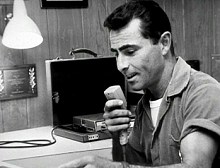
Even Hemingway wrote in a one sentence at a time mindset. Serling, being aware of his capacities, didn’t limit himself to actual writing of words. His generation of technology at least afforded him the dicta-phone so he could keep pace with his mind.

Write on, Rod!

de Bono on Creativity

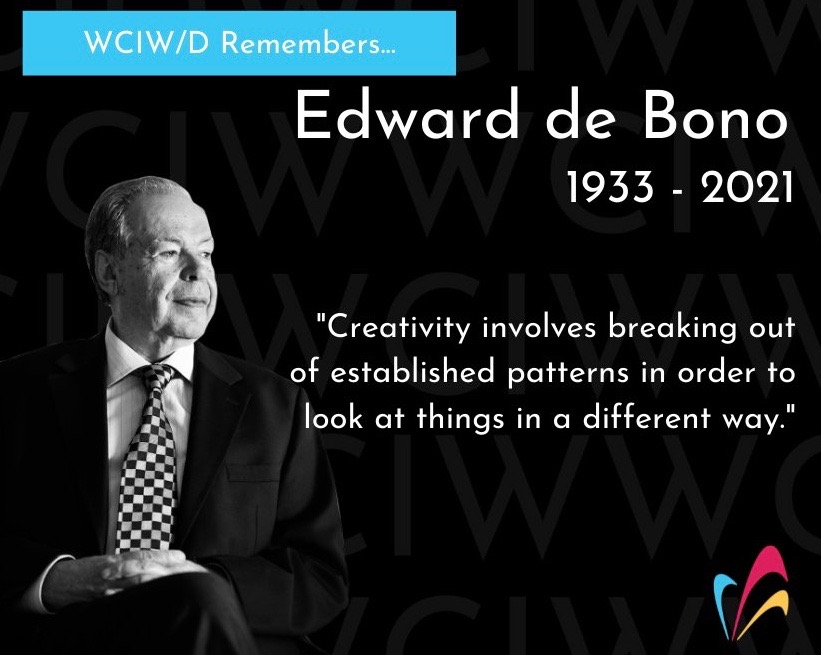
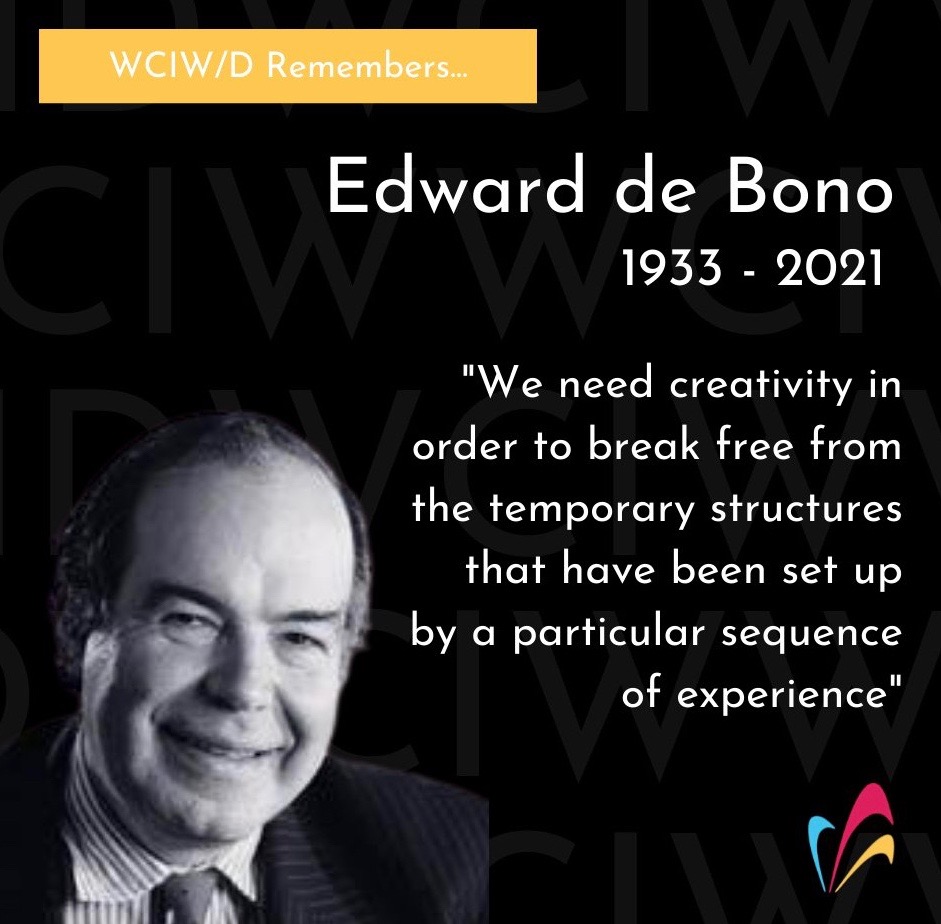
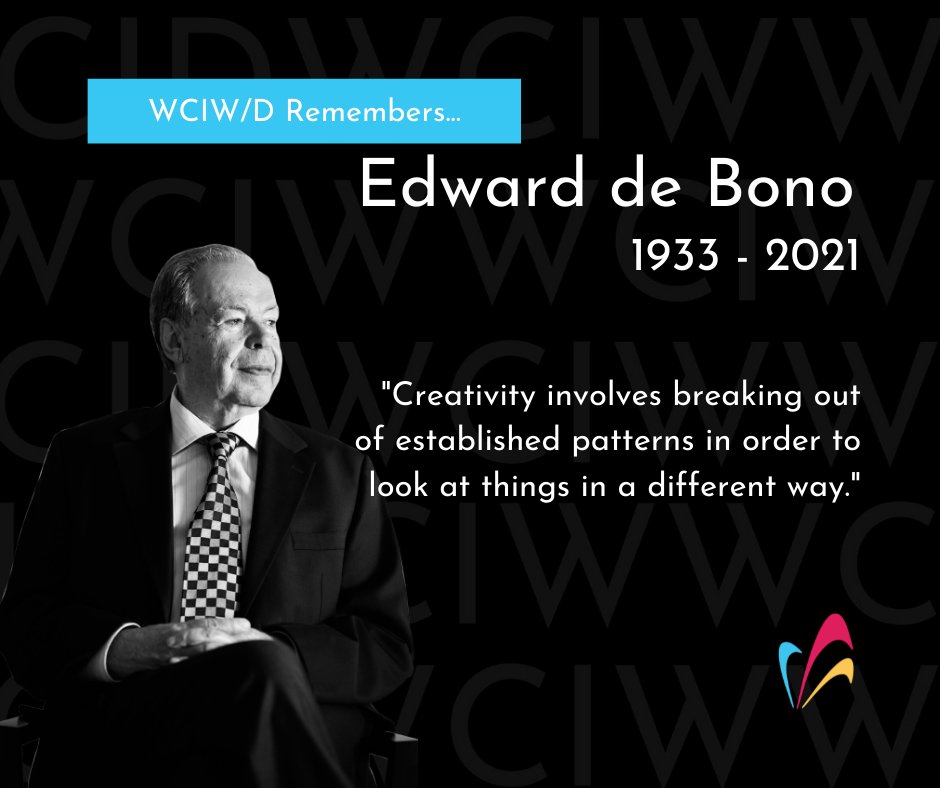
As you may know, Edward de Bono recently passed away. What he leaves with him is a vast treasure trove of creative insights and reminders of how and what we might do to strengthen and enhance our own creativity. Here are some select quotes from him provided by the World Creativity Innovation Week/Day and Prady, whom we thank for letting us further promote the creative thoughts of Dr. de Bono.

More de Bono quotes:

A memory is what is left when something happens and does not completely unhappen.

Most executives, many scientists, and almost all business school graduates believe that if you analyze data, this will give you new ideas. Unfortunately, this belief is totally wrong. The mind can only see what it is prepared to see.

Creativity is a great motivator because it makes people interested in what they are doing. Creativity gives hope that there can be a worthwhile idea. Creativity gives the possibility of some sort of achievement to everyone. Creativity makes life more fun and more interesting.

Creative thinking is not a talent, it is a skill that can be learnt. It empowers people by adding strength to their natural abilities which improves teamwork, productivity and where appropriate profits.

The need to be right all the time is the biggest bar to new ideas.

Bonus Quotes:

Humor is by far the most significant activity of the human brain.

It has always surprised me how little attention philosophers have paid to humor, since it is a more significant process of mind than reason. Reason can only sort out perceptions, but the humor process is involved in changing them.

Hopefully making a ruckus, one blog post at a time!

Be sure to check out my other blog, Joe’s Journey, for personal insights on life and its detours.

Don’t Look Now, Our Creativity is Leaking

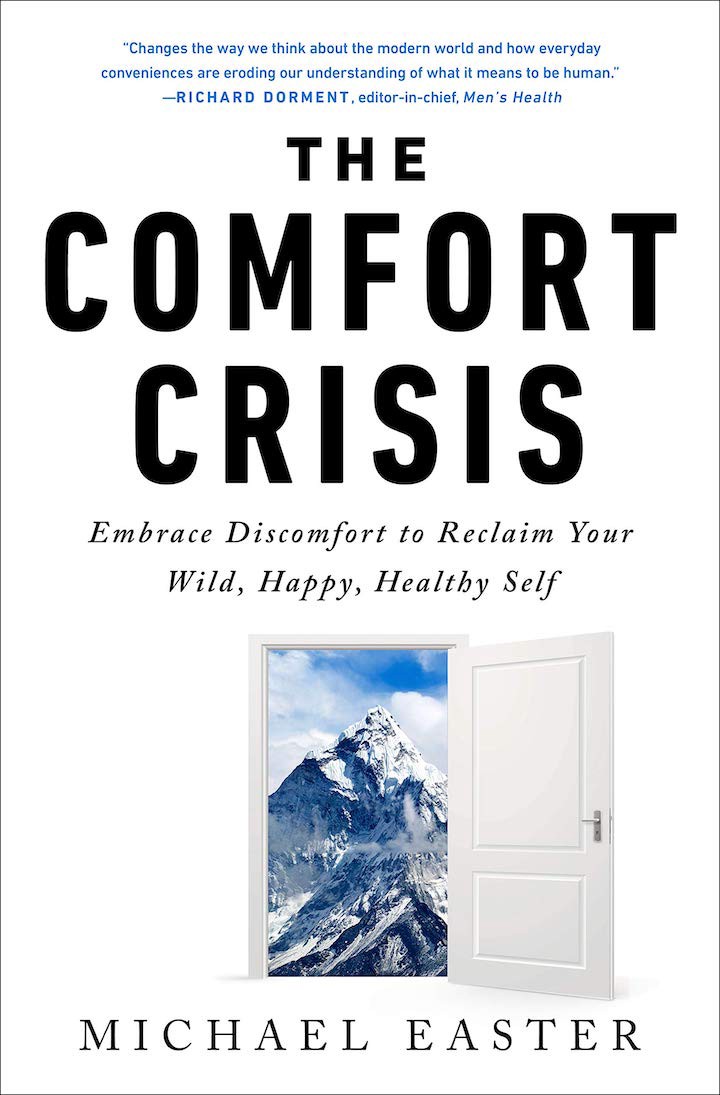
Portions of this post are based on excerpts from the book by Michael Easter, The Comfort Crisis. We spend an awful lot of time consuming digital media, lest we get easily bored. A recent study looked at what happens to a bored mind without easy access to media?

The Canadian neuroscientist James Danckert recruited some volunteers and put them into a neuroimaging scanner, and induced them into a mood of being bored They had them watch two guys hanging laundry for eight minutes. You could say they were bored out of their gords!

While bored, a part of their brains called the “default mode network” fired on. It’s a network of brain regions that activates when we’re unfocused, when our mind is off and wandering. Mind wandering is a rest state that restores and rebuilds the resources needed to work better and more efficiently when we’re focused on the outside world.

Mind wandering is also a key driver of creativity, which is why other studies have found that bored people score significantly higher on creativity tests. Research dating back to the 1950s may explain why we’re now facing a “creativity crisis.”

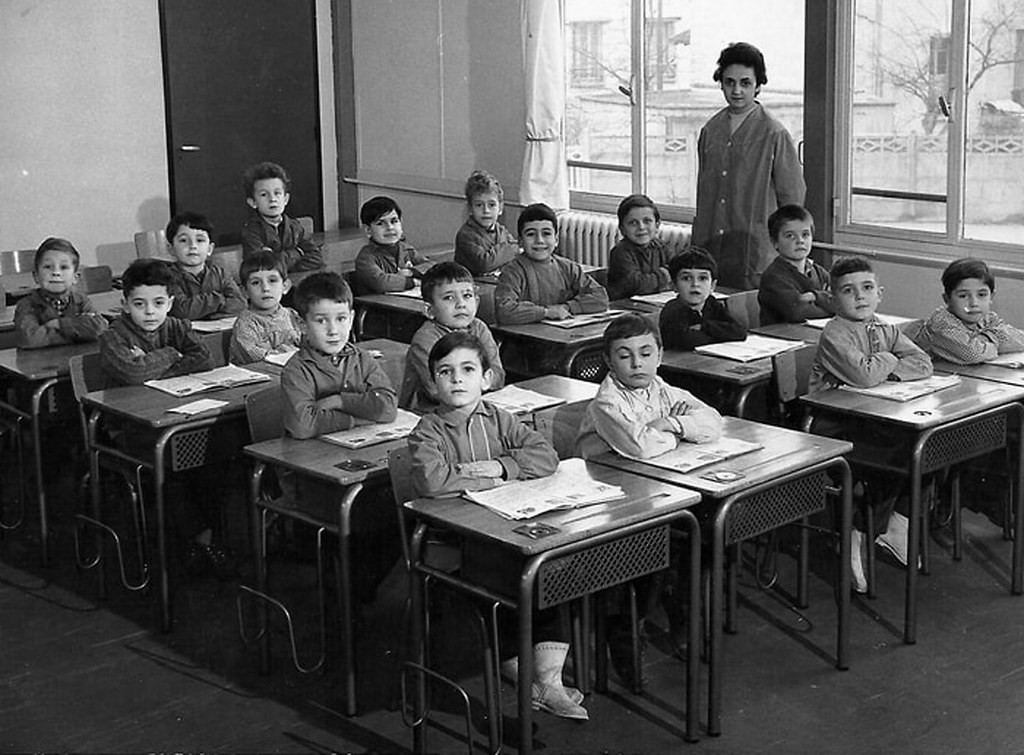
If I didn’t already know this was a 1950’s Classroom, I would have guessed it. Has that look and feel – BTW, where are the little girls?

Ellis Paul Torrance was an American psychologist. In the 1950s he noticed something off target about American classrooms. Teachers tended to prefer the subdued, book-smart kids. They didn’t much care for the kids who had tons of energy and big ideas. Kids who’d think up odd interpretations of readings, inventive excuses for why they didn’t do their homework, and morph into mad scientists every lab day.

The system deemed these kids “bad.” But Torrance felt they were misunderstood. Because if a problem comes up in the real world, all the book-smart kids look for an answer in … a book. But what if the answer isn’t in a book? Then a person needs to get creative.

He thus devoted his life to studying creativity and its uses for good. In 1958 he developed the “Torrance Test.” It’s since become the gold standard for gauging creativity. The TTCT (Torrance Tests of Creative Thinking) assess how creatively a child’s mind works and are often given to children to determine advanced placement or as part of an entrance examination. Instead of traditionally taught subjects such as reading or math, these tests assess creativity. Children are scored on a number of aspects, including:

  • Creative titles for pictures
  • Expressions
  • Imagery
  • and Humor

He had a large group of children in the Minnesota public school system take the exam. It includes exercises like showing a kid a toy and asking her, “how would you improve this toy to make it more fun?”

Torrance analyzed all the kids’ scores. He then tracked every accomplishment the kids earned across their lives, until he died in 2003, when his colleagues took on the job. If one of the kids wrote a book, he’d mark it; if a kid founded a business, he’d mark it; if a kid submitted a patent, he’d mark it. Every achievement was logged. What he found raises big questions about how we judge intelligence.

The kids who came up with more, better ideas in the initial tests were the ones who became the most accomplished adults. They were successful inventors and architects, CEOs and college presidents, authors and diplomats, etc.

Torrance testing, in fact, bests IQ testing so much so that a recent study of Torrance’s Kids found that creativity was a threefold better predictor of much of the students’ accomplishment compared to their IQ scores.

Now, according to Easter, we’ve killed off one of the main drivers of creativity: mind wandering. The result? A researcher at the University of William and Mary analyzed 300,000 Torrance Test scores since the 50s. She found that creativity scores began to nosedive in 1990.

She concluded that we’re now facing a “creativity crisis.” The scientist blames our hurried, over-scheduled lives and “ever increasing amounts of time interacting with electronic entertainment devices.”

And that’s bad news. Particularly when we consider that creativity is a critical skill in today’s economy, where most of us work with our brains rather than brawn.

Despite what productivity gurus will have us believe, the key to improving creativity might be to occasionally do nothing at all. Or, at least, not dive into a screen. We’ll think distinctly, in a way that delivers more original ideas.

Yet, ironically, society’s tech giants still deliver more advanced software to supposedly aid us in our creativity, while holding us increasingly captive. A proper balance has yet to be realized. And may not ever.

While it may sound silly, occasionally doing nothing works. At least for me, it does. Of course, my body may not be doing anything but my mind is usually traveling at warp speed. It’s usually during these times that I let my mental forces do what they’ll do. More times than not, they produce . . . an idea . . . several ideas . . . a partial script . . . something to which I can apply time-in-the-future to develop.

Boredom is just one evolutionary discomfort we’ve lost from our lives. Easter’s book, The Comfort Crisis, investigates nine others, covering what happens to our bodies, minds, and sense of self without them—and the benefits we can reap by reintroducing these evolutionary discomforts into our lives.

Seth Godin on Creativity

“To count, it needs to ship,” Seth Godin.

Whatever you end up creating, for it to count, it needs to ship. Ship in the sense that it needs to be published, displayed, lectured, drawn, invented, etc. Whatever you create needs exposure.

If you’re not that familiar with Seth or his myriad of work, go explore Seth’s site. You’ll be glad you did.

I’ve been following Seth’s podcast, Akimbo, for several years now and find it quite nourishing. I also subscribe to his emails. How he does this 365 days of the year, I’ll never know.

But, I’m glad he does.

So take a listen below to Seth’s take on Creativity if you haven’t already. Once done, choose to create something.

Then ship it!

Hopefully making a ruckus, one blog post at a time!

Be sure to check out my other blog, Joe’s Journey, for personal insights on life and its detours.

Special Edition: Creativity Mastermind, Father of Lateral Thinking Edward de Bono Has Died

I couldn’t let the week go by without a Tip-o-the (Six) Hats to the truly creative wizard I had the pleasure of meeting back in 2005 at an international creativity conference.

Creative thinker Edward de Bono has died less than a month after celebrating his 88th birthday. De Bono died last Wednesday morning and the news of his passing was announced by his family. 

I really didn’t know anything about him before I met him at this conference in Austin, Texas. He was one of the featured panelists at the conference and, one could argue, probably the most famous. He was also unassuming as he sat there on the panel giving out advice and counsel based on his many books, especially Six Hats.

Edward de Bono photo: Roy Zhao

That’s one of several he autographed for me as we visited for a brief bit following his presentation.

Born in Malta, De Bono graduated as a doctor but went on to study psychology and physiology from where he developed an interest in thinking processes.

He fathered the phrase lateral thinking, which has an entry in the Oxford English Dictionary, and developed multiple thinking strategies, including the Six Thinking Hats method.

In a statement, his family described de Bono as a global citizen, who returned to Malta in his final years.

“This has always been his home. He lived an extraordinary life, inspiring, encouraging and enabling all of us to be better and more creative thinkers. He wrote in his book The Mechanism of Mind: ‘A memory is what is left when something happens and does not completely unhappen.’ May the memory of Edward live on and inspire many future generations,” the family said.

De Bono received his initial education at St Edward’s College and the Royal University of Malta, where he achieved a degree in medicine. Then as a Rhodes Scholar at Christchurch, Oxford, where he gained a degree in psychology and physiology and a D.Phil. in medicine.

He holds a PhD from Cambridge, a DDes from the Royal Melbourne Institute of Technology, and a LLD from Dundee. He has had faculty appointments at the universities of Oxford, Cambridge, London and Harvard. 

Thanks to the World Creativity and Innovation Week/Day

He has written over 60 books and programs, with translations into 43 languages, has been invited to lecture in 58 countries and has made three television series. Included among these 60 books are Serious Creativity, Creativity Workout, and Handbook for the Positive Revolution, all now displayed in my library with his autograph.

His ideas have been sought by governments, not for profit organizations and many of the leading corporations in the world, such as IBM, Boeing, Nokia, Siemens, 3M, GM, Kraft, Nestle, Du Pont, Prudential, Shell, Bosch, Goldman Sachs, Ernst & Young and others.

The global consultancy, Accenture, chose him as one of the fifty most influential business thinkers. In a 2004 interview with MaltaToday, de Bono even proposed a solution to the Israeli-Palestinian conflict as he launched his thinking centre in Malta.

In 1994, de Bono was made an officer of the National Order of Merit by the President of Malta.

Thanks to Kurt Sanson of MaltaToday for material upon which this blog is based.

Hopefully making a ruckus, one blog post at a time!

Be sure to check out my other blog, Joe’s Journey, for personal insights on life and its detours.

Depression, Creativity and Leadership-Part 2

In Part 1 it was suggested that dwelling on repetitive thoughts can lead to useful reasoning and help with problem-solving. Another suggestion is that a depressed person may have a more realistic assessment of a situation. However, there are little data to support the notion that these cognitive features of major depression may aid in problem solving or creativity.

Previously, the example of Abraham Lincoln was used to raise the question as to whether he rose to greatness in spite of his apparent depression or alternatively was in some way aided by it. In reviewing arguments in favor of depression contributing to creativity or leadership, it was suggested that there are a number of challenges to the evolutionary viewpoint that depression might have desirable qualities.

Here in Part 2, again adapted from an article in Psychology Today, at least two kinds of cognitive traits have been taken to support some positive aspects of depression. They suggest that either the ruminations typical of depression, or a potentially more realistic assessment of situations, may have value in problem-solving.

Potential value of repetitive thoughts . . .

The notion that dwelling on repetitive thoughts may be useful has recently gained support from a study showing changes in brain networks associated with this activity (1). The “analytical rumination hypothesis” suggests that ruminations can lead to useful reasoning, first in a causal analysis and then in a problem-solving analysis. The implication is that ruminations can help a person come up with explanations and solutions for an unhappy event.

Counter-arguments would be that this view works best when depression seems tied to a particular trauma, and may more likely be a healthy response in a person who is sad after a specific upset; it is less clear how it might work in seemingly paralyzing severe depression, chronic depression, post-stroke depression, or mood disorders of old age (3).

Among those who study evolutionary psychology, there is an even split over whether rumination is adaptive; it suggests that supporters are more likely to be non-clinicians, while clinicians, who have witnessed patients who seem stuck in ongoing non-constructive circular thinking, are more skeptical (4).

We need bear in mind the distinction between sadness, and major depression, in which a despondent mood dominates one’s life for at least two weeks, and is associated with decreased functioning, cognitive changes, and a host of physical symptoms.

It might be that ruminations are more likely to be useful when one is sad, but that in major depression they are more likely to be circular and non-constructive. In major depression ruminations might be part of a constellation of cognitive changes which are generally unhelpful, like alterations in memoryattention and decision-making.

Realistic assessment of situations

A second argument as to how depression might be adaptive suggests that persons with depression benefit from what is known as “depressive realism.” In one often-cited study, depressed and non-depressed students were given problems on a computer and asked to what degree they felt their actions were related to a light flashing on the screen.

Non-depressed subjects tended to overestimate their responsibility when light flashing was frequent and considered desirable, and to underestimate it when lights were considered undesirable. Depressed persons had much more realistic assessments of the degree to which their actions were responsible for the lights flashing (5).

The degree to which depressive realism could play a role is not firmly established. One large analysis of available studies concluded that overall there was “a small depressive realism effect.” On the other hand, the authors noted that the findings were more likely to be positive in studies that lacked objective measures of realism and relied more on self-report (6).

In summary, reaching back to part 1 of this two-part series, depression’s ubiquity does not necessarily argue that evolution has favored it as an advantageous trait. Though it is an attractive idea, modern studies have had mixed results on whether there is a relationship between major depression and creativity.

The hypothesis that ruminations in depression lead to problem-solving is controversial, and may be of limited applicability. A second notion is depressive realism, but its effect is small and whether it is seen at all is highly dependent on the methodology of the studies.

It’s important to distinguish between sadness or depressed feelings in response to specific difficult experiences, and major depressive disorders. It seems possible that we have a built-in response to specific difficult experiences which sometimes can be of help in assessing problems and leading to solutions.

It also seems possible that some people such as Lincoln found ways to harness their distress and use it to spur a drive for achievement. But this is different from arguing that major depression is an often helpful state, or that any possible upside compensates for the suffering it involves.

As for me, my bouts with depression would have to produce a significant upside to adequately compensate for what I go through to get back to a state of normalcy. Thus far, only time, positive thought and medication help me get out of the clutches of depression. While in those clutches, however, I trust I don’t lose access to my inherent creativity. We all have it and it can be amazing!

References

1. Zhang, R. et al.: Rumination network dysfunction in major depression: a brain connectome study. Prog. Neur-Psychopharmacol and Biol. Psychiat. 98, March 2020. https://doi.org/10.1016/j.pnpbp.2019.109819

3. Lehrer, J.: Comments by Peter Kramer in ‘Depression’s Upside’, New York Times, February 25, 2010.

4. Kennair L.E.O., Kleppestø T.H., Larsen S.M., Jørgensen B.E.G. (2017) Depression: Is Rumination Really Adaptive?. In: Shackelford T., Zeigler-Hill V. (eds) The Evolution of Psychopathology. Evolutionary Psychology. Springer, Cham. https://doi.org/10.1007/978-3-319-60576-0_3

5. L.B. Alloy and L.Y. Abramson: Judgment of contingency in depressed and nondepressed students: sadder but wiser? J. Experimental Psychol. General 108: 441-485, 1979. https://pubmed.ncbi.nlm.nih.gov/528910/

6. Moore, M.T. and Fresco, D.M.: Depressive realism: a meta-analytic review. Clin. Psychol. Rev. 32: 496-509, 2012. https://doi.org/10.1016/j.cpr.2012.05.004

Bored? Good! Quarantined? Yes! How’s Your Creativity? Read This.

Anxiety, panic, fear, pandemic stress: The cornerstones of the negative universe. Yet, while all hell is breaking around us, can we still muster up the courage to innovate and create. Is creativity still alive or is it merely napping? Do we create out of despair or want? Out of necessity or desire? I guess that depends on each one of us.

In a recent article in Psychology Today, boredom is cited as an almost certain stimuli for creativity. Now, some of you may not agree with this, and that’s okay. If you don’t and even if you do, let me hear from you with your reasoning.

According to the article, which contains some very interesting points I want to share with you, you’ll see explosive creativity everywhere you look: in how people stuck at home are constructing elaborate recreations of their favorite artworks for the #GettyChallenge; or how we make ways to connect—whether it’s singing from our balconies or happy hour delivery via drones—while social distancing; even in the acerbic memes and uplifting stories flooding social media to offer inane distractions and inspire hope during this crisis.

Interestingly, quarantine and the resulting ennui (a feeling of listlessness and dissatisfaction arising from a lack of excitement) of our home-bound brains have proven to be a catalyst for innovation. Thus, boredom breeds inventive creativity, as long as it’s the right kind of boredom.

Fruitful Boredom

Psychological studies describe five levels of boredom: indifferent, calibrating, searching, reactant, and apathetic. In its seeking state, boredom drives us to find something to engage and delight us. Think of the imaginary friend you had as a child; you did have an imaginary friend, didn’t you? Or the games you’d play with that certain stuffed animal, whose goal in life seemed to be avoiding Mom’s washing machine. Both scenarios seemed to trigger one’s own imagination, and, thus, your creativity. (Note: At least it did mine.)

In today’s society, real boredom escapes us; it seems everywhere you look, all eyes are staring into multiple-shaped devices hosting 24/7 news and entertainment. It’s as if we have to go out of our way to truly be bored.

bonding time of mother and child

Photo by cottonbro on Pexels.com

While technology provides us creative outlets and a means of connecting when we are physically isolated from one another, these distractions are like the digital equivalent of junk food for our brains while good old fashioned boredom is a hunger that nurtures creative thinking.

What’s unique about this quarantine is that it constrains us in so many ways.  Our typical means of working, socializing, and even provisioning ourselves have been dramatically restricted. And while people tend to think that constraints limit creativity and innovation, research proves quite the opposite to be true.

Continue reading

New Report Reveals Crisis in Creative Effectiveness

We like to think that every creative execution hits right on target. Well, we know better even when we don’t like to admit it. A recent report from the UK, suggests quite the opposite, that creative effectiveness is being called into question.

UK advertising agencies are fast-paced, dynamic and produce advertising, media and marketing that many consider to be the envy of the world.  One organization that voices their concerns, showcases their work and continuously develops their skills to keep them at the top of their game is the Institute of Practitioners in Advertising (IPA), incorporated by Royal Charter.

The IPA exists to help members be the best they can be. They set the protocols for the UK industry’s best practice standards. They advise on how to choose an agency, how to run an agency or how to behave if you work in an agency. They also work collaboratively with members to improve diversity within the industry.

So, as this new report makes the rounds of the British ad scene, it will be interesting to see what the reaction is. It will, I dare say, be interesting to watch what, if any, reaction there is here in the US. If anything, the US has always been much more conservative in our approach to advertising compared to the UK. Does that conservatism mean our ads are more effective than theirs. Doubtful. It’s sort of like comparing apples and oranges. Continue reading

“Creativity,” Again, Most In-Demand Soft Skill for 2020, Says LinkedIn!

Not surprisingly, CREATIVITY is once again king of the soft skills for 2020. Based on a LinkedIn Learning report from earlier this year, Creativity was not only the most in-demand soft skill last year, it has retained its place as we move onward in 2020.

Furthermore, LinkedIn said, “Organizations need people who can creatively approach problems and tasks across all business roles, from software engineering to HR”.

LinkedIn Learning researched timely data from their network of over 660+ million professionals and 20+ million jobs to reveal the 15 most in-demand soft and hard skills of 2020. Persuasion, collaboration, adaptability and emotional intelligence rounded out the top five, all skills that demonstrate how we work with others and bring new ideas to the table.  Four of the five most in-demand soft skills remain in their top spots year over year.

The lone exception, LinkedIn noted, was emotional intelligence — defined as the ability to perceive, evaluate and respond to your own emotions and the emotions of others — a newcomer to its list, which “underscores the importance of effectively responding to and interacting with our colleagues.”

The one variation in the most in-demand soft skills list indicates that companies are gravitating toward talent with interpersonal and people-oriented skills. It’s notable that employers are placing more emphasis on emotional intelligence in particular.

The top 5 most in-demand soft skills are: 

#1 Creativity – Same as 2019

Organizations need people who can creatively approach problems and tasks across all business roles, from software engineering to HR. Focus on honing your ability to bring new ideas to the table in 2020.

#2 Persuasion – Same as 2019

Leaders and hiring managers value individuals who can explain the “why.” To advance your career, brush up on your ability to effectively communicate ideas and persuade your colleagues and stakeholders that it’s in their best interest to follow your lead.

#3 Collaboration – Same as 2019

High-functioning teams can accomplish more than any individual—and organizations know it. Learn how your strengths can complement those of your colleagues to reach a common goal.

#4 Adaptability – Same as 2019

The only constant in life—and in business—is change. To stand out in 2020, embrace that reality and make sure to show up with a positive attitude and open-minded professionalism, especially in stressful situations.

#5 Emotional Intelligence – New

Emotional intelligence is the ability to perceive, evaluate, and respond to your own emotions and the emotions of others. New to the most in-demand skills list this year, the need for emotional intelligence underscores the importance of effectively responding to and interacting with our colleagues.

Continue reading

Crisis Coping for Creative Pros – Part 3 of 3

Over the past two blog posts about crisis coping, we’ve listened in on a conversation between the author, Ellyn Kail, and photographer Danny Ghitis about various methods to cope for creatives who have been entangled in the Coronavirus pandemic.

In this, the third and last post of the series, they explore what it’s like finding a sense of community during these very scary times.

*********************************

In the last two weeks, I have received more than two dozen emails about the temporary closures of galleries and studio spaces amid the coronavirus pandemic. I’ve received several more about canceled exhibitions. This is a period of uncertainty for the photography community as a whole, but in this time, we’ve also witnessed people coming together.

In between those letters about closures and cancelations, there have also been emails from artists who are hosting camera giveaways, publishers who are discounting their books, and non-profit organizations who are offering free talks and photog resources.

Globally, photographers are sharing information about how we can donate supplies to local hospitals and encouraging us all to practice social distancing for the safety and well-being of the community.

Over the past week, we’ve spoken to the photographer and professional development coach Danny Ghitis about how creatives can cope during this time and continue to create meaningful work in unprecedented circumstances.

Photography, like any art form, can be a solitary pursuit, but it’s also full of communities and resources. With all the recent gallery closures and exhibition cancellations, how can photographers stay connected and engaged with one another?

“This is so crucial. One of the main causes of my own burnout was a feeling of isolation as a photographer, and that was way before all this coronavirus mayhem. We are wired to need other people. That lone wolf photographer icon can be really damaging because it makes asking for help look like a weakness when, in reality, it’s a superpower.

“In a way, this moment offers a unique opportunity. Everyone is struggling with the same overarching challenge. Everyone needs help, and we have the technology to easily stay in touch. We’re not as spread thin as usual with a thousand networking events, galleries, meetings, etc. So reach out, offer support, provide feedback, invite conversation, have a virtual coffee, host a roundtable discussion.”

Has the creative community faced any upheavals like this one in recent years, if not on the same scale? If so, what can we learn from that time, and how can we apply those lessons to the here and now?

“I graduated from college with a photojournalism degree in 2006, the year before the iPhone hit the market and changed everything. The newspaper bureau where I interned closed a couple months after I arrived (not my fault, I swear!). I started my freelance career at the same time as the 2008 financial meltdown.

“Somehow, I made it work and grew as a human and professional. And guess what, I’m not that special. Human beings are resilient by evolutionary design. We’ve outlasted and overpowered nearly every other living organism and are capable of incredible adaptation. If you’re reading this and you’re human, you already have the tools you need inside your body.”

What are some ways you see the creative community coming together right now to support and help one another? Any moments that have given you hope?

“All of a sudden we’re in it together. We have a common struggle and purpose. We’re thinking collectively like a tribe like in the good old prehistoric days. Of course, we don’t wish sickness and suffering upon anyone and hope this goes away soon, but it does offer a unique opportunity to see the big picture.

“I keep getting emails and social media posts about virtual gatherings and support groups, and I am getting more messages than usual from friends checking in. I just started an online meetup group, and there are lots of others out there if you’re willing to search. It’s all about taking initiative and reaching out.”

How would you advise photographers and other creatives who suddenly have a lot of free time on their hands?

“This can be viewed as a great opportunity because we’re being forced to evaluate how to spend our time wisely. First, the mindset work. If you’re not in a good state of mind, it’s very hard to be focused and productive. If you want business results, practice self-care. Remember how flight attendants demonstrate putting on your oxygen mask first? Same deal. Take care of yourself to take care of others.

“Ask yourself, ‘How can I serve?’ It’s easy to get caught up in self-centered problem solving during a crisis, while orienting toward service can be more effective in creating action and will make you feel better. What do others need, and what skills do you have that can help them?”

**********

We are truly living in unprecedented times. Deadly times. History has recorded plagues, wars, and various catastrophes yet we’ve managed to survive. Granted, the planet has lost life in measurable means before but we’ve never faced a global pandemic like this before. I guess, in a sense, this could be compared to chemical warfare on a global scale from an invisible enemy.

Yet, we will live on. We will create and innovate. We have to do that now to find a vaccine to nullify the virus so we may begin to get used to a new normal. Things won’t be the same since we won’t be the same, those of us who will survive. But we will. We have to. Together. Smarter. Stronger. More persistent. Less partisan.

Wait, what’s that? It’s creativity knocking at the door. Let’s welcome her in, shall we!


This is part three of three of our interview with Danny Ghitis. Here are parts one and two.