
Just last week I read in AdAge about recent developments in the industry to deal with current trends and news-making discussion. Thanks to Ewan Larkin, Gillian Follett, Brandon Doerrer, and Jon Springer for putting this article together. I felt it appropriate to share with you for reading pleasure and knowledge.
Advertising Week New York returned to the Penn District last week with a bevy of creators, the same dizzying lines and crowds and, at least in intent, less AI conversation. Agentic media buying was a hot topic, too, with executives mulling over how much control software should have over the process. Key takeaways below.
The push and pull of AI
One year after ChatGPT trucks swarmed the conference, Advertising Week tried to turn down the volume on AI. The push started before the event, with a campaign promoting face-to-face interaction. This week, event staff wore T-shirts urging attendees to “give AI a break,” a message that also blared on screens during panels.
“I’ve been to eight conferences this year and this is the first one where the panels and conversations were not completely dominated by talk of AI,” said Tom Morrissy, chief growth officer at media agency Noble People.
That could also be because some of the AI conversation shifted to other marketing conferences held this week. Former WPP CEO Mark Read brought his new invite-only, AI-focused event series, Prompt, to Manhattan on Tuesday. On Wednesday, influencer marketing platform Statusphere hosted its inaugural Status Summit, centered on how AI is reshaping the customer journey. And on Thursday, marketing leaders including Ulta Chief Marketing Officer Kelly Mahoney and PepsiCo Beverages U.S. CMO Mark Kirkham took the stage at Zeta Live, the annual conference hosted by martech company Zeta Global.
Still, plenty of Advertising Week programming focused on AI, from agentic commerce to how brands compete in the world of large language models. There was a good deal of tech on display, too. Kovio, which sells ad space on humanoid robots, had one stumbling through the building, waving and blowing kisses at the many passersby it drew.
Celebrities, big crowds and a change in venue
The Female Quotient’s FQ Lounge was one of the hottest spots, consistently packed from Monday through Wednesday as attendees sought out CMOs and brand executives.
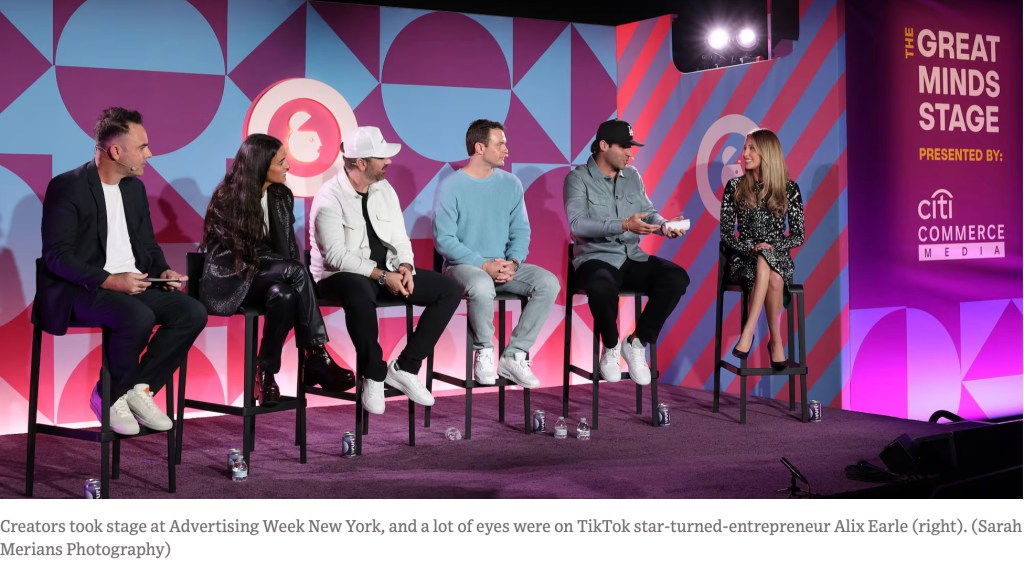
Trevor Noah drew a long line for his Great Minds Stage session focused on brand partnerships and YouTube. Attendees also crammed into the small Marketplace Stage room to see Terry Crews and leaders from Ogilvy and Creative Artists Agency discuss AI and protecting creator and celebrity likenesses. TikTok star-turned-entrepreneur Alix Earle was on stage Tuesday morning for a conversation about the creator economy.
Creator marketing has outgrown the sponsored post
Conversations around creator marketing have officially evolved beyond best practices for brand-sponsored social posts. Several panels instead explored creators’ growing influence on everything from AI search to Hollywood.
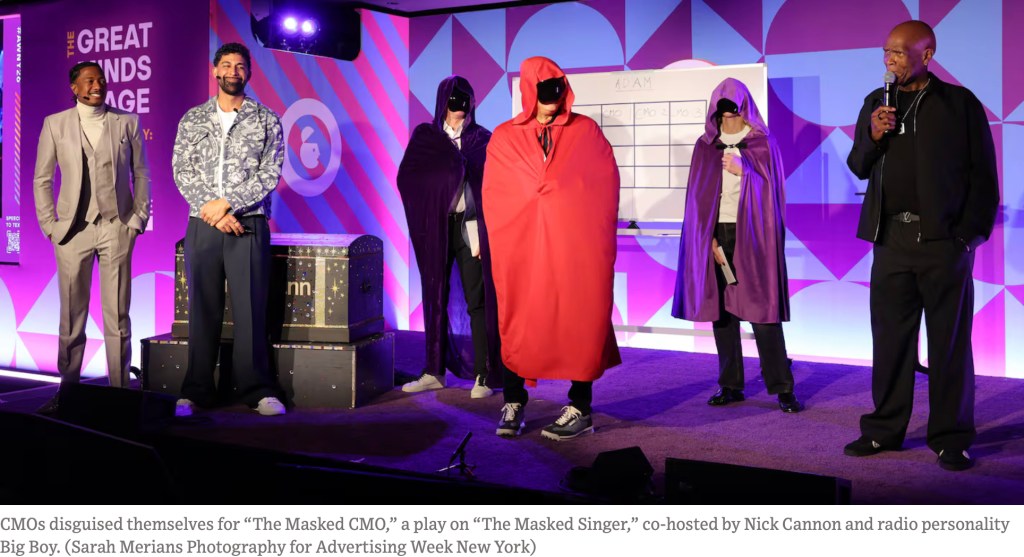
On Thursday, creator Dhar Mann took over the main stage to host Advertising Week’s first “Creator Day,” where CMOs, creators and other attendees participated in games and challenges inspired by reality TV formats. A session called “The Masked CMO” (inspired by Fox’s “The Masked Singer”) had NFL CMO Tim Ellis, Blizzard Entertainment CMO Monica Austin and Wendy’s newly installed CMO Tariq Hassan don cloaks and masks and describe what they’re seeking from creator partners.
“Facilitating the environments where creators and marketers can be together in the same room is something I think we need to do more often,” said Jessica Williams, CMO of financial services app OnePay, who spoke during Mann’s Creator Day. She said she’s focused on establishing more direct relationships with creators, particularly those who work with the brand on larger, longer-term campaigns, rather than routing everything through agencies.
“I have so many creators now that I can just text [to ask] ‘Hey, what do you think about this? Do you have anyone who might be interested in this?’” Williams said. Earle made a similar point during her main stage appearance, saying she’s currently in group chats with two brands she’s working on campaigns for and values being directly involved in those discussions.
Blenders Eyewear took that philosophy a step further in July, when it brought creator Jordan Howlett into the C-suite as the brand’s first chief content officer. On stage at Advertising Week, Howlett and Blenders CEO Jack Gray discussed how the partnership goes beyond a typical ambassador deal, giving Howlett a say in the brand’s content strategy and product development.
“We’re reaching such a transitional period, where I think a lot of people—creator, brand or otherwise—are realizing that the previous [creator marketing] model … has run its course,” Howlett told Ad Age. He expects that more brand-creator partnerships in 2027 will resemble his relationship with Blenders.
Another recurring theme was marketers allocating bigger parts of their creator budgets to creator-hosted events and experiences in 2027. Scott and Alexis Fisher, co-founders of Creator Nation, the newly launched, Live Nation-backed creator management venture, told Ad Age that helping creators organize and host live events—from stadium tours to mall meet-and-greets—is a major priority for the firm.
“We want to bring back that fandom and the fan experience that really drives creators,” said Scott Fisher, who founded talent firm Select Management Group in 2010. He recalled that in the creator economy’s early days, “our clients would show up to a mall, and the fire department would get called” when the crowd inevitably got too large. “If you have fans, then you have a business—a long-term business.”
Creator-hosted events are emerging as a bigger priority across industries. OnePay’s Williams and Carlos Wigle, chief creative officer at personal-injury law firm Morgan & Morgan, both said they plan to partner with creators on events next year. “In a world of AI, people want those real experiences,” Williams said.
Agentic media buying questions remain
Leaders from brands and agencies discussed the potential for AI agents to take over more of the media buying process, and questions remain about how much control advertisers are actually willing to hand over. Several sessions explored the technology needed to automate media transactions, connect agents across buying platforms and shift more investment decisions away from humans.
A Thursday session presented by Vistar Media—featuring Maureen Bosetti, chief investment officer at Omnicom Media; Bruce Williams, CEO of dentsu X; and Danielle Sporkin, senior VP of media and marketing services at Ferrero—examined the risk of prioritizing faster media execution at the expense of strategy, creative and a meaningful understanding of audiences. At a Wednesday panel hosted by Snowflake, Jason Dailey, North American agency partnerships lead at Meta, and Mike Treon, head of connected TV and video strategy at PMG, stressed that agents still need a deeper understanding of brands’ businesses before they can be trusted to make those decisions.
Dailey said agents need three things to make useful media decisions: context, constraints and an understanding of consequences. That includes everything from a brand’s budget and margins to seasonality and restrictions on where it will advertise. While AI models have become more sophisticated, connecting them to that information remains challenging.
“The models were really never the hard part,” Dailey said. “The hard part was, how do you take those three C’s and then actually get that into the ad system?”
Meta announced new capabilities for its AI business assistant that provide more memory of advertisers’ past campaigns, goals and seasonality, along with tests of tools that allow advertisers to create campaigns, adjust targeting and change budgets through conversational prompts. Meta is also expanding its Model Context Protocol server, which allows advertisers to connect outside AI tools to its ad platform. Actions prepared by agents can be transferred into Ads Manager as drafts, with explicit advertiser approval required before campaigns go live.
For now, adoption remains uneven. Dailey said some agency partners are restricting access to agentic tools to a handful of employees, while others are making them available across their organizations. The degree of autonomy varies as well, from allowing agents to retrieve campaign information to permitting them to make actual changes. Those decisions depend partly on each organization’s technology investments and appetite for risk.
Hopefully making a ruckus, one blog post at a time!
Be sure to check out my other blog,Joe’s Journey, for selected short stories and personal insights on life and its detours.

