The end of mid-size agencies? Inside the shifts that will reshape the ad business

This story is part of Ad Age’s Future of Advertising 2030 series exploring how marketing, media and creativity will evolve over the next five years.

Advertising agencies are in the process of setting strategies for the next five years despite numerous unknowns—the impact of AI, speed of consolidation and increasing ease of in-housing among them. These variables may have wide-reaching impact, including the potential demise of mid-size agencies, that marketers should be preparing for now.

On Ad Age Insider, Ad Age reporters look at the future of ad agencies and strategies that industry leaders are putting into place now to prepare.

“A lot of [agencies’] executional work becomes commoditized by AI, and a lot of marketers will have pretty robust in-house systems. So the real value and agency lie in their strategic thinking and being able to bring an outsider perspective to the equation.” –Ewan Larkin, agency reporter, Ad Age

Ad Age Insider podcast transcript

Parker Herren, host: How will the agency landscape transform by 2030? What has surprised you guys the most in your reporting on the future of agencies?

The demise of mid-size agencies

Brian Bonilla, senior agency reporter: It’s hard to be surprised, but I would say something that might surprise people in general—the role of the mid-size agency might go away by 2030, meaning we’re already seeing a lot of small, independent agencies get a lot of business, but we’re now starting to see those same agencies competing with each other and competing with large agencies and seeing a leveling of new business opportunities. And at the same time, mid-size agencies, which typically range from like 100 to maybe 250 employees, are competing with large holdco networks of like 5,000 employees for the same business. 

So by 2030, you’re going to see those mid-sized agencies either merge with other entities or sell to private equity firms or things like that. That’s going to be something that might be surprising for a lot of people, and I think will happen quicker than people realize.

How agency structures will shift

Ewan Larkin, agency reporter: This is interesting. For a couple of years, agencies have been trying to market themselves as consultants, and it hasn’t really stuck. To some degree, it has, but I think it’s obvious they are still service providers fundamentally. But I actually do think now we might see that shift start to stick a little bit. A lot of the executional work becomes commoditized by AI, and a lot of marketers will have pretty robust in-house systems. So the real value at agencies lies in their strategic thinking and being able to bring an outsider perspective to the equation. 

I think that puts them in direct contact … with the likes of Deloitte Digital and Accenture Song. So the focus for agencies really should be building up some of those consulting capabilities and commerce consulting capabilities. Agencies like VML are already starting to do this. They rolled out a unit earlier that encompasses consulting, CX and other things, and that already accounts for about 40% of their overall global revenue. So, I expect more people to make moves like this. This is one of the early stages of holding companies really being able to package up one of those offerings.

Parker: For Ad Age’s Future of Advertising package, media reporter Brandon Doerrer wrote about 2030 readiness. And chief technology reporter Garett Sloane dug into the 2030 tech stack. That sounds pretty thrilling. What did you guys find in your reporting?

Brandon: People tend to think that there are just going to be more and more integrated accounts, especially between creative and media. The walls are really coming down between those two functions. We are seeing brands increasingly hire the same agency to handle both of those functions. So, agencies are going to need to get used to those two functions not being in silos anymore, not having walls exist between those two teams.

Garett: We’re already starting to see these roles change. We’re seeing shifting ways of billing clients, different business models, different services agencies have to cater to. So, it’s already happening. It’s going to happen more and more where agencies are going to have to operate as platforms and services that can interact with brands and help brands build their ad tech stacks, acting as consultants, acting as facilitators into this futuristic landscape.

That’s where agencies need to go, and they’re starting already by developing new products and services. Whether that will work is still an open question, and if they can adjust and change—some will, some won’t.

The social AOR resurgence

Parker: Let’s talk influencers. Gillian Follett covered the future of the social and influencer space. Is there any way the future of influencers will impact agencies in 2030?

Gillian: Experts that I talked to for the story said that they predict the spectrum of influencer agencies will stretch to the extremes. So, we’ll see more brands working with influencer functions within larger holding companies, or we’ll see brands looking to very specialized boutique agencies who specialize in specific platforms or types of creators, like gaming creators, for example.

We’re also going to continue to see influencer budgets increase, not at the same meteoric rate that we’ve seen over the past couple of years, but based on forecasts from intelligence companies like eMarketer, it’s definitely on an upward trajectory. 

We’re also seeing a resurgence of social agency of record assignments from brands across different categories. Something that I spoke to one marketer about was this idea that it’s not just the brands that are trying to target Gen Z or want to be social-first anymore that are looking for social AORs. It’s brands that they wouldn’t expect, like more established legacy brands are looking for social AORs. And a lot of these brands are seeking the insights that social media can provide in terms of what consumers are looking for, the types of products that they’re craving and using social as the foundation for their marketing campaigns rather than having social be a tacked-on piece at the end.

Parker: Okay, Lindsay, I’m going to let you round out this group with some intel from your reporting on the RFP process in 2030.

Lindsay Rittenhouse, senior agency reporter: Within the RFP process, agencies are going to have to stop the theater—the glossy presentations, the pitch decks, and really showcase how you’re working as a team. Get ready to be in more chemistry meetings—enough with the showboating and the theater in the pitch.

Parker: Tell us how marketers should begin preparing for that now.

Lindsay: Well, they have to set up the process so that there are more chemistry meetings and more time for the meatier stuff, the interviewing, the briefings, the working together, and just get rid of some of the processes. You don’t have to do these massive pitch presentations. [Marketers] are the ones who set the process for the RFP, so don’t allow the theatrics.

Agencies in 2030—how to plan ahead

Parker: I want to hear everyone’s advice for how marketers or agency leaders can begin prepping for their 2030 strategy. Why don’t we just go round robin, starting with you, Brian.

Brian: Start thinking about what type of agency model do you want as a marketer. We’re seeing roster agency models become way more popular, meaning instead of having just one AOR handle everything, I’ll have a social agency here, I’ll have a creative agency here or I’ll have a roster of five creative agencies. 

If you’re an agency, start thinking about what model makes the most sense for you to be in—should I be more niche or should I broaden my capabilities? And as a marketer—same question but on the flip side. If I’m going to be spending less on marketing, but I’m expecting to have more outcomes, what is the best model that makes sense for my external partnerships? Because I do think agencies will still be necessary as much as we’re talking about in-housing and things like that.

Ewan: They need to clarify which functions they want done in-house, which ones they need outsourced, very clearly defining what they can do themselves versus what is essential that they get from an external partner. There is a push for efficiency, and, obviously, everybody wants to save costs, so they want to bring it in-house, but you are going to need an external partner. You always do need that outside perspective. So, very clearly define what needs to be done yourselves and what you need an agency for. 

But rethinking agency relationships in general—they’ve always been seen as providers, that’s what they are, but now a lot of them are going to be actually helping build those internal capabilities. So identify which agencies are high-level strategic thinkers, which ones really understand your brand and your challenges, which ones can help me build my internal chops. Those are the ones that I think are likely to have long-term value.

Brandon: On the agency side of things, if you’re a creative agency and you don’t already have media capabilities, really digging in and evaluating if it would be worth building that out. If you have a unique angle, something to offer brands to make yourself stand out from the plethora of media agencies that can do the same thing. Media is probably in a similar boat. At least having an understanding of various creative processes is going to be helpful.

On the marketer side of things, brands can just not be afraid to ask. I did a story not too long ago about how indie creative agencies can respond to requests for media services. And the reason why agencies are starting to think about either building these capabilities internally or which media agencies they can partner with is because they’re getting these requests. Marketers—don’t be afraid to ask if you have an indie creative shop that you’re working with that doesn’t do media. They’re getting used to getting that question already, and they are starting to think about how to best answer that question. So, no dumb questions is the advice.

Garett: They could start developing the services and tools, and some are. We’ve seen agencies launch AI agents—the trading bots that they can all of a sudden potentially give out to brands to start to use. A lot of these tools that agencies are building are internal, but eventually, they’re going to make them external and start shipping them to brands to use as part of their suite of services. So, agencies start building internally and then will start giving it out to the masses.

Gillian: Brands should start considering whether they want to look to agencies to help them with sharpening their social strategies to adapt to this new way of seeking consumer insights from social and using social as a starting point for marketing. For some brands, it might make more sense to develop a social media team in-house to lead these efforts for the brand. Some brands have sought social media agencies of record because of the wide range of functions that are involved in social media marketing today, like paid social, creator marketing, social media intelligence gathering. There’s just a lot that goes into it these days.

Brands should start considering whether that’s something they can do in-house, or if they need to find partners to help them develop those strategies as social becomes more and more important.

Key Takeaways

  • Mid-size agencies will likely disappear by 2030, either merging or selling to private equity firms
  • Agencies are shifting from ad makers to consultants and platform builders
  • Creative and media functions will merge as brands increasingly hire one agency for both services

Hopefully making a ruckus, one blog post at a time!

Be sure to check out my other blog, Joe’s Journey, for selected short stories and personal insights on life and its detours.


Creative ideas—not spreadsheets—drive long-term brand growth

In a recent edition of Ad Age I caught an interesting article posted by Jon Gibbs having to do with the importance of creative ideas to brand growth. I thought it appropriate enough to share it with you. So here goes . . . enjoy!

In today’s climate of shrinking budgets, AI automation and relentless pressure to prove ROI fast, marketers are increasingly forced to make creative decisions based on what’s measurable rather than what’s meaningful. Dashboards and spreadsheets dominate boardroom conversations. But metrics tell you only what has worked. Creativity shows you what could work.

That difference is critical. The most powerful growth doesn’t come from simply following the data; it comes from ideas bold enough to break new ground. Ideas that capture attention, stir emotion and become memorable. Safe decisions may feel efficient, but safe doesn’t build distinctiveness. Safe builds sameness. And sameness is a dangerous place for brands to be in a hyper-competitive, three-second-attention world.

Creativity is what gives brands an edge. It’s how you move from being seen to being remembered. In other words, when creativity leads, the numbers follow.

The problem is that creative ambition is often cut short by over-measurement. Distinctive ideas can feel unfamiliar at first, and unfamiliarity makes people uncomfortable in a test group. Measure too early, and you’re often just testing comfort levels, not long-term effectiveness. As a result, bold work gets diluted or dropped before it has the chance to breathe.

So how can leaders, whether running an agency or leading marketing inside a brand, protect creativity in a world ruled by metrics?

Trust your instincts

We often turn to measurement when we’re unsure about trusting our instincts. But instinct isn’t guesswork: it’s built on years of experience, consumer understanding and category knowledge. Leaders who know their brand and market well should feel confident backing that expertise when making decisions.

That doesn’t mean being reckless. It means recognising that the best creative decisions often come from people who understand the brand and its audience most deeply, not from what a spreadsheet says.

Protect the process

Great ideas take time to evolve. They need space to be explored, debated and refined. Forcing ideas through rapid testing cycles or rushed approval rounds is more likely to drown out the creative ideas in favor of safer ideas proven by metrics. Agency leaders should create an environment where their teams can push boundaries without the constant fear of metrics-based rejection early on. Brand leaders must give their agencies the space to explore, not demand instant metrics.

The world’s obsession with efficiency often makes this worse. Too many global brand decisions happen in 15-minute Teams calls with a yes or no verdict. That’s not enough time for the deeper conversations that sharpen ideas. Feedback loops matter; every time work is put on the table, the team learn more about each other’s insights and instincts. Cutting those discussions out cuts out a lot of that depth that drives strong creative ideas. 

Protecting the process also means resisting the urge to test too soon. The point of iterative feedback is to build confidence before the work goes in front of consumers; otherwise, you end up evaluating unfinished thinking.

Know when to hold your nerve

Almost every bold idea meets a moment of doubt. They’re supposed to feel novel or different. Leaders earn their value by having the conviction to back the work. If the strategy is sound, the team is experienced and the creative instinct is strong, that’s the time to stand by it. 

Brand campaigns that hold their nerve are usually the ones that people remember. Nike did this with its “So Win” Super Bowl return this year (after 27 years), which highlighted the rise of female athletes. Rather than celebrity cameos or quick laughs, it backed a cinematic, purpose-driven film, and the risk paid off with one of the most celebrated ads of the night.

Use metrics wisely

Metrics are essential for informing insight, for sense-checking later in the process and for guiding optimization once work is in market. But they shouldn’t dictate the earliest imaginative ideas, because those ideas need space to breathe. 

And not all research is equal. Too often, multimillion-dollar brand decisions hinge on the cheapest possible online focus group. Thirty people in a £500 panel should not determine the fate of a £25 million brand. Poor-quality research is worse than no research at all. Whether you’re commissioning research on the brand side or interpreting it on the agency side, resist the temptation to reduce decisions to the cheapest possible test.

Telstra’s recent stop-motion campaign, which scooped the Cannes Lions Film Craft Grand Prix, is a good example: 26 playful shorts that probably wouldn’t have survived an early focus group, but once in market, they resonated widely. It proves the value of creative originality.

Champion distinctiveness over novelty

Bold does not mean weird for weird’s sake. Distinctive ideas are rooted in what makes a brand unique. It amplifies personality, sharpens positioning and makes the brand easier to recall in buying moments. Leaders should push teams to be distinctive, not just different, by allowing space for imaginative thinking, while asking the right questions: what does the brand want to be known for? What makes it meaningfully different? How can creativity make that difference visible and memorable?

Too many people today have become conditioned to believe that what can be measured is what matters most, but agency and brand leaders need to show that the truth is the opposite. What matters most often can’t be fully measured in advance. 

The campaigns that thrive will be the ones with leaders who defend creativity against premature measurement, holding their nerve when bold ideas feel risky, and treating creativity as the most important driver of growth.

Hopefully making a ruckus, one blog post at a time!

Be sure to check out my other blog, Joe’s Journey, for selected short stories and personal insights on life and its detours.

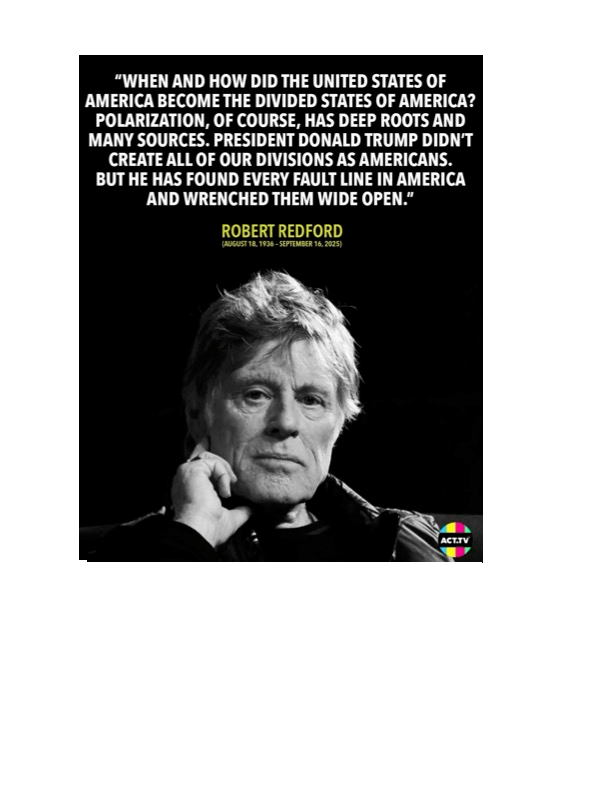
Mr. Redford, R.I.P. Sir. Life Well Lived.

When perusing Threads last night, I ran across this quote from the recently deceased actor/icon Robert Redford. As he was, in my opinion and in many others, a creative genius, I felt this quote appropriate to share on my creative blog.

Mr. Redford was many things to many people and I’m sure by now you have read or heard many of the tributes that have poured in from across the globe. Whether you saw him in one of his many movie roles or learned from him at the Sundance Film Festival or heard him in one of his environmental lectures, you witnessed a very talented individual expressing views he deeply believed in. You may have even shared some of his views. Maybe not.

Either way, in my opinion, Mr. Redford is entitled to our respect. He was a class individual, wonderful actor, impactful director/producer and a global icon who was always quite humble. Whether or not the collective “we” want to admit it, the entertainment industry and in particular the film industry lost a legend this week.

Regardless of how each of us was impacted and touched by Mr. Redford, we are all a little better off because of him. Rest in peace, Bob Redford. You deserve it!

Hopefully making a ruckus, one blog post at a time

Advertising Ethics Must Become a Core Creative Capability

Ethics. A word that is at times used too little because most people don’t think ethics exists any longer. It has been said that a man or woman is not truly whole if he or she does not possess ethical behavior within. It’s has become painfully obvious that some of us don’t. That’s sad.

It’s particularly troubling in marketing and advertising. For years those industries, especially advertising, had a lower ethics image than used car salesmen. Fortunately, that image is not as bad as it was. Today’s environment and enhanced creativity has increased the need for a true belief and practice of ethical behavior in what the industry puts forth to the consumer.

The following article is a good dissertation on the importance of ethics in advertising and its crucial need when developing creativity.

*******

If the world’s most prestigious stage for creativity can be gamed, what does that say about the structures behind the stories we tell?

There are still advertising professionals who treat ethics as something to call in after the crash, never to integrate into the system. 

The Cannes Lions cheating scandal has exposed a fracture at the heart of advertising: a growing contradiction between the public ideals that the advertising industry promotes and the problematic business behaviors behind the scenes.

In the advertising industry, we like to think of ourselves as storytellers. But in truth, we are choice architects. We shape how people see, feel and decide, often invisibly, powerfully and at scale. That is a position of enormous influence, and it carries a moral impact.

As legal scholar Cass Sunstein has long argued, even small nudges can have major consequences. What we design into our messaging, the defaults, the frames and the incentives, can improve lives or quietly exploit them. In advertising, as in public policy, how we shape choice matters as much as what we say.

Yet, astonishingly, there are still advertising professionals who treat ethics like outsourced IT support: something to call in after the crash, never to integrate into the system.

This is not just shortsighted. It’s reckless. Ethics is not a bolt-on; it is the foundation. No trust, no transaction. Ethics cannot be outsourced; it must be embedded into every campaign as a priority capability.

The ethical advantage

Advertising thrives when people believe in it. Yet today, surveys show consumer trust in advertising hovering near historic lows. Greenwashing, data misuse and AI-manipulated content have all made audiences wary of what they see. Worse, new entrants to the profession increasingly ask: Does this industry reflect my values?

The answer must be yes. But only if we earn it.

Ethical advertising isn’t a compliance checkbox; it’s a design choice. And it can be a competitive edge. Agencies and brands that adopt clear ethical standards, disclose targeting criteria, evidence-backed sustainability claims and consent-based personalization are not only preempting legal risk, but signaling integrity. And integrity is sticky.

Consumers, employees, shareholders and customers all want to work with firms they can trust. That trust must be built by actions, not taglines.

The role of learning and professional development

Ethical decision-making in advertising isn’t instinctive; it’s learned. As the landscape evolves, so too must the frameworks and training that guide professionals in the field. We are entering an era where fluency in ethical reasoning is as essential as creative talent or data literacy. This is the professional norm in law, finance, medicine, architecture, engineering, real estate and most other major professions.

That’s why continuous learning matters. Whether you’re navigating consent-based data use, sustainability claims or AI-generated content, knowing how to assess what’s fair, transparent and responsible requires both study and structure. Ethical practice is not just a matter of personal judgment; it’s a professional discipline. 

What comes next

Ethical practice doesn’t constrain creativity; it liberates it. When boundaries are clear and trust is high, bold ideas flourish. When young professionals believe they’re part of something credible, they stay. And when clients see ethics as a lever, not a liability, better work gets made.

The Institute for Advertising Ethics is an organization that spearheads ethical standards in education of our profession. I am a founding member and firmly believe in the continued development of the professionals in our industry. Ethics is a standard of practice we dare not let go to the wayside. After all, excellence in creativity is at stake, along with our reputation as practitioners of the industry.

Havas Puts Neurodivergent Creatives Center Stage at Cannes Lions

“Beyond the Brief” aims to redefine creative inclusion

This is another article I came across from the Cannes Festival last month that I wanted to share. It was written by AUDREY KEMP, a staff reporter for Adweek based in New York City. It has an interesting take on the creative industry and the players of today leading us into advertising’s future.

Havas is using Cannes Lions’ global stage to challenge the ad industry’s assumptions about what creative talent looks like—and who gets to be included.

On Monday, June 16, the French holding company debuted “Beyond the Brief,” a global campaign that positions neurodivergent minds as the future of the creative industry.

The effort builds on Havas’ Neuroverse initiative, launched in March, which supports the recruitment, retention, and development of neurodivergent talent through training, inclusive design, and partnerships. It’s also backed by new research from the agency, in partnership with nonprofit Understood.org and the 4A’s, that examines how neurodivergent creatives experience the workplace.

One stat that stood out to Donna Murphy, global CEO of Havas Creative and Health Networks, is that 40% of neurodivergent people are unemployed.

“The creative power they have is bar none,” Murphy told ADWEEK. “We saw a unique opportunity, not only for inclusion, but also for the market expansion of our clients.”

Inclusion as Innovation

Havas sees the lack of neurodiverse talent in advertising not just as an inclusion issue, but a source of untapped commercial potential. According to the agency’s study, over half of Gen Z identifies as neurodivergent—a demographic shift that’s forcing brands to reconsider how they design, market, and communicate.

“They think differently, they have sensory issues, and they see differently. If they go into a store and it’s not curated properly, and they’re overwhelmed, they leave,” said Murphy. “If you aren’t speaking to them, you’re going to miss that whole part of the market.”

The agency’s work around neurodivergence isn’t new. In 2023, Havas created a campaign for Reckitt-owned detergent brand, Vanish, that followed the daily life of a young autistic girl. During development, the team learned that autism and ADHD are often underdiagnosed in women and girls—a theme the campaign brought to light.

The spot sparked national conversation in the U.K., racking up 5 million TikTok views in 24 hours and, according to Murphy, leading to “the highest ever month of autism diagnosis.”

“Beyond the Brief” takes that advocacy global, with teaser ads along Cannes’ Croisette posing the question: “What if the future of creativity doesn’t look like the past—and never did?”

The campaign culminated in a main stage panel on Monday at the Lumière Theatre in the Palais, titled “Neurodivergent Minds: They Don’t Need Advertising—Advertising Needs Them.” Timed with Neurodiversity Pride Day, the session featured Murphy; global recording artist Lola Young; Renee Connolly, chief belonging and inclusion officer at Merck; and The New York Times’ Michael Barbaro as moderator.

The campaign title is also a deliberate nod to the awards culture of Cannes.

“We have to remind ourselves sometimes that Cannes is an award show,” said Loris Repellin, chief of staff, Havas Creative and Havas Health Networks. “The campaign that receives the most awards [is the one that] goes beyond the brief.”

Tools for Change

Off the Croisette, Havas is building infrastructure to support neurodivergent talent. The agency has developed training programs and partnered with an architecture firm to design more inclusive spaces, complete with VR simulations to illustrate sensory processing differences in the workplace.

The agency is expanding these efforts across its network, including through Havas People—its talent communications and employer branding division—and a growing neurodiversity practice. Havas has also begun hiring neurodivergent talent, including Sydney, a former intern now working as a copywriter, and Catherine, a leading SEO expert—though the agency did not share their full names.

The network is planning an experiment at the festival following an influencer marketing shopping spree

But systemic change, Murphy said, takes more than hiring. “They work totally differently. Sometimes they need to work remotely. Sometimes they need quiet space. Sometimes they need extra time. Sometimes they need less time,” she said of neurodivergent people. “Traditional employees don’t always have the patience to deal with it… which is why the training is so important.”

Murphy admitted that while Havas has already begun its journey to include neurodiverse talent in its workforce, “we don’t have all the answers… we’re still learning as we go.”

But she maintained that agencies that don’t embrace this growing talent pool are “going to fall behind.”

Hopefully making a ruckus, one blog post at a time!

Be sure to check out my other blog, Joe’s Journey, for selected short stories and personal insights on life and its detours.

‘AI Will Not Save Advertising’ – Apple’s Tor Myhren

The marketing leader opened Cannes Lions by arguing for human craft as the industry’s superpower.


“There’s no AI more capable of making us feel than the human mind,” Myhren told Cannes Lions attendees. (Tim Nudd/Ad Age)

This is the week of the Cannes Creativity Festival in Cannes, France, which some of you are aware. As such, commentary and opinions on the global advertising and creative community are being espoused far and wide. This blog shares some of that with you like this piece from BRITTANEY KIEFER. Brittaney is Adweek’s creative editor based in London.

Like advertisers from Coca-Cola to Google, Apple has previously caught backlash for seemingly elevating technology’s power above human creativity. 

But on the first day of Cannes Lions, Apple marketing leader Tor Myhren made a case for human creativity as the industry’s savior and superpower.  

Like last year, AI will likely be a hot topic at Cannes Lions. There’s both good news and bad news when it comes to AI, according to Myhren, vice president of marketing communications at Apple, which is Cannes Lions’ 2025 Creative Marketer of the Year

“The good news is AI is not going to kill advertising,” Myhren said on stage Monday. “The bad news is AI is not going to save advertising. We’ve got to save ourselves, by believing in what’s always made this industry special: human creativity.”

Will Creators Be the Future of Cannes Creativity?

Apple has long been a creatively esteemed brand, so Myhren’s talk drew a large crowd. But his comments were also notable after the company drew backlash last year for its “Crush” ad, which depicted a hydraulic press flattening artistic objects such as musical instruments, paint cans, and a camera.

Some critics called the ad “soul-crushing” for its portrayal of the destruction of creative tools, and it tapped into creative people’s fear about how tech like AI could jeopardize their professions. Myrhen apologized for “Crush” at the time, saying, “We missed the mark.”

In his Cannes remarks, Myrhen shifted the focus away from technology to the human talent at the heart of the industry. “Human touch is our superpower,” he said. “It’s the secret to building long-term brand love.”

For those still fearful about AI’s potential destructive power, Myhren ended his speech with a call to action: “AI will ride shotgun and be the best creative partner this industry has ever seen,” he said. “But we’ve got to drive.”

Hopefully making a ruckus, one blog post at a time

Be sure to check out my other blog, Joe’s Journey, for selected short stories and personal insights on life and its detours.

Misfits: Leading the Way in Innovation

Recently I came across this article on innovation but from a point of view I had not really thought about before. Its author, Gonçalo Melo, is an inspiring designer who has also authored many articles on design and design thinking. It’s an interesting read and I thought I’d share it with you.

Innovation has a history of being driven by those who refuse to conform, the self-proclaimed misfits of society. These individuals, often labeled as unconventional or rebellious, have a unique approach to innovation — they prioritize passion over convention. Let’s delve into the captivating world of misfit innovators and discover why their focus on passion is a key to their success.

The Power of Nonconformity:

Misfits have an innate resistance to conformity. They’re not motivated by societal norms or traditional paths; instead, they are driven by their own vision and unbridled passion. This refusal to adhere to the status quo allows them to see opportunities others might miss.

Passion as the North Star:

For misfit innovators, passion serves as their guiding star. They don’t embark on projects solely for profit or recognition; they pursue endeavors that genuinely excite them. This unwavering passion fuels their creativity and determination.

Embracing Failure as Fuel:

Misfits understand that innovation often involves risk and failure. They don’t shy away from challenges or setbacks; instead, they use them as stepping stones to refine their ideas and achieve their goals. Failure is not a deterrent but a source of motivation.

The Art of Authenticity:

Misfits are unapologetically themselves. They don’t conform to corporate or societal expectations of how they should behave or present themselves. This authenticity resonates with others and attracts like-minded individuals who share their passion.

Reshaping Industries:

History is rife with examples of misfits who disrupted entire industries. Think of Steve Jobs, who transformed technology and entertainment with his passion for design and user experience. His unconventional approach redefined what was possible.

Igniting Collaborative Fires:

Misfits have a magnetic quality that draws in collaborators who share their vision. These partnerships are not built on hierarchy but on a shared passion for innovation. Together, they challenge norms and drive progress.

The Passion-Driven Workforce:

In today’s competitive job market, misfit innovators are reshaping the workforce. They prioritize meaningful work over traditional employment, valuing companies that align with their passions and values.

Cultivating Inclusive Environments:

Misfits foster inclusive environments where diversity of thought is celebrated. They recognize that innovation thrives when individuals from varied backgrounds and perspectives come together in pursuit of a common passion.

A Misfit Renaissance:

As society evolves, the misfit spirit is on the rise. Increasingly, individuals are prioritizing their passions over conventional career paths, leading to a renaissance of innovation driven by authenticity and purpose.

The Challenge to Conventional Wisdom:

Misfit innovators challenge us to question conventional wisdom and explore new horizons. They remind us that passion is a powerful force capable of reshaping industries, redefining success, and inspiring a brighter, more innovative future.

In a world often driven by conformity and convention, misfit innovators serve as beacons of inspiration. Their unwavering focus on passion demonstrates that tru innovation arises not from adherence to norms but from the pursuit of what sets your soul on fire. As we celebrate the misfits, we celebrate the future of innovation itself.

Hopefully making a ruckus, one blog post at a time!

Be sure to check out my other blog, Joe’s Journey, for selected short stories and personal insights on life and its detours.
Creativity: Key Driver to Profitability in B2B Advertising

In my continuing effort to share pertinent information regarding the value that creativity plays in today’s marketplace, I share the following interview from LinkedIn as it relates to business-to-business advertising.

As part of a multi-year partnership between LinkedIn and Cannes Lions, LinkedIn along with its think tank, the B2B Institute, worked with the Cannes Lions as a strategic thought partner to develop the Creative B2B Lions Awards. Below are excerpts from a LinkedIn interview with Tyrona Heath, Director of Marketing Engagement at LinkedIn’s B2B Institute. It is aimed at celebrating and championing B2B excellence to drive creativity and excitement amongst B2B brands, marketers, and advertisers.

Summary:

  • Creativity is a key driver of profitability in B2B marketing and plays a crucial role in building brand recognition, differentiation, and market share
  • B2B advertising is facing a crisis of creativity, with research showing that 75% of B2B ads receive a low effectiveness rating
  • B2B brand building has a massive untapped opportunity, with significant growth potential in the marketing services industry

When you talk about creativity in B2B, it can feel abstract. Can you explain it in a tangible and relatable way?

For a long time, people have associated B2B with purely business-related content, detached from the principles that influence decision-making. However, B2B content is consumed by human decision-makers who are influenced by the same factors as any other audience. Emotion, storytelling, music, characters, and persuasive techniques are all necessary in B2B to inspire decision-making. Ultimately, it’s about creating a memorable brand that stands out and drives effective outcomes, with creativity at the center.

Is B2B advertising facing a crisis of creativity? And if so, how did we get here?

In the case of B2B advertising, there is a significant opportunity for improvement. Research indicates that the majority of B2B ads lack memorability and effectiveness. According to an analysis with our creative effectiveness partner, System1, a staggering 75% of B2B ads received a low effectiveness rating of one star out of five. These ads failed to leave a lasting impression, effectively communicate the message, or evoke an emotional response. This means they were not effective in building brand awareness or generating a return on investment.

How do you sell the need for brand building and creativity to senior marketers or budget holders?

That’s a great question, and it relates to our previous discussion about marketing to the CFO. Ogilvy Rory Sutherland once compared discussing brand with a finance director to talking about the healing power of crystals to a head surgeon. To finance-focused individuals, brand discussions may come across as fluffy and irrelevant. The best ads are effective because they better encode an association in a buyer’s memory, and brand building is one of the most powerful levers for driving business growth by building memories. We need to shift our mindset to effectively communicate the connection and value of brand building and creativity.

Continue reading

Special Quotes and a Christmas Gift, too

This being the week before Christmas I thought it appropriate to present some special quotes for this month and to end the list with a Christmas thought. Season’s Greetings and Happy Holidays!

Neither wisdom nor good will is now dominant. Hope lies in dreams, in imagination and in the courage of those who dare to make dreams into reality. – Jonas Salk

Some questions don’t have answers, which is a terribly difficult lesson to learn. — Katharine Graham, member, Advertising Hall of Fame

I want to put a ding in the universe. – Steve Jobs

Let’s gear our advertising to sell goods, but let’s recognize also that advertising has a broad social responsibility. — Leo Burnett, member, Advertising Hall of Fame

Nobody has ever built a brand by imitating somebody else’s advertising. — David Ogilvy, member, Advertising Hall of Fame

The heart of creativity is discipline. — William Bernbach, member, Advertising Hall of Fame

Like the musical score, a mission statement is only as good as the performance it inspires. — Keith Reinhard, member, Advertising Hall of Fame

I do not regard advertising as entertainment or an art form, but as a medium of information. — David Ogilvy, member, Advertising Hall of Fame

In writing advertising it must always be kept in mind that the customer often knows more about the goods than the advertising writers because they have had experience in buying them, and any seeming deception in a statement is costly, not only in the expense of the advertising but in the detrimental effect produced upon the customer, who believes she has been misled. — John Wanamaker, member, Advertising Hall of Fame

Christmas is more than barging up and down department store aisles and pushing people out of the way. Christmas is another thing finer than that. Richer, finer, truer, and it should come with patience and love, charity, compassion. ~ Rod Serling


Hopefully making a ruckus, one blog post at a time!

Be sure to check out my other blog, Joe’s Journey, for personal insights on life and its detours.

And, check out creative selections from my website.

Jolan tru!

If Opinions Can Live In A Silo, Can Creativity?

Over the past few weeks I’ve shared several articles on trending topics in advertising and marketing and what they say or imply about creativity. This week’s blog is really no different. This time around I came across an opinion piece I thought interesting and, yes, I wanted to share their view.

Ernie Schenck argues that creatives must put their politics and biases aside to tap into their full potential. This is obviously easier said than done. Is that realistic, you might ask? Doubtful, you might say. Well, in either case, what say you? After you read this blog, let me know your thoughts.

***********

Recently, I (Ernie) came across a post on LinkedIn in which the author claimed to have sworn off news for three years. Wait, what? Three years of no news? No Chicago Tribune or New York Times or San Francisco Chronicle. Three years without Fox or Morning Brew or MSNBC or NPR or Politico. No nothing. For three years.

Crazy, right?

Who pulls the plug on the news? Madness. If a bus in California went off a cliff last night, if another one of Elon Musk’s rockets blew up trying to land on its feet, if a few thousand people got their stomachs pumped after an encounter with a bean burrito at Chipotle, well, we’d need to know that. Wouldn’t we?

We might, but the evidence is pretty solid that our brains might not. As any neuroscientist will tell you, the human brain is neuroplastic. That means it has a tendency to change the way it thinks according to the ideas and attitudes that surround it.

If those ideas and attitudes are positive, then the brain sees things through a positive lens. Subject it to a steady diet of negative stuff, and bingo: suddenly, it starts seeing everything, and I mean everything, through a dark lens that can influence how you perceive your family, your friends, the people you work with and—if you’re in a creative field, this is the scary part—your creative ability.

But it’s possible something might be smothering your creative powers even more than the Debbie Downer we call the news. Something so insidious, it could be sucking the creative energy out of you at this very moment, and you’d never even suspect it. Even worse, there’s not a whole lot we can do about it unless we’re ready to loosen our grip on our opinions.

Why is that?

Creativity has to be unbound. It has to be free to go here and go there, uninfluenced by anything that could keep it from pursuing a particular path. If I believe Republicans are hateful, narrow-minded mouth breathers, if I believe that Democrats are elitist, holier-than-thou snobs, if I’m absolutely dug in on the idea that television is only screwy, branded entertainment and social media is rotting our brains, then the scope of my thinking is limited. We might think we can put our personal biases in a box. We might think we can keep them from seeping into our work. And maybe some of us can. But most of us? Not likely.

Creativity has to be unbound. It has to be free to go here and go there, uninfluenced by anything that could keep it from pursuing a particular path.

When you’re a creative director, you see this all the time. A team comes in. They’ve got some ideas they want to run by you. As they go through the work, you can’t help but think: OK, just like I don’t want to see the strategy bleeding through, I don’t want to see that East Coast intelligentsia thing bleeding through either. The same way I don’t want to see that red state thing if you’re in, say, Texas. In both cases, opinion leaks into the work. It skews things. It forces you to miss paths, blinded by your biases. And that’s a problem.

What this suggests is that the most creatively liberated people are the ones who don’t have a stubborn point of view on anything. It’s called “intellectual humility,” the willingness to recognize that knowledge is fallible and that no one possesses absolute understanding of any subject or issue. When you’re intellectually fluid, anything is possible.

Dogs and cats are both great. Red is as good as blue or purple or chartreuse. Vanilla? Pistachio? Praline fudge? Yes. Yes. And yes. You’re open to anything, so you’re open to any ideas—no matter how odd or quirky or misshapen—that might bubble up into your consciousness. In theory at least, you cannot be your most openminded, creatively untethered self unless you can truly empathize with other perspectives.

Few people are capable of this, as you can imagine, and creatives are no different. We think dogs are cool and cats are freaks. Beyoncé rules, and Sheeran is overrated. Steak is good, and tofu is, well, what was it our mothers used to say? If you can’t say something nice…

All that said, maybe you can convince me that I’m wrong about all of this. Maybe you can stuff your opinions away so that they won’t send your work off in one direction or another. Maybe you can do that. And I promise, I’ll try to remain open to the possibility that you could be right. But I don’t believe it. 

Ernie Schenck is a freelance writer, a creative director and a regular contributor to CA’s Advertising column.

*************

To begin with, I’m not sure that opinions can or do live in a silo. Creativity? True, the more one isolates, the more limited is creativity. I should know. I’m living that now and have been for the past few years. But that doesn’t mean creativity is dead in that environment. Creativity does need room to flourish, no question. Realistically, though, creativity will always be doing some sort of battle with outside influencers. That’s just life. However, they need to be kept to a minimum.


Hopefully making a ruckus, one blog post at a time!

Be sure to check out my other blog, Joe’s Journey, for personal insights on life and its detours.

And, check out creative selections from my website.

Jolan tru!