Merry Christmas & Happy Birthday, Dad!

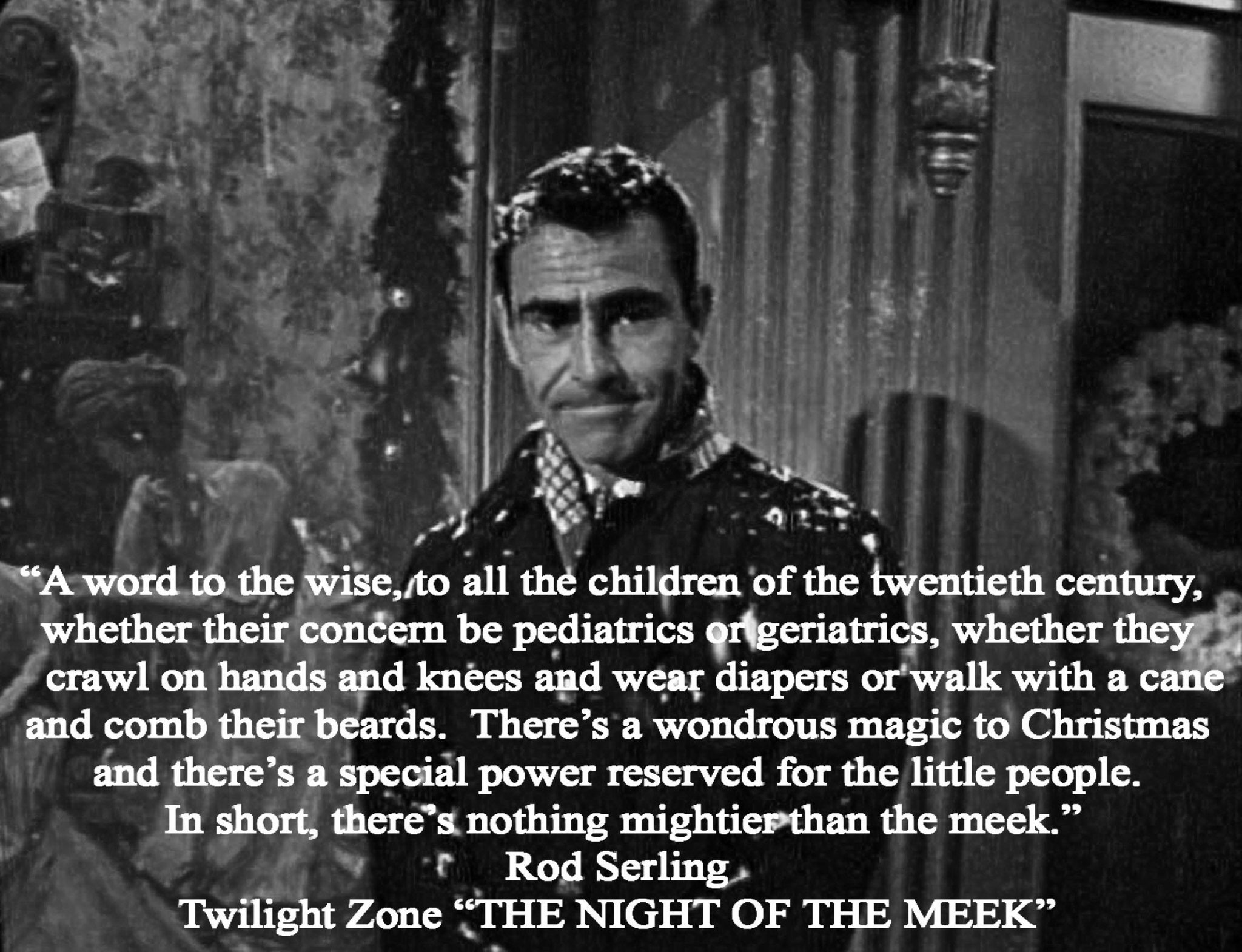
“Christmas is more than barging up and down department store aisles and pushing people out of the way. Christmas is another thing finer than that. Richer, finer, truer, and it should come with patience and love, charity, compassion.” — Rod Serling

Today is my Dad’s birthday. He left us when he was 72 back in 1978. I miss him. I miss my family, most of whom have passed on from when I knew them growing up. He would agree with Mr. Serling and the quotes above and below. Dad was a quiet man; even tempered. Like my Uncle June, a true gentleman.

Mom, Dad, Grandmother (Maw) 1976

Rod Serling was another man I admired and respected. As a writer, I’ve looked to Rod as a sort of mentor, always conscientious as to what I put down in words. I always strive to be insightful, imaginative and entertaining, just as Rod did. Alas, we lost him in 1975, the year I graduated from college. when he was only 50. The words and messages he brought forth then are just as powerful and meaningful today. Dad would definitely approve.

Merry Christmas and Happy Birthday, Daddy and long live Rod Serling!!

Hopefully making a ruckus, one blog post at a time!

Be sure to check out my other blog, Joe’s Journey, for selected short stories and personal insights on life and its detours.


The end of mid-size agencies? Inside the shifts that will reshape the ad business

This story is part of Ad Age’s Future of Advertising 2030 series exploring how marketing, media and creativity will evolve over the next five years.

Advertising agencies are in the process of setting strategies for the next five years despite numerous unknowns—the impact of AI, speed of consolidation and increasing ease of in-housing among them. These variables may have wide-reaching impact, including the potential demise of mid-size agencies, that marketers should be preparing for now.

On Ad Age Insider, Ad Age reporters look at the future of ad agencies and strategies that industry leaders are putting into place now to prepare.

“A lot of [agencies’] executional work becomes commoditized by AI, and a lot of marketers will have pretty robust in-house systems. So the real value and agency lie in their strategic thinking and being able to bring an outsider perspective to the equation.” –Ewan Larkin, agency reporter, Ad Age

Ad Age Insider podcast transcript

Parker Herren, host: How will the agency landscape transform by 2030? What has surprised you guys the most in your reporting on the future of agencies?

The demise of mid-size agencies

Brian Bonilla, senior agency reporter: It’s hard to be surprised, but I would say something that might surprise people in general—the role of the mid-size agency might go away by 2030, meaning we’re already seeing a lot of small, independent agencies get a lot of business, but we’re now starting to see those same agencies competing with each other and competing with large agencies and seeing a leveling of new business opportunities. And at the same time, mid-size agencies, which typically range from like 100 to maybe 250 employees, are competing with large holdco networks of like 5,000 employees for the same business. 

So by 2030, you’re going to see those mid-sized agencies either merge with other entities or sell to private equity firms or things like that. That’s going to be something that might be surprising for a lot of people, and I think will happen quicker than people realize.

How agency structures will shift

Ewan Larkin, agency reporter: This is interesting. For a couple of years, agencies have been trying to market themselves as consultants, and it hasn’t really stuck. To some degree, it has, but I think it’s obvious they are still service providers fundamentally. But I actually do think now we might see that shift start to stick a little bit. A lot of the executional work becomes commoditized by AI, and a lot of marketers will have pretty robust in-house systems. So the real value at agencies lies in their strategic thinking and being able to bring an outsider perspective to the equation. 

I think that puts them in direct contact … with the likes of Deloitte Digital and Accenture Song. So the focus for agencies really should be building up some of those consulting capabilities and commerce consulting capabilities. Agencies like VML are already starting to do this. They rolled out a unit earlier that encompasses consulting, CX and other things, and that already accounts for about 40% of their overall global revenue. So, I expect more people to make moves like this. This is one of the early stages of holding companies really being able to package up one of those offerings.

Parker: For Ad Age’s Future of Advertising package, media reporter Brandon Doerrer wrote about 2030 readiness. And chief technology reporter Garett Sloane dug into the 2030 tech stack. That sounds pretty thrilling. What did you guys find in your reporting?

Brandon: People tend to think that there are just going to be more and more integrated accounts, especially between creative and media. The walls are really coming down between those two functions. We are seeing brands increasingly hire the same agency to handle both of those functions. So, agencies are going to need to get used to those two functions not being in silos anymore, not having walls exist between those two teams.

Garett: We’re already starting to see these roles change. We’re seeing shifting ways of billing clients, different business models, different services agencies have to cater to. So, it’s already happening. It’s going to happen more and more where agencies are going to have to operate as platforms and services that can interact with brands and help brands build their ad tech stacks, acting as consultants, acting as facilitators into this futuristic landscape.

That’s where agencies need to go, and they’re starting already by developing new products and services. Whether that will work is still an open question, and if they can adjust and change—some will, some won’t.

The social AOR resurgence

Parker: Let’s talk influencers. Gillian Follett covered the future of the social and influencer space. Is there any way the future of influencers will impact agencies in 2030?

Gillian: Experts that I talked to for the story said that they predict the spectrum of influencer agencies will stretch to the extremes. So, we’ll see more brands working with influencer functions within larger holding companies, or we’ll see brands looking to very specialized boutique agencies who specialize in specific platforms or types of creators, like gaming creators, for example.

We’re also going to continue to see influencer budgets increase, not at the same meteoric rate that we’ve seen over the past couple of years, but based on forecasts from intelligence companies like eMarketer, it’s definitely on an upward trajectory. 

We’re also seeing a resurgence of social agency of record assignments from brands across different categories. Something that I spoke to one marketer about was this idea that it’s not just the brands that are trying to target Gen Z or want to be social-first anymore that are looking for social AORs. It’s brands that they wouldn’t expect, like more established legacy brands are looking for social AORs. And a lot of these brands are seeking the insights that social media can provide in terms of what consumers are looking for, the types of products that they’re craving and using social as the foundation for their marketing campaigns rather than having social be a tacked-on piece at the end.

Parker: Okay, Lindsay, I’m going to let you round out this group with some intel from your reporting on the RFP process in 2030.

Lindsay Rittenhouse, senior agency reporter: Within the RFP process, agencies are going to have to stop the theater—the glossy presentations, the pitch decks, and really showcase how you’re working as a team. Get ready to be in more chemistry meetings—enough with the showboating and the theater in the pitch.

Parker: Tell us how marketers should begin preparing for that now.

Lindsay: Well, they have to set up the process so that there are more chemistry meetings and more time for the meatier stuff, the interviewing, the briefings, the working together, and just get rid of some of the processes. You don’t have to do these massive pitch presentations. [Marketers] are the ones who set the process for the RFP, so don’t allow the theatrics.

Agencies in 2030—how to plan ahead

Parker: I want to hear everyone’s advice for how marketers or agency leaders can begin prepping for their 2030 strategy. Why don’t we just go round robin, starting with you, Brian.

Brian: Start thinking about what type of agency model do you want as a marketer. We’re seeing roster agency models become way more popular, meaning instead of having just one AOR handle everything, I’ll have a social agency here, I’ll have a creative agency here or I’ll have a roster of five creative agencies. 

If you’re an agency, start thinking about what model makes the most sense for you to be in—should I be more niche or should I broaden my capabilities? And as a marketer—same question but on the flip side. If I’m going to be spending less on marketing, but I’m expecting to have more outcomes, what is the best model that makes sense for my external partnerships? Because I do think agencies will still be necessary as much as we’re talking about in-housing and things like that.

Ewan: They need to clarify which functions they want done in-house, which ones they need outsourced, very clearly defining what they can do themselves versus what is essential that they get from an external partner. There is a push for efficiency, and, obviously, everybody wants to save costs, so they want to bring it in-house, but you are going to need an external partner. You always do need that outside perspective. So, very clearly define what needs to be done yourselves and what you need an agency for. 

But rethinking agency relationships in general—they’ve always been seen as providers, that’s what they are, but now a lot of them are going to be actually helping build those internal capabilities. So identify which agencies are high-level strategic thinkers, which ones really understand your brand and your challenges, which ones can help me build my internal chops. Those are the ones that I think are likely to have long-term value.

Brandon: On the agency side of things, if you’re a creative agency and you don’t already have media capabilities, really digging in and evaluating if it would be worth building that out. If you have a unique angle, something to offer brands to make yourself stand out from the plethora of media agencies that can do the same thing. Media is probably in a similar boat. At least having an understanding of various creative processes is going to be helpful.

On the marketer side of things, brands can just not be afraid to ask. I did a story not too long ago about how indie creative agencies can respond to requests for media services. And the reason why agencies are starting to think about either building these capabilities internally or which media agencies they can partner with is because they’re getting these requests. Marketers—don’t be afraid to ask if you have an indie creative shop that you’re working with that doesn’t do media. They’re getting used to getting that question already, and they are starting to think about how to best answer that question. So, no dumb questions is the advice.

Garett: They could start developing the services and tools, and some are. We’ve seen agencies launch AI agents—the trading bots that they can all of a sudden potentially give out to brands to start to use. A lot of these tools that agencies are building are internal, but eventually, they’re going to make them external and start shipping them to brands to use as part of their suite of services. So, agencies start building internally and then will start giving it out to the masses.

Gillian: Brands should start considering whether they want to look to agencies to help them with sharpening their social strategies to adapt to this new way of seeking consumer insights from social and using social as a starting point for marketing. For some brands, it might make more sense to develop a social media team in-house to lead these efforts for the brand. Some brands have sought social media agencies of record because of the wide range of functions that are involved in social media marketing today, like paid social, creator marketing, social media intelligence gathering. There’s just a lot that goes into it these days.

Brands should start considering whether that’s something they can do in-house, or if they need to find partners to help them develop those strategies as social becomes more and more important.

Key Takeaways

  • Mid-size agencies will likely disappear by 2030, either merging or selling to private equity firms
  • Agencies are shifting from ad makers to consultants and platform builders
  • Creative and media functions will merge as brands increasingly hire one agency for both services

Hopefully making a ruckus, one blog post at a time!

Be sure to check out my other blog, Joe’s Journey, for selected short stories and personal insights on life and its detours.
8 agency leaders divulge the most pressing issues facing their business—and how they’re navigating them

The 4As hosted a roundtable with Ad Age and seven industry leaders from holding companies and independent agencies at Advertising Week New York to discuss some of the most pressing issues facing executives today.

Lindsay Rittenhouse reported that the roundtable included a lineup of executives spanning a wide range of roles and companies: 4As CEO Justin Thomas-Copeland; Stacey Hightower, CEO of Omnicom Specialty Marketing Group; Frances Webster, CEO of independent agency Walrus; Tracey Faux-Pattani, CEO of independent shop Butler, Shine, Stern & Partners; Chris Foster, CEO of Omnicom Public Relations Group; Ian Grody, chief creative officer of independent shop Giant Spoon; Joe Baratelli, executive VP and chief creative officer of independent agency RPA; and Nada Bradbury, CEO of Ad-ID, which sets a standard for the industry to identify advertising assets across all media.

These leaders discussed a wide range of topics, including how they are using AI in their day-to-day; how they are driving value in their agencies; the means to stand out in an increasingly crowded market; and what talent they are hiring.

Some takeaways from the conversation:

How agency leaders are using AI

Webster said Walrus is using AI to respond to an “RFI right now … it’s helping us with upfront strategy and segmentation.”

“It’s like the internet from the ‘90s, you’ve got to surf the wave and you can’t have a two-year plan,” she said. “It’s a three-month plan or a six-month plan. But if you’re not engaging with it, you’re out.”

Hightower said Omnicom Specialty Marketing Group has been using AI in Europe “for quite some time.” He said the agency created a call center that has been using AI to speak with customers who dial in on branded hotlines. It’s also now bringing internal efficiencies. For example, Omnicom Specialty Marketing Group uses AI to sift through resumes.

“We do probably 5,000, on average, hires a year in Europe … We can’t get to every resume that comes into our inbox,” Hightower said.

“We’re an indie shop, so we’re bootstrapping everything,” Baratelli said. “We’re using it around the stuff no one wants to do, reporting, scoping.”

The conversation came on the heels of Madison Logic releasing new research from a Harris Interactive survey of more than 300 business-to-business marketing leaders. It found that three in four of those surveyed believe the future of advertising will be defined by AI-driven creative processes (73%) in the next five years. Two in three of those surveyed predicted personalization at scale and immersive advertising (66% each) will become more prevalent, and 84% believe traditional advertising will be dead by 2030.

Still, all of the executives agreed that advertising is a relationship business and nothing will change that.

“It’s important to point out that these are all really responsible uses of AI,” Ad-ID’s Bradbury said. “What we are seeing on our side is folks trying to understand the various uses of AI. So everybody does all this great work [and] we’re getting calls saying, ‘Can you help verify this for me? Is this a product that came out of an agency? There’s this other layer that you just can’t control [AI] that we need to start to wrap our arms around it.”

Strategists are in demand

AdAge asked what jobs are most in demand right now and strategy was the one definitive.

Faux-Pattani said BSSP is always on the hunt for great strategists, but noted that the shop sometimes struggles to find truly top candidates in that space. She said curiosity is always needed in that role, but the agency has had a hard time finding candidates who have curiosity that is “intuitive” versus “data curiosity.”

The strategy role is also shifting and putting more pressure on professionals in those roles.

Since clients are buying more “connected solutions,” agencies need strategies to be adept in everything from “commerce to brand, to media, to analytics, to creative understanding,” Thomas-Copeland said. “I don’t know any strategies that can do all of those things really well. And then at the same time in the room there was a call for strategy as a function to be front-of-house with clients. So suddenly they’re in a new environment.”

Webster argued that strategists and account people now have to “battle together … as an account strategist, you really need to understand your client’s business much better than they do.”

Hunting for new business opportunities

Most of the executives said there is a lot of opportunity to win new pieces of business, but they are far-ranging in size. Industry and agency leaders also have to be strategic in deciding what accounts to go after. 

Health care agency reviews are on the rise, for example, and Faux-Pattani said she sees a lot more “emerging brands” looking to hire shops right now.

In terms of the boon in health care agency reviews, Thomas-Copeland said that category has always been more “resilient” to macroeconomic factors. Still, 4As agency members have told the organization that even within health care marketing, “projects are not being solidified … in terms of planning and commitments, there’s a bit less of that,” he said.

Thomas-Copeland said agencies are having to place “their bets on where they’re going to look for opportunity, and trying to get really good at judging what is an opportunity that looks like it has some longevity, versus the one-and-done.”

“We’ve been very selective over the past 18 months or so in terms of the clients that we pursue from a business perspective and it’s worked,” Giant Spoon’s Grody said. “Over the last six months, we’ve won 67% of our pitches. The reason is we go after fewer, bigger, better and then we find smaller clients where we see that profound growth potential.”

Webster said Walrus has had success going after emerging brands that have reached $200 million to $400 million in revenue and are “ready to spend. They’re either getting ready for an IPO or sale, or they’ve just sold and need to show return on that investment,” she said.

For Omnicom Public Relations Group, Foster said it’s a much different situation.

“We will probably chase 2,500 RFPs in the course of a year,” he said. “We’re doing 100 or so a week as a network, if not more. The deal flow is very different in PR than advertising and media … in Europe, I’m seeing competitive consolidation in the marketplace, and so the deal sizes are small because there’s just a lot more competition.”

How to stand out in a crowded market

Faux-Pattani said she’s starting to see more intimate pitches with two or three competing shops, versus somewhere between four and six, which she welcomes. She said she sometimes will turn down a pitch if there are too many shops vying for the account.

That might be good for the agencies invited to pitch, but that means there are even fewer opportunities to get a foot in the door. The executives discussed how they are standing out in an increasingly overcrowded market that sees new agencies popping up seemingly every day to compete with holding company shops and independents alike.

“There are 14,000 agencies out there,” Webster said, making it more pertinent to understand your niche and where it makes sense for you to show up as an agency. Walrus, she said, goes after the opportunities it wants, rather than waiting for them.

“We have a robust sales department, PR program and outreach program,” she said. “For these smaller pieces of business, too, it’s much easier to hunt—to prospect, build, identify opportunities and make relationships, so we’re not actually having to go into a pitch. We close a lot of business that way.”

Hightower said Omnicom Specialty Marketing Group promotes itself through “product innovation and storytelling.”

“In Europe, we will pitch a suite of modalities, so we’ll say, ‘Give us your budget and we’ll figure out the best way to implement your spend across a number of modalities,” he said. “That has resonated well in that marketplace. In the U.S., it’s been through technology, building platforms where we are able to acquire data about the client, about their value chain, and then providing them feedback that can help them reduce costs and get more bang for their buck.”

Despite the conservative backlash to diversity initiatives, the executives said they remain committed.

The state of DEI

“From a 4As standpoint, the focus will continue to be on inclusive teams, and inclusive teams are great for business, they’re great for being an economic multiplier, they’re great for brands being much more in tune with the market,” Thomas-Copeland said.

Webster reiterated that point, saying companies with diverse boards and teams outperform those that are not.

“We’ve always been committed to inclusivity,” Grody said. “We remain committed to inclusivity. Nothing has changed.”

Hopefully making a ruckus, one blog post at a time!

Be sure to check out my other blog, Joe’s Journey, for selected short stories and personal insights on life and its detours.
Ideas, not AI, will decide who survives in 2030

In a world where everything can be personalized and optimized, there’s only one true differentiator left: ideas. (Adobe Stock)

AI will undoubtedly shrink the marketing services industry. Or so that’s the opinion of industry paper Ad Age via author Barry Lowenthal in a recent piece a few weeks back. Thought it worthwhile to share again especially to those of you who may not have seen it yet.

Many of the functions agencies are paid for today—targeting, media planning, asset versioning — are already being handled faster and cheaper by machines.

Yet the most successful agencies in 2030 won’t be those with the biggest AI budgets; they’ll be the ones still capable of original thought.

Since the explosion of generative AI, holding companies have raced to future-proof themselves, pouring hundreds of millions of dollars into the technology. They’ve hired engineers, signed vendor deals and built proprietary tools. The logic is that automation improves margins by enabling more work to be produced with less overhead, and it’s attractive to clients.

But here’s the problem: Everyone is doing the same thing.

AI platforms might look different, but they’re powered by the same foundation—similar models, trained on similar data, offering similar outputs.

AI is a great equalizer. While early investment and enterprise deals offer short-term advantages, the tools are ultimately accessible to all. As technology becomes commodified, there’s only one true differentiator left: ideas.

In a world where everything can be personalized and optimized—where every ad element, from celebrity to color palette to music cue, is engineered for conversion—what cuts through is the unexpected.

Zany, emotional, human ideas. The kinds that make people laugh out loud, tear up or text a friend because it hit a nerve. The kind no algorithm can predict because they come from life experience, not data.

Those ideas aren’t born from prompts or dashboards, but from humans living messy, interesting lives—wandering museums, walking unfamiliar streets, swapping stories at a dive bar.

The agencies that stay relevant in an AI era will be the ones that protect this kind of cultural immersion. They’ll hire for life experience, not just technical literacy. They’ll measure inspiration like they do performance, instead of grinding their teams into creative exhaustion. They’ll reward originality over speed and efficiency. 

If the goal is to survive the next five years, curiosity and creative instinct must be treated as core competencies.

That means rethinking workflows to allow time for discovery, not just delivery. It means protecting those unproductive long walks and deep rabbit holes.

The payoff won’t always show up neatly in a dashboard, so it will be a challenging pitch to the CFO. But in a world where AI devours everything else agencies in once thought made them valuable, it’s the only bet worth making.

That’s the future. And no, you can’t buy it; you have to nurture it.

********

I agree with Mr. Lowenthal, original thought leading to creatively inspired ideas will and must lead the way. I’ve been involved in this business for several decades and I realize that the industry has turned into a young person’s game. Most have grown up with AI and consider it the “standard.” That is unfortunate. It still must be considered a tool in the work belt of the creative person who’s developing the idea. It can’t be used as the end-all. That is unless sameness is one’s idea of creative thought.

Hopefully making a ruckus, one blog post at a time!

Be sure to check out my other blog, Joe’s Journey, for selected short stories and personal insights on life and its detours.