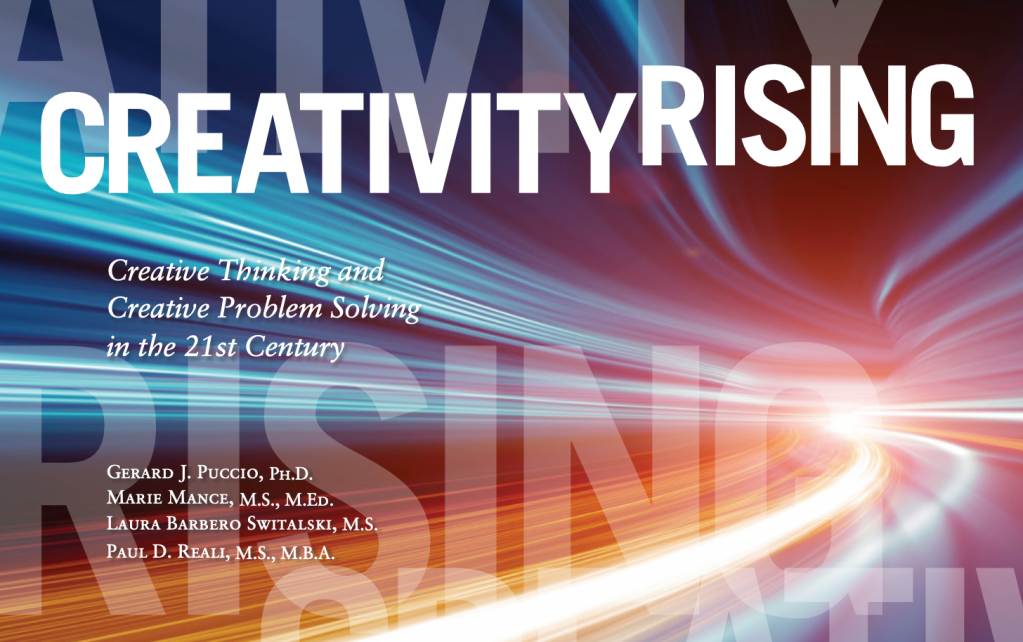
I’m on the email list of Buffalo State University’s Center for Applied Imagination and so I receive notices from time to time about upcoming lectures and seminars and the like. The publication cited below is from one of their recent notices.
From the authors . . . The need for creativity has never been greater. In fact, we chose the title, “Creativity Rising: Creative Thinking and Creative Problem Solving in the 21st Century,” to reflect this belief. If we are to live healthy, productive lives in this century we must develop the mind-set and the skill set for effectively responding to and initiating change. Creativity Rising is both a why-to and how-to guide to help you create your own future. In this book we: • explore the nature of creativity • debunk common myths about creativity • describe the rapid rise of change in the 21st century • outline the time-tested Creative Problem Solving process, an approach to on-demand creativity.
Hopefully making a ruckus, one blog post at a time!
Be sure to check out my other blog,Joe’s Journey, for selected short stories and personal insights on life and its detours.
An unlikely pairing some would surmise but they’re actually made for each other. In another of various selected articles from AdAge, this article I read recently by Matt Kaupa discusses how best for brands to align data with creative and do so from the beginning. Developing and studying one or the other separately won’t do any good.
At first glance, “data” and “creative” feel like opposites. One loves structure, the other color. One obsesses over decimal points, the other ellipses. But when they team up, the results can be surprising. And the best work happens when they collaborate from the start—not when data shows up at the end to judge. Here’s how to get there.
Don’t wait until after launch
Too often, data gets invited to the party only after a campaign is out in the world. At that point, it’s just there to grade the work, not shape it. Data and creative are two ingredients in the same dish. If you taste the soup only after it’s served, you can complain about the flavor—but you missed your shot to add the seasoning.
Strategy: Bring analysts into the creative kickoff. Audience insights—demographics, psychographics, behaviors, even reactions to past campaigns—can shape tone, format and story direction from day one. If you want to measure success, then why wouldn’t measurement help guide the strategy?
Example: Want to talk to busy moms in Charlotte? Don’t guess. See what they actually engage with at 10 p.m. Trying to position a brand as “premium” but still “relatable”? Let sentiment data show the words they use—not the words you wish they used.
Speak in the audience’s words
Every brand has its own vocabulary, but if your audience doesn’t speak that language, you’re basically shouting into the void. It doesn’t matter how clever your copy is if no one understands it—or worse, if it feels out of touch.
Strategy: Pull top organic search terms and social comments into the copy deck. Use their words, not yours.
Example: In industries like health care or finance, expert language doesn’t always translate. Otolaryngology? That’s just an ENT.
Don’t ignore A/B test losers
Everyone loves a winner, but the losing versions of a campaign are often way more interesting. They show you where instincts clashed with reality—and that tension is where new ideas live.
Strategy: Treat every test as a learning lab, not just a scoreboard. Every version has a story to tell—whether it’s what to do, or what to avoid.
Example: Sometimes insights come from a single weird data blip. Why did that version spike in Wisconsin? It didn’t have anything to do with cheese—or overrated football teams (skol!).
Let dashboards tell a story
Dashboards don’t have to be painful. But let’s be honest: They usually are. They’re dense, ugly and built for people who already live and breathe numbers. For everyone else? They’re more like a punishment than a resource.
Strategy: Co-build reporting visuals with designers so your dashboards are as compelling as your campaigns. When data looks like a story, people actually use it. Also, dummy-proof your insights: structure data and visuals in a way that reduces the number of assumptions—especially wrong ones—that your audience has to make.
Example: Imagine if your media dashboard looked less like a spreadsheet exploded and more like an infographic—highlighting trends, telling a narrative, and pulling out the “so what” at a glance. One client stopped ignoring their reports entirely once we reframed their monthly dashboard like a campaign storyboard. Suddenly, the CFO wasn’t just tolerating the data—he was quoting it in meetings.
Flip feedback into fuel
Brands collect mountains of feedback but rarely use it for anything more than “good job” or “try again.” What if, instead of treating it like a report card, you treated it like raw material? Customers are basically writing copy for you every day.
Strategy: Use real-time listening tools to turn survey responses or social reactions into iterative campaign content.
Example: Imagine a spot stitched together directly from customer feedback. Or a campaign whose copy comes entirely from what people are saying online.
Wrap smarter
When the campaign’s over, most people move on to the next thing. But the wrap-up is where the hidden treasure lives. Go beyond “what performed” and dig into why—because those answers set you up for the next win.
Strategy: Cluster analysis can reveal new audience segments. Performance patterns can challenge assumptions. Maybe Gen Z does like long-form after all—just not when you lead with product shots.
Data shouldn’t chase creative, and creative shouldn’t wait for data. The smartest work happens when both teams co-own the problem from day one. Remember that data isn’t just numbers. Just as we need to speak our audience’s language, we also need to speak the creatives’ language. Incorporate qualitative data—social comments, organic searches, reviews, surveys—to make sure we don’t lose the forest for the numbers.
Hopefully making a ruckus, one blog post at a time!
Be sure to check out my other blog, Joe’s Journey, for selected short stories and personal insights on life and its detours.
In a recent edition of Ad Age I caught an interesting article posted by Jon Gibbs having to do with the importance of creative ideas to brand growth. I thought it appropriate enough to share it with you. So here goes . . . enjoy!
In today’s climate of shrinking budgets, AI automation and relentless pressure to prove ROI fast, marketers are increasingly forced to make creative decisions based on what’s measurable rather than what’s meaningful. Dashboards and spreadsheets dominate boardroom conversations. But metrics tell you only what has worked. Creativity shows you what could work.
That difference is critical. The most powerful growth doesn’t come from simply following the data; it comes from ideas bold enough to break new ground. Ideas that capture attention, stir emotion and become memorable. Safe decisions may feel efficient, but safe doesn’t build distinctiveness. Safe builds sameness. And sameness is a dangerous place for brands to be in a hyper-competitive, three-second-attention world.
Creativity is what gives brands an edge. It’s how you move from being seen to being remembered. In other words, when creativity leads, the numbers follow.
The problem is that creative ambition is often cut short by over-measurement. Distinctive ideas can feel unfamiliar at first, and unfamiliarity makes people uncomfortable in a test group. Measure too early, and you’re often just testing comfort levels, not long-term effectiveness. As a result, bold work gets diluted or dropped before it has the chance to breathe.
So how can leaders, whether running an agency or leading marketing inside a brand, protect creativity in a world ruled by metrics?
Trust your instincts
We often turn to measurement when we’re unsure about trusting our instincts. But instinct isn’t guesswork: it’s built on years of experience, consumer understanding and category knowledge. Leaders who know their brand and market well should feel confident backing that expertise when making decisions.
That doesn’t mean being reckless. It means recognising that the best creative decisions often come from people who understand the brand and its audience most deeply, not from what a spreadsheet says.
Protect the process
Great ideas take time to evolve. They need space to be explored, debated and refined. Forcing ideas through rapid testing cycles or rushed approval rounds is more likely to drown out the creative ideas in favor of safer ideas proven by metrics. Agency leaders should create an environment where their teams can push boundaries without the constant fear of metrics-based rejection early on. Brand leaders must give their agencies the space to explore, not demand instant metrics.
The world’s obsession with efficiency often makes this worse. Too many global brand decisions happen in 15-minute Teams calls with a yes or no verdict. That’s not enough time for the deeper conversations that sharpen ideas. Feedback loops matter; every time work is put on the table, the team learn more about each other’s insights and instincts. Cutting those discussions out cuts out a lot of that depth that drives strong creative ideas.
Protecting the process also means resisting the urge to test too soon. The point of iterative feedback is to build confidence before the work goes in front of consumers; otherwise, you end up evaluating unfinished thinking.
Know when to hold your nerve
Almost every bold idea meets a moment of doubt. They’re supposed to feel novel or different. Leaders earn their value by having the conviction to back the work. If the strategy is sound, the team is experienced and the creative instinct is strong, that’s the time to stand by it.
Brand campaigns that hold their nerve are usually the ones that people remember. Nike did this with its “So Win” Super Bowl return this year (after 27 years), which highlighted the rise of female athletes. Rather than celebrity cameos or quick laughs, it backed a cinematic, purpose-driven film, and the risk paid off with one of the most celebrated ads of the night.
Use metrics wisely
Metrics are essential for informing insight, for sense-checking later in the process and for guiding optimization once work is in market. But they shouldn’t dictate the earliest imaginative ideas, because those ideas need space to breathe.
And not all research is equal. Too often, multimillion-dollar brand decisions hinge on the cheapest possible online focus group. Thirty people in a £500 panel should not determine the fate of a £25 million brand. Poor-quality research is worse than no research at all. Whether you’re commissioning research on the brand side or interpreting it on the agency side, resist the temptation to reduce decisions to the cheapest possible test.
Telstra’s recent stop-motion campaign, which scooped the Cannes Lions Film Craft Grand Prix, is a good example: 26 playful shorts that probably wouldn’t have survived an early focus group, but once in market, they resonated widely. It proves the value of creative originality.
Champion distinctiveness over novelty
Bold does not mean weird for weird’s sake. Distinctive ideas are rooted in what makes a brand unique. It amplifies personality, sharpens positioning and makes the brand easier to recall in buying moments. Leaders should push teams to be distinctive, not just different, by allowing space for imaginative thinking, while asking the right questions: what does the brand want to be known for? What makes it meaningfully different? How can creativity make that difference visible and memorable?
Too many people today have become conditioned to believe that what can be measured is what matters most, but agency and brand leaders need to show that the truth is the opposite. What matters most often can’t be fully measured in advance.
The campaigns that thrive will be the ones with leaders who defend creativity against premature measurement, holding their nerve when bold ideas feel risky, and treating creativity as the most important driver of growth.
Hopefully making a ruckus, one blog post at a time!
Be sure to check out my other blog, Joe’s Journey, for selected short stories and personal insights on life and its detours.
Albeit some years back, I came up with a list of tips for kick-starting one’s creativity. These are tips I’ve learned over the years and have put into practice. May they serve you as well as they have me!
Hopefully making a ruckus, one blog post at a time!
Be sure to check out my other blog, Joe’s Journey, for personal insights on life and its detours.
Feel free to review various creative selections from mywebsite.
I don’t know how Seth Godin does it. He writes and publishes a blog everyday, 365 days a year. I have trouble publishing my two blogs each WEEK!
Part of my problem is having something interesting to publish. That is every blogger’s nightmare. There have been times I write a blog the night before because I came up with an idea and just developed it.
When I’m in a pinch and nothing comes to mind, I try and change my focus. In a way, I let myself become distracted, not by merely doing something else but by switching creative gears and concentrating on another creative project.
It was where my muse wanted to take me, so I let it. What is a muse you might ask?
Muse, in Greco-Roman religion and mythology, any of a group of sister goddesses of obscure but ancient origin, the chief centre of whose cult was Mount Helicon in Boeotia, Greece. They were born in Pieria, at the foot of Mount Olympus.
They probably were originally the patron goddesses of poets (who in early times were also musicians, providing their own accompaniments), although later their range was extended to include all liberal arts and sciences—hence, their connection with such institutions as the Museum (Mouseion, seat of the Muses) at Alexandria, Egypt. There were nine Muses as early as Homer’sOdyssey, and Homer invokes either a Muse or the Muses collectively from time to time.
Virgil (centre) holding a scroll with a quotation from the Aeneid, with the epic Muse (left) and the tragic Muse (right), Roman mosaic, 2nd–3rd century ad. Courtesy of the Musée Le Bardo, Tunis
As the creative juices begin to flow and my “new” project begins to take shape, I begin to develop several ideas that would make for interesting blog posts. I did, however, make sure I finished what I had previously started so I could “celebrate” the accomplishment (a musical slide show).
Whether or not you follow your instincts when you have a calling to do so, is up to you. Your mind and imagination are wondrous tools in the creative process. Don’t ignore them.
Hopefully making a ruckus, one blog post at a time!
Be sure to check out my other blog, Joe’s Journey, for a different kind of playground for creativity, innovation and inspiring stuff.
Creativity depends on strategy to be effective and successful. And vice versa. Do they need to live in harmony together? From the United Kingdom, the British agency Five by Five’s strategy director Catherine McPherson and creative director Ravi Beeharry discuss the secret to an effective relationship between creativity, strategy and craft.
Strategy, creativity, or craft – which is more important to a successful ad? And how should they work together?
“It used to be like a relay race, with each department handing the baton to another along the production line,” says Five by Five’s strategy director Catherine McPherson. “But today rather than strategy handing over a brief and washing its hands, we’re now running alongside the creatives and cheering them on.”
To an extent, the secret to effective advertising has always been found in the relationship between strategy, creativity, and craft. Too much strategy can leave a campaign feeling more like a PowerPoint presentation, whilst unrestrained creativity risks derailing a brand’s messaging. Get the balance right, however, and you land on the kind of genius which works miracles in the marketplace.
“While there is a balance to be struck, there isn’t a simple formula,” notes creative director Ravi Beeharry. “You have to look at it on a case-by-case basis. Take the iconic Meerkat from Compare the Market, for example.
You might look at that and consider it to be an example of creativity which went a bit out of control. What is a meerkat saying about that brand? But in practice it was enormously effective because the balance was right in that instance”.
Knowing which element should take prominence, the pair agree, comes down to your definition of success.
“Does success mean winning at Cannes, or does it mean driving sales in the short-term? Or is it brand recognition? It might sound obvious, but being intentional about the end result is the first step to getting the balance right”, says Catherine.
“Something we’ll reference quite often at Five by Five is Peter Field’s research into the recent decline in creative effectiveness, and one takeaway from that has been that we don’t look for compromise between strategy and creativity but rather look for harmony. They should feed into one another”.
“The best creativity bounces off strategy like it’s a springboard”, notes Ravi. “And craft is the execution – actually, let me rephrase that. Craft is good execution. Knowing the precise balance between those elements will ultimately come down to judgement and context. It all adds up to having strong ideas, clearly communicated”.
‘Strong ideas, clearly communicated’ is Five by Five’s strategic approach to briefs. It’s what ensures their clients’ brands get noticed, processed and recalled – and it’s ultimately what delivers effective campaigns.
And as Ravi notes, when it comes to measuring a successful campaign, context will always be king. However, in recent years a fracturing media environment has made identifying that context all the more challenging.
The Ever-Growing Crowd
One reality of the modern industry is that an idea can no longer realistically be designed to live in one place. The seemingly endless proliferation of channels and platforms which occurred in the last decade has created a marketing landscape with more nuance than at any point in the industry’s history. But, according to Catherine and Ravi, there are still ways of finding the right balance between strategy, creativity, and craft.
“Something which we’ve lost sight of, I feel, is precisely what we should be using these different platforms for. They don’t need to be additional challenges, they should be seen as additional tools.
“If you’re going to take one single idea and contort it to fit a TV screen as well as a mobile phone, then I’ve no doubt that storytelling and quality will suffer as a result. But if you work out how to take a central idea and present it in a bespoke way for different formats, then you’re far more likely to have an impactful campaign”, she says.
For Ravi, there’s an opportunity for brands to become more memorable by elevating creativity and craft across multiple platforms. “It’s probably true to say that there’s a focus on promotion over entertainment at the moment”, he says. “And perhaps much of the culture and capabilities of social platforms, for example, lend themselves to promotion.”
“But look at what Nike put out just recently after Nadal won the Grand Slam. There wasn’t a single pair of trainers or shorts advertised, just a celebration of a sporting achievement which played into Nike’s brand in such an obvious way it doesn’t need underlining.
I came across that video on Twitter, so that’s a great example of using a social platform to drive results through entertainment. It’s a great execution of strategy, creativity, and craft”.
In the words of both Catherine and Ravi, these kinds of pitch-perfect ideas are the cumulative result of a long-term approach to each of strategy, creativity, and craft.
“McDonalds is another example of a brand that gets this consistently right”, says Catherine. “They run a lot of product-focused ads on the high street but they also consistently come out with beautifully-told stories based on human truths, designed for TV.”
“It’s creativity, strategy, and craft working in perfect harmony over the course of many years. And it’s because they’ve nailed their brand-building that the shorter-term promotions work so well”.
That long-term approach, then, is perhaps as close to a ‘winning formula’ as a brand is likely to get. But, as Ravi points out, the best insights are invariably based on a kind of magic which can’t be bottled.
“At Five by Five we have an unprecedented number of tools and analytics available to us”, he says, “but those genius ideas which link strategy, creativity and craft together can’t come out of a formula. If they could, it wouldn’t really be genius”.
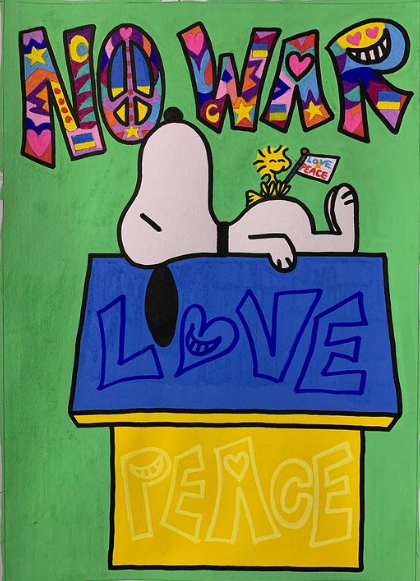
Live Long and Prosper, Ukraine!
Hopefully making a ruckus, one blog post at a time!
Be sure to check out my other blog, Joe’s Journey, for a different kind of playground for creativity, innovation and inspiring stuff.
Stumped. Writer’s Block. Stymied. Confused. It’s all a jumble of nothingness.
What Do You Write When You Don’t Know What to Write About?
So, how do you turn nothingness into somethingness? Start writing! Anything.
The words will come, thoughts will flow and, eventually, creativity will blossom.
You can’t force it, however. It must evolve naturally, at your own pace. Usually, if a creative suggestion doesn’t appear in your thoughts within about 20 minutes or so, abort the process and go on to something else. Then come back to it hours later or the following day.
Some writers think before they write. Some think as they write. Some writers don’t think at all; they just write a bunch of gobbledygook. That’s fine, as long as you go back and turn the gobbledygook into useful garbage.
Turning that garbage into something quite palpable and enticing will take a process of editing and refinement but when you’re at this stage, you’ve got it made.
Hopefully making a ruckus, one blog post at a time!
Be sure to check out my other blog, Joe’s Journey, for a different kind of playground for creativity, innovation and inspiring stuff.
Research shows that creatives are faced with fewer resources and greater demand. They helped their businesses pivot to remote work last year by improving productivity and learning new technical skills. Further, and in contrast to the trend of bringing design talent and work in-house for the past several years, in-house creative teams are more inclined to partner with outside creative agencies and freelancers.
That’s according to key findings in a new report based on a survey of 400 creatives and marketers. The fourth annual Creative Management Report by inMotionNow and InSource, a professional association for creatives, identified industry changes stemming from the pandemic, along with creative trends to watch over the next year.
These findings demonstrate just how much creative teams have evolved. More importantly, it underscores why marketing and business leaders have become increasingly reliant on creatives for that vital Design Thinking, a process that starts with user insights, challenges assumptions and redefines problems, not just for design and deliverables.
Below are three takeaways for marketing leaders.
1. Providing Strategic Value Is Now Table Stakes for Creative Teams — Balanced with Speed, Resource and Volume Constraints
The study identified the top three challenges facing creatives as follows:
The speed at which they are expected to work (73%)
Too few resources to accomplish the work (61%)
High demand for more creative content (59%)
While those are all familiar challenges to most creatives, what they did not identify as a top challenge is of equal interest: Respondents didn’t identify “being seen as a strategic contributor” as among the top three—for the first time in the four-year history of the survey.
“We have a seat at the strategic table, but that’s because we’ve earned it and we continue to earn it every day and raise the bar on what we can contribute,” said Hank Lucas, head of creative services at global life sciences organization MilliporeSigma.
Lucas was one of five outside experts who contributed written analysis about the survey’s findings to the report.
“We’re not just here to make some pretty stuff,” he said. “Tell us what you’re trying to achieve and let us help you move the needle.”
2. Creative Problem-Solving and Adaptability Were Crucial to Remote Work
In subsequent questions, respondents were more precise about the specific resource constraints presented as the pandemic unfolded. While 58% said their workloads had increased, about one-third said their teams experienced layoffs and furloughs. In addition, another 31% faced budget cuts which eliminated some of the technology tools that facilitate the creative process.
Despite the adversity, creatives rose to the occasion and brought their problem-solving talents and adaptability to bear. Most creatives (57%) claimed they “became more productive” despite cuts to budget and staff. Another two-thirds of respondents learned new skills such as video, livestreaming and podcasting, all of which proved pivotal to business continuity during remote work.
The resource constraints may have also prompted creative and marketing leaders to rethink the in-housing trend—that is, bringing design talent and work in-house rather than using external agencies—that’s unfolded in recent years.
While in-house creative teams still manage much of the work, the majority (86%) reported that they currently partner with agencies and freelancers. Further, in 2021 about one-third of teams are planning to increase the work they send to outside resources. This creates new opportunities and demands for tools and processes for collaboration.
When prompted why they hire outside agencies, respondents stated that their top reason was in order to access specialized skills (64%). Subsequent responses were a need for increased capacity (44%), assistance with strategy development (24%) and quicker completion of work (20%).
“The beauty of working with freelancers is that you don’t have to go through this whole hiring and onboarding process,” says April Koenig, founder and CEO of Creatives on Call. “You can find people who have the targeted skill sets that you need and get them in and get the work done quickly.”
She notes that approach may also help with fatigue and burnout, which have become critical leadership issues over the past 12 months. “This really helps alleviate some of the physical and emotional pressure that teams face when the organization is so reliant on them,” she says.
4 Ways Play Gets You Out of a Brain Rut, and Helps One Deal with a Crisis.
The human brain can get stuck in a rut thanks to neural pathways and a fondness for the familiar. So how can you free your brain and lead it on a path to innovation? Based on research and real-life examples from great minds, here are four ways Play can get you out of a brain rut:
1. Cross Train Your Brain
Each cross-training activity works a different, but complementary, part of the body that will help get you stronger in the overall event, task or project. In other words, if you’re a novelist, try your hand at poetry. If you’re a painter, dabble in sculpting. If you’re a computer scientist, play around with web design. For instance, how did playing violin help Einstein theorize about matter and energy?
A study from UC Irvine and the University of Wisconsin found that giving piano lessons to preschoolers significantly improved their spatial-temporal reasoning— a key skill needed for math and science—much more than giving computer lessons, singing lessons, or no lessons at all. So try a new activity within your field or related to it; you’ll expand your neural connections and strengthen your brain overall.
2. Take a Shower, Go for a Walk or Do Some Other Mundane Activity
First, creativity and relaxation could be linked. I’ve found that whenever I’m really tired, my creativity just hits a wall. Trying to go on is fruitless. Wrap it up and go to bed or walk away from whatever it is you’re working on and come back to it in several hours or the next day. Depending on when you’re doing this, try something boring, like showering or taking a walk (though some folks would argue that this exercise is not boring) or go for a swim. These tasks don’t require substantial cognitive effort, so our brains are free to wander. And contrary to popular belief, a brain “at rest” isn’t really resting at all.
Second, distractions may boost creativity. Research by Harvard professor Shelley Carson found that high creative achievement was associated with low latent inhibition, or the capacity to screen out irrelevant information, especially if the participants had a high IQ. For the creative mind, inspiration can be found everywhere. Sometimes, you just need to distract yourself long enough to notice it. Continue reading →
Last week I posted about my upcoming trek to Baton Rouge and shared a list of creative guidelines to keep in mind when enhancing one’s creativity. That was what I shared with the ad club of Baton Rouge last Friday. One of the main items I shared was the Creativity Survival Kit and that’s what I’d like to review on this post, especially for folks who have no idea what I’m talking about.
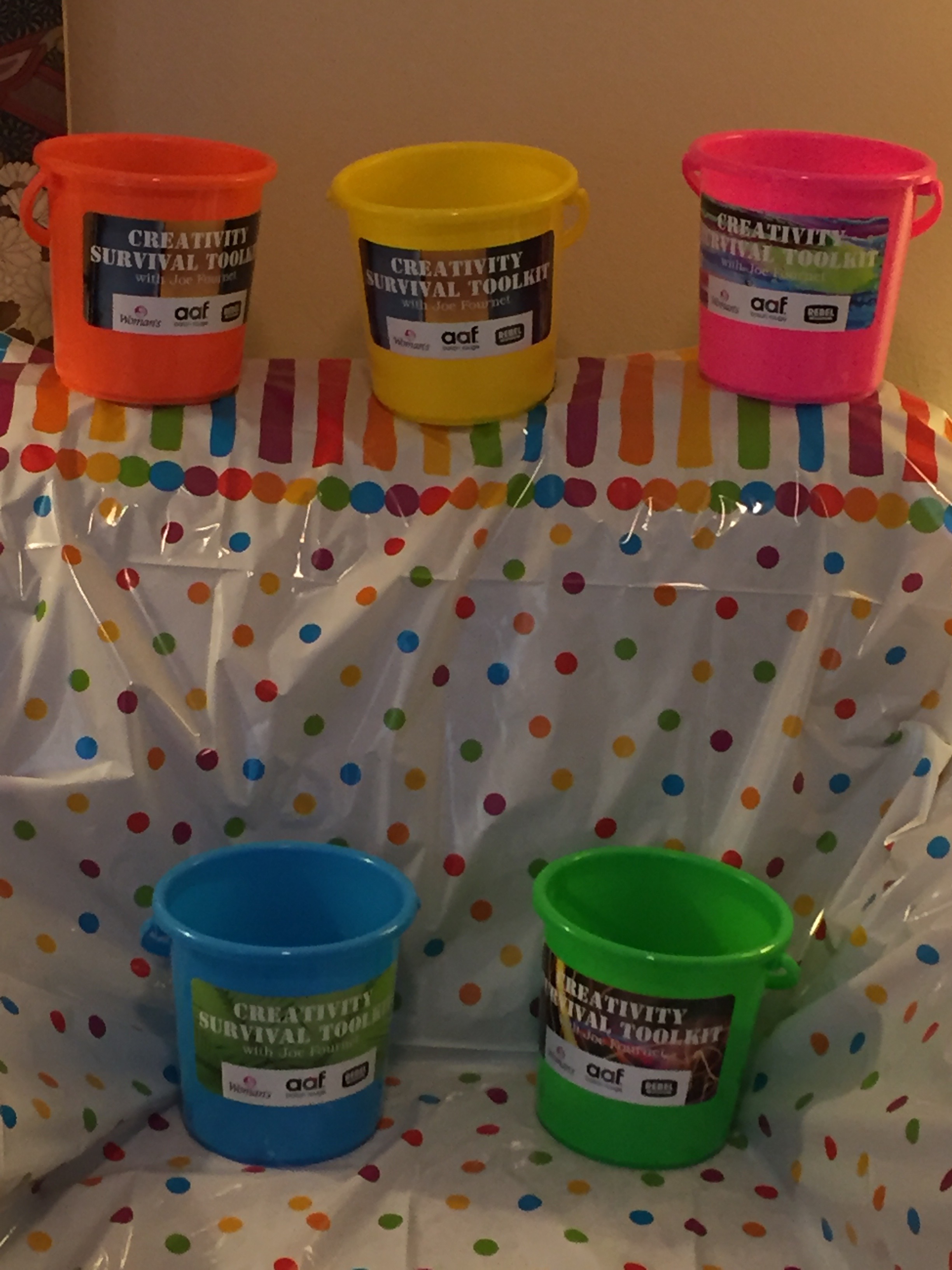
One of several different colored Creativity Kits the Baton Rouge ad club made as giveaways.
The Creativity Survival (Tool) Kit is simply any container or bucket filled with items that make you feel creative or think creatively. The contents can be almost anything depending on the individual.
They can be notes that remind you of various things, especially those items that are too large to fit into your bucket. They can be serious or silly. No judgements here; after all, it’s YOUR kit.
One of the main elements in the Kit is a stack of Post It Notes. The timed exercise, lead by a moderator, is thus: Whatever problem confronts you to be solved, needs a specific question to be asked that may help solve it. The more specific, the better.
The challenge is to come up with, say, 50 ideas in five minutes or, if you dare, 100 ideas in ten minutes. Once this is done, pick your 25 best ideas and, are you ready for this . . . TRASH THEM! Then from the 25 remaining, select your next 20 best ideas . . . and . . . TRASH THEM!
I know this is not what you’re used to doing, but trust me, this is a different take on a standard way of drilling down to the best idea. I call it the Evil Twin Technique.
Now, you’re left with five “maybe not-so-great-ideas.” For the purposes of this exercise, select three of them that you feel are good and, you know the drill, TRASH THEM. From the two remaining, trash one that you feel is better than the other one. You have one idea left. It may not have been one you thought about when you first began or one that you paid little or no attention to during this process.
You’ve come upon your Evil Twin. Whether or not it pans out as a worthwhile idea to help solve your problem remains to be seen. Your due process may bear that out. If you can combine this exercise with the more standard approach (instead of trashing the “best ideas,” keep them and simply narrow the list down to just one), it will be interesting what types of solution approaches one could come up with.
Some other items in my kit include
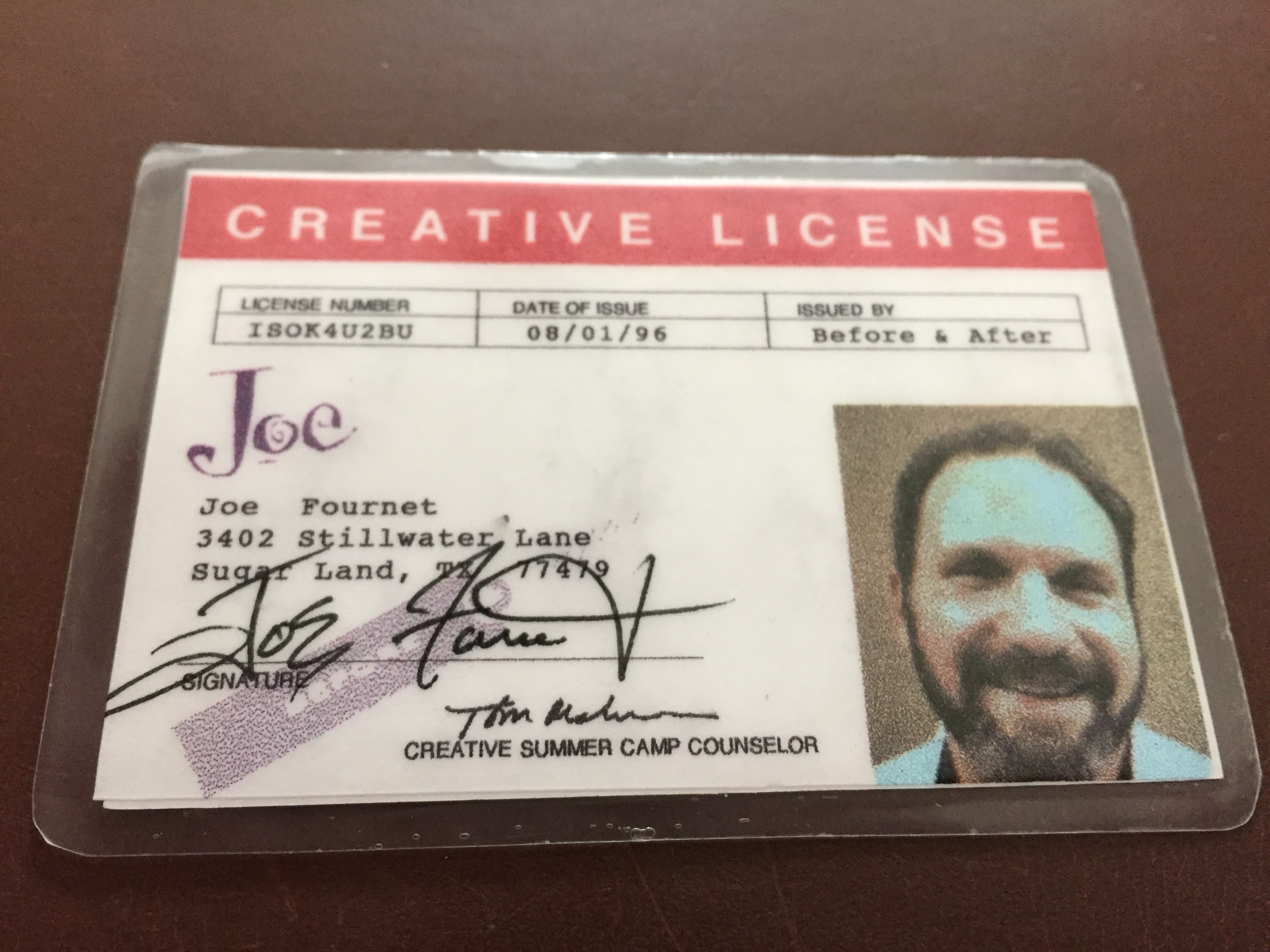
and my certification
along with my alter ego, Snoopy, and his pal, the Energizer Bunny. What can I say, I have an eclectic tool kit!
As my business card states, “Crayons. The essence of creativity.” Crayons are colorful and so should your world of creativity. Similarly, your Creativity Survival Toolkit should reflect your colorful personality and lend itself to enhance your creative world.
Hopefully making a ruckus, one blog post at a time!
Be sure to check out my other blog,Joe’s Journey, for personal insights on life and its detours.






 ideasnmoreblog