Creativity Without Productivity?

Though I’m not sure where I first read this post, I believe its author is a designer named Noah Kay. It intrigued me so I thought I’d pass it on to my fellow creatives, and those who want to be.

I’ve always considered myself a “creative person”. I’ve always been into art, always had a deep appreciation for it. Paintings, drawings, sculpture, music, writings, movies, games, you name it. I have a distinct appreciation for all of them and the uniqueness for what each can accomplish only in their own medium. Eventually design was tacked onto that list and became seriously entrenched in the idea of doing it for a living. And now that’s what I do. I’m a designer, for my real life job, right now in this timeline.

I feel like there’s something I need to create. Something I need to make on almost this instinctual level, but nothing really seems to really hit this imaginary mark I seem to have created for myself.

Looking back I feel like so many outlets for my creativity throughout my life have been rooted in some sort of need for productivity surrounding work or potential work: Highschool and college classes giving out artistic or design related assignments, pursuits for the prospect of getting a specific type of job, or to potentially expand my skills of a job I already have.

I told myself that I want to “get back to making things just for me” about a year ago now, since I was in a “creative rut” for a good 3 years beforehand. Well, less of a rut and more of a prison.

My previous job would leave me so exhausted that the idea of coming home and working on endeavors that didn’t melt my brain was not in the cards. Brain was out of gas. But because I wanted out of my then job, I forced myself to other things. But many of those things were for the purpose of getting a different job or furthering my career: Working for non-profits, honing my skills in After Effects to be able to add that extra bullet point on my resume, working on my portfolio endlessly to make it feel like something I both don’t hate and recruiters don’t hate.

I didn’t entirely hate what I was doing since I had a bit more creative freedom in choosing and executing on these projects, but there was still this veneer of “these things need to make me hirable”. That same veneer was on school projects made through the relatively narrow framework we’re taught in design school. The same veneer was on the extremely restricted world of haphazard corporate design that suffocated me for almost 3 years.

What drew me to design in the first place was the artistic side, which has been beaten out of so much of what we see today. I’ve always loved looking through old design history books, looking at techniques and pieces from non-European designers, seeing how people crack and break that Unimark-crafted framework that has been beaten into us by both big money and Eurocentric dominance influencing design curriculum.

This is the first time in my life that I don’t desperately want to leave my job, I don’t have any mandated assignments to finish, I don’t have any mandated guidelines to follow. And honestly I think that’s why I’m feeling this way because to be honest, I’ve never done my design work like this before. Photography has always kind of been my “fuck around and find out” medium of choice, but applying that same mode of thinking to a form of creativity which I have done my entire life in the exact opposite way is…more difficult.

I think that’s why I’ve been trying other things I haven’t done before too, like this whole “writing” thing I’ve been doing sporadically or even making a couple of YouTube videos that I hope people never see. Mentally breaking that restriction of “will making this get me a job” as the primary motive for whether I go pursuing a project or not. This general sense of aimlessness has me throwing darts at the proverbial dartboard to see if trying something else completely unrelated will tick that box I’m desperately trying to erase.

I tell other people things like this in regards to creativity all the time, “if you like it and you want to try it then fuck it dude, ball out. go nuts. see what happens.” and I really need to start taking my own advice here.

I don’t need to know why, I don’t need to rationalize it, I don’t need to be “productive”, I just need to make.

Where this fellow is a designer, I’m a writer with design instincts. I can relate to a lot of what he says, especially the corporate aspect.

To my readers, I hope you get something out of this as well.

Balancing Creativity and Constraints: Reflections of a Designer

Having worked with a variety of designers in my time, I found this piece interesting from not only the perspective of a designer but also from that of most creatives. She, as in Shreya Agarwal, asks pertinent questions about which we all have pondered at one time or another. My question to you is this: Do you agree? Comments?

*********

As I transitioned from the consultancy to the in-house design universe, a lingering question became my guiding star: What truly brings a design to life?

My time as a consultant was full of lessons learned across diverse industries and work cultures. As my former boss aptly noted, we should be paying our clients for the crash courses we received with each new project. However, I felt a sense of dissatisfaction. I yearned for my designs to be more than just concepts — I wanted them to inhabit the real world, to be used, tested, and improved upon.

After spending some time as a designer in a product company, my perception of the design role has undergone a shift, and I believe it’s a change for the better.

We’re all familiar with the romanticized notion of a ‘designer’. In this fantastical world, problems fall neatly into line, leaving us with ample time for creative musings. Our brilliance is celebrated, and our perspectives are treated as profound wisdom. We’re devoted to catering to every user, doing deep research, and crafting smooth micro-interactions.

In an ideal world, it would be sunny-side up, but reality’s clouds have a habit of raining on our parade.

How often have we been told, “This looks great, but it’s not feasible”? How many times has our enthusiasm been dampened by the weight of business constraints? This pain is real and shared by many, including myself. Yet, I’ve grown to relish these moments. Now, every time someone utters those discouraging words, I respond with a curious, “Which part? Why not? How can we change it? How can we enhance it?” I prioritize the well-being of users over the pixel-perfect transition from Figma to code, which becomes less crucial. What truly matters is delivering value to users, regardless of the means. This leads me to the question that continually echoes in my thoughts: Who can collaborate with me to transform my design into reality?

Design isn’t a lone ranger, it doesn’t ride solo; it’s more like a supporting actor in a complex drama. Design exists in a symphony with other functions like product, engineering, and analytics. This collaboration and compromise is the journey from creation to implementation. It’s the teamwork with engineers who turn your meticulously crafted visions into digital reality, with product managers who chart the course, and with analytics that provide the feedback loop for iterative improvement. However, let’s address the misconception that some designers harbor, I did too — the idea of single-handedly reshaping the universe through a UI overhaul. Allow me to interject with a resounding “Ahem, no.”

Yes, that’s the revelation. Design isn’t here to sprinkle fairy dust on the company; it’s here to serve business goals. Granted, serving the business also involves doing good by the user.

A good design can sometimes be the tiniest adjustments that wield the most significant impact. Because, let’s be honest, even seemingly minor modifications like resizing carousels or revamping interactions can come with hefty price tags. From my counterparts in product management, arises a crucial question for every designer: What is the return on investment for this design?

Design embarks on a journey — from pixels on your screen to the engineers’ coding stations, culminating in its release into the wild. This is why, before you seek investments from a myriad of collaborators (product, engineers, analytics, marketing, and beyond), ask yourself this question: Does it merit bringing this design to life? It is not about possessiveness over your design but nurturing it, allowing it to adapt and endure the rigors of technical considerations, budget constraints, and ever-shifting user landscapes.

Design can be extravagant or accessible, the essence lies in understanding your company’s ethos and financial scope. My personal quest is to make the most bang for the least buck, maximizing impact while minimizing expenditure.

Being a designer resembles tightrope walking — a delicate balance of creative aspirations and business considerations, the sweet spot where brilliance meets pragmatism, where innovation doesn’t tip over into extravagance. So, how much design is too much design? Well, it’s the amount you can manage without tumbling off the rope.

***********

For the most part, I agree with her perspective. However, IMHO, good design echoes and enhances the idea it is supporting. If the design is such that it overtakes the idea or muddies the concept, not to mention the message, one might need to go back to the proverbial drawing board.

The challenge to those egotistical creatives out there (most, if not all of us) is to strike that balance between creativity and the constraints that embody the project as it is presented to us. Admittedly, that’s easier said than done. But try we must. Failure’s a part of the process . That’s a possible outcome of reality. It’s included at no extra charge during the process of creativity. Those who embrace that concept will be better off than those who don’t.


Hopefully making a ruckus, one blog post at a time!

Be sure to check out my other blog, Joe’s Journey, for personal insights on life and its detours.

And, check out creative selections from my website.

Jolan tru!

Masking Emotional Creativity

Mask-tongue

What an unusual and intriguing exhibit. Emotions on display.

Extraordinary.

When I first saw some of these works in an article, I thought “how inspiring!” So, I wanted to share. Creativity, as this blog illustrates, comes in a variety of executions. Even though digital seems to be everywhere these days, I find it refreshing to see exhibits like this one in London that showcase a traditional form of creativity – in paper.

The upcoming 2018 London Design Biennale will be devoted to the theme of ‘Emotional States’. National entries will explore how design affects every aspect of our lives – the way we live and how we live – and influences our very being, emotions and experiences.

For the second consecutive edition, Pentagram, the world’s largest independently-owned design studio, has created the visual identity and promotional materials for the Biennale. As with the previous identity, a restricted colour palette of orange, black and white is used.

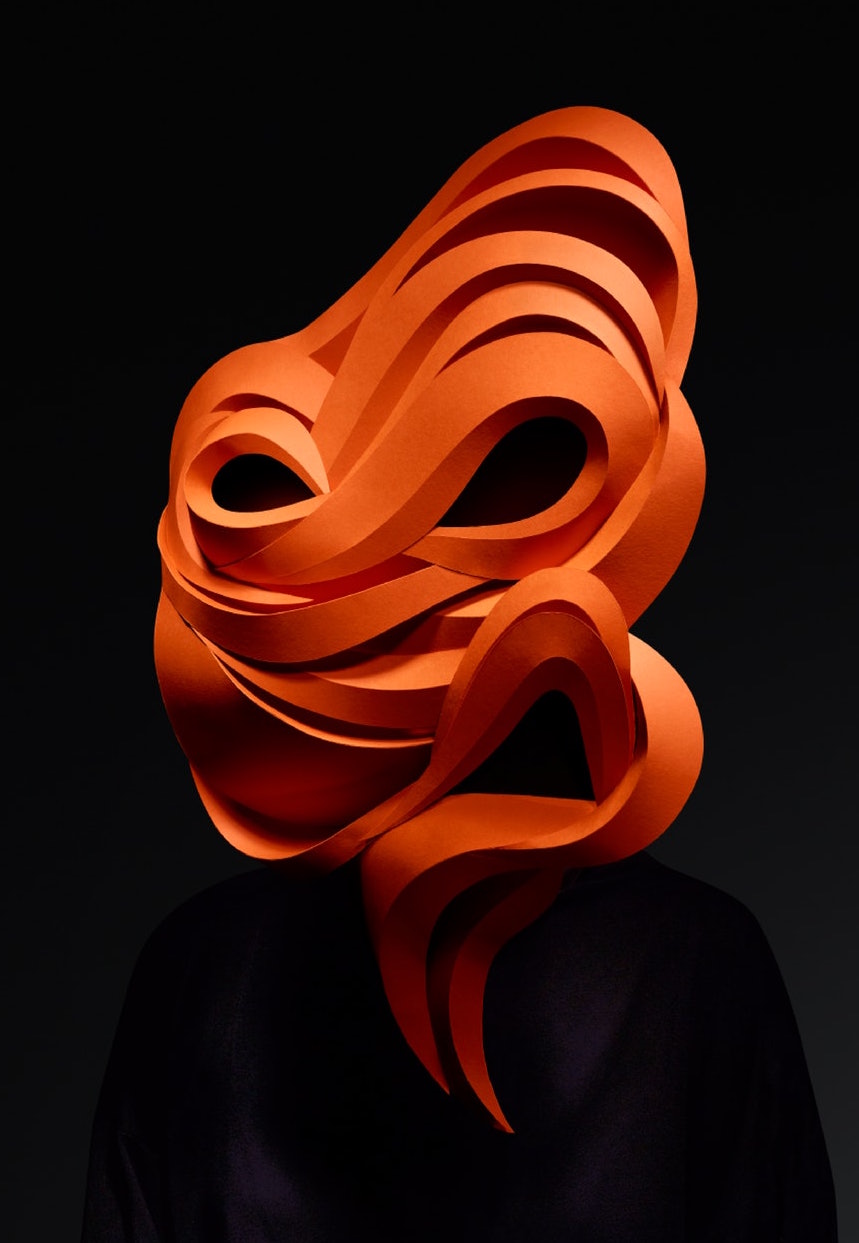
In response to the theme of ‘Emotional States’ and taking inspiration from Charles Darwin’s seven universal emotions, Pentagram created and commissioned a series of arresting masks, handmade by Wakefield-based paper artist Andy Singleton and photographed by London-based John Ross.

Mask1

A universal phenomenon that spans centuries, masks have been used to interpret and illustrate the beautiful, the grotesque, the sublime – and everything else in between. Pentagram’s aim was to create a series of masks that could subtly, yet coherently, communicate this diverse range of emotional states.

Pentagram decided to use paper – supplied by G.F Smith – to create the final masks, owing to both its flexibility as a material, and its capacity to inspire intimacy from the intricate nature of its craft. Working with paper-artist Andy Singleton in an iterative process of trial and error, the final form of each mask was defined, and subsequently sculpted.

The resulting avant-garde masks, photographed by John Ross, bring the Biennale’s theme to life in a way that is independent of race, gender and age. The striking visual identity delivers captivating visuals that have been applied across the event’s online banners, print, outdoor, social media and marketing materials – which were also designed by Pentagram.

Masks 1

Masks 2


Read more about the upcoming September exhibit and

Pentagram’s involvement.

Creativity Tip # 25: Problems and Puzzles

It could start out looking like a wall. A very tall wall. How do I get over it? Around it? Through it?

Problems are like that, as are various creative challenges that aren’t yet fully explored.

Or that have just been dumped in your lap.

Overcoming them – getting through or around that wall – is where creativity of the mind comes in. Think time. What to do first? How are you sizing up this “behemoth?”

Think of it as a big puzzle but you can’t even begin to solve it – and create something wonderful – until you break it down into smaller, more manageable pieces.

Maybe you start by just jotting down some thoughts and questions in no special order. Don’t try to write the first page, for example, or even the opening paragraph. Don’t try to design the entire project; just play with a couple of images or design elements.

Do whatever you can to trigger your creative juices. They’ll take care of the rest. If you’re lucky, they may lead you to more questions and, subsequently, some refined answers. That’s where your contact on this project comes into play.

Don’t be intimidated by the enormity of the project, aka, puzzle. Concentrate on one piece at a time.

You may not notice it at first but when you do this, your mind begins to relax. You feel less overwhelmed than when you started. Note that I didn’t say “calm.” That will come but you’ll probably feel more invigorated because progress is being made, and your creative juices are flowing.

When this happens, your mind may also take you on a path that “plays with” or addresses other pieces of this puzzle. Go with it.

Before you know it, a clear picture will start to emerge; a composite of all the puzzle pieces.

One piece at a time. Thoughtfully.