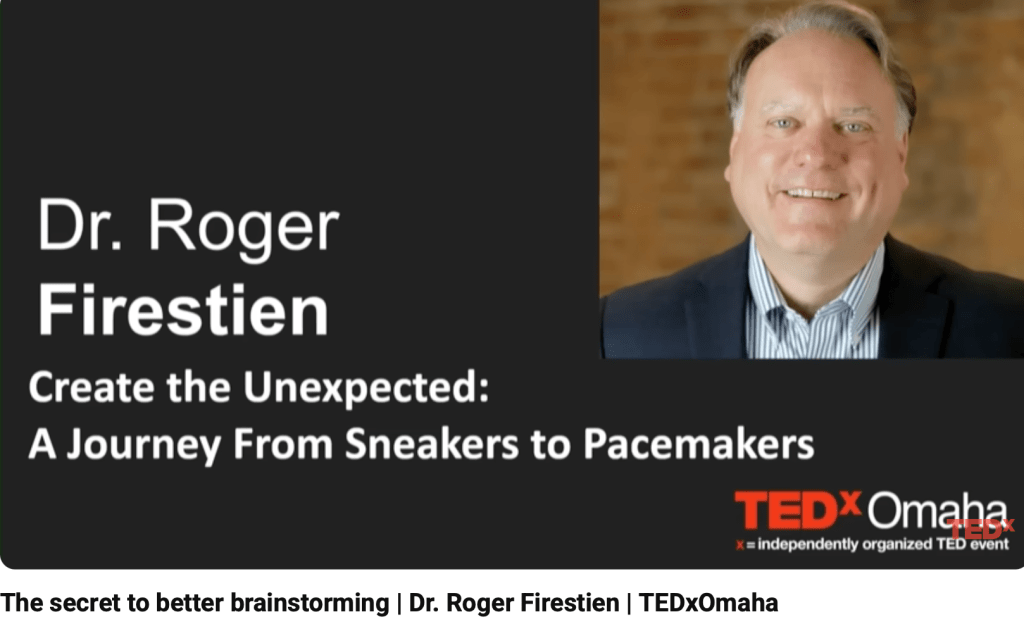
I’ve had the privilege of listening to Dr. Firestien on several occasions when attending a webinar from the Center for Applied Imagination at Buffalo State in New York. He’s quite interesting and very personable.
What do a kingfisher, a hazard light and a waffle iron have in common? A creativity technique called Forced Connections, which leads to break through innovations. Brainstorming and coming up with new ideas is easy, we do it every day. Or so we think. The truth is we barely scratch the surface with our ”more of the same ideas”. We fall extremely short with quantity and quality of really good ideas. We miss the mark on really good innovations, because “More of the Same” does not break into big time innovation. Time to shift ideation gears with Dr. Roger Firestien and find out how to use a really simple ideation tool called ‘forced connections’. Not a new technique and certainly not a secret to those who work in the field of creativity, marketing or the business of creating ‘new and different’. However, new to most of us. Game changer. Creativity changer. Innovation changer.
Dr. Firestien is an associate professor and senior faculty member at the Center for Applied Imagination at SUNY Buffalo State and President of Innovation Resources, Inc. He is the author of six books, including Leading on the Creative Edge and Why didn’t I think of that? His expert views on creativity have been reported in Fast Company, Forbes, Investor’s Business Daily and The New York Times. When Roger is not traveling, he lives in Buffalo, New York, and regularly works cattle on the SK Hereford Ranch near Medina, New York This talk was given at a TEDx event using the TED conference format but independently organized by a local community.
Hopefully making a ruckus, one blog post at a time!
Be sure to check out my other blog,Joe’s Journey, for selected short stories and personal insights on life and its detours.
Late last year ADAge’s Tim Rudd penned an article about the alleged death of creativity. Well, some argue that its death may be premature. The campaign described below illustrates that point of view. As Tim reports . . .
Creativity may not be six feet under, but D&AD (Design & Art Direction) is still here to poke it with a stick.
The global creativity nonprofit is kicking off its 2026 award season with a global campaign from Uncommon Creative Studio that pushes the industry to stop hovering over the “think” button and start hitting “make.” Its centerpiece is a manifesto that challenges the too-common habit of watching ideas drift by rather than shaping them into something tangible. The work signals a shift toward more hands-on creative energy at a moment when the industry seems increasingly cautious.
The campaign leans on stark visuals and a single provocative question: Is creativity alive or dead? It stretches across D&AD’s awards, learning initiatives and talent effort, inviting practitioners to respond through action instead of commentary. The rollout also introduces a refreshed identity for the 2026 awards, turning the manifesto into a design brief for the entire program.
(D&AD) A massive Times Square billboard displays a bold message about misjudging bad ads as the death of creativity, illuminated above the city at night.
Alongside the identity comes the reveal of the 2026 jury presidents, a slate of creative leaders drawn from a mix of global brands and agencies such as Dentsu Tokyo, Airbnb, FCB Global, 72andSunny, Havas Health & You and others. Their remit is to steer the judging with the manifesto’s call for experimentation and decisiveness in mind. D&AD positions the jury presidents as creative figures who already operate with a bias toward making.
“Creativity doesn’t die, it drifts. It gets buried under deadlines, data and fear of taking risks,” said Lisa Smith, D&AD president and Uncommon’s global chief design officer. “This manifesto is a reminder to the industry that ideas are only as powerful as the people brave enough to make them real. As creative leaders, we have a responsibility to protect that spirit—to keep making, experimenting and proving that bold, human ideas still matter. D&AD exists to champion that pulse. To show that creativity isn’t just alive—it’s vital.”
(D&AD) A storefront covered in black-and-white posters displays bold gothic text declaring “Creativity is Dead” and “Creativity is Alive” alongside graphic logos.
(D&AD) A row of black-and-white street posters on a graffitied wall presents stark slogans about creativity and work beside the D&AD logo.
This year’s D&AD awards also introduce new categories meant to reflect the ways ideas move through culture. Brand Transformation spotlights work that blends strategic thinking with the craft of execution. Cultural Influence highlights projects that shape conversation or find a place in the wider cultural bloodstream. Sports Entertainment covers creative output tied to sport from campaigns to content to fan engagement.
“Creativity today is more decentralized than ever, coming from makers, creators, in-house teams and a new wave of independent studios. Our role is to ensure all these voices are equipped and inspired to keep pushing creative excellence forward,” said Donal Keenan, D&AD’s chief operating officer. “Yet in this abundance, creativity risks becoming diluted. Brands are finding it harder than ever to cut through and truly engage audiences, which is exactly why this provocation is needed.”
D&AD is also launching an editorial hub that digs into the same big question at the heart of the campaign. The platform collects commentary from designers and advertisers who are looking at how creativity has changed in a landscape of nonstop feeds and constant distraction.
(D&AD) A minimalist white typographic poster lays out a manifesto proclaiming “Creativity is Dead” before urging readers to revive it with intention.
As long as there are people who continue to push boundaries, creators who are never satisfied, folks who are always curious and a consuming public who always want refreshing and innovative ideas, creativity will never die. It will always be alive and thriving.
Hopefully making a ruckus, one blog post at a time!
Be sure to check out my other blog,Joe’s Journey, for selected short stories and personal insights on life and its detours.
I came across this article last month in one of the industry trade pubs and thought it quite relevant, not to mention interesting. The author, Wayne Best, chief creative officer of VML New York, cites one of the pioneers of creativity in advertising, one Bill Bernbach, as a major force during the sixties. The industry during that time is totally different than it is today. Mr. Best offers some viable suggestions as to how to resurrect, if you will, that creative zest so pronounced during Bernbach’s time.
I’m in total agreement with what Mr. Best suggests. I’ve been thinking the same for years and used to speak on these topics when on the AAF speakers’ junket. Today, with the advent of AI, they have been much more difficult to be realized and put into practice.
Mr. Best writes . . . I have no personal connection to DDB. I have never worked there and have very little knowledge of the culture at the time its name was “retired.” I do, however, have a great deal of respect for Bill Bernbach. I still use quotes he uttered from before I was alive. He ushered in the power of creativity in advertising.
That led me to wonder if his name disappearing (well, the B in DDB) was the end of the era of creativity. I have decided the answer is no.
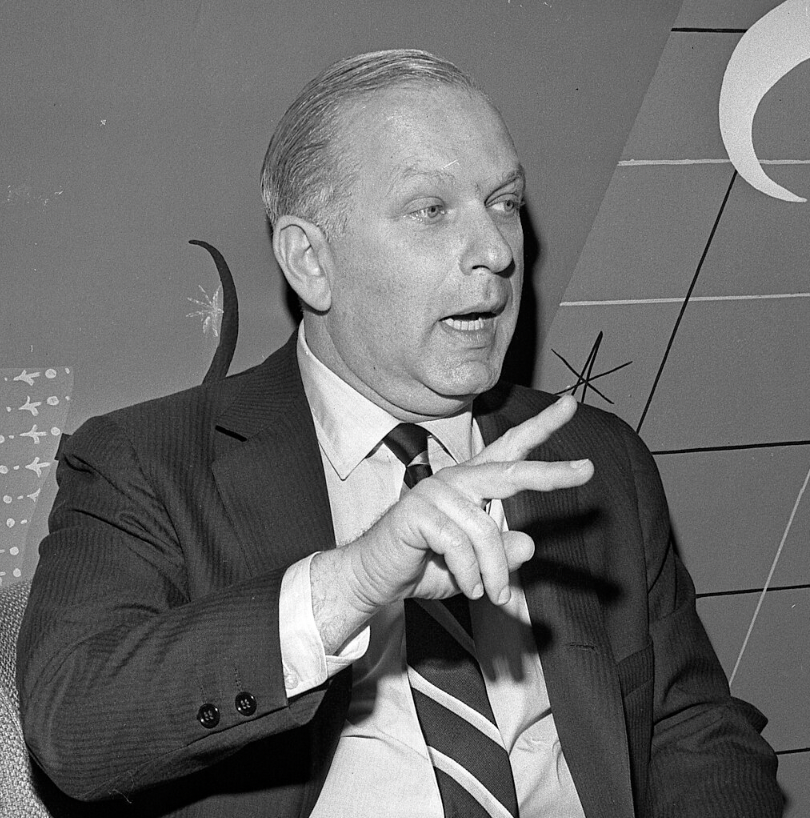
Advertising executive, William Bernbach at press conference discussing his stance against cigarette advertising. Original caption: NO SMOKING—William Bernbach, newly named “The man who contributed most to advertising in 1963,” said Thursday that advertising cigarettes amounts to “just selling sickness.” He voiced several other strong opinions on advertising at a press conference here, but denied being a crusader. Photo: Jack Carrick, Los Angeles Times
I will admit that I miss the days when smart, insightful advertising was prolific and opening an awards book was like unwrapping a gift. That’s not to say great work isn’t still happening, but lately it feels like the priorities have been put on data, systems and efficiency. And learning how to best use AI.
These are good things. They are changing advertising for the better. Yes, some jobs will change as a result. For instance, it’s a hard time to be a storyboard artist. But the best storyboard artists have visual taste and can tell a good story. Those skills are still needed; it’s just that the tools that get you there have changed.
So, embrace change and adapt.
Resistance is futile.
That last line is not meant to be eerie. It’s just true. The sooner you acknowledge it, the further you’ll go. After all, the path to great work is to kill good work. Progress requires you to kill your darlings so you’re free to think in less expected ways.
Yes, media and production efficiencies can optimize our budgets. Customization and transcreation will continue to improve. But there is still an itch that all of that can’t scratch. And that is love.
Great brands have a place in our hearts, and that love still needs to be earned. It starts with a great product, but that’s just the beginning. Steve Jobs didn’t just produce great products; he also found a way to connect with people on a very human level. “1984” isn’t just an ad for a computer, it’s a celebration of individuality and a middle finger to corporations. “Here’s to the Crazy Ones” is about honoring the misfits who are daring enough to think they can change the world. The brand has a distinct point of view.
Data doesn’t do that. And AI aggregates the past rather than finding the unexpected. It doesn’t have the soft skills. It doesn’t have empathy.
That said, I don’t think our quest for data or AI are to blame for our current creative lull.
We’ve made it hard on ourselves to do breakthrough work.
We’ve added layers and layers of decision-makers. We’ve tried to be all things to all people. We’ve become afraid to make hard decisions and take chances, and that’s dangerous, because when you don’t make hard decisions, you sit in the middle. And the world ignores the middle, no matter the media budget.
I’m sure there are things I’m leaving out, but here are five things I know absolutely get in the way of building a great brand. None of them have to do with AI:
1. There are too many people involved in the decision-making. While it’s important to listen to opinions, a camel is a horse designed by a committee. Listening to people is fine, but somebody needs to be the decider, or you will build that camel.
2. If you try to please everybody, you will excite nobody. To be a great brand, you need to have a distinct POV. This means there are a lot of things you need to not say. Deciding what not to say is harder than deciding what to say, because different stakeholders care about different things.
3. Building a brand the right way takes time. We are always in a rush today, and the speed of AI and digital production has us moving faster than ever. Technology helps with the daily work, but to crack the bigger brand work, you need to be thoughtful and deliberate. Impatience is not a virtue.
4. Write shorter briefs. It’s hard. Writing long-winded briefs that everyone can read and find the “thing” they care about covered in the many pages is easy. Finding that sharp, pointed thing you can own in a sentence is hard. But until it gets sharp at the brief stage, you’ll be wasting expensive creative time. Make the hard decisions on what matters, and what doesn’t matter, at the brief stage. Or it will create endless swirl.
5. Never forget the problem you’re actually trying to solve. It’s easy for Walmart to promote deals on its website, but the bigger challenge is making consumers feel good when their neighbors see that Walmart box on their porch. It’s not an accident Walmart started using popular music and celebrities and buying high-profile media. When you keep the bigger goal in mind, it makes daily decisions easier.
I’m still sad when I see the greatest names in advertising dropped into a six-foot hole. But hey, those people were already dead. It’s what we learn from them that matters. If Bill Bernbach were alive today, he wouldn’t be moaning about the death of the print ad, he’d be figuring out how to build a real connection between a brand and the humans who need it given our current environment.
I am bullish on 2026.
As we learn to work with AI, it gets less scary and more helpful. The weirdness of the pandemic is wearing off. Mergers have become less of a shock and more of a way of working. And the best minds I know are anxious to be more creative again. They’re excited to do unexpected and wonderful things.
Let’s roll up our sleeves and get to work.
Hopefully making a ruckus, one blog post at a time!
Be sure to check out my other blog, Joe’s Journey, for selected short stories and personal insights on life and its detours.
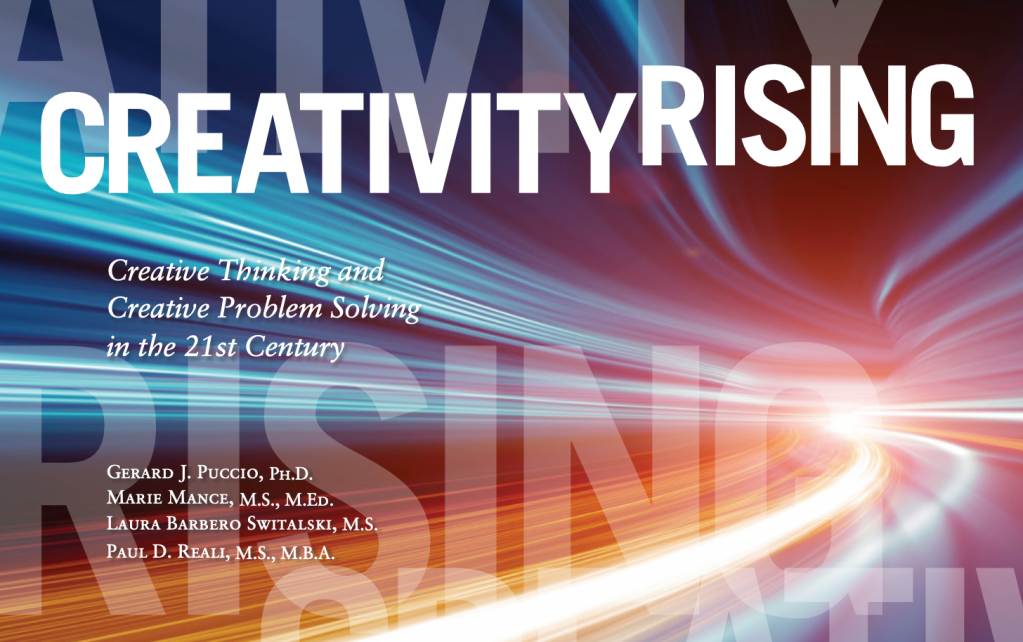
I’m on the email list of Buffalo State University’s Center for Applied Imagination and so I receive notices from time to time about upcoming lectures and seminars and the like. The publication cited below is from one of their recent notices.
From the authors . . . The need for creativity has never been greater. In fact, we chose the title, “Creativity Rising: Creative Thinking and Creative Problem Solving in the 21st Century,” to reflect this belief. If we are to live healthy, productive lives in this century we must develop the mind-set and the skill set for effectively responding to and initiating change. Creativity Rising is both a why-to and how-to guide to help you create your own future. In this book we: • explore the nature of creativity • debunk common myths about creativity • describe the rapid rise of change in the 21st century • outline the time-tested Creative Problem Solving process, an approach to on-demand creativity.
Hopefully making a ruckus, one blog post at a time!
Be sure to check out my other blog,Joe’s Journey, for selected short stories and personal insights on life and its detours.



 ideasnmoreblog